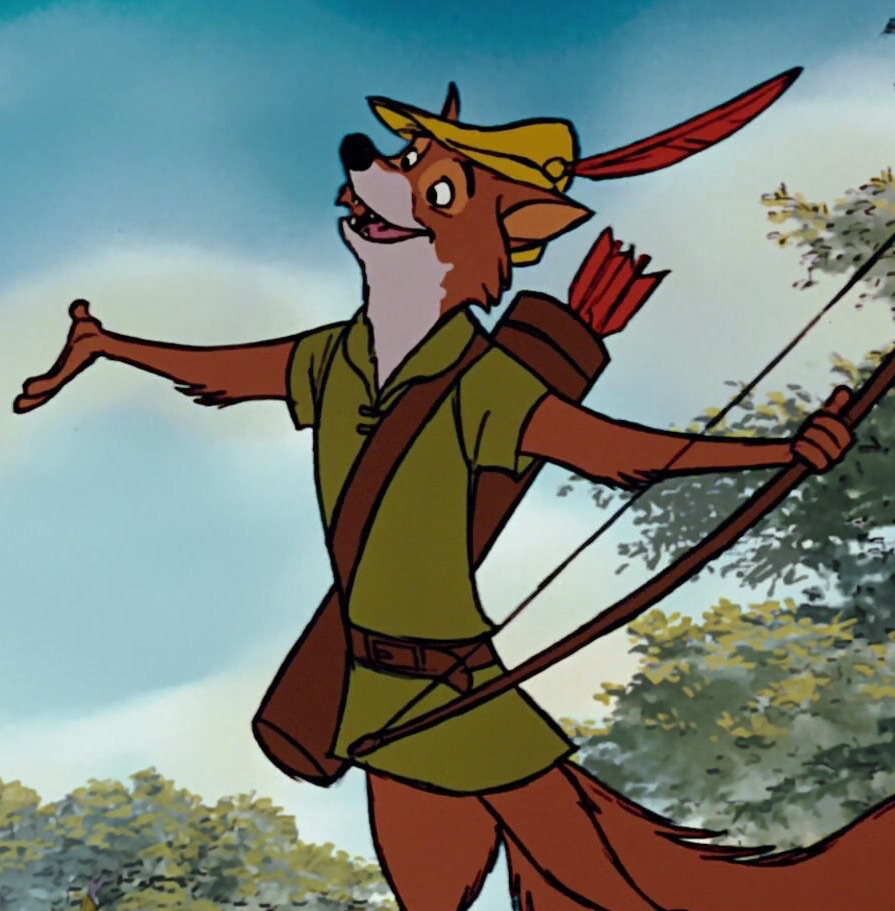
“But with Faith and Understanding, You Will Journey from Boy to Man”

Tarzan

Based on the Tarzan of the Apes novels (which I have never read), it is considered the last movie of the Disney Renaissance. The film features Glenn Close as Kala, Brian Blessed (a famous British actor who I am not as familiar as some of my compatriots) as Clayton, and Rosie O’Donnell as Terk. Music was done by Phil Collins, who I was unaware until years after the film, already had a successful music career in the eighties.

An overarching theme of the movie is the notion of two families; it’s even mentioned in the opening song; “two worlds, one family/trust your heart, let fate decide, to guide these lives we see.” The film opens on two families; Kerchak and Kala and their son, happy. Then we see Tarzan’s parents bravely escape a burning ship. They make a life in the jungle. But both stories end in tragedy; the leopard Sabor first kills Kala and Kerchak’s child. As Kala mourns the loss of her son, she hears a strange cry. She’s led to the human’s tree house [which that whole bit reminds me of The Swiss Family Robinson; I know the old Disney version] and discovers the bodies of Tarzan’s parents (never realized we actually saw the bodies until recently, though it’s probable that I didn’t notice them as a kid). She then discovers an adorable baby Tarzan, but looks up to startlingly find Sabor lying in wait. The leopard attacks and Tarzan’s giggles distract kids from realizing that Kala and the baby are in danger. Gorilla and child manage to escape and Kala goes to introduce her find to her troop. However, Kerchak argues that the baby is “not our kind;” but Kala persists and he reluctantly agrees that she may keep the child, but warns that it “doesn’t make him my son.”

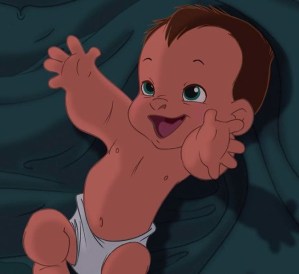
baby Tarzan (2)
Isn’t he so sweet and adorable?


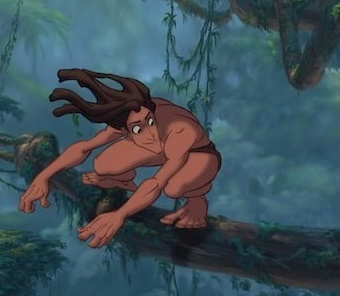
Kala soothes baby Tarzan that evening with a lullaby, You’ll Be in My Heart, “this bond between us/can’t be broken.” “From this day on/now and forevermore.” As Tarzan grows, he struggles to find his own place in his world. Kala encourages him to find his own sound; which is how his famous yell comes to be. He doesn’t quite fit in with the gorillas, but he’s brave…and reckless. He causes an elephant stampede that crashes through the gorilla troop. Kerchak takes him to task, stating to Kala he will “never be one of us.” Tarzan splashes mud on himself in an effort to look like a gorilla, but Kala patiently points out he has two eyes, like her. And a nose, like her. Their hands are similar, but there are distinct differences. The most important thing is that they both have a heartbeat. During Son of Man, Tarzan uses his own flair to accomplish what other animals do, “someday you talk with pride/son of man, a man in time you’ll be.” We Tarzan tree surfingwitness Tarzan transform into an adult man. He figures out a spear – Kerchak doesn’t quite approve. His typical vine swinging comes about since he can’t keep up with gorillas on the ground; and new for this interpretation, Tarzan uses the moss-covered trees to glide on [I remember watching some clip on Disney channel of one of the artists being inspired by his own son’s skateboarding and that was how that bit was created].
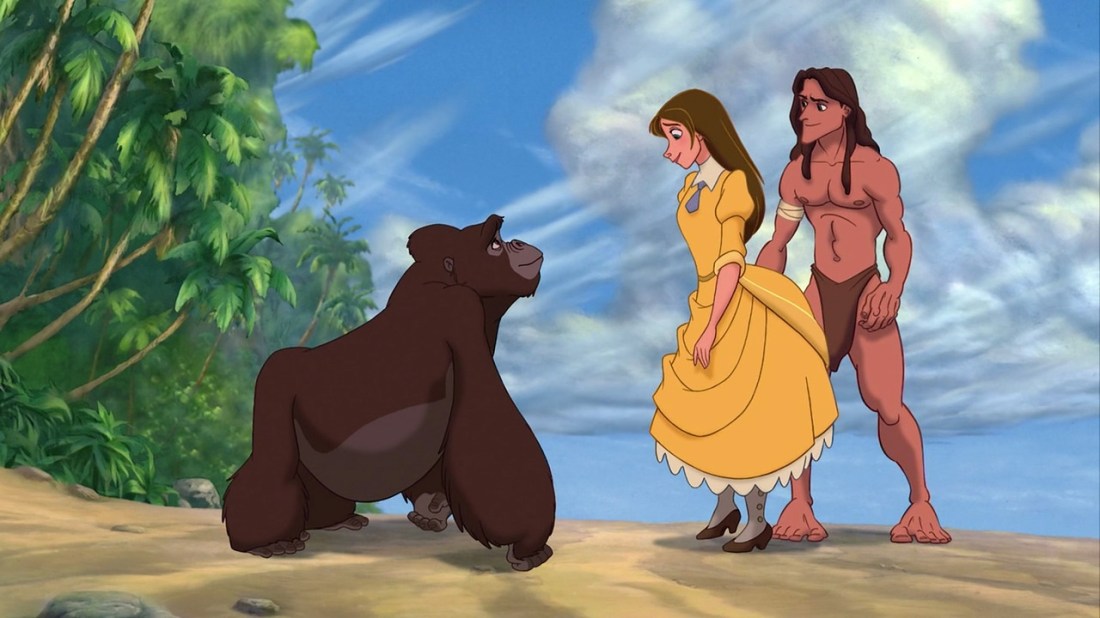
An old enemy makes an appearance: Sabor attacks near the gorilla troop. Kerchak first tries to fight the leopard, but he stumbles after some swipes. Tarzan grabs his spear and jumps into the fray. Both combatants land strikes on each other. Tarzan loses the top of his spear and it seems like Sabor will be victorious; they fall into a pit and leopard is the first thing the gorillas see emerge. It’s followed by Tarzan, who holds the body aloft and lets out his cry. He then lays his defeated enemy before Kerchak and we can see that Kerchak is starting to respect Tarzan and he almost speaks, when a strange sound fills the air.

Kerchak leads his troop away, but Tarzan is curious. He investigates and comes across a shell, sniffing and tasting it (kids, do not try that at home; it’s also not the first time we the audience have seen a shell casing; there was a discarded rifle and shell in the treehouse when Kala discovers Tarzan and we even heard the muted echo of a gunshot). He eventually comes upon Jane, who got separated from her group: her professor father and Clayton, their hired protection (who seems too pleased with destroying the jungle). Jane had stopped to draw a picture of a baby baboon, but wouldn’t let the little monkey keep the picture. His cries bring his whole family of baboons who chase Jane. Tarzan swings to the rescue! Jane’s not terribly pleased at first, screeching several times. They eventually take shelter in a tree branch, the dispute with the baboons settled thanks to Tarzan. Tarzan is even more curious now; this creature in front of him resembles him. Jane, being a properly brought up British woman is appalled at her invasion of personal space, but becomes excited once Tarzan mimics her speech. Introductions are simple: Jane…Tarzan [brings back a memory of my dear French teacher who would harangue us to learn proper sentence structure because “you cannot always go around ‘You Tarzan, Me Jane.'”]

Meanwhile, Terk, Tantor, and their other gorilla friends stumble into the humans’ camp while looking for Tarzan and are utterly fascinated by all the sounds the strange things in camp (the teapot set is reminiscent of Mrs. Potts) and begin Trashin’ the Camp (the pop version is Phil Collins and N*SYNC; again, it was the nineties, we liked our boy bands). Tarzan and Jane arrive, breaking up the party. Jane’s amazed at Tarzan’s interaction with the gorillas. But Kerchak has found them and the animals leave. Leaving Jane to describe her rescue to her father and Clayton as: “I was saved by a flying wild man in a loincloth.”

Kerchak orders the gorillas to stay away from the strangers; Tarzan argues that they’re not dangerous, demanding why Kerchak is threatened by anything different. The leader’s final word on the matter is to “protect this family.” When Kala approaches her son, all he can do is dispiritedly ask “why didn’t you tell me there were creatures that look like me?” He begins sneaking off to the human camp to learn more about these Strangers Like Me. “I just know there is something bigger out there/I wanna know/ can you show me?/I wanna know about these strangers like me/tell me more/please show me/something’s familiar about these strangers like me.” Jane is thrilled to teach Tarzan, hoping it will foster a link to the gorillas she and her father are studying.

But the time comes that the boat has arrived to take them back to England. Jane wants Tarzan to come with them to London; he should be with his own kind. Clayton puts the idea in Tarzan’s head that if Jane sees the gorillas, she’ll stay. So Tarzan arranges for Terk and Tantor to distract Kerchak and introduces the Brits to his mother and the troop. Clayton marks the spot on his map and Kerchak thunders back into the nest. Tarzan holds off the leader to let the other humans run. Afterwards, he’s mortified of what he did, holding off Kerchak and the troop leader claims that the young man has betrayed them all.

Kala determines it is time to show Tarzan the truth, where she found him. Tarzan discovers his baby blanket, and a picture of his father, and mother. He comes out of the overgrown treehouse in presumably one of his father’s suits. All Kala has ever wanted for her son is for him to be happy. He bids her a tearful farewell, “no matter where I go, you will always be my mother;” Kala replies “and you will always be in my heart” and Tarzan proceeds to the beach and boards the ship for London. He walks into a trap. Clayton has staged a mutiny and he and his men are taking cages into the forest to capture Tarzan’s gorilla family “at 300 pounds sterling a head.” Terk is upset at Tarzan’s leaving, but Tantor hears Tarzan’s shout and drags the gorilla to rescue their friend. Clayton has locked Tarzan, Jane, and the others in the hold where Tarzan is frantically trying to escape; but he can’t climb metal in his shoes. Jane gets him to stop, stating that Clayton betrayed them. No, Tarzan betrayed his family, he responds. The ship rocks as Tantor heaves aboard, a well placed foot breaks through the hold and Tarzan is out and leaping overboard.

At the gorilla’s nest, Clayton and his men net and cage the gorillas, capturing Kala. Kerchak fights to protect his family and Clayton announces “I think this one will be better off stuffed!” As Clayton cocks his shotgun, Tarzan’s yell echoes, followed by a stampede of animals (they gathered as Tarzan ran through them, removing his human clothes). Tarzan kicks Clayton down and cuts Kerchak’s bonds. “You came back,” the leader remarks. “I came home,” the man corrects. He sets about freeing the rest of the gorillas, but Kala is already caged and on her way back to the boat. Jane spots her and swings to her rescue, her old baboon friends help, Tarzan arriving just in time to knock the last man out. A shot rings out, grazing Tarzan’s arm; Clayton has declared “I have some hunting to do.” Enraged, Kerchak charges the man; another shot, Kerchak drops. Tarzan checks on his leader and he too charges at Clayton. He dodges the bullets and leads Clayton higher into the trees. The gun is dropped at one point; Tarzan gets a hold of it and levels it at the hunter. “Go ahead, shoot…be a man,” the hunter dares. He flinches at Tarzan’s imitation of a gunshot, then Tarzan smashes the gun, declaring “not a man like you.” Incensed, Clayton starts hacking at Tarzan with his machete, Tarzan backs away, but starts flinging the vines at Clayton, tangling him. A short standoff, then Clayton is back, hacking at the vines, but not paying attention to the order. He creates his own noose, ignoring Tarzan’s warning, and drops. In the flickering shadows of the coming rainstorm, we see the outline of a now dead Clayton, his machete sticking up from the ground.

Tarzan checks on Kerchak, the other gorillas of the troop gathered around their leader. The man begs forgiveness; “no, forgive me,” the dying gorilla breathes, “for not understanding that you have always been one of us. Our family will look to you now….Take care of them, my son,” placing his larger hand on Tarzan’s shoulder. It falls as Kerchak closes his eyes; Tarzan gathers the large gorilla in his bulky arms, embracing the only father he ever knew. Looking to the rest of the troop, he takes his place, striking an intimidating gorilla pose, thumping his chest, and the rest of the gorillas follow him from Kerchak.

Jane and her father attempt to leave again, bidding farewell to Tarzan. Jane argues with her father that she belongs in London. “But you love him,” her father retorts. Her glove blows away and she makes up her mind, swimming back to shore. Her father soon follows and politely ignores his daughter kissing Tarzan. Two Worlds reprises, showing Tarzan’s new family, which includes Jane and Kala; Jane now in less obtrusive clothing. The movie closes on the echo of Tarzan’s yell.

While Tarzan is not a favorite of mine, I enjoy the characterizations and the music. It’s a fun soundtrack to listen to. Tarzan is a very good hero; he has both brains and brawn. I would argue that his mistakes that bring about the climax of the story are made out of innocence; he has never dealt with someone who is manipulative and deceitful. Who hasn’t gotten excited about something new and ignore the old for a while? While Kerchak was harsh, he was a leader of a troop of gorillas and saw Tarzan as an outsider and thus dangerous. (Though really, a baby? He was adorable and blew spit bubbles. It’s a bit like Jungle Book; even though Mowgli is young, he’ll grow into a man and man is dangerous…then one could get into the whole ‘nature vs. nurture’ debate…and I won’t).

Kala was a sweet mother and what would be gained from telling Tarzan that there were other creatures like him when they were dead and she was unaware new ones had come to the area. She had a little boy who was insecure enough as it was; she focused on what was similar, not what was different (a very good lesson, and not beaten over our heads like some other Disney parables). Jane…not my favorite Disney female, a little stuffy at first and a bit pompous, not letting the baby baboon have the drawing. But she’s smart and not afraid of hard work. She and Tarzan do make a good pair and I was happy that Tarzan chose to stay with his original family, and pleased that Jane chose to stay with him (because after the adventure she had, what else would compare? You are already fascinated with gorillas, now is your chance to study them full time).

Tarzan ending

There was a sequel in 2002, Tarzan and Jane, and a prequel, Tarzan II: The Legend Begins in 2005, along with a TV series, The Legend of Tarzan [and apparently a Broadway musical…no idea that existed]. I have not seen any of those films and I don’t recall the cartoon. Out of curiosity’s sake, I did watch the 2016 film The Legend of Tarzan, which involves the characters going back to Africa after being in England for several years. Being unfamiliar with the original book material, I was a bit confused by the film and it seemed to focus heavily on big action sequences. Though, the villain was stupid: he knows what Tarzan is like, so let’s piss him off.

As always, let me know if you have any questions or comments.

Next Time: The Emperor’s New Groove

“I Know Every Mile, Will Be Worth My While”

First, let me apologize for the delay; working retail at this time of year occupies more of my time, and with the Thanksgiving holiday last week, I decided to forego posting.  I’ll probably only post once a week until the new year, and most likely will not post the week of Christmas.  I hope everyone has a good holiday season and find moments for peace and quiet.  Now, on with the show!

Hercules

Based on the Greek mythological tale, it features Tate Donovan as the voice of adult Hercules (and my mind has just been blown because I figured out he plays [Spoiler Alert!] Mac’s father aka the Oversight of Phoenix in the rebooted MacGyver series. I just kept repeating “What!” when I read that.) Danny DeVito is his trainer, Phil, and Susan Egen is Megara.

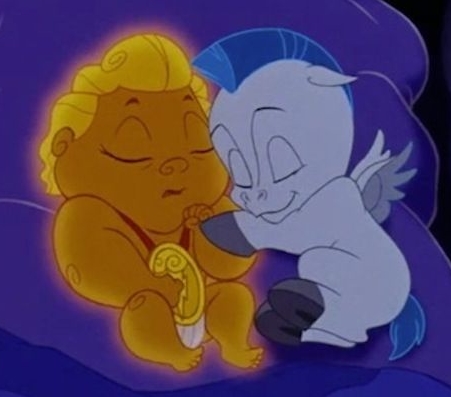
baby hercules and pegasus
They’re adorable as babies

The film opens with a dusty narrator, but he’s interrupted by the Muses who spice up the prologue of Zeus trapping the Titans and give a gospel flair. Years and years later, Zeus and his wife Hera are having a party for their baby boy, Hercules. Their gift to their son is baby Pegasus. Zeus’s brother, Hades, ruler of the Underworld, stops by for a moment, but returns to his domain for a meeting with the Fates (three [ugly] women who control the lifelines of mortals). He has a plan to release the Titans and take down Zeus, so he can rule, but wants to know from the Fates if Hercules will spoil everything. Short answer, yes. So, for his plan to be a success, he sends his stooges, Pain and Panic (little demons? I don’t know what they are; I thought they were funny as a kid) to kidnap Hercules, feed him a potion to make him mortal, and kill him. They fail at giving baby Hercules every drop of the potion, so he retains his god-like strength, and even ties the shape shifting demons into a knot, laughing all the while. Fearing Hades’s wrath at their failure, Pain and Panic decide not to mention it to the god. An older couple take Hercules in and raise him.

Eighteen years later, we check back in with Hercules, a gangly teenager who can’t control his strength, causing accidents and damage, and is thus deemed a freak by everyone else. Taking pity on their son, his parents reveal that he was adopted and he wore an insignia of the gods around his neck when they found him. He will Go the Distance [Cross Country runners have adopted this as an anthem] and find out where he belongs. The answers lie at the temple for Zeus, which springs to life for Hercules. The statue informs Hercules of his true heritage, but he cannot join the gods on Mount Olympus as a mortal; he must perform an act of true heroism for his god status to be reinstated. To aid his son on his journey, Zeus reunites him with Pegasus and sends him to Phil, a trainer of heroes. Hercules vows “I won’t let you down, father!”

Unfortunately, Phil’s island is a mess and he’s retired. A little bolt of lightning persuades Phil to take on Hercules, who is his One Last Hope. He’s dreamed of training a hero so great, the gods will put a constellation of him in the sky and everyone can say, “that’s Phil’s boy.” Hercules starts clumsy, but he bulks up over the years and soon passes the courses with ease. To prove his mettle, Phil takes him to Thebes. Along the way, they hear a damsel in distress. A centaur (which I thought centaurs were good?) has a damsel in his clutches. Megara, Meg by her friends, if she had any, is sassy and spunky. “I’m a damsel. I’m in distress. I can handle this, have a nice day.” Hercules does defeat the centaur, but he gets tongue-tied around Meg (understandable considering his interaction with females prior to this would have been minimal) Phil and Pegasus drag him away and Meg meets with Hades. She works for the god of the Underworld and he is not pleased with Pain and Panic when he discovers Hercules is still alive. He has a new plan to get the strong man out of his way so he can reorganize the cosmos.

Thebes is a city in chaos; constant natural disasters and monster attacks. According to Phil, a good place to test out Hercules as a hero. He gets his first chance from Meg, who comes running up to him, spouting a story of two boys trapped under a rock. Hercules saves the kids easily, but moving the rock uncovered a hydra. He quickly learns, after being eaten and slicing his way out, that cutting one head off just makes three more grow in its place, so he soon has a mass of heads ready to chomp him. He finally defeats the hydra by causing a rock slide. He’s buried for a moment and Hades is gleeful, but Hercules prevails. After that, he turns Zero to Hero [my favorite song from the movie]; he defeats any monster Hades throws at him and racks up crowds of adoring fans. However, while Hercules reenacts his tales for his father, he’s disappointed to find out he still hasn’t become a true hero and cannot join Zeus on Olympus.

Hades is desperate. He wants Meg to discover whether “wonder boy” has any weaknesses. He owns her; she sold her soul to him to save her boyfriend, but the boyfriend was scum and ran off with another woman. If Meg does this task for Hades, the god will grant her her freedom. She persuades Hercules to play hooky for a day with her (the lion skin Hercules is wearing at the beginning of the scene is Scar from Lion King). The couple has a lovely date, interrupted at the end by Pegasus and Phil. Meg Won’t Say I’m in Love, completely different from most heroines in a Disney movie. Hades appears and doesn’t buy that Hercules doesn’t have a weakness, then realizes, Meg is the man’s weakness. Phil overhears Meg and Hades talking and has to break the news to Hercules. The young man is so in love, he won’t hear it and Phil quits.

Pain and Panic distract and tie up Pegasus so Hades has the man alone. He offers a deal; Hercules gives up his strength for the next twenty-four hours, and Hades will set Meg free (he has the woman bound and gagged). Hercules agrees upon the condition that Meg will be safe. His heart is broken when Hades reveals that Phil spoke the truth. Hades is off to free the Titans, Hercules and Meg are both crying over their heartbreak (Meg’s upset that she’s caused Hercules pain).

While the Titans attack Olympus, Hades sends a Cyclops to take care of Hercules. Even without his strength, he still faces the monster. Meg frees Pegasus and they retrieve Phil to help Hercules. A bit of a pep talk from his trainer, and Hercules defeats the Cyclops, but Meg pushes him out of the way from a falling pillar. Hercules’s strength returns, since Hades’s deal was broken. He rushes to Olympus to save the gods; the Titans are defeated, but Hades gets one last gloat in about Meg. The hero arrives just after Meg’s life line is cut by the Fates. He ventures to the Underworld to save her, making a new deal. A trade; his soul for Meg’s. Hades agrees, but knows there’s a loophole; Hercules won’t survive the swim in the River of Souls; Hades will have both of their souls. As the Fates go to cut his life line, the scissors won’t cut, the line turns gold. Meaning, Hercules is a god. He strides out of the river, pushes Hades in, and returns Meg’s soul to her body.

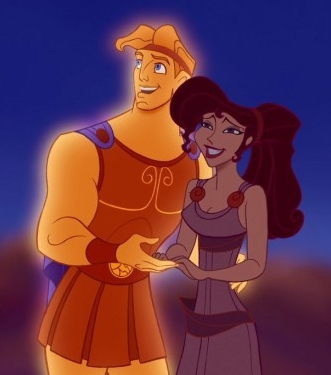
Hercules-Meg

The pair are whisked to Olympus, where the gods are ready to welcome Hercules to their ranks. His willing sacrifice of his life for Meg’s was the act of a true hero. He gives up god hood to remain with Meg; they finally share a kiss. A final chorus cheers and declare A Star is Born. A constellation of Hercules is flung among the stars and Phil gets his hero.

Since my interests center primarily on British myths, I am not as familiar with Greek myths (I have a friend who has more of an interest and according to her, Disney tamed down the story; but what do we expect from Disney?) The movie has a good message about what a true hero is and Hercules doesn’t let the fame go to his head, which I appreciate; the writers ensured the Hercules remained a truly “good guy.” I remember there was a cartoon that ran for a while on Disney Channel. For me, Hercules wouldn’t rank as high as say, Lion King, but I do appreciate now how sassy Meg is. She is a more modern woman and I love how she is able to take care of herself. She won’t fall into the stereotypical role of being helpless. Yes, she falls for Hercules, but because he is genuinely caring and nice. The Muses are fun. So, overall, an enjoyable watch, but not one I’m going to rush to add to my DVD collection.

I welcome questions or comments.  What’s your opinion on Meg and Hercules?

Next Time: Mulan

“But the Sun Rollin’ High, Through the Sapphire Sky”

The Lion King

One of the top grossing animated films of all time, it won Best Original Score and Best Original Song for Can You Feel the Love Tonight at the Academy Awards; and was scored by legend Hans Zimmer (he’d later score Pirates of the Caribbean) and lyrics were by Tim Rice (who has worked with Andrew Lloyd Webber) and songs by Elton John [I most strongly connect Elton John to this movie, even though I’m sure I listened to his music growing up.] It ranks pretty high on my list of Disney favorites. The artistry is beautiful, the songs are fun, it’s a complex story (inspired by Shakespeare’s Hamlet [I am a bad English major and not terribly familiar with Hamlet; I saw one updated version performed by David Tenannt]) and a wonderful cast of voice actors. Highlights include James Earl Jones (most iconic as Darth Vader) as Mufasa, Jeremy Irons (a marvelous thespian who plays Henry IV in BBC’s Hollow Crown productions) appropriate for the Shakespearean role of Scar. Jonathan Taylor Thomas (from Home Improvement) is young Simba; adult Simba is voiced by Matthew Broderick. Whoopi Goldberg (I mainly know her from this film and Sister Act and didn’t realize she was a stand-up comedian until I was a teenager) is one of the hyenas, and Broadway star Nathan Lane (he would later team up with Matthew Broderick for The Producers film) is Timon.

the-lion-king-original
(Too many pictures to choose from!)

The opening of The Lion King is iconic; I think most people know the movie from that scene alone. Young Simba is presented to the animal kingdom (Emma Swan jokes about the scene in Season 3 of Once Upon a Time) as we learn “there’s more to see/than ever be seen/more to do/than ever be done” and are all connected to the great Circle of Life. All of the animals bow to the little prince, a sunbeam highlighting the scene. We next meet Scar, the king’s younger brother who was next in line for the throne, until Simba was born. He doesn’t hide his disdain and refusal to show for the presentation. Unfortunately, Mufasa doesn’t know what to do with his troublesome kinsman and Scar is free to plot. An image that come back a few times in the movie is Rafiki’s drawing of Simba in his tree.

A few years pass and Simba wakes his father early (with a typical argument between the parents on whose son he is at that time of morning) so Mufasa can show him the kingdom. “Everything the light touches,” Mufasa explains, is their kingdom. The Outlands are beyond their borders and young Simba must never go there. Mufasa further prepares his son that the time will come when Mufasa will no longer be king, it will be Simba’s turn, and cautions that there is more to being a king than doing whatever one wants. There is a balance to life that the king must watch over. Of course, this lesson is interrupted by a brief pouncing practice, much to Zazu’s chagrin (another song, The Morning Report, was added in the Special Edition and appears on the corresponding soundtrack).

Mufasa must attend to royal duties so Simba visits his “weird” uncle and the meddling Scar puts the idea purposefully in young Simba’s head to explore the forbidden Elephant Graveyard. Of course, who should accompany Simba on his adventure is his best friend, Nala. Zazu lets slip that the two are betrothed (a human custom) and will one day be married (they protest now…just wait). As children are wont to do, Simba focuses on the fun of being “free to do it all my way” and merrily describes his rule and why I Just Can’t Wait to Be King. “Everywhere you look/I’m standing spotlight!”

The Elephant Graveyard is not as fun as Simba planned; after his claim to “laugh in the face of danger!”they run into three hyenas, Shanzi, Banzai, and Ed. Luckily, Mufasa arrives and scares off the three hyenas before they really hurt Simba or Nala. Mufasa is understandably very disappointed in his son and reiterates his earlier lesson that one day he will die, though he’ll look on from the stars above. A king is brave when he has to be and despite Simba’s thought that his dad isn’t scared of anything, Mufasa admits he was scared of losing Simba. There is a lovely wrestling match, putting worries aside.
Pals

That evening, Scar visits the hyenas, and confesses that he sent Simba and Nala to thescar be prepared Graveyard for the hyenas to “take care of.” He’s “surrounded by idiots” who can’t even do their job. What needs to happen is that Mufasa needs to die; without daddy dearest around, Simba will be simple prey. And then “in justice deliciously squared,” without those two in the way, Scar can assume the throne “I’ll be king undisputed/respected, saluted/and seen for the wonder I am!” and promises the hyenas a new life. A lot of the imagery from Be Prepared is influenced by Nazi propaganda: most explicitly, their march. Be Prepared is a fantastic villain song as well and Jeremy Irons is deliciously hammy [Jim Cummings (voice of Ed) had to finish the song for Jeremy Irons when the latter threw out his voice].
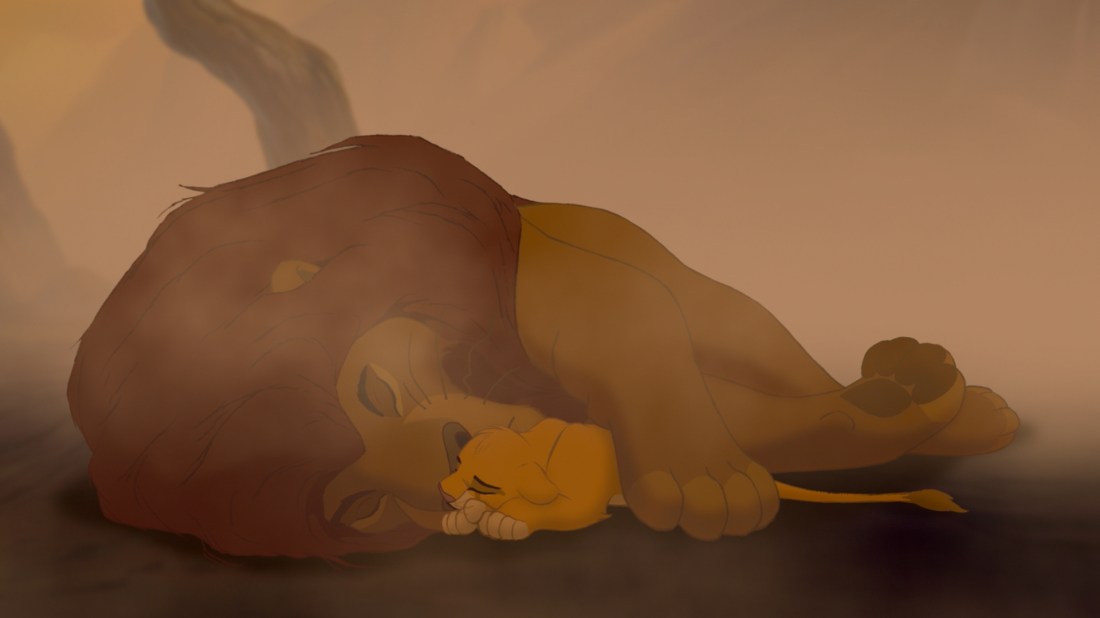
Scar promises Simba a surprise for he and his father the next day and leaves the cub in a gorge. The “surprise” is a wildebeest stampede (a scene equal to any action scene today and full of drama and tension). Scar acts suitably worried and runs alongside Mufasa as Zazu flies ahead to find Simba. But once Mufasa enters the gorge, Scar prowls around the top, knocking Zazu out to prevent the royal majordomo from getting further help. Mufasa finds his son and tosses him to safety, but is carried away by the pressing wildebeests. He jumps to the cliff a moment later and begs his brother for help. Scar sinks his claws into his brother’s legs and murmurs “Long live the king!” before flinging him into the mass. Simba witnesses his father’s fall and in the dusty aftermath, searches for him. He finds Mufasa’s still body (I cry every time, even as an adult) and pleads that “we’ve got to go.” The young cub realizes his dad is dead and tears streak his fur and he curls next to his protector one last time. Scar emerges and reinforces Simba’s thoughts that if it hadn’t been for him, his father would still be alive. He then directs his grief-shocked nephew to “run away and never return.” A moment later, he commands the hyena trio to “kill him.” Simba willingly falls into a bramble bush at the bottom of a cliff and gets away. After Banzai falls in, neither Shenzi nor Ed want to come out looking like “cactus butt,” and they determine if Simba was ever to return, they’d kill him then, shouting the warning to the departing cub. Scar, “with heavy heart” assumes the throne and “ushers in a new era” of living alongside hyenas. Rafiki wipes away the drawing of Simba in sorrow.

death_of_mufasa
(Sorry if it makes you tear up, but it’s such a poignant moment)

Buzzards float about a stretched out Simba; he’s providentially rescued by a warthog and meerkat, Pumba and Timon. At first, Timon suggests leaving him since he’s a lion, but Pumba ponders that he could grow up to be on their side. Timon’s advice to the depressed cub once he awakens is to put his past behind him; “when the world turns it back on you, you turn your back on da world.” They’re outcasts too and they teach him about Hakuna Matata, their “no worry” lifestyle, and how to eat bugs [that grossed me out as a kid. And yeah, Disney, we knew you meant “farted” even as kids. That was actually our favorite part of the song to sing-along to.]

There’s a fun montage showing the progression of time as the new trio crosses a bridge, repeating “Hakuna Matata.” All grown-up now, Timon, Pumba, and Simba discuss what “stars” truly are. Timon claims they’re “fireflies that got stuck up in that big bluish-black thing.” Pumba is scientifically correct stating they are balls of gas burning billions of miles away. And Simba shares what his father told him about the kings of the past looking down on them. He’s laughed at by Timon and Pumba and leaves to ponder the tragedy of his life. His scent drifts in the breeze to old Rafiki, who recognizes it and joyfully realizes Simba is alive. “It is time,” the monkey declares, now drawing a mane on Simba.

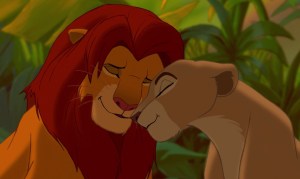
simba and nalaThe following morning, Timon and Pumba are out searching for grubs, singing The Lion Sleeps Tonight [this is how I know that song, despite it being older than the movie]. Pumba wanders off, to be chased by a grown lioness. Simba to the rescue! Until he’s pinned in a very familiar manner and recognizes a grown up Nala. Nala is understandably surprised to discover that Simba is alive and urges him to return with her to the Pride Lands and claim his throne. Simba decides that he and Nala need to have a talk, alone. Timon bemoans the two old friends’ romantic Can You Feel the Love Tonight [probably my second favorite Disney love song.  Elton John’s solo version is the only “pop” version of Disney songs that I liked growing up]. As an adult, some of their actions take on more meaning, like the looks between them while Nala is lying down. But I still think it’s sweet; they’re simple gestures between two beings that care about each other. And Simba looks a lot like his dad at times. Yet, at the end, the couple continues to argue over Simba’s return. He refuses; he can’t face his past. Nala wonders “why won’t he be the king I know he is/the king I see inside?” She tells him she’s disappointed that he’s not the same Simba she remembers. Simba in turns accuses her of sounding like his father. “Good, at least one of us does.” They fight further; Simba refuses to tell her the truth of why he ran away, deeming that to tell her now and return to the Pride Lands won’t change anything, and stalks off. He shouts his despair to the stars, reproving his father, “You said you’d always be there for me!” Quieter, “but you’re not. And it’s all my fault.”
A little chant echoes on the wind. Rafiki is dancing in a tree and comes down to impart wisdom on Simba. Simba can’t answer his question, “who are you?” Rafiki knows; he’s Mufasa’s boy. When Simba says that Mufasa has been dead for a while, Rafiki states “wrong again! He’s alive! And I’ll show him to you!” The crazy monkey leads Simba through vines and trees and roots [How to Train Your Dragon 2 has a scene that echoes this one] to a pool. Rafiki urges Simba to “look harder” at his reflection. The lion sees Mufasa, as Rafiki states, “he lives in you” (becomes a song title in the sequel). Mufasa’s bass voice rumbles and the clouds part, forming his silhouette. Mufasa chides his son that he has forgotten him; by forgetting who Simba truly is, he has forgotten Mufasa. Simba must take his place in the circle of life; he is Mufasa’s son and the one true king. He fades away, urging Simba to “remember.” Simba begs his father, “please, don’t leave me,” still the scared lion cub. Rafiki picks up the lesson and a whack from his stick knocks some sense into Simba, that while change is not easy, it is good. One can either run from their past, or learn from it. Hans Zimmer’s theme plays over a wonderful superimposed shot of Simba running back to the Pride Lands. Nala, Timon, and Pumba soon catch up and agree to help Simba reclaim his home. When he cautions that it will be dangerous, Nala echoes his childish claim “I laugh in the face of danger!” Timon and Pumba act as live bait, dressing in drag and doing the hula, a little bit of comedic relief before we delve into the drama.

We witness the devastation that Scar’s rule had wrought. The land is barren and we find out from Sarabi, Mufasa’s widow that the herds have moved on. She advises that they leave Pride Rock. Scar refuses. “Then you have sentenced us to death!” “I am the king,” he replies, “I can do whatever I want!” He swipes at the lioness, but Simba leaps to her defense. Both she and Scar first assume he’s Mufasa. Sarabi is pleased to see her grown son; Scar is annoyed to discover that the hyena trio failed at their mission. Simba growls at his uncle, “give me one good reason why I shouldn’t rip you apart.” Scar states that the hyenas think he’s king, but then sinisterly turns the conversation back on Simba, dragging up how Mufasa died, pressuring Simba to admit that he killed his father. “Murderer!” he instantly declares and further pushes, all the while circling his nephew, stating that it was Simba’s fault, even if it was an accident. A very confused Simba slips on the edge of Pride Rock, lightning from the gathering storm lighting a fire beneath. Scar recalls a similar scene, and digs his claws into Simba’s paws the same way he had Mufasa’s. He whispers his little secret: “I killed Mufasa!” Simba leaps onto Scar, now declaring him the murderer. A paw on Scar’s throat compels Scar to admit the truth out loud. The hyenas are on Simba and lionesses attack the hyenas.

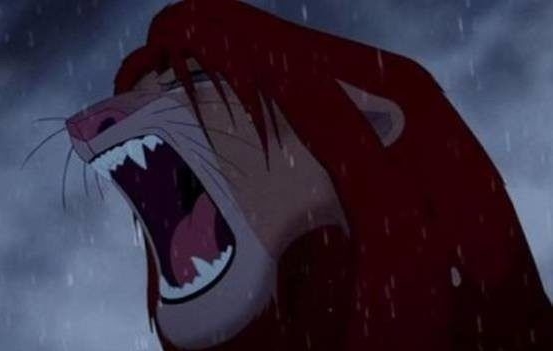
War breaks out (with a brief comedic interlude with monkey kung-fu and a bit about “Mr. Pig.” I still don’t get that reference, but I thought it was hilarious as a kid). Scar attempts to slink away, but Simba is on him, growling that Scar doesn’t deserve to live. Scar pleads that the hyenas are the real enemy (Ed, Banazi, and Shenzi can hear this) and Simba decides he won’t be like Scar; he won’t kill him. Instead, he instructs him to “run away and never return.” Scar plays dirty and swipes ash into Simba’s eyes. There is a violent showdown between the two before Simba flips Scar over and down to a ledge below. Scar thinks he’s in the clear when the hyenas come to him, but they turn on him since he claimed they were the enemy. Shadows play on the rock behind, not giving us a direct view at what happens. It rains harder, putting out the fire and washing away the stain of Scar. To music that gives me goosebumps, Simba at first hesitates to approach the edge of Pride Rock; he had run and hidden from this responsibility, scared he was unsuited, but one last echo of “Remember” from Mufasa and Simba proudly takes his place at the edge of Pride Rock and releases a mighty roar. It’s echoed by the lionesses and greenry springs into the Pride Lands.

simba roar

The movie ends with a triumphant reprise of Circle of Life, which continues with the presentation of Simba and Nala’s cub.

There was a direct-to-video sequel, The Lion King II: Simba’s Pride (a play on both a lion belonging to a “pride,” and his daughter being his pride, and maybe even Simba’s own pride and how it affects his own decisions…though that’s a little deep for the movie and not as evident) that came out four years after the original. A tale about Simba and Nala’s daughter, Kiara. Her story mimics her father’s at time, having to go out and experience life on her own before she understands what her father taught her. There are elements of Romeo and Juliet in the plot; two warring families, their children falling in love. Except, the couple does not die at the end! Some of the songs are good and overall a good story; I consider it one of Disney’s better sequels (especially compared to most of their other animated sequels). In addition to a cartoon series in the 90s, Timon and Pumba’s story, Lion King 11/2 came out in 2004; there are funny parts, but it definitely doesn’t live up to the original. Now on Disney Junior, there is a new cartoon series about Simba’s son (I see plot hole regarding the sequel), called Lion Guard.

The original film was transformed into a Broadway production in 1997, and is still running (meaning it recently celebrated its twentieth anniversary…wow). It was nominated for Best Musical and Best Original Score at the Tony’s and did win in several other categories. Next summer, a live-action/CGI adaptation is due out, with an all-star cast; most notably, James Earl Jones will reprise his role as Mufasa (no teaser out yet, but I am excited to see it).

Overall, this is a great family film. It’s about family, responsibility; the characters are deliciously complex and I feel it has stood the test of time. Even though I have seen the movie several times, I still get apprehensive during the stampede and Scar and Simba’s showdown, and sad at Mufasa’s death. Timon and Pumba were my favorite characters as a kid, because they were funny. Now, I enjoy Scar as a villain, and I wish we could have seen more of Mufasa since he is a very wise king and very loving of his son. I can feel a connection to Simba as a young adult facing responsibilities. The artwork is phenomenal; the emotions they are able to put into the faces and still have them look like lion’s; just look at Simba’s face right before he roars at the end. Re-watching the movie has awakened my love of the film; it ranks towards the top of my list.

As always, I welcome questions or comments. Do you like any of the pop versions of Disney songs?

Next Time: Pocahontas

“You Ain’t Never Had a Friend Like Me!”

Aladdin

What I remember most of this movie is the great soundtrack and Robin Williams’ humor; Genie is probably my favorite character from the movie. The movie is based off of the compilation The Book of One Thousand and One Nights and set somewhere vaguely Middle-East (I kept thinking Persia while watching the film). Nevertheless, it is nice to see something other than a European fairytale. The overarching theme of the film is “it’s what is inside that counts,” looking for the “diamond in the ruff.”

We’re first introduced to the villain of the film, Jafar, as he uses a petty crook (who just killed someone, it sounds like), to enter “the Cave of Wonders,” in search of a mysterious lamp. The cave opening, a talking sand tiger, warns that the only one who can enter is “one whose worth lies far within.” Which is apparently not the crook, because he’s eaten. Jafar’s stooge is a talking parrot, Iago (voiced by Gilbert Godfrey) who alternates between calm and agitated.

Aladdin is not our typical Disney hero. He’s an orphaned “street rat” that steals on a daily basis to survive, staying One Jump ahead of the guards. We also get glimpses at a different culture; the sword eater, fire walker, and more. The characters are also dressed differently; Aladdin does not have a shirt, the women’s midriffs are showing. Once Aladdin has won his prize, he feasts with his monkey friend, Abu. Yet, when he sees two small children searching for scraps, he shares what little he has. They hear a parade and investigate, finding another suitor has arrived for the princess. The children get in the way and the snooty prince attempts to whip them, but Aladdin once again steps in. He’s insulted by the condescending man, though gets the dig in about a horse having two rear-ends (that bit goes over kids heads). When he and Abu reach their “home,” there’s a brief reprise of Aladdin wishing one day to live in the palace, where all of their problems will be solved.

[Fun fact: Aladdin’s voice actor, Scott Weinger played Steve, DJ Tanner’s boyfriend, in Full House; there’s even a joke in the episode where the cast goes to Disneyland.]

For one resident of the palace, it’s a cage. The princess Jasmine desires freedom outside the palace walls. She’s never had friends; everything has been taken care of for her. She hates the law that states she must marry a prince by her birthday (in three days’ time) and has sent away every suitor. Bluntly put, she does not want to be a princess. That evening, she runs away and come morning, wanders the marketplace, catching Aladdin’s eye. He jumps to her rescue while she stumbles over the notion of “paying.” They run into, and away from the guards and Jasmine keeps up with Aladdin; demonstrating she trusts him. Amongst their talk, the couple finds out that they both feel trapped by their lives and station. The pair is eventually caught and Aladdin is taken to the palace dungeon, despite Jasmine’s protests and revelation that she is the princess.

aladdin cast

The Sultan is a bit childish at times and is regularly hypnotized by Jafar so the royal vizier can get his way. Jafar covets the title of Sultan and will use his sorcery to gain it. He cons the Sultan into giving up his blue diamond [yes, diamonds come in almost every shade of the rainbow, including blue] so he can “divine” the proper suitor for Jasmine. Instead, Jafar uses it to conjure who the Cave meant could enter. He sees Aladdin and plots a way to get the boy. When confronted by Jasmine for his treatment of Aladdin, he tells her that the street rat was beheaded for kidnapping her. Jasmine is devastated.

That evening, Jafar disguises himself as an old, crippled prisoner and convinces Aladdin to help him retrieve the lamp from the Cave of Wonders, promising the boy the rest of the treasure. Aladdin is allowed to enter the Cave and he and Abu meet Carpet, a helpful magic carpet who leads them past the glittering heaps of gold to the lamp. Abu is tempted by a forbidden gem and just as Aladdin has the lamp in his grasp, Abu grabs the gem, causing the whole Cave to start collapsing. They manage to reach the opening (in an early CG sequence that reminds me a bit of a video game [not that I’ve played many], nevertheless, very thrilling), but Jafar insists on the lamp first and before turning back to help Aladdin, he pulls out a dagger (why are bad guy daggers always crooked? Do they not pay the extra for quality craftsmanship?). Abu saves Aladdin, but they are swallowed up by the Cave.

Abu was also a sneaky monkey and stole back the lamp. Aladdin takes a closer look at the lamp and rubs at some smudging. Out pops Genie! Aladdin is his new master and is allowed three wishes. Genie elucidates Aladdin to the possibilities, telling the lad that he’s never had a Friend Like Me (my favorite song of the movie) and highlighting Robin Williams’ comedic range. What kid didn’t wish they had a genie after that? Aladdin demonstrates that while poor, he is not stupid and tricks Genie into getting them out of the cave, without using any of his wishes. He even asks Genie what he would wish for and Genie reveals that while he has “phenomenal mystical powers,” he’s bound to the lamp and his master. He’d wish for freedom, but only his master can do so. Aladdin promises he’ll reserve his third wish for that and his first proper wish is to become a prince, so he can see Jasmine again, stating that she’s smart, fun, and beautiful (glad they added the “smart” and “fun” qualities). (Sebastian is briefly glimpsed as Genie ponders the wish)

Back in Agrabah (a fictional city), Jasmine has told her father of Jafar executing Aladdin and the Sultan reprimands his vizier. Jasmine also states that one benefit to being forced to marry; “when I am queen, I will have the power to get rid of you.” Jafar is even more desperate to become Sultan and Iago suggests that Jafar marries Jasmine to gain the throne and afterwards, they drop Jasmine and her father off a cliff. The pair manically laughs. Jafar returns to the throne room and attempts to hypnotize the Sultan to obey his plan. The Sultan breaks at one point, declaring Jafar too old, but Jafar continues to pressure. His spell is broken a second time by a loud commotion.

Prince Ali has arrived. Genie (disguised as…a whole bunch of people throughout the song, even mimicking parade announcers) extols his virtues, claiming he’s generous, strong as ten men, and his servants are all “lousy with loyalty.” People who never spared Aladdin a thought or viewed him as worthless, now view Ali as attractive and worthy of respect. The Sultan’s excited by Ali’s arrival and is eager to introduce his daughter to a fine, upstanding gentleman like Ali, claiming he is “an excellent judge of character” [and we all say “Not!]. Of course, Aladdin has to act like every other arrogant suitor Jasmine has seen when he asks permission to court her. She dismisses him, stating “I am not a prize to be won!” Genie urges Al to “tell the truth” on who he really is, but Al (Genie’s nickname for Aladdin) feels like Jasmine wouldn’t have time for him if he wasn’t a prince. Aladdin flies up to see Jasmine again and when he fumbles around, he reminds Jasmine of someone she met in the marketplace. Ali scoffs, but when Jasmine tells him off again, he agrees that she “should be free to make her own choice,” and offers to leave. Startling everyone when he steps off the balcony, we are relieved to find out Carpet caught him. He offers the princess a ride, holding out his hand and once again asking “do you trust me?”

a whole new world

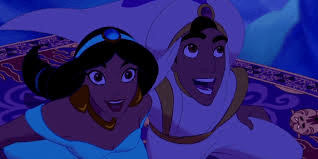
The couple takes a romantic flight, Aladdin showing the princess A Whole New World [I know both parts to this song, not really caring to differentiate when learning as a child. Further fun note: Jasmine’s singing voice is the same as Mulan’s, Lea Salonga, who has played Kim in Miss Saigon, and both Éponine and Fantine in Les Misérables]. The pair is thrilled at the prospect that their new world holds, “no one to tell us no/or where to go/or say we’re only dreaming.” It’s a “thrilling place, for you and me.” They fly by the Sphinx in Egypt (and are the reason the nose is broken), through Greece, and end in China. Jasmine tricks Ali into admitting he was the one she met in the marketplace, but he still doesn’t reveal that he’s not a prince. When he drops Jasmine back off at her balcony, Carpet helps them share their first kiss.

But Jafar has gotten his way with the Sultan, and Jasmine is told she will marry the vizier. At the same time, Aladdin is captured, chained, and dropped off a cliff into the sea. His hand manages to rub the lamp, sending Genie out and Aladdin’s second wish is used to save his life. Genie was happy to do it; he’s getting fond of Al. Aladdin confronts Jafar and smashes his staff, releasing the Sultan from its spell. Jafar uses sorcery to disappear, but has realized that Prince Ali (or Abooboo, as he refers to him) is Aladdin and has the lamp. Iago gets the lamp the next day, after Genie and Al have had a fight. Jasmine has chosen Ali to marry and Aladdin wants to keep Genie around just in case, and won’t be able to free him. Without the Genie, he’s just Aladdin and the only reason anyone thinks he’s worth anything is because of Genie.

With the lamp in his possession, Jafar quickly uses his first wish to become Sultan. But Jasmine and her father refuse to bow to him. So be it, they will cower before a sorcerer, Jafar’s second wish is to become the most powerful sorcerer in the world. Jafar mocks Aladdin when he comes to rescue the former Sultan and princess and reveals who he really is to Jasmine, before sending him to a snowy mountaintop. Aladdin survives and once again flies back to Agrabah to put things to right.

Jafar has changed everything around; Jasmine’s pet tiger, Raja is now a kitten, the former Sultan is a puppet and Iago is shoving crackers in his mouth (the Sultan had previously fed Iago lots of crackers, but it was done in kindness), and Jasmine now wears red and is chained, feeding Jafar. Jafar still wants to marry her and at first she refuses. Jafar attempts to use his third wish to force her to love him, but that is against the rules (as is bringing back someone from the dead and killing someone). When she catches sight of Aladdin sneaking into the palace, she turns the charm on and seduces Jafar as a distraction. The lad is caught and calls Jafar a “cowardly snake” for not fighting him himself. Jafar’s answer is to turn into a giant snake (and you wonder why so many kids don’t like snakes) and traps Jasmine in a giant hourglass of sand. Aladdin tricks Jafar into using his third wish to become a genie. Meaning, that while Jafar will gain immense power, he will also be trapped in his own lamp. With Jafar gone, Aladdin can smash the glass and all of Jafar’s magic is undone.

The couple face the truth, that Aladdin is not a prince, but Jasmine still loves him. As the Sultan says, “am I Sultan, or am I Sultan;” he has the power to change the law and allows his daughter to choose whomever she’d like to marry. She of course chooses Aladdin. Al uses his last wish to set Genie free and he flies off to explore the world, donning a Goofy hat.

There was a cartoon series and two direct-to-video sequels. Neither sequel lives up to the original film; the quality more in line with the series, though the third movie does include Aladdin and Jasmine finally getting married and Aladdin meeting his long-thought-dead father (voiced by John Rhys-Davis, and Lumiere’s Jerry Orbach is back as the villain). There is a Broadway production currently running and a live-action adaptation due out next year. The teaser doesn’t reveal much, so I’m not sure how excited I am to see the movie yet.

Aladdin truly is a hero, protecting those weaker than him and never asking for anything in return. He’s impressed by Jasmine’s spunk, as well as her beauty. He bodily puts himself in harm’s way to save the world from Jafar. Jasmine is the first princess that has pointed out that being a princess is not always fun and is not entirely glamorous. I did go as Jasmine one year for Halloween; my mother made my costume and my older brother was Peter Pan.  The  couple are good role models, loving each other for what’s on the inside.

Questions? Comments? What’s your favorite Disney love song?

Next Time: The Lion King

“We Got a Hot Crustacean Band”

The Little Mermaid

We’ve reached the Disney movies that came out during my lifetime. The Little Mermaid is also the first movie part of the coined “Disney Renaissance,” when Disney returned to making movie musicals. The story is based on Hans Christian Anderson’s fairytale, though we no longer have a storybook opening to introduce the tale. Instead, we’re greeted by a sailing ship, with the sailors singing Fathoms Below. One comments to Prince Eric and his advisor, Grimsby, that King Triton is to thank for the fair weather; Grimsby denounces mermaids as “nautical nonsense,” while the sailor insists. Once under water, we eventually come to the city of Atlantica, which is preparing for a concert, featuring Triton’s daughters, composed by Sebastian.

[Note: is has been suggested by pintrest that Triton’s daughters stand for the seven seas, depending on their hair and personality. As a kid, I just he just wanted all of his daughters to have names starting with “A”]

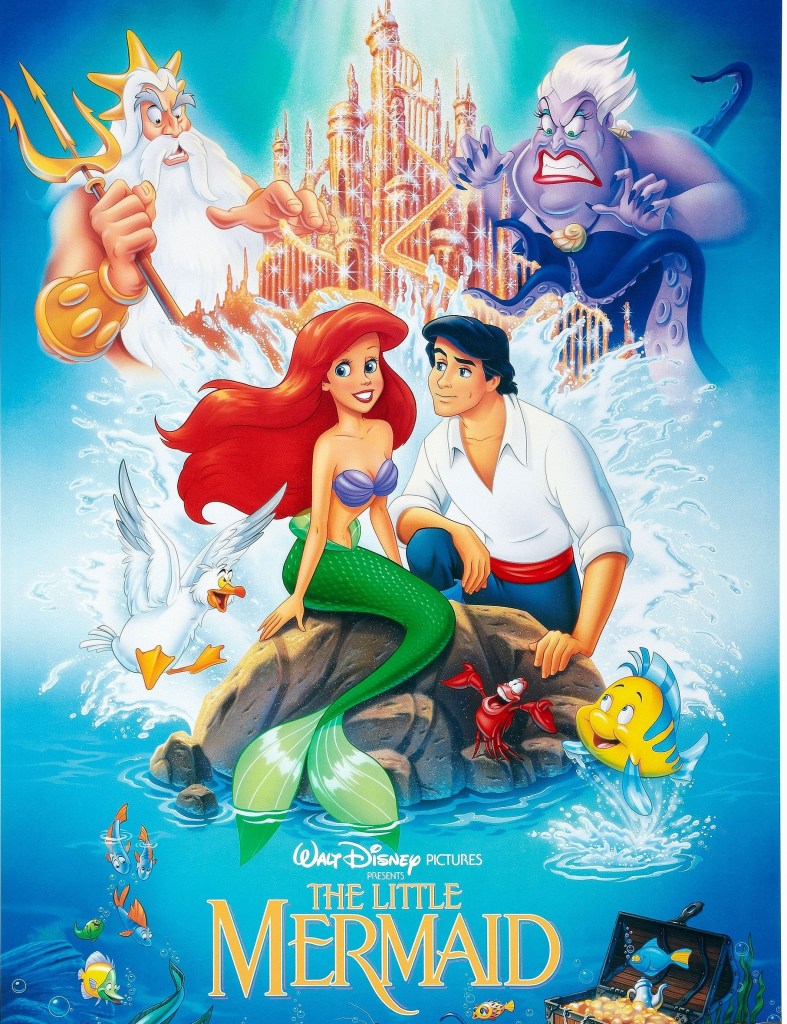
The-Little-Mermaid-Movie-Poster

Ariel misses her debut because she is out exploring old shipwrecks with her fish friend, Flounder, searching for human artifacts. Flounder is certainly more cautious than Ariel and they manage to run into a shark. They take their findings to the surface to ask a sea gull, Scuttle, what they are for. According to the idiotic bird, a fork is a “dinglehopper” and used to comb one’s hair, while a pipe is a “snarfblat” and is a musical instrument. That reminds Ariel she missed the concert. Triton is furious and is even more so when he finds out Ariel has been going to the surface. Such actions are forbidden; she could have been seen by a barbaric human (the prequel that came out in 2008 explains that Triton’s wife had been killed by humans). Ariel’s retort is that she is sixteen, she’s not a child (and every adult is thinking, oh yes you are). Triton fires back with the classic, “as long as you live in my ocean, you obey my rules.” (That rarely works on kids/teens.) Once the argument has ended, Triton assigns Sebastian to look after Ariel.


part of your worldWhat Sebastian discovers is Ariel’s treasure trove. And while Ariel has numerous bits and bobs, she wants more; she yearns to be Part of Your World. As anyone who daydreams about life being different, she guesses, “betcha on land/they understand/bet they don’t reprimand daughters, bright young women.”  [Yes, for a while, I thought I’d be all grown up at sixteen….nooo.  I’m almost twice that and I still have no idea what I’m doing.  Yes, Ariel dear, human daughters do get reprimanded when they do something stupid]. All the while, the sea witch Ursula (who apparently once ruled the ocean) has had her two eels, Flotsam and Jetsam tailing Ariel and figures that she can exact revenge on King Triton through his daughter. Ariel is intrigued by a dark shape and swims to the surface to discover Eric’s ship is throwing a celebration for the prince’s birthday (complete with huge statue, which Grimsby hoped would have been a wedding present; the whole kingdom wants to see their prince settle down with the right girl [at least they include “right”]). The party is cut short when a hurricane blows in; lightning hits the sail and starts a fire. The ship runs into a reef and the crew is thrown overboard (or manages to get into a lifeboat somehow). However, Eric’s beloved canine companion, Max, is still onboard. The prince goes back for Max, but his foot gets stuck in the crumbling deck. He throws Max overboard and we next see an explosion, caused by the fire hitting gunpowder. Ariel swims in to rescue the handsome prince. They wash ashore a beach and she reprises her song, even more desperate to be part of the human world.

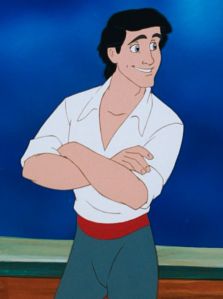
 

Ursula is positively cackling; King Triton’s daughter has fallen in love with a human! A prince, to be precise! Sebastian attempts to talk sense into the teenager, rationalizing life is better Under the Sea (a catchy, full-ocean production that I can’t help but smile every time I hear). Ariel’s sisters, and even Triton notice her changed behavior; humming all the time, always in a happy mood. The older girls inform their father that the youngest is in love. He assumes it’s a merman (who else could it be?) and calls in Sebastian. Sebastian, despite telling himself to “remain calm,” spills the secret. Ariel is happily flirting with the statue of Eric that has landed in her trove (how serendipitous) when her father appears in the shadows. He is absolutely incensed and destroys her treasures, including the statue, as a way to get through to her. As we’ve noticed before, he regrets his actions once his temper has abated. Flotsam and Jetsam swoop in and persuade Ariel to go to Ursula to solve her problems.

Ursula welcomes Ariel into her domain and justifies that she uses her powers to help Poor Unfortunate Souls [gotta admit, I’d love to perform this song; it’s sassy and so much fun to portray a villian]. The only way for Ariel to get what she wants is to become a human. And for this, Ursula just wants Ariel’s voice. When Ariel protests on how can she convince Eric to bestow true love’s kiss by the third sunset (in order to remain a human versus turning back into a mermaid and belonging to Ursula) Ursula retorts that she’ll “have your looks, your pretty face.” After all, human males prefer ladies to not say a word [I could go into how this has happened in periods of society, but I shan’t] The teen signs the contract, Ursula casts her spell and Ariel indeed becomes a human. Sebastian and Flounder rush her to the surface.

On land, Eric hasn’t been able to get the woman who saved his life out of his head, or the prince erictune she sang. Max leads him to Ariel (the dog recognizes her scent). She seems familiar, but without her voice, she can’t be the one. Nevertheless, Prince Eric is a gentleman and eagerly agrees to take care of the young woman (they assume she was in a traumatic shipwreck). Sebastian follows Ariel into the castle, though he has to run for his life in the kitchen from French chef Louis, who loves Les Poissons. During dinner, Eric stares at Ariel and is happy to give her a tour the next morning. Ariel demonstrates that she is certainly different from other ladies. That evening, Eric takes her out in a boat and Sebastian takes matters into his own…claws; they’re running out of time to keep Ariel out of Ursula’s grasp. The crab sets the mood and urges the prince to Kiss the Girl (and helps Eric guess her proper name). Yet, just when the couple is leaning in, the eels dump them. Things are getting too close for Ursula; she has to take matters into her own tentacles. While Eric is deciding to choose Ariel over a mysterious woman (thanks to advice from Grimsby), a mysterious woman appears on the beach! With the voice he remembers! And…Eric is hypnotized.
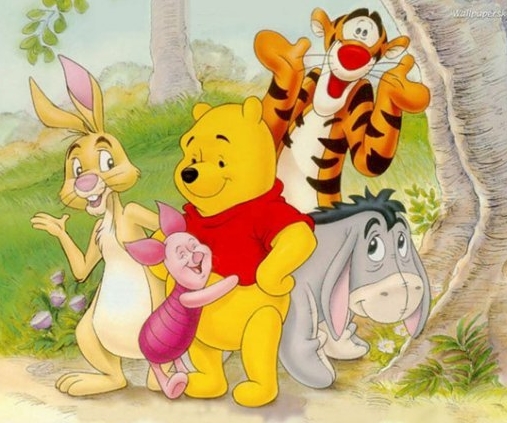
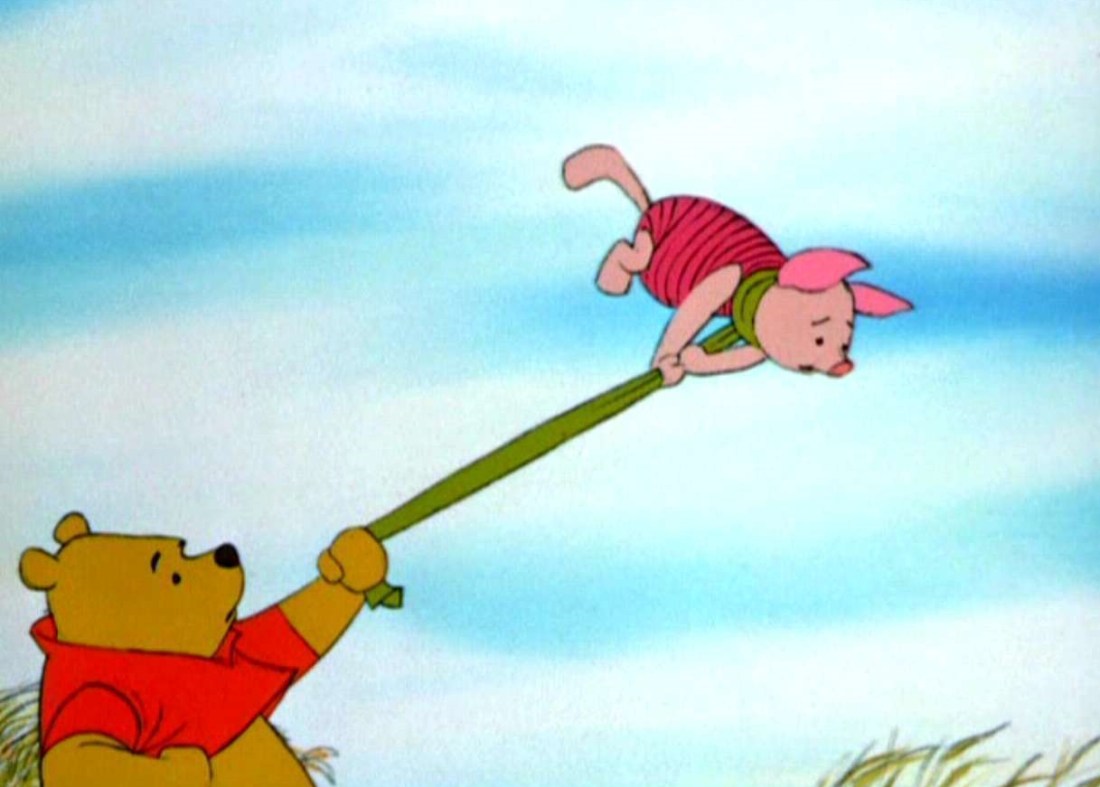
Scuttle wakes Ariel the next morning, congratulating her on the happy news of her impeding marriage to Eric; the whole kingdom is talking about the wedding that afternoon. But when Ariel runs down the stairs, there is a dark-haired woman simpering next to Eric, who is instructing that the wedding ship leaves at sundown. The ship sets sail at dusk, without Ariel onboard. Yet, Scuttle has more news; he’s discovered that the new woman, Vanessa, is Ursula in disguise. Sebastian has Flounder help Ariel get to the ship, he’ll fetch Triton, and Scuttle is to stall the wedding. Scuttle is aided by the nearby animals who wreak absolute havoc. Max is pleased to get back at Vanessa (who kicked him; add animal cruelty to the charges, and further proof to Eric if he wasn’t hypnotized). In the commotion, Ariel’s voice is released and returns to its proper host, breaking the spell over Eric. Unfortunately, before they can have a proper conversation and kiss, the sun sets, turning Ariel back into a mermaid. Ursula has returned to being an octopus (or squid) and takes off with Ariel.

They meet up with Triton, who attempts to break the contract with his trident. Signed, it’s binding and no magic can change it, except, an exchange; Triton for Ariel, relinquishing the crown and trident to Ursula. Reacting as a father, Triton agrees. Now the commander of the seven seas, Ursula advances on Ariel, but Eric throws a spear to distract her. He’s lost his love once, he won’t lose her again. His attack causes Flotsam and Jetsam to pull him further under water. Sebastian and Flounder team up to release him. Ursula’s shot with the trident, meant for Eric, misses (thanks to Ariel) and hits her pets, destroying them. Angry, she grows until she towers over the surface. Ariel and Eric were initially caught on her crown, but jump away, quickly separated by the waves churned by Ursula. The sea witch traps Ariel and is bent on killing her with a blast from the trident. Those same waves also brought up the shipwrecks; Eric commandeers one and aims, running Ursula through (he jumps off during her death throes). With her death and the return of the trident, her curses are reversed, reverting her garden of creepy seaweed back to merfolk, including Triton.

Ariel once again returns Eric to shore and she wistfully sits on a rock (in a mimicry of the real Little Mermaid statue in Copenhagen; I thought the movie took place in France for the longest time, actually, it’s probably set in Denmark). Sebastian muses to Triton that children must be free to live their own lives. One problem – how much Triton is going to miss his daughter. He grants her legs (and a new, sparkly dress; better than that sheet from earlier). Ariel eagerly runs to Eric and they finally get their kiss. Which transforms into a wedding. Triton rises in the water for a final goodbye, Ariel whispering “I love you, Daddy,” and Eric bowing to his father-in-law. He casts a rainbow over the ship and we know “they lived happily ever after.”

ArielMarriage

Little Mermaid did have a spin-off cartoon that ran in the nineties (I watched regularly) and it has been adapted into a Broadway stage musical (I think I saw part of it while at Disney World). There was a sequel, Return to the Sea involving Ariel and Eric’s daughter, Melody; and as already stated, there was a prequel. There is another Little Mermaid movie that came out in August of 2018 that seems to have a completely different storyline from the Disney classic (I was excited, then confused). There have been rumors of a Disney live-action retelling for several years, but nothing is truly known for certain, especially a release date.

While Ariel is not my favorite princess (nevertheless, it found its way to our VCR plenty), I do appreciate that she wanted to take her fate in her own hands (to good and bad consequences. If it involves visiting an evil witch and signing over your voice or “belonging” to someone, bad. Good that she fights for what she loves). She swims after Eric’s wedding ship, even though she’s uncoordinated as a human, to save Eric. She does not ask her father for legs at the end, but he was kind enough to gift them (that whole: if you love something, let it go). Triton is a typical father (though he has to balance raising seven daughter and running a large underwater kingdom). He wonders if he did the right thing and wants to lay down rules, but not stifle his children. Eric is a good match for Ariel. He does not hesitate to rescue his beloved dog, takes care of his advisor and crew. He takes in a woman in trouble even though he had no clue who she was. While Ariel instantly fell in love with Eric and Eric had fallen in love with the woman he rescued, he also fell in love with the true Ariel. All in all, a better role model for young people.

Questions? Comments? Any other adults find it a little disconcerting that a man is being encouraged to kiss a young woman who can’t speak?

Next Time: Beauty and the Beast

“All Stuffed With Fluff”

The Many Adventures of Winnie the Pooh

Love, love, love Winnie the Pooh! Behind How to Train Your Dragon and Lord of the Rings/Hobbit it is one of the things guaranteed to put a smile on my face. I am not aware exactly of how or when I first fell in love with Winnie the Pooh; it’s been a favorite as long as I can remember. I have a copy of A.A. Milne’s book, several Disney board books, and a more recent treasury. When my brother and sister-in-law were expecting, I knew I would be getting Pooh bear items; it’s classic and works for boys or girls. Pooh celebrated his 90th birthday in 2016 and more information about his background has been released. Like the real story of a bear named Winnie (I have that book).

Pooh

The movie opens once again with a storybook in the supposed nursery of Christopher Robin. The nursery is actually very reminiscent of the one from Mary Poppins, with the same bedspread, similar blocks and furniture. Our narrator gives a little background and explains that all of Christopher Robin’s friends like in a “wonderful world of make believe,” the Hundred Acre Wood. The film is made of shorter segments, like chapters; the book even flips pages between stories, with an adorable intro tune. We’re treated to several songs throughout the movie. Pooh sings as he practices his “stoutness exercises,” perfectly content to be who he is. Sadly, he is out of honey, so Pooh must go get some more and a flittering bee gives him an idea. After falling out of the tree from his initial plan to simply climb, Pooh borrows a balloon from Christopher Robin, then rolls in the mud, becoming a Little Black Rain Cloud. He floats up to the bee hive, but the bees suspect (which Pooh spells correctly, he often has more than “very little brains”) and after flying about for a bit, Pooh lands with Christopher Robin in the mud.

Next, Pooh visits Rabbit for lunch and overindulges on honey. He gets stuck when he tries to leave and no tugging or pulling works to free him. So, Pooh must wait until he’s thinner to leave. Rabbit’s not pleased by his houseguest, though he attempts to decorate Pooh’s backside (it doesn’t work out). Gopher makes an appearance (he’s not in every chapter and not often part of the core group of characters). Just when Rabbit despairs ever using his other door, Pooh budges. There’s a little parade and everyone joins in to free Pooh. A little too much “oomph” and he flies into the bee tree and is finally able to enjoy honey again.

The Hundred Acre Wood has a Blustery Day next. Pooh’s diddy takes lyrics from the book as he skips along to visit his Thoughtful Spot. After some thinking (and input from Gopher) he decides to wish his “very dear friend, Piglet” a “happy Winds-Day.” Alas, the little Piglet is blown about by the wind and becomes a kite. They run into Owl, his tree and house rocking back and forth in the wind, before it’s finally blown over. The Blustery Day turns into a Blustery Night and there’s a new sound in the Wood. Pooh, being a bear of very little brain, lets the new noise in. Turns out, it’s a Tigger! I think The Wonderful Thing About Tiggers is the most famous song from Winnie the Pooh. It’s very cheerful and “bouncy.” Tigger puts the idea in Pooh’s head that there are Heffalumps and Woozles out to steal the bear’s honey (Pooh attempts to correct Tigger by saying they’re elephants and weasels. I wonder sometimes who is the one “with very little brains.”) That sequence has always been a bit weird to me, not as cute and cuddly as the rest.

blustery day

After Pooh’s dream, the windy day has become a stormy night and the following morning, the Rain, Rain, Rain Came Down, Down Down. The lyrics tell the brief tale of Piglet’s home flooding and washing him out the window. Pooh falls off a tree branch and they’re both caught. Christopher Robin starts to mount a rescue, sending Owl to locate their friends. A waterfall causes Piglet and Pooh to swap places; Pooh is now on the chair and Piglet is in the honey pot. They wash up at Christopher Robin’s place and Christopher Robin declares Pooh to be a hero for rescuing Piglet. They throw a party once the water has receded. Yet, all this time, Eeyore has been searching for a new house for Owl. He takes the group to a lovely tree with the sign “Trespassers Will” in front; Piglet’s house (the tale is it’s short for “Trespassers William,” Piglet’s grandfather). [Yes, as adults, we realize that it probably is the beginning of “Trespassers Will Be Prosecuted” or something. It’s adorable as a child]. Piglet is cheered as a hero for letting Owl have his house. Pooh declares that Piglet will live with him.

The next chapter is about bouncing. Rabbit has had enough of Tigger bouncing him and ruining his garden. He gets the idea to take Tigger into the woods and lose him. When they find him again, Tigger will be sorry and never bounce them again (children, this is not a safe, or smart idea). Instead, when Piglet, Pooh, and Rabbit take Tigger out the next day, it is them who end up getting lost in the mist. Pooh eventually leads Piglet out by listening to his stomach. Wandering around the forest for hours leads Rabbit’s mind to play tricks on him, scaring him with the sound of frogs and caterpillars munching on leaves. He’s subsequently bounced by Tigger, who leads him out; Rabbit’s plan backfired.
But Tigger gets himself into trouble nevertheless. The first snow of the season, he plays with Roo and they decide to “bounce,” not climb a tall tree. Tiggers, while not good at ice skating, are apparently scared of heights. Pooh, and Piglet, who have been following [their own] tracks, come across the pair and go to get help. Roo has no problem jumping down. The narrator has to flip the book so Tigger can slide down the text. Rabbit attempts to hold Tigger to his rash promise to never bounce again. But their other friends are all sad and miss the old Tigger, so Rabbit caves. Tigger also points out that Rabbit’s feet are made for bouncing.

In general, the denizens of the Hundred Acre Wood are accepting of each other.  No one pushes one another to be different.  They all look up to Christopher Robin as their boy, but they also put up with Owl’s long stories (except when danger is imminent, such as the waterfall during the rainy day).  They don’t tell Eeyore off for constantly losing his tail and they don’t want to hurt his feelings when he finds Piglet’s house for Owl.  Kanga lets Roo play with Tigger, simply cautioning to “be careful” and bundle up, but she doesn’t criticize Tigger for bouncing to the top of a tree.  Rabbit tends to be the sourpuss of the group, openly disliking Tigger’s bouncing, but they encourage him to accept Tigger.  Piglet is never made to feel bad about being the smallest and he’s Pooh’s very best friend, an odd pair.  And while Pooh is a “silly old bear,” they listen to his ideas.  It was a very encouraging show as a child and demonstrates that you can be friends with anyone.

We come to the last chapter, where Christopher Robin has to go away to school. But he has a walk with his “silly old bear,” discussing “doing nothing,” and they’ll never forget each other. They stop at their iconic bridge and we’re left feeling warm and fuzzy inside.

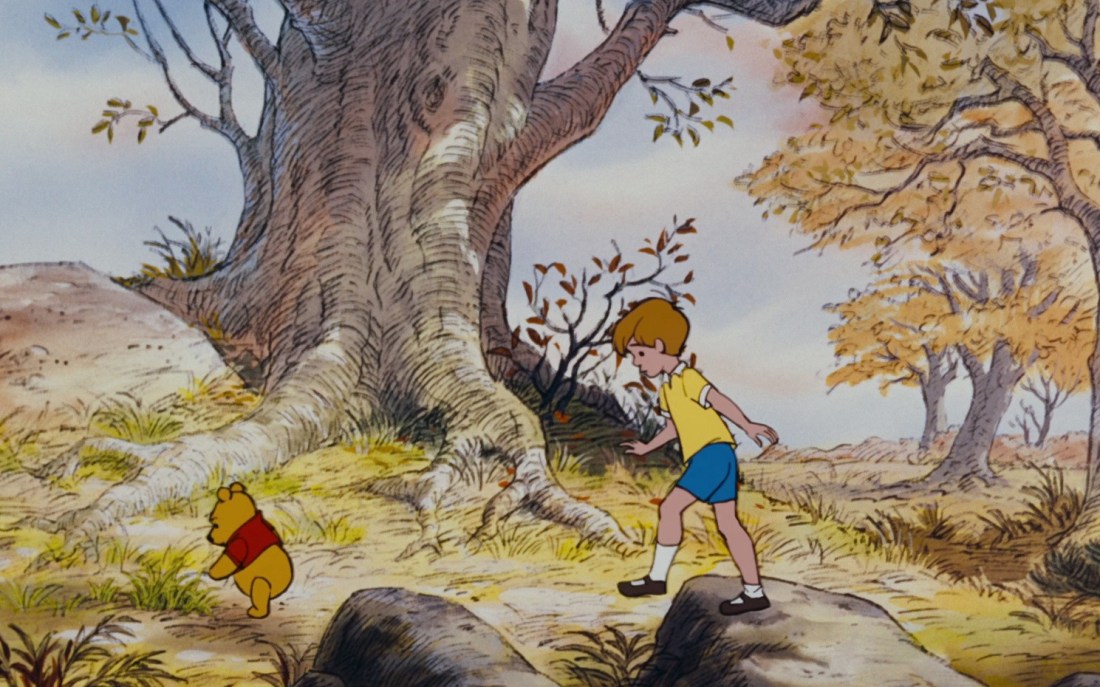
Winnie_the_Pooh_and_Christopher_Robin

When I was in Disney, I managed to capture a few pictures of Pooh throughout the park, but did not manage to meet him (if I ever go back, that is a goal).  We rode his ride and visited the shrubberies in England.  About the time I was born, Disney put out a cartoon series, The New Adventures of Winnie the Pooh, which I watched for years as a small child; it was a staple on the Disney Channel. There have been numerous other movies and shows involving Pooh Bear. I’ve seen some, like The Search for Christopher Robin.  I did watch Goodbye Christopher Robin and that depressed me. I finished that movie feeling bad for ever liking Winnie the Pooh since it created bad memories for Christopher Robin. The more recent Christopher Robin movie, starring Ewan McGregor is happier. There are sad moments, as can be expected considering Christopher Robin is grown up, but the ending is happy (and in view of Mark Gatiss as Christopher’s boss, I see Mycroft from Sherlock and I want him taken down). So, Pooh and Robin Hood are certainly at the top of my list of Disney favorites; Pooh edges Robin out a little.

Questions?  Comments?  Who was your favorite childhood character?

Up Next: The Little Mermaid

Golly, What a Day

Robin Hood

This remains one of my favorite Disney movies and started my interest in British folklore. There is no historical proof of a singular “Robin Hood” existing but tales of him date to the fifteenth century. As with other films and shows about Arthurian legend, I’ll swing back around and post about other Robin Hood films.

Another storybook opening, and simplified history (taking a course in medieval history in college taught me that Richard was not the best king and the whole Plantagenet line is kind of messed up). Our narrator Alan-a-Dale, a rooster, informs us that this is the animal kingdom’s version of the tale and it is “what really happened.” Oo-de-lally is a fun diddy and introduces us to the characters. As an adult, I appreciate Little John cautioning Robin about the chances he’s taking. And as an adult, I recognize how many times Robin comes close to dying. As a child, I related more to Robin; “ha ha! They’ll never catch me!” The bit about “rob” being a naughty word is a bone tossed due to it being a children’s movie.

Robin_Hood_Disney

Little John and Robin are given the chance to further “borrow” from the rich when a royal procession passes through Sherwood Forest to collect taxes in Nottingham. To do so, they dress up as fortune-telling women. Sir Hiss is actually a typical royal advisor; attempting to be blunt, but also kissing up. Prince John is a whiny brat with an enlarged younger-sibling complex. It’s funny as a child when he sucks his thumb and throws a tantrum. And I laughed when Little John and Robin ran away with all that gold and Prince John’s robe.

While Prince John overshadows the Sherriff of Nottingham as the primary villain, the Sherriff is no picnic either. He blatantly steals from the injured and from a child on his birthday. Robin stops by, coming in as a blind beggar, to cheer the boy up. The kids lead us to the castle, where they and we in turn meet Maid Marian, and her lady-in-waiting, Lady Kluck. This is when we discover that Marian and Robin were sweethearts years ago, before Marian went to London (we’re never told why she went to London or what brought her back). It is also revealed that she is the niece of King Richard (which would technically make her Prince John’s niece as well). A phrase that adults catch that goes over children’s head is when Skippy shouts “death to tyrants!” We learn later, in school, that this is what John Wilkes Booth shouts after he’s shot President Lincoln. Make of that what you will. Remember: this is from the kid that thinks kisses are “sissy stuff.”

Once the children have left, Marian tells Kluck that she is still in love with Robin, but worries he’s forgotten her in the time she’s been gone. Then we see Robin humming, paying no attention to the dinner he is burning, because he’s thinking about Marian. And he still loves her, but feels he can’t marry her since he is an outlaw and that is not the life that she deserves. Little John and Friar Tuck both try to cheer him up, Tuck declaring that Richard will pardon Robin when he returns from the Crusades and the king will end up with “an outlaw for an in-law.” Oh, and to really cheer Robin up, there is an archery tournament the next day where Maid Marian will kiss the winner.

The tournament, as the merry band guesses, is Prince John’s plan to capture Robin. Robin has disguised himself as a stork (though Marian recognizes his eyes). But his skill raises suspicion and Hiss realizes who he is (there is a whole funny bit with him flying about in a balloon after being kicked out by Prince John and disguised Little John, then sealed in a barrel of ale by Alan and Tuck). When Robin wins the tournament, John cuts away his disguise and orders his immediate death (okay, a little dark for a kid). Marian pleads for Robin’s life to be spared, because she loves him. Robin returns her love, but Prince John won’t be swayed, shouting “off with his head!” when Robin loudly declares “long live King Richard!” Little John to the rescue! He threatens Prince John to let Robin go, but when the Sherriff discovers the subterfuge, a battle breaks out. Which was honestly my favorite part of the movie as a kid…and still is. Marian at first seems like a typical damsel in distress, calling for Robin to help her. But she does throw a pie to distract a vulture. She eagerly accepts Robin’s marriage proposal and agrees to a honeymoon in “London, Normandy, and sunny Spain.” (The movie does get some historical notes correct: mentioning the Normans and Normandy, Marian’s costume. However, Little John’s purple ruff is inaccurate; that fashion piece wouldn’t show up until Elizabeth I). The little football gag is hilarious, including the snippets of college fight songs.

phony king of england

Love is not my favorite Disney love song. Part of it stems from the scene being really boring as a kid, after the high energy of the battle. Phony King of England, on the other hand, is hilarious. And includes further nuggets of history. No, history books do not call him the “phony King of England.” The Illustrated Encyclopedia of Royal Britain put out by Charles Phillip describes John as “an unprincipled opportunist…[who] made a series of bad decisions in pursuit of short-term advantage (46).” He was known as Lackland due to being the younger son, and losing territory in France that had been gained by his father, Henry II. His taxation policies when he fought to reclaim that land led to the barons’ revolt which brought about the Magna Carta, which “guaranteed the reform of royal abuses of power and turned out to be the first step in establishing constitutional government in England (47).” It was true that Eleanor of Aquitaine (a truly awesome queen) favored elder brother Richard over John, but their father favored him (not that it helped when both sons revolted). “Too late to be known as John the First, he’s sure to be known as John the Worst,” is rather true. There have been no other “Johns” in the royal family. [Further historical note: John at least had children to succeed him; Richard did not. Richard also was rarely in England due to either being on Crusade, captured, or simply preferring France. Can you tell where my interests lay in college? lol]


Disney note: it has been pointed out and I can verify after watching Disney movies for the past month or so, that the dance scene in Robin Hood borrows from Jungle Book and Aristocats. I see nothing wrong with the fact and just find it a bit of a “fun fact.”

Continuing on! Prince John is furious now, between Robin’s escape and the peasants’ irreverence. He’s tripled taxes and thus, most everyone is in jail due to their inability to pay. When the Sherriff pays a visit to Friar Tuck and takes the lone coin from the poor box, Tuck kicks the lackey out and they fight in the churchyard. Tuck is arrested for treason. Prince John sentences him to be hung in the morning in an effort to draw out Robin and thus make it a double hanging (again, a bit dark for a kids’ film). Robin re-uses his blind beggar disguise to gain information from the Sherriff (Trigger is a bit paranoid, but Nutsy and the Sherriff are both idiots). Robin and Little John plan a jailbreak (Marian and Kluck must have stayed back in Sherwood Forest). Little John will take care of the jail and Robin will go after Prince John’s gold.

And they’re almost successful. Hiss wakes up as Robin grabs the last bag of gold, but Robin escapes on his zip line and Little John has the rest of the prisoners loaded on a cart. But one of the baby bunnies has been left behind. Robin sends the rest on and he goes back. The guards manage to close the gate, but the bunny fits through; Robin climbs. The Sherriff chases him into the tower and his torch lights the room on fire. Robin escapes to the roof, but the flames still lick at him. This remains a bit of a nail-biter and I can remember being worried during this scene as a child and almost in tears when Robin jumps and the arrows seem to have possibly killed him, one sticking through his hat. It doesn’t help that Little John and Skippy are worried and almost in tears themselves. Happily, Robin is alive and shouts “a pox on the phony king of England!” Prince John is incensed again and pushed over the edge when Hiss points out his flaws and mentions that his mother’s castle is now on fire. The Prince chases Hiss with a stick, thumb in his mouth again, Hiss crying for help because “he’s gone stark-raving mad!”

The final scenes show that Robin Hood has been pardoned and there’s a wedding; his and Marian’s. King Richard has returned and “straightened everything out.” The monarch chuckles to Tuck that he now has “an outlaw for an in-law,” quoting the friar’s prediction. Prince John and his cronies have been arrested and are shown to be toiling in the rock field. The carriage is reminiscent of Cinderella’s (and Marian’s dress and the bouquet are not historically accurate, but it’s a children’s movie and that is what we are familiar with in regards to a wedding). And they live happily ever after!

As I stated in the beginning, Robin Hood remains one of my favorite Disney movies. It’s got lots of action, a little bit of a love story; though I’ve always enjoyed it for the tale solely about Robin. To me, the music isn’t quite as good as the soundtracks from the eighties and nineties (I’ve got nothing against the Sherman Brothers; I love Chitty Chitty Bang Bang and Mary Poppins [those will be mentioned in a future musical section]). But I’d love to hear what you guys think. Do you have a favorite folk hero? Favorite period in history?

Next Time: The Many Adventures of Winnie the Pooh

“Because a Cat’s the Only Cat Who Knows Where it’s At”

The Aristocats

A play on the word “aristocrats,” ’tis a tale of a family of aristocratic cats in early twentieth-century Paris. Their owner, typically referred to as Madame, though occasionally referred to as “Adelaide” by the elderly lawyer, is a former opera singer (her favorite role was Carmen, from Bizet’s opera of the same name [the song playing on the record player is Habarnera]). Her dearest companions are her four cats; Duchess and her kittens Toulouse (a nod toFrench artist Henri de Toulouse-Lautrec), Berlioz (a reference to French composer Hector Berlioz) and Marie (an homage to Marie Antoinette, most likely). They are cared for by indulgent butler, Edgar. Except when Edgar eavesdrops on Madame’s conversation with her lawyer, he discovers that he will inherit her vast fortune after the cats.

kitten trio

One could call Madame a crazy cat lady; leaving a family of cats a fortune seems…ridiculous on a level. They’re cats; what are they going to do with it? But I view her sympathetically with Duchess. She’s an old woman who has admitted she has no living relatives (we don’t know if she was ever married, ever had any children) and her closest companions have been this family of cats. So, if she wants to, why not leave the money to the cats?

madame adelade

Duchess carries on her day, heedless of Edgar’s plotting and scheming, educating her offspring to be proper aristocrats. Toulouse practices his painting while Berlioz accompanies Marie practicing her Scales and Arpeggios. Toulouse and Berlioz are typical brothers, who like to roughhouse a bit (the piano gets some paint on it at one point and they practice fighting alley cats) while Marie is a little diva, swooning at romantic phrases and insisting she’s a lady. “Ladies don’t start fights, but they can finish them.” Her brothers’ response to her insisting “ladies first,” is that she is “not a lady, you’re nothing but a sister!” Duchess keeps patient control of them. Their lunch, served by Edgar, includes sleeping pills so he can remove them from the house that evening quietly.

He drives his motorbike out into the country and runs into two hounds, Napoleon and Lafayette (yes, the movies does indeed take place in Paris. If Notre Dame and the Eiffel Tower aren’t enough proof). A wild and slightly improbable chase later, the basket with Duchess and her kittens is left under a bridge. A storm wakes them up and they realize what has happened. They take shelter in their basket and wait for morning.

Morning brings Thomas O’Malley Cat singing an introduction (with words that I am not sure of to this day). Duchess is the only cat visible during his exposition, so he flirts. He’s flustered by the appearance of her kittens and almost rescinds his offer of help. Duchess, while very ladylike, does not hesitate to set off with her children. O’Malley comes to his senses and scares up a ride for them (Marie spends a portion of the movie as the damsel in distress). When they’re kicked off the truck by a “horrible human,” the group attempts to take the train tracks. An actual train chases them off and Marie is in distress again. That escapade introduces them to Abigail and Amelia Gabble, very silly English geese. (Their giggling is incessant). With them they do manage to return to Paris and meet up with “Uncle Waldo,” who is “marinated.” He seems a harmless enough drunk, but as an adult, I take it with a grain of salt. (Abigail and Amelia giggle throughout)

Back at Madame’s mansion, she has discovered her beloved cats missing. Edgar brags to the horse, Frou Frou, and mouse, Roquefort (a French cheese) that he is the now famous catnapper from the paper, though he realizes he lost some items when he abandoned the cats. He must retrieve them before they’re found by the police. This leads to another run in with Lafayette and Napoleon (who still asserts he is the leader and he’ll decide).

It is too late in the evening for Duchess and her kittens to return to Madame, so they crash at O’Malley’s pad where Scat Cat and the gang are swinging. (I used to like Everybody Wants to Be a Cat more before it was part of a medley for a synchronized swimming routine. It took several years before I could listen to it again.) I think I even cringed as a child at some of the stereotypical racial characterizations; I knew that was not how Asians should be portrayed, it was demeaning. The song is still “bouncy,” as Berlioz states. There’s a harp interlude that I always forget is part of the song. It’s a nice demonstration that both sides can appreciate each style. Once the kittens are asleep, Thomas and Duchess have a conversation. Duchess wants to stay with Thomas, but she won’t leave Madame. Madame loves them very much and would miss them terribly. Berlioz sadly sums up the children’s feelings: “Well, we almost had a father.”
scat cat

O’Malley is still a gentle-cat and sees Duchess and the kittens home. To be grabbed by Edgar again and locked in a trunk to be sent to Timbuktu. Roquefort is sent to fetch O’Malley, who sends him to Scat Cat (real smart, Tom, sending a mouse to a gang of cats). They attack Edgar, with some help from Frou Frou, and he switches places with Duchess et al and he’s carted off to Timbuktu instead. Madame is happily reunited with her companions, and gladly adds another man to the house. She comments to her lawyer that the new will should include any offspring Thomas and Duchess have, both of whom seem open to the idea. Madame blithely mentions that if Edgar knew about the will, he would not have left. I guess she thought that Edgar had just run off. In addition, Madame has started a new foundation, giving a home to all the alley cats of Paris (so she can enjoy the swing music).

I tend to associate this movie with my mother, since she loves cats. The kittens are adorable and act like human siblings; Duchess is a remarkable female feline, with all of the poise and manners of breeding, but she’s also able to accept and befriend those of a lower class, without being condescending. Overall, it would rank under Jungle Book, but certainly higher than some other Disney movies (Lady and the Tramp, for instance. I didn’t mind puppies and dogs in 101 Dalmatians, but I’m not fond of Lady and the Tramp).

Let me know if you have any questions or comments!

Up Next: Robin Hood

“Man Cub”

A quick note first: this may seem to be posted early, but I’m attempting to increase the number of posts per week.  I cannot guarantee strict consistency of two posts per week; I work in retail and we are coming upon a busy time of year.  But I have so many more movies and some TV shows I’d like to get to!

Jungle Book

Based on the “Mowgli” stories of Rudyard Kipling (I think I tried to read Rikki-Tikki-Tavi when I was young; if I finished it, I didn’t like it). Based in India, it tells the story of a young “man cub” Mowgli who was lost as an infant in the jungle. He’s found by a panther, Bagheera, but taken to a family of wolves. Ten years later, a threat returns to the jungle; the tiger, Shere Kahn. The “man cub” must return to the “man village;” Shere Kahn fears and hates men and the tiger will not rest until Mowgli is dead and will kill any who protect the boy. Bagheera volunteers to lead Mowgli back to the village.

jungle book cover
The cover I remember from video tapes

Mowgli does not understand why he has to leave the only home he’s ever known. Along the way, Bagheera and Mowgli run into Kaa, the snake, who attempts to hypnotize Mowgli in order to eat him. Then they meet a herd of elephants, under the leadership of Colonel Hathi (with a catchy marching cadence). Mowgli seems to enjoy copying other animals’ mannerisms and continues to put up a fuss about leaving. At the end of his patience, Bagheera first growls at the child, “you’re going if I have to drag you every step of the way” (I’m sure this is what every parent tells a wayward child at some point) and finally exclaims that Mowgli is on his own!

Well, Mowgli next meets Baloo, a sloth bear (I didn’t realize what sort of bear he was until recently; as a child, he was always a bear. Not the same as Winnie the Pooh, but a bear nevertheless; possibly classified as a “grey bear” compared to a “black bear” or “grizzly bear.”) And Baloo is the opposite of Bagheera, who seems practical, while Baloo sings about the Bare Necessities and a carefree lifestyle. I’m still not sure what a “paw paw” or “prickly pear” are, but they were fun as a kid. [Upon re-watching, he’s almost a prequel to Timon and Pumba: carefree life, no worries, eat bugs.] Baloo takes an instant liking to “little britches” and quickly adopts the boy as his own cub. He promises Mowgli that he can stay in the jungle with “good ol’ Papa Bear.”

I Wanna Be Like You
“I Wanna Be Like You”

Until the monkeys nab him and take him to the ancient ruins to meet King Louie. The orangutan wants to Be Like You and makes a deal with the man cub; he’ll help Mowgli stay in the jungle in exchange for knowledge on how to make “man’s red flower” aka, fire. But Mowgli doesn’t know how to make fire, which we find out is one of Shere Kahn’s greatest fears (this may be why Louie wants to know how to create it). Mowgli is in fact rescued by Bagheera and Baloo and while he sleeps that evening, the two adults have a discussion; Mowgli must go back to the man village; he will be safer there, Baloo alone cannot protect him. When the bear tells the boy the news come morning, Mowgli runs…into Kaa again.

In the meantime, we are introduced to Shere Kahn. His deer hunt (yes, there are apparently deer in the jungle in India) is interrupted by the elephant brigade and he hears the news about a lost man cub. He was not aware that there was a man cub in the jungle. (Good going, heroes) So the tiger has joined the hunt for the man cub. Kaa has managed to hypnotize Mowgli again and prevent Shere Kahn from finding the boy, but Mowgli wakes and pushes the python out of the tree, again. Mowgli next comes across a group of vultures (nice ones, based off of the Beatles), but by this point, he’s depressed that none of his “friends” want to keep him around. All he wants to do is stay in the jungle and they keep making him leave. The vulture quartet explain What Friends Are For (they’ve never met an animal they didn’t like…adults get the double meaning), though they’re interrupted at the end with Shere Kahn’s appearance. Mowgli, being young and stupid, isn’t afraid of Shere Kahn and refuses to run, even when the tiger gives him a “sporting” head start. Luckily, Baloo arrives to grab the tiger’s tail and a rain storm picks up. Lightning strikes a tree, creating fire and the vultures urge Mowgli to act. The boy grabs a lit branch and ties it to Shere Kahn’s tail. The tiger runs off in fear; except he’s already struck down Baloo. Bagheera gives a touching eulogy…but Baloo’s not really dead.

Baloo declares “nothin or nobody gonna come between” him and his cub. Until they hear odd singing; a young girl is fetching water from the river. Mowgli wants a better look and (falls in love, I guess). Baloo urges him to come back to the jungle; Bagheera urges that he goes on to his own kind. Mowgli follows the girl into the village. The End.

In 2016, Disney re-made the animated tale into live action. I have seen it; though I haven’t been able to get my hands on it again. I do remember it being a more mature tale; Shere Kahn kills Mowgli’s wolf father. The film shows Mowgli as more human; using “tricks” to accomplish tasks rather than imitating other animals. I enjoy the jazzy soundtrack from the animated movie; they tried with Bare Necessities, but some of the charm was lost. The newer rendition of I Wanna Be Like You is dark and foreboding and Louie was large and definitely not Mowgli’s friend. The end is opposite from the animated; Mowgli does use fire to defeat Shere Kahn, but he stays in the jungle, rather than return to the man village.

2016 jungle book
Cover of the 2016 live-action version

There is sequel planned for the live-action movie, and a movie titled Mowgli due out in 2019 (directed by Andy Serkis [Gollum/Smegol] and starring Cate Blanchett, Christian Bale, and Benedict Cumberbatch), though I’m not sure how closely it will resemble the Disney story. There was a direct sequel to the animated film – I saw it once and all I can remember is that Mowgli ended up in the jungle again, somehow, and there have been numerous other iterations of the Jungle Book story. I, however, remember the characters in the cartoon TaleSpin (I still have some of the episodes released on tapes), where Baloo is a pilot, Shere Kahn is a villainous business-tiger, and Louie runs a club. (I think some of my fondness stems from the fact that Baloo had a plane and my father loves flying and planes). [Fun note: the air pirates from TaleSpin show up in the rebooted DuckTales cartoon, with added singing. Further proof that I have not outgrown Disney]

talespin logo
TaleSpin logo

Oh, and if any of the voices from the animated film sound familiar; they are. Phil Harris was Baloo (Bill Murray in the live-action) and he went on to voice O’Malley in Aristocats and Little John in Robin Hood (the animation style of the bears are very similar as well). Sebastian Cabot was Bagheera (Ben Kinsgley’s role in the live-action) and we’ve previously heard him as Sir Ector in Sword in the Stone and the always trusty Narrator in several movies. Sterling Holloway was Kaa (Scarlett Johanson in the live-action) and he’s the ever lovable Winnie the Pooh [I try to ignore that fact because that just makes things a little creepy]. Colonel Hathi was voiced J. Pat O’Malley, who seems to have a long run with Disney. Mowgli and Christopher Robin share Bruce Reitherman as a voice. Idris Elba as Shere Kahn and Christopher Walken as King Louie are other big name stars in the live-action adaptation.

In the spectrum of “Disney movies I like,” Jungle Book falls in the middle. I’d probably watch it if it was on television and didn’t have other plans. As a child, I thought it was fun for another child to live with animals; we like imitating them anyway. And Mowgli at least tries to make friends with other animals. I sided with Baloo and wanted Mowgli to stay with his jungle buddies. And the girl’s actions, even to me as a child, were obvious that she was trying to get Mowgli to go with her.

As always, let me know if you have any comments, or questions. What was your favorite Disney cartoon?

Next Time: Aristocats

“Wart” is a Horrible Name for a Child

The Sword in the Stone

This was the first iteration of the Arthurian legend I was exposed to; luckily it was not the version that got me interested in the legend. Overall, it has a good message for kids about education and that the best way to move up in the world and to be someone of importance is to have a solid foundation. Brains over brawn, and all that. But just like the source material, T.H. White’s The Once and Future King, I contest it’s characterization. (A tiny bit of background on me as I avoid delving into a rant…I have done some reading on Arthurian legend and my capstone project from college was on Morgan le Fae, where I read The Once and Future King, Le Morte d’Arthur, Mary Stewart’s Crystal Cave sequence, and The Mists of Avalon among other interpretations and I am aware there are several ways of looking at the legend.)

Carrying on…Disney’s movie opens on a storybook, though added this time, singing! And glosses over a decent chunk of the legend…like Uther. Arthur’s father. Though, considering he committed adultery in order to beget Arthur…not the most child-friendly backstory. Disney sums it up as “the good king died.” The country descended into chaos, but lo, magically, a sword appeared in a stone in London town (historical note: not called London at that time). Inscribed upon the sword in gold letters: “Whoso pulleth out this sword of this stone and anvil is rightwise king born of England.” Many tried and failed. The sword is eventually forgotten and England falls into the Dark Ages. (Further historical note: that is not how the Dark Ages happened).

sword in the stone
Forgot that I had done this…there is an “attraction” at Disney where you can attempt to pull the sword from the stone. “King” has been changed to “Ruler” in the inscription.

We first meet an old man with a long white beard, blue robe and hat, complaining about the lack of electricity and plumbing; our first hint that he is not all he seems since even as kids we have figured out those didn’t exist in the Middle Ages. He’s preparing for “someone important” to drop by, as he tells his talking owl, Archimedes. Fate has willed that he will guide a young boy to his place in the world. We next meet said young, scrawny boy – Arthur, called Wart, and muscular Kay. Wart messes up Kay’s shot and rushes into the woods to retrieve the arrow. Demonstrating his lack of grace again, he falls into the old man’s home (landing on the carefully placed chair). The old man introduces himself as Merlin, a wizard who can see centuries into the future (and possibly time travel; in The Once and Future King, White writes that Merlin lives backwards in time). He has futuristic plans and models laying about his home, such as a locomotive and starts expounding that children need a good education. He agrees to accompany Wart back to the castle to begin. A memorable scene of nonsense words packs up his belongings, though Merlin cautions young Wart that magic won’t answer all problems.

Wart’s foster father, Sir Ector is against Merlin’s insistence on an education for Wart at first. His method for raising the klutz is a demerit system and assigning chores (not wholly a bad notion, it does teach responsibility, the excess is the problem). Pellinore brings word of a [jousting] tournament in London that will decide who will be King of England (question: was this not tried before?) Wart correctly explains that only men of proper birth can become knights (and thus, compete in the tournament); Wart being an orphan can only hope to train as a squire, an assistant to a knight. Merlin is tricky and wrangles an agreement for education from Ector. Merlin’s method of teaching involves transforming himself and Wart into different animals. Their first go-about is as fish where we are treated to a diddy teaching us about “for every to there is a fro, for every up there is a down,” and ultimately, brains beat brawn.

Merlin’s next lesson, after magically setting the dishes to wash themselves (not quite as disastrous as Mickey’s stunt with the mops) is to turn him and the boy into squirrels, whose lives are full of trouble. We learn alongside Wart about love (and how persistent female squirrels are about pursuing a mate). I felt a little bad with Wart at how broken-hearted the young girl squirrel was when she found out Wart was human. Next, Wart is turned into a bird and is briefly tutored by Archimedes. Unfortunately, they come across another house in the woods; this time, belonging to Mad Madam Mim. (Note: Mim does not appear in other versions of the Arthurian legend, though there are several other witches, including the Lady of the Lake, Morgan le Fae, and Queen Mab). She takes delight in gruesome and grim games and wishes to destroy Wart since he is friends with Merlin. Merlin shows up to save Wart and is challenged to a wizard’s duel (different from Harry Potter), where the opponents transform themselves into different animals to order to kill each other. Merlin wins in the end by becoming a germ (to her purple dragon; the music at that point reminded me of the music from Sleeping Beauty when Maleficent was a dragon).

merlin and mim wizard duel

Wart is given the news at the castle that he will accompany Ector and newly knighted Sir Kay to London for the tournament. Merlin is disappointed and a bit outraged that Wart still prefers to be a squire rather than continuing his education. He blows himself to Bermuda and the tournament arrives. Unfortunately, Wart has forgotten Kay’s sword back at the inn, which is now locked. He spies a sword in a churchyard, stuck in an anvil and pulls it out. Pellinore realizes that the sword young Wart handed Kay is the legendary Sword in the Stone. He and other knights urge Arthur to show them where he retrieved it and pull it out again. He does so and is crowned King of England. Merlin comes back when Arthur wishes for help ruling the country. The wizard’s parting words are about Arthur’s tale living on for centuries, even being made into “motion pictures.”

I’ll finish the Disney movies and circle back to other interpretations of Arthur (I loved BBC’s Merlin, despite its deviation from traditional legend). It’s a subject I’d love to do more research on; I’ve got some books, but a very long reading list. Until then, any questions? Comments? What’s your favorite legend or myth?

Up Next: Jungle Book