
The Sound of Music
Probably my favorite musical of all time and I don’t even mind that it’s nearly three hours long. It’s a Rodgers and Hammerstein classic and the range is well suited to my voice; I’d love to perform it sometime. It too stars Julie Andrews and was released one year after Mary Poppins. It won Best Picture in 1965, and Julie was nominated for Best Actress. Julie is Maria, and the cast includes Christopher Plummer as Captain Von Trapp. It is based on the life of the Von Trapp family singers, who did escape Austria  before war broke out. They traveled in the United States, singing, before they settled in Vermont, where they founded the Trapp Family Lodge (it reminded them of the mountains of Austria). But some aspects of their lives were changed for the film; their father was not as cold as he appeared and there were more children with different names.
The film opens on the mountains and Maria twirls around, “the hills are alive/ with the Sound of Music/ with songs they have sung/ for a thousand years.” Bells ring after the song and she has to run back to the abbey. The audience is treated to a little tour of Salzburg [ironically, the movie is not all that well known in Austria]. The other nuns in the abbey ask Mother Superior, “how do you solve a problem like Maria.” “How do you catch a cloud/ and pin it down…but how do you make her stay/ and listen to all you say/ how do you keep a wave/ upon the sand?” In the end, she’s a girl, not a demon nor a lamb. But Mother Superior does speak to Maria. The young woman can’t stop singing and she may not have been prepared for the kind of life that nuns lead. So Mother Superior will have her act as a governess to seven children, to see if she can really live the nun’s life. Maria is nervous at first, but finds I Have Confidence.
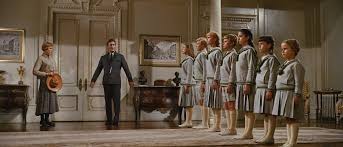 Her introduction to the Captain is not the best. He expects his home and his children to be run with discipline and calls for his children with a whistle; like one would on a ship [that never happened]. Maria refuses and admits she was trouble at the abbey [the truth]. Liesl is 16, Friedrich is 14, Louisa 13, Kurt 11, Brigitta 10, Marta 7, and Gretl 5. As many children are wont to do when someone new arrives and they’re trying to get attention, they play tricks on Maria. But she surprises them and takes them in stride, and I believe that is why some of the younger girls begin crying at dinner. Liesl sneaks out to meet the telegram boy, Rolf. She is Sixteen Going on Seventeen, while he is seventeen, so Liesl hopes Rolf will tell her how to act in a grown up world. They dance in the gazebo while it rains and at the end, Rolf pulls Liesl in for a kiss. She grins in joy later, then has to sneak in to Maria’s room.
Maria discovers from household gossip that Captain Von Trapp is considering marrying Baroness Schrader, but the Captain will not grant Maria’s request for play clothes for the children. She makes inroads with Liesl, so the young woman admits she may in fact still need a governess. Gretl runs into Maria’s room, scared of the thunder, quickly followed by the other girls. The boys join a minute later, to “make sure the girls weren’t scared.” Maria shares that she thinks of My Favorite Things when something scares or saddens her (I adore this song), “and then I don’t feel/ so bad.” The children begin laughing and they’re having a merry time, until the Captain appears. Maria covers for Liesl, but the Captain asks that Maria acquire discipline while he is gone. She gets an idea from her curtains as she finishes her song.
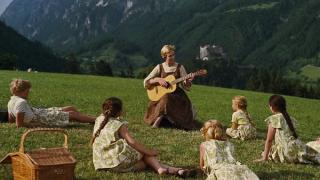 While the Captain is away, Maria makes new play clothes for the children from her old drapes, since new ones are to be made. They traipse about Salzburg and Maria takes them to her hill and teaches them to sing. “Let’s start at the very beginning/ a very good place to start/ when you read/ you begin with A B C/ when you sing / you being with Do Re Mi.” (This is a classic choir song and the solfeg is actually very helpful.) The Captain returns home with the Baroness, and Uncle Max. The Captain feels that the Baroness has brought meaning back into his life and she does not want to speak out of turn with Max. Though she admits that wedding bells may be ringing, but she’s very fond of the Captain. Max wants to keep the money between the two in the family. They are surprisingly joined by the children from the river, where they tip over the boat (the young actress playing Gretl couldn’t swim, so she was carried out of the water). The Captain sends his children in to change, but doesn’t want to discuss them with Maria. She stands up to the Captain, insisting they are children and all they want is love. A sound breaks their argument; the children singing. The Captain is surprised. Maria watches as he joins his children on The Sound of Music and the family hug afterwards. The Captain apologizes to Maria in the entryway and asks her to stay. She managed to bring music back into the house.
Life is merrier. The children show off a puppet show and The Lonely Goatherd to the other adults and Max wants to enter them into a local music festival. The Captain refuses; his children will not sing in public. They do ask their father to sing; he chooses Edelweiss (which is not actually an actual Austrian folk song or national anthem; in fact, it was the last song Hammerstein wrote). The Baroness notices the looks the Captain gives Maria and so suggests a party, so all of his friends can meet her.
Underlying the family storyline are the historical events of the end of the thirties. Hitler has begun his rise in Germany and wishes to annex Austria and join it to Germany, the Anschluss. Rolf has already mentioned it and Herr Zeller attends the party, noting the Austrian flag hanging in the Captain’s home. Captain Von Trapp was a hero of the Austrian navy in the first world war. Zeller butts heads with the Captain a little, but they keep it light since it is a party.
Maria starts to show the children an Austrian folk dance, but Kurt is too short. The Captain assists. Maria flushes. The Baroness witnesses. Then it is time for the children to say good night. The guests assemble for So Long, Farewell; Gretl is such a sweet child. Max insists to the Captain that Maria stay with adults for dinner and the Baroness offers to help Maria change. She mentions to Maria that the Captain has been noticing her; the Baroness can tell that Maria loves the Captain, and the Captain may even think he is in love with her. Maria decides to leave and the Baroness agrees.
Intermission. After the Entr’acte back through Salzburg, the children are despondent. They are not happy with the Baroness and she even remarks to Max that her solution to the children is boarding school. The children don’t even want to sing anymore. They venture to the abbey and ask to see Maria, but she’s in seclusion and not seeing anyone. Mother Superior calls her in to find out what happened with the Von Trapps. Maria was not mistreated, but she can’t face him again. Mother Superior asks her plainly, “are you in love with him?” “I don’t know!” Maria exclaims. Mother Superior counsels the young woman that she has a great capacity for love, but she must decide what she will do with it. Maria should return to the Von Trapps, face her problems, and discover the life she was born to live. Climb Ev’ry Mountain, Mother Superior counsels; “follow ev’ry rainbow/ ’till you find your dream/ a dream that will need/ all the love you can give/ ev’ry day of your life/ for as long as you live.”
Maria does return, as the children sing My Favorite Things to lift their spirits (after claiming to have eaten loads of berries and missing dinner). They’re thrilled, as is Maria, until she discovers the Captain’s engagement. She tells the Captain she will remain until a new governess is found. But the Baroness and Captain break off the engagement. The Captain admits he has not been fair to the Baroness, loving someone else. And the Baroness needs to be needed, or at least, need her money. The Captain goes to Maria that evening at the gazebo and kisses her. Something Good has come to their lives. Their wedding follows at the abbey, with the organ and choir reprising Maria.
Max has the children rehearse for the festival while Maria and the Captain are on their honeymoon. The Anschluss has occurred and Nazi flags drape the buildings [there were concerns with filming whether the people would dislike the flags so soon after the war, but it was better than using news film]. Zeller wishes to speak to the Captain, but he has not returned yet. He insists that “nothing in Austria has changed,” everything is still the same. The Captain and Maria have in fact returned home to find a Nazi flag on their house. There is a telegram delivered from Rolf via Liesl ordering the Captain to report for a position in the Third Reich. He decides the family must get out of Austria, tonight. The Germans are waiting for the family that evening when they try to sneak out (the butler was a Nazi-sympathizer). The family uses the festival as their excuse and in fact 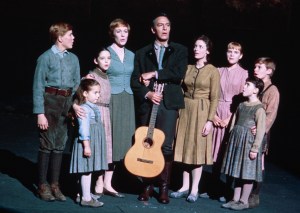 perform as a whole. It’s a rearrangement of Do Re Mi and the Captain follows by singing Edelweiss with the crowd. Max reveals the Third Reich’s plans for the Captain, causing the audience to mutter against the Nazi invasion; the family will perform a final encore, So Long, Farewell. When the winners of the festival are announced, the Von Trapp family is gone.
They take refuge at the abbey and Mother Superior hides them in the cemetery. There are always nerves as the Nazis shine their flashlight, searching for the family, even if it’s the dozen-th time I have watched the movie. Rolf hides and discovers the family as they start to get away. He pulls a gun on the Captain; it’s him the Nazis want, not the family. The Captain manages to get the gun and begs Rolf to come with them, he’s only a boy. But when he says that Rolf is not a Nazi, Rolf raises the alarm, just to prove that he is. The nuns have taken pieces of the Nazis cars to stop them from following the Von Trapps. The family hikes into the mountain and will cross into Switzerland on foot. A choir reprises the chorus of Climb Ev’ry Mountain as the family passes by [what actually happened is that they took a train into Italy, then made their way to England and ultimately the United States. If they had gone over the mountains, they would have ended up in Germany, near Hitler’s mountain retreat.]
The family storyline in the film is heartwarming; a father learning to reconnect with his children, especially through music. The music is superb; there’s a reason it is one of the best known musicals.
Further Reading:
Agathe von Trapp: Memories Before and After The Sound of Music, written by the eldest von Trapp daughter and contains the actual history of the family. It’s a nice read; even though the family initially disliked the film since it portrays their father colder than reality, they recognize the impact it has had on moviegoers.
The Sound of Music Companion by Laurence Maslon and Julie Andrews, behind the scenes of filming and bringing the original stage production to life.
Julie Andrews also has two autobiographies out at this time, Home and Home Work
This film with the half dozen previous posts, made up a big portion of my childhood. Definitely danced around the living room to the soundtrack of Joseph. As already noted, my brother and I watched these on repeat as children. I still love to sing along to these soundtracks. 1776 was the influence of a paper I wrote in college; aided by a dozen of my mother’s books on John Adams.
Ah yes, by now I have watched Hamilton thanks to Disney +. I didn’t mind the middle part, but it started to drag on at the end. It’s a very cool concept, to mix American history with modern music and dance. But…I will always love 1776.
Up Next: I’ll start the action/adventure section. Posts might be spread out a bit more to give me a chance to truly analyze story and character aspects. It’ll definitely take us through Christmas. I begin with the Zorro movies.


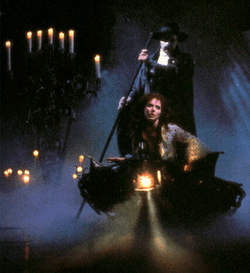 Thus begins the titular Phantom of the Opera (and most famous track of the entire show). The Phantom, Christine’s Angel of Music, draws her down below the opera house to an underground lake. He poles a boat across to his quarters, where there is a shrine to Christine. But she is still transfixed, the Phantom’s “power over you/ grows stronger yet.” The Phantom asks Christine to sing and she progresses higher and higher (eventually hitting an E two octaves above middle C). The Phantom further seduces Christine with his voice in the darkly romantic Music of the Night [my favorite piece]. As an adult, you realize how creepy the Phantom truly is, declaring that young Christine belongs to him. “Close your eyes/ and surrender/ to your darkest dreams/ purge your thoughts/ of the life/ you knew before.” He shows her a mannequin of herself, decked out in a wedding dress. She faints and the Phantom lays her on his bed; reminder, she is in her undergarments and a robe.
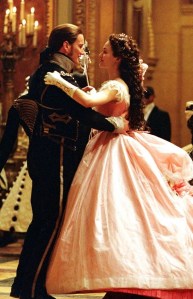 The second half of the performance begins with a Masquerade. The cast celebrates several months of relief and peace from the Phantom. In the movie they are dressed in black and white, though they are in colorful garb in the show. Christine and Raoul have secretly gotten engaged. But the Phantom appears to ruin their fun. Why So Silent, did you think I had left for good? He has written a new opera, Don Juan Triumphant, along with more notes. Carlotta must be taught to act, Piangi must lose some weight, and Christine must return to him for further instruction. He hisses to her that she belongs to him and steals her ring. Raoul follows the Phantom through a trap door, armed with a sword, but disoriented by a ring of mirrors. Madame Giry rescues Raoul and takes him to her room to reveal the truth of the Phantom. Years ago, when she was studying to be a ballerina, there was a traveling fair. One of their exhibits with the “Demon’s Child,” a young boy who usually wore a bag over his head in a cage. Until he was beaten and the bag removed, showing a disfigured face. Giry felt bad for the boy, so even after she sees him strangle his tormentor, she helps him escape and leads him underneath the opera house. And that is where he has stayed. She claims he is a genius. Raoul argues it has turned to madness.

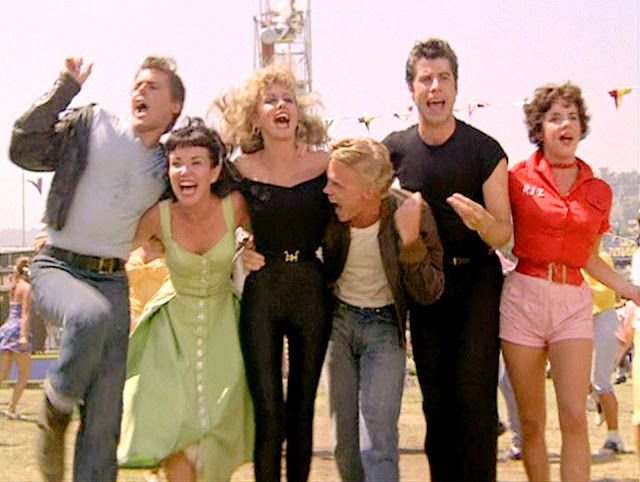
 included music, like the title track by Kenny Loggins, who also did Danger Zone from Top Gun). Big city kid moves to small town to discover they have outlawed dancing due to an accident several years ago. He hooks up with the preacher’s daughter, Ariel, who’s acting out against her father. Everything is eventually resolved and they do hold a dance at the end. The newer version came out in 2011 and starred Julianne Hough (Dancing with the Stars pro) as Ariel and Kenny Wormald (a professional dancer as well) as Ren. Dennis Quaid plays the town’s preacher. It was updated from 1984 and I like the newer dance moves, though it is a very close remake. There’s a fun country song by Big and Rich, Fake ID (I can stand country music, I will not claim it as a favorite). Ok, the demeaning way his friend talks about women sometimes makes me want to slap him.
 quite wealthy now with the royalties from her books; she buys Hill Top Farm in the Lake District, from her old friend, William Heelis. Slowly, Beatrix comes back to life. She draws again and has new stories buzzing about. She reconnects with William, and they share the notion that the landscape of the Lake District needs preserved, farms should be kept farming, not bought out by developers.
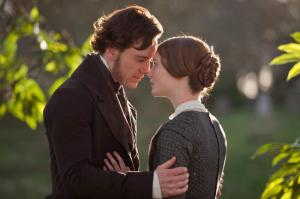 happiness?” He tucks a small flower in her hair. Later, news comes that Jane’s cousin has committed suicide and her aunt requests she return home. Jane acquiesces, only for her aunt to reveal that she lied to Jane’s other uncle when he inquired of her whereabouts, wishing to bequeath his estate. Jane returns to Thornfield Hall in good spirits, though she is greeted by the rumor of Rochester’s engagement to Miss Ingram. She informs him she will seek a job elsewhere. She and Rochester share a confusing conversation about their souls before Rochester asks her plainly to be his wife. The sun shines brightly and the couple are happy.
 invite her to accompany them to the Peak District (which seems absolutely stunning). Elizabeth attempts to persuade her father to not let Lydia go or else she will become the most determined flirt. Mr. Bennett simply wants peace and feels that Lydia is too poor and insignificant to get into too much trouble. Elizabeth and her relatives break down near Pemberly (where Mr. Darcy lives) and decide to visit. Elizabeth wanders and discovers Georgiana playing, and Mr. Darcy. She flees, but Darcy follows. He then calls at their lodgings and invites them over the following day. Georgiana is a cheerful young lady and is determined to be friends with Elizabeth; it is clear Darcy dearly loves his sister. Their lovely day ends in despair when news arrives that Lydia has run off with Mr. Wickham. Darcy feels it is his fault for not outing Wickham sooner; Elizabeth feels at fault for not sharing her knowledge with her family. The men of the family set out after Lydia. News returns home that Wickham will marry Lydia for a pittance.
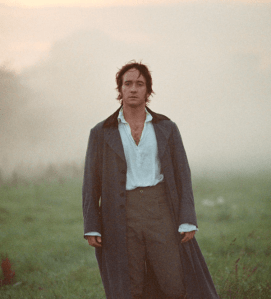 She takes another early morning walk and meets Mr. Darcy in the mist (an utterly breathtaking scene). She attempts to make amends, for judging him so harshly. Darcy tells her, she must know, it was all for her. His affections have not changed; she has bewitched him body and soul [another line I desire in my own proposal]…”I love, I love, I love you and never wished to be parted” (and this is why we love Jane Austen). Elizabeth gently kisses his hands and their foreheads meet as the sun rises. They return to the Bennett household to get permission from Mr. Bennett. He is confused; they all thought she didn’t like him. Elizabeth tells her father she was utterly wrong about him; they are so similar, and so stubborn. In short, she loves him. She also explains how Mr. Darcy has already helped their family, but he would not want Mr. Bennett to respond.
 An added treat: this is me in a Jane Austen inspired gown that I wore for Halloween one year at college; made by my talented mother (I did not inherit that talent). I still have the dress.
 Dreamer in the Mirror