
Braveheart
Just about the least historically accurate movie ever filmed. While there is not a lot of written history about William Wallace from that time period, there is in regards to other elements of the film. Mel Gibson and writer, Randall Wallace (no relation) have stated that they did not intend for the story to be accurate, just a good, cinematic story. I came to this movie several years after getting interested in Scottish history; and no, this movie had no influence on that. I actually got into Scottish history due to historical romances, many of which take place during Robert the Bruce’s campaigns against the English. So my loyalty is to the Bruce (another national hero in Scotland). There is a Wallace Monument near Stirling in Scotland, a statue on the Bermersyde estate, near Melrose in the Scottish borders (where William Wallace really was from, not the highlands), and there is a statue of him alongside Robert the Bruce at the gates to Edinburgh castle. There is a Robert the Bruce statue erected at Bannockburn, which is near Stirling, and was refurbished in time for the 700th anniversary of the significant battle.
Before I delve into the history portion of the movie, let’s cover cast real quick. Obviously, Mel Gibson stars as William Wallace (Braveheart was actually an moniker for Robert the Bruce). Hello James Cosmo as the elder Campbell. Brian Cox (Agamemnon in Troy and William Styker in the X-Men trilogy) is William’s uncle Argyle Wallace. And playing another red-head, Brendan Gleeson is Hamish (Reynald from Kingdom of Heaven).
The film begins in 1280 and the opening narration claims the king of Scotland had just died without an heir. Not true: Alexander III ruled until 1286 and had an infant granddaughter, Margaret. She ruled for four years (bringing us to 1290), never having set foot in Scotland and there was a succession crisis upon her death; there were thirteen rival claimants for the throne. The two strongest contestants were John Balliol and Robert Bruce, both descendants of King David I’s daughters (Royal Britain by Charles Phillips, pgs 69-70).
The narration continues that the king of England was Edward I, known as Longshanks, and referred to him as a pagan. Yeah, Edward was not pagan. There were no true pagans in Britain since the Vikings. Edward I even fought in the Crusades. Maybe they were hoping to pass this off as “creative license,” that the Scots would consider Edward pagan. Though, it’s hypocritical to make the comment that history is written by those who hang heroes as a way to pass off this as correct Scottish history. Because Britain as a whole was Christian. And Catholic. And England was Christianized before Scotland.
“Edward brought a ferocious martial vigor to his reign, forcefully imposing his authority on his realm, ending Welsh independence and waging a series of brutal wars in the north that later earned him the nickname ‘Hammer of the Scots’ (Royal Britain, pg. 50). He erected a ring of castles in Wales and borderlands to control the Welsh. He annexed the land and made it a principality of England. Hence why the crown prince is known as the Prince of Wales (remember the Black Prince from Knight’s Tale? This is how he had that title. Even though he died before becoming king). This is when the Welsh hero Llywelyn ap Gruffudd comes in to play. When the succession crisis arose in Scotland, the Scottish nobles asked Edward to arbitrate. Well, that just opened the door for Edward to take control through choosing John Balliol, who would swear fealty to Edward. When Balliol was captured and put in the Tower of London, the Scottish nobles revolted. And that’s when the Stone of Scone (ancient coronation stone of Scotland) was taken and put in Westminster Abbey. It was finally returned, 700 years later in 1996 (British Kings and Queens by Sandra Forty, pgs. 60-61).
So, right off the bat, we know this movie has messed with the timeline “for dramatic purposes.” You can’t just put things together, “hey, these happened in this place at some point,” and mash them together. That’s Hollywood for you. Carrying on with the story they are telling, young William Wallace witnesses the massacre at the first gathering, called by Edward. The men left for another meeting and William’s father and older brother are killed off screen. William’s uncle Argyle fetches William and remarks the evening after the funeral, that the men are playing “outlawed tunes on outlawed pipes.” Another time period inaccuracy: bagpipes and that music weren’t outlawed by the English until the 1700s, after the Battle of Culloden (think Outlander). So they’re a good 500 years off.
Another historical note: tartans as we know them today and are represented in the movie, are not referred to in written form until 1471. “References to tartan in Gaelic literature date from the early sixteenth century, and descriptions of the multicolored clot appear in Lowland Scots by the 1570s (Clans and Tartans of Scotland and Ireland by James Mackay, pg. 15). The big craze for tartan was brought by English King George IV when he visited Scotland in 1822, wearing a kilt. “Although tartan features prominently (an anachronistically) in the film, it bears no resemblance to an identifiable sett (pg. 36).”
Edward marries his son to Isabella, princess of France, though I don’t believe she is actually named on screen in the entire movie. Though prince Edward has a favorite amongst the court, Piers Gaveston (again, never named), and quite possibly closer than that. That bit is historically accurate. However, Edward II didn’t marry Princess Isabella until after his father’s death (Royal Britain, pg. 52). They’re just mucking up the whole timeline, aren’t they! Longshanks has the brilliant idea to breed the Scots out of Scotland. “The trouble with Scotland is that it’s full of Scots!” Edward declares (not sure if he actually said that), and declares ‘prima noctis,’ that any English noble has sexual rights to any common Scottish woman the first night of her wedding. That was not actually a thing, pretty sure the Catholic church would frown upon that.
This kicks off the trouble. William has returned home after being educated by Argyle. He rides through a wedding and witnesses this fictional right being enforced. All the while, a young woman is making eyes with him. It’s his old flame, Murrin (she had given William a thistle at his father’s funeral. And that is all the back story they are shown, but they’re supposed to be desperately in love with each other, after having no contact with each other for at least a decade). Then William takes her riding and immediately wants to court her. You haven’t seen each other for over ten years, how do you know you’re compatible? Her father refuses until William proves he’s only interested in peace. They still meet secretly and marry secretly. A creepy old English guard notices them being friendly with each other and tries to force himself on Murrin. William attempts to rescue her, but she’s still captured and her throat is slit by the English magistrate, who claims he has shown leniency to the Scots and they’ve lived in relative peace. William rides in, seemingly surrendering, then pulls out what looks like nun chucks and attacks the English. The other Scots join in and William soon slits the throat of the magistrate.
Men start gathering to Wallace’s cause. They next attack a Scottish castle. Edward starts worrying about the rebellion, but leaves his son to take care of it while he journeys to France (um, if the French king’s daughter is married to the English king’s son, why does England still have to go fight France? Probably because England was fighting France at that time, because Edward II hadn’t married Isabella yet). That solves nothing. The Scots just attack another castle. Robert the Bruce is discussing Wallace’s rebellion with his father. His father urges him to retain ties to England, as many other Scottish nobles do. Robert wants to side with William. The Irish join the Scots, eager to fight the English historically, at this time, the Scottish and Irish did fight each other).
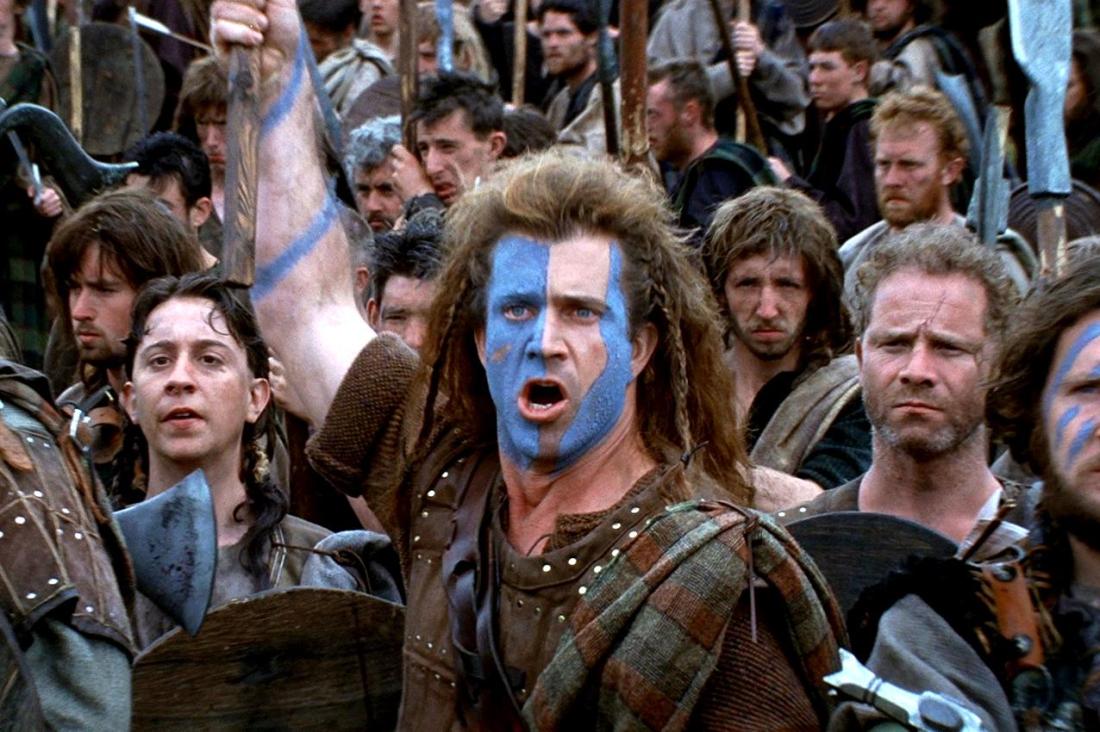
And we come to the battle of Stirling. Which is supposed to have a bridge, conveniently missing in the film, since it was too difficult to film. That’s why the English had problems; they got bottlenecked. Really, this movie isn’t too great with geography. Edinburgh looks nothing like what it should. There’s a big hill in Edinburgh, that is not shown at all. Continuing with the movie version, the common Scots don’t want to fight for the nobles and start to leave before Wallace rides in with anachronistic blue face paint. He gives a rousing speech “they make take our lives, but they’ll never take our freedom.” He rides with the nobles to pick a fight, demanding that the English “beg forgiveness for a hundred years of theft, rape, and murder.” The battle begins, with England eventually retreating. I always feel bad for the horses in battle scenes. I know they’re not actually harmed, but in history they were.
William is knighted and tries to persuade Robert the Bruce to join him. The people and the nobles respect the Bruce; if he leads, they will follow, including Will. William and his men proceed to attack York and behead the king’s nephew. Outraged, Edward decides to send Isabella to negotiate peace, sensing that William will not harm a woman. Alone in the English court and distant from her husband, Isabella falls for William Wallace and sends him warnings when she can. Wallace will not yield to England. Edward tries to trap William, but is secretly foiled by Isabella. William once again approaches the nobles to unite Scotland. Robert gives his word to William, but his father has other ideas.
Come the battle of Falkirk, the Scots face the English again. But Edward has bribed the Scottish nobles and they leave the battle. Edward has more men in reserves and crushes the Scottish army. A helmeted knight faces Wallace and unhorses him. Underneath the helmet, it’s Robert the Bruce. Wallace is shocked and Robert feels bad. He sends William to safety and yells at his father later. Once he’s healed, William kills the nobles who betrayed him. He runs to the hills and tall tales about him spread. He sees the princess again and they sleep together. There is montage of the princess in love while both elderly fathers grow ill.
The nobles betray William again; William trusts Robert who does try to save him, but is not successful. William is taken to trial in England and will not confess to treason; he never swore allegiance to Edward I. He is found guilty and will be punished. Isabella tries to talk William into confessing, but he won’t. She goes to the king to beg mercy, but he won’t yield. She remarks to a guard that the king will be dead in a month and his son is weak, so who will truly rule? To Edward, she murmurs that “a child not of your line grows in my belly; your son will not sit long on the throne, I swear.” Not true.
As already stated, Isabella and Edward II aren’t married yet at the time of Wallace’s rebellion. And their son isn’t born until 1312. Edward II wasn’t a good king either and even had another favorite, Hugh Despenser after Gaveston is beheaded by his barons (not thrown out a window by Edward I as shown in the movie). And Isabella indeed became powerful when her husband took up with Despenser. She plotted Edward II’s downfall with Roger Mortimer; in 1326 they captured Edward and in 1327 forced him to abdicate for his fourteen-year-old son, also named Edward. Later that year, he was murdered in Berkeley Castle in Gloucestershire. A few years later, Mortimer is sent to the Tower and Isabella is exiled (Royal Britain, pgs. 53-54).
The film shows William’s drawn-out torture. First, he is hung. Then released and urged to confess. Then he is racked, and released, and urged to confess. By the time he is laid out, the crowd is pleading for mercy. But William shouts “Freedom!” as his entrails are removed (mercifully not shown on camera). He is beheaded (not shown, thankfully), drawn and quartered. Longshanks dies as William shouts. The closing narration hits on Bannockburn in 1314, where the Scots won their freedom. Robert the Bruce leads them to victory. That event just celebrated its 700th anniversary and I know my British magazines all featured articles that year.
I beg your pardon on the amount of history I wove in; I have a passion for Scottish history, as I mentioned, born of historical romances. I also was teased for my interest in Scottish history in high school, which just makes me stubbornly hold on to it (bit like a Viking, lol). This is the type of writing I like to do, mixing in history. I enjoyed it in college, and being the little nerd that I am, I miss is. So I did enjoy diving into this film and examining the true history of the time period. And now I want to carry on reading some of my Scottish romance series I have been neglecting. We’ll see if I actually get to them (I’m to the point that I have started some books I’ll have to re-start because it’s been so long. This was so much easier in college!) A decent note for the movie; yes, we cheer for Scottish independence, I’ll never argue against that. And it does keep me more awake that the previous few historical movies. And the musical theme is just beautiful. I am interested in watching Netflix’s film with Chris Pine on Robert the Bruce, Outlaw King.
Next Time: We start delving into the Tudor dynasty (another time period I am familiar with), starting with Lady Jane
 Godfrey that the man is his father (meaning Balian grew up as a bastard; his life really isn’t going well, is it?) Godfrey gladly takes his son in and begins to teach him the art of being a knight. Even defends him against guards who came to arrest him. Godfrey takes an arrow, which then festers. The Hospitaler tends to Godfrey as best he can, but they make for Messina, the port to the Holy Land. Godfrey instructs his son to serve the king of Jerusalem. On his death bed, he knights his son and calls him to defend the people.
 warns him that their army cannot go far from water. Balian stays behind and looks to the defense of the city. And yes, Saladin wins the battle, since the Christian army drops from exhaustion (he points out to his generals where the Christians went wrong; yes God may decide who wins a battle, but tactics and planning also play a part. Simply saying “God will protect us,” does not prevent a sword from cutting a body in two). Saladin cuts Reynald’s throat, but won’t kill another king, so Guy lives.
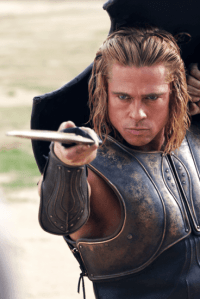 The Trojans attack at night with giant fire balls, which leads into the Trojan army advancing. Achilles joins the fight and faces Hector. Hector cuts his throat and reveals that it is Achilles’ beloved younger cousin. Hector declares enough for one day. Achilles’ second in command delivers the news. The next day, Achilles rides alone to the gates of Troy and demands Hector to face him. Hector, an honorable man, faces Achilles. And behind the scenes trivia reveals that Eric Bana and Brad Pitt did not use stunt doubles for the duel. (They also has a gentleman’s agreement to pay for every accidental hit; $50 for each light blow, $100 for each hard blow. Brad Pitt ended up paying Eric Bana $750; Bana didn’t own anything to Pitt.) It’s a good duel, but really didn’t enrapture me. Achilles defeats Hector, then ties his body to his chariot to drag back to the Greeks. That evening, king Priam comes to Achilles to beg for his son’s body, so he can have an honorable funeral. “Even enemies can show respect.” Achilles relents and allows Troy to have their twelve days of mourning, and lets Briseis return to Troy. Agamemnon is furious.
 Dreamer in the Mirror