Disney’s Second Attempt at the Robin Hood Legend, or, That Time Disney Tried to Re-Write English History

Princess of Thieves

Produced by the Wonderful World of Disney, it tells the tale of the daughter of Robin Hood and Maid Marian. Stuart Wilson (who is Don Rafael Montero, the antagonist of The Mask of Zorro) is Robin Hood and Kiera Knightley is Gwyn (ironically, she will play Guinevere in 2004’s King Arthur). This is the movie that really got me thinking of a kickass heroine who fights like a man, the starting point for my fantasy series [it will get written, someday] This is also the movie that really got me into the legend of Robin Hood.

Opening narration claims that history has forgotten the tale of Robin Hood’s child. It places the story in 1184, which is oddly before a lot of other Robin Hood tales take place. And historically, before King Richard even took the throne. (But, we don’t tend to count on Disney for historical accuracy). Cardaggian, the Sheriff of Nottingham’s man, reports to his master that Robin Hood has had a child, should they put a price on the infant’s head. Equal to the one on his father’s, the Sheriff declares. “Robin Hood will not have a son.” The Sheriff misunderstood Cardaggian, the baby is a girl. They laugh and apparently do not put a price on the infant’s head. We never see Marian, but we hear her ask Robin to protect their daughter. I am assuming this is a polite way to show that Marian died as a result of childbirth. We do see a cute transition of Gwyn growing up; she appears to have lived at an abbey with Friar Tuck. Her best friend is a young student, Froderick (and reminds me a bit of Ever After, which came out three years prior to this film); she later tells Friar Tuck she does not view Froderick as husband material, though it is evident that Froderick has developed feelings for Gwyn. Gwyn has grown to hate how often and how long her father is gone and wishes he was not so loyal to the king. She can count his visits on one hand, now she’ll need two for he and Will Scarlett are on their way home.

However, their world is about to be thrown into chaos; Richard is dying. And the king has apparently stated he wants his illegitimate son, Phillip to take the throne over John. John disguises himself as a messenger and rides to Nottingham to deliver the news to the Sheriff. Phillip is due to land in England soon and the natural assumption is that Robin, as supremely trusted by Richard, will greet the boy and secure his passage through England. John wants Phillip dead. The Sheriff charges Cardaggian with the task. They will know the young man by his signet ring.

Gwyn happily greets her father, who is surprised to see how much his daughter has grown. But he quickly passes her over and cheerfully greet his friends. Robin gets the notice to help Phillip and so must leave again. Gwyn begs her father to let her accompany him; he refuses and even makes comments that she will have other chances to meet the prince. She doesn’t want to go to meet the “absent son of an absent king;” she wants to help her father; she’s as good as a son. She’s willing to fight, and possibly die, for his cause. He orders her to stay at the abbey, where she belongs. Later, to Frodrick, she complains that father and daughter shouldn’t be fighting each other, they should be fighting side by side against Prince John. She’d rather be the master of her own destiny, than a slave to her fears. So, she cuts her hair that evening and sneaks into Frodrick’s room to borrow his clothes; she can pass herself as a boy (that only works if you do not have a lot of curves).
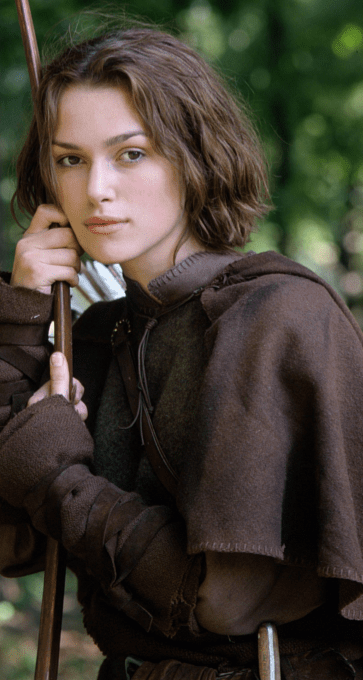
Gwyn princess of thieves

In France, Phillip is journeying to the coast to make his way to England. He’s in the company of a French countess and his valet, Conrad; the two men share a strong physical resemblance to each other. Phillip has no desire to wear the crown; as king, he would be expected to do something about war and plague and uprisings. When they stop for the evening, Conrad overhears their escort discussing Phillip’s murder. He sneaks his friend out and they make the crossing on their own. Phillip lends Conrad his jacket when the other man gets cold.

In the neighboring shire where Phillip is to arrive, Gwyn mimic’s her father’s heroics and stands up for a hungry child to a nobleman. She leads the guards on a merry chase, which ultimately acts as a perfect distraction for Will and Robin to sneak in. Frodrick followed her and they meet up in the forest, where the Sheriff’s men are searching for Phillip. They have to separate and Gwyn is soon outnumbered. Two men jump to her rescue; Will and Robin. Robin is displeased at his daughter’s disobedience. They agree to find Frodrick. The young man was captured, but Nottingham has him released and followed, figuring he’ll lead him to something. Robin meets Frodrick in the chapel that evening, which turns out to be a trap. Frodrick and Gwyn escape, but Will and Robin are captured and taken to the Tower of London for questioning. Gwyn sends Frodrick back to the abbey for help, she will follow her father.

Phillip and Conrad have landed in England and go to meet “Robin Hood.” Cardaiggan stands in, giving the secret phrase. Phillip had let Conrad lead the visit and they’re about to switch back, passing off the signet ring, when Conrad is shot in the back. Phillip escapes. Gwyn eventually comes across his horse. They scuffle for a bit, but Phillip quickly realizes that Gwyn is a woman, not a man as she appears. He’s willing to give her the horse; a lady should not have to walk, he states. Do women not have legs and feet, Gwyn argues. Very well, they will share the horse.

In London, John and the French countess examine the body of “Phillip.” The countess realizes that it is Conrad they had killed; Phillip is still alive. John is furious. He tortures Robin for Phillip’s whereabouts.

Meanwhile, Gwyn and Phillip end up in an argument over Robin Hood. Phillip believes that he killed his friend; he’s continuing the charade that he is the valet, Conrad. Gwyn states that it’s not possible and reveals that she is Robin Hood’s daughter. This carries on into a discussion on John and England. “Conrad” (aka Phillip) feels that John may be the better king, since he knows England and Phillip doesn’t want the crown. Gwyn tells her companion about the hardships the English people face under John. A prince has an obligation to his people. They hear about an archery tournament in Nottingham, where they assume Robin was taken. The winner will be able to get into the castle. In true Robin Hood style, Gwyn ultimately wins by splitting the Sheriff’s arrow. The Sheriff notes the similarity in style. At the feast that evening, Phillip recognizes Caradiggan and they have to leave before he’s spotted. They run into the friars. Phillip ends up in a discussion with Frodrick and thinks that the two are brother and sister. Frodrick claims they’re betrothed; he sees the way Gwyn looks at Phillip.

The friars have managed to capture the Sheriff, who is out looking for Phillip. Frodrick is tasked with guarding the Sheriff overnight. The older man wiggles his way out of the ropes and knocks out Frodrick. (Um, he didn’t get hit that hard, I don’t know why he didn’t just get back up and was out until morning). Gwyn is angry at Frodrick. “Conrad” keeps his promise to rescue Robin and still heads out for London. “Conrad” and Gwyn step away for a few quite moments; Gwyn sets the record straight that she is not betrothed. Conrad is pleased and kisses her. However, when they get back to the main camp, word has spread amongst the people that Phillip is still alive. Conrad reveals himself to be Phillip, the proof is his signet ring. He had hoped to get back to France quietly and live out his life. But they have shown him that he needs to take the crown and help them. Prince John’s army attacks. In the fray, Gwyn notices that the Sheriff takes aim at Phillip. She calls out a warning, but Frodrick is closer and takes the arrow for the prince (the lad lives, ’tis a shoulder wound).

Phillip and Gwyn continue to the Tower to rescue Robin while John proceeds with his coronation. They find Gwyn’s father, and he orders them on to stop the coronation. He’ll find Will. In the castle yard, the friars take on the guards and Robin battles the Sheriff. Caradggian catches Robin and suggests the Sheriff shoot him with an arrow, how poetic. But the arrow is caught by another, by Gwyn. The Sheriff is now the one outnumbered. Phillip breaks into the coronation and demands the crown, as Richard’s chosen successor. John is correct that he is king by law (and historically, Richard never had Phillip crowned king; there has never been a King Phillip of England [queens have married a Phillip, Mary I did, as has Elizabeth II]). He then shouts for everyone to kill Phillip. They won’t listen to him anymore; they have another prince to back, one who won’t tax them into poverty.

The film ends with Phillip about to be crowned. Gwyn has her hair done prettily and is wearing a fancy dress. Phillip has give Frodrick a job on his council, but Gwyn will not marry Phillip, claiming she is a commoner (a bit of a break from traditional lore, since Robin is typically viewed as a noble and Maid Marian is almost always viewed as nobility and a relation of some sort to Richard). Phillip wishes they could be Conrad and Gwyn again, if only for a minute. Gwyn vows to serve Phillip the same way Robin served Richard. Phillip accepts, and Robin and Gwyn will both serve their new king. Closing narration states that history will forget Phillip (um, yeah, cause he was never king) and he never married, instead, he pledged his heart to a common woman, of uncommon valor.

The movie is good as a Wonderful World of Disney production. The fight sequences are nothing spectacular. Costumes are closer to period accurate than some. Gwyn and Phillip were well developed; it’s a Disney production, so of course, there had to be a bit of romance. Honestly, the film would have been completely fine without that little niggle. Gwyn is aware of her shortcomings and apologizes when she does wrong. Robin learns to accept the child he has; even though he wanted a better life, his daughter grew up to be just like him; he cannot protect her forever. I like Gwyn’s spunk and as I already stated, it was an inspiration to characters I write. An enjoyable watch, but not a favorite.

Up Next: 2010’s Robin Hood

“Always On Guard, Defending the People’s Rights”

Robin Hood: Men in Tights

Another of Mel Brooks’ spoofs (like Spaceballs was of Star Wars). Stars Cary Elwes (most famous for Princess Bride, but I also knew him from Lady Jane [he plays Guilford Dudley, husband to Lady Jane Grey, the nine days’ Queen of England between young Edward VI and Mary I]; and Elwes later plays the conniving villain in Ella Enchanted) as Robin, a whole bunch of actors that I should know, but don’t. I do know that Eric Allan Kramer, Little John, goes on to play the dad in Disney Channel’s Good Luck Charlie. It took me a while to accept to watch this movie originally; I’m not that big into parodies. But now I watch it and chuckle.

The film opens with flaming arrows, recalling the flaming arrows from Prince of Thieves. Except now we see the other side; the village that gets burned. The brief intro and back story are given by Merry Men rappers, interspersed with “hey nonny nonny,” (an Elizabethan expression). Similar to Prince of Thieves, we next see a prison in the Holy Land, that they try to run like a hotel. Robin quickly escapes, this time with everyone. His compatriot, Asneeze, asks Robin to look after his son, Achoo, an exchange student in England. Robin kisses the shores of England (again, a call to Prince of cary elwes robin hoodThieves), though there’s a Hollywood-like “England” sign (and Rule Britannia playing). He obtains a horse (muttering “my kingdom for a horse,” a line from Shakespeare) and is now in familiar brown and green garb, including tights; an homage to Errol Flynn’s costume. He comes upon a young lad being beaten by guards and figures it’s Achoo. He unleashes several arrows tied together to chase the guards away.

They walk to Loxley Hall, only to find that it’s being carted away. Robin’s blind servant, Blinkin (again, taken from Prince of Thieves), informs Robin that his entire family, including pets, are dead. But they left him “the key to the greatest treasure in the land,” worn on a cord around the neck. The trio next encounter the Sheriff of Rottingham, who speaks out of order when he gets flustered. It’s rather hilarious. Robin soundly sends Rottingham on his way.

Marian sings a song of finding her true love (well, at least she’s honest about what role she plays in the story). She wears an Everlast chastity belt and is overseen by Broomhilda. Prince John does appear in this film; he and Rottingham interact like John and Gisborne did in Errol Flynn’s film. Mortiana is now Latrine, not quite as creepy; she lusts after Rottinghamn, instead of serving him.

Little John and Robin indeed fight on a bridge (though as Achoo points out, the stream is barely a trickle; they could simply walk across). The staves get shorter and shorter as they keep breaking them, until they’re hitting each other’s knuckles. Robin wins. He then meets Will Scarlett…O’Hara, who’s from Georgia; this was preceded by a joke between Blinklin and Achoo, over the misinterpretation of “Hey Blinklin,” as “Abe Lincoln.” Robin crashes the Prince’s party alone and that scene is a strong takeoff of Errol Flynn’s portrayal: bringing in a wild beast for the feast, charming John and Marian. Why should the people of England listen to Robin to revolt against John? “Because, unlike some other Robin Hoods, I can speak with an English accent.” This is calling out Kevin Costner for not having an English accent in Prince of Thieves. It’s been said that he tried, but it came out really bad. Also, I certainly hope Elwes can speak with an English accent; he is English! Rottingham really gets his words mixed up when Marian likes Robin’s flirtations. He challenges Robin to a duel, just them, and Rottingham’s guards. They all line up, knights in armor. Robin swings into one and they go down like dominos. He and his men escape and rally the villagers in Sherwood forest, Robin parodying Winston Churchill speeches from the second World War. They get their uniform: green tights, brown tops, and pointy hats.

The Sheriff asks for help to get rid of Robin. I’m sure it’s a play on the Godfather; not my favorite part; it’s different, it’s funny (I guess), but it comes across like Rottingham and Prince John can’t come up with the idea on their own. Marian overhears the plot and rides to warn Robin. His Merry Men just finished singing about their tights (it is a rather hilarious ditty). He does not really promise to not attend the archery tournament, but he steps away with Marian for some romancing. There’s an overdone song (if it wasn’t obvious, neither Marian nor Robin do their own singing. They hired professional singers). Broomhilde still interferes with them kissing and the ladies return to the castle. The next day, his loyal followers wear dresses to sneak in while Robin wears an obvious disguise, looking like Mark Twain (all these calls to the future…this is why I don’t watch parody movies).

Shock of shocks, Robin loses the archery tournament! Wait, breaking the fourth wall, pull out the scripts. He’s in luck, he gets another shot! This time, he pulls out the big arrow, the Patriot Arrow (based off the Patriot Missle), it pulls some physics-defying stunts and he wins! Rottingham captures him, but Marian offers herself as Rottingham’s wife if he spares Robin. As John states, there will either be a wedding or a hanging.

Robin is strung up, ready for the hangman. Rottingham has the alter set next to the gallows, so Marian will be less inclined to change her mind. There’ a “Hey Abbot!” joke [I have never seen that show, but I know of it] along with historically inaccurate organ and Mendelssohn’s Wedding March [again, this is why I don’t watch parodies]. Rottingham’s first name is Mervin, poor sap. Achoos shoots through Robin’s rope just as Marian has to vow to obey Rottingham. Well, Rottingham will have her, whether they’re married or not. He carries her off and Robin gives chase, rather like Prince of Thieves. “Prepare for the fight scene,” Robin declares; and it turns out rather good. Cary Elwes does have experience fencing from his time in Princess Bride. A little break for shadow puppets and the cord around his neck is cut, releasing the key that fits perfectly into Marian’s chastity belt. Robin unknowingly stabs Rottingham, but Latrine to the rescue, if Rottingham promises to marry her instead. He agrees, then changes his mind when she drags him off.

Outside, Robin prepares to marry Marian, since Broomhilde insisted. Rabbi Tuckman, a play on Friar Tuck, and portrayed by Mel Brooks himself, performs a very short ceremony, but he’s interrupted by a Scottish voice. Sir Patrick Stewart cameos as King Richard, like Sir Sean Connery did in Prince of Thieves, hence the Scottish accent. A few things he has to take care of; John has surrounded his name with a foul stench and thus, all the toilets in the land will now be called “johns.” He knights Robin. Then, it is his royal right to kiss the bride. As Rabbi Tuckman mutters, it’s good to be king. Robin and Marian are wed and happily ever after! (Though they have a bit of difficulty with the key their wedding night.)

Overall: the “Men in Tights” song is funny, I like the dig at Costner for not having an English accent, the sword fighting sequences are good. But, if I’m going to sit down and watch a Robin Hood movie; and I actually want a plot and drama and a story, it won’t be this one. The bad guys are complete idiots (and if they’re bad guys worthy of the caliber of intelligent heroes, they have to have some brains). Marian is simply the swooning damsel in distress. I understand the film is wholly comedic and I also know that I don’t tend to get humor. I’m more of a fan of snark and sarcasm and witty banter. Give me best friends bickering and I chuckle.

So, what is your opinion of parody films? Love ’em, hate ’em?

Next Time: Princess of Theives

“Why a Spoon?”

Robin Hood: Prince of Thieves

A 90s action take on the Robin Hood legend, it was a favorite in my house until the Russell Crowe version came out. It features an all-star cast, headed up by Kevin Costner (decorated for Dances with Wolves – have not seen) as Robin, Alan Rickman is his equal as the Sheriff of Nottingham, Morgan Freeman as Azeem, Christian Slater is Will Scarlett, Brian Blessed as Lord Locksley, Michael Wincott (he’ll later show up as Rochefort in Three Musketeers) as Guy of Gisborne, and Michael McShane (I recognize him as funny Professor Keenbean from the Richie Rich movies) as Friar Tuck. The theme from the film is now used by Disney promotions on their DVDs (no, this is not a Disney film).

The background to the opening credits is the Bayeux tapestry, an embroidered cloth that depicts the Norman conquest. This rendition is set in 1194 and starts in a prison in Jerusalem. English war prisoners are tortured and the guard turns to another man, claiming he stole something, of which the punishment is to lose a hand. Another prisoner speaks up to spare the man, but they’re both unchained. He does not flinch from the sword, displaying “English courage.” At the last minute, he pulls back, causing the guard to lose his hand. He fights his way out, aided by a Moorish prisoner. The three make it out, but the leader’s friend is killed topside. With his dying breath Peter requests his ring be taken back to his sister and the man is to promise to protect her. The two men left introduce themselves as Azeem, the Moor, and Robin of Locksley. Since Robin saved his life, Azeem will follow him until the debt is repaid.

Back in England, Lord Locksley is writing a letter to find out what has befallen his son in the Holy Land. He’s interrupted by his servant Duncan and another man who says that his family is in danger. The Lord rides out, to find a crew of men in white cloaks (who look disturbingly like the KKK) waiting for him. They’re headed by the Sheriff who gives Locksley the choice, join us, or die. Locksley declares “never” and rides to meet them.

Four months later, Robin and Azeem land on English shores at the White Cliffs of Dover. Robin is so pleased to be home, he kisses to ground. He keeps trying to send Azeem home, but the Moor is determined to fulfill his oath. Azeem is an educated and wise man; he stays a few steps behind Robin, stating it is safer to appear his slave in this land than his equal. He maintains his prayers, even when Robin is fighting the Sheriff’s men, led by Guy of Gisborne. Robin does defeat the men and sends Gisborne back to the Sheriff with the message to stay off his land. Unfortunately, Robin arrives home to find the castle burned and his father decaying in a hanging cell. Old Duncan, now blinded, reports that Locksley was accused of devil worship and supposedly confessed to the crime. Robin now will not rest until he has avenged his father, swearing it in blood.

Gisborne reports to his cousin, the Sheriff at Nottingham castle. An eye is watching through the wall and we shortly meet its owner, Mortiana, a creepy, creepy witch. I do not watch how she scries for the future, nope. But she foresees that the Lionheart (Richard) is proceeded home by the son of a dead man (Robin). The Sherriff asks if that will affect their plans. She’s seen their deaths, at the hand of a painted man, who they determine is the Moor traveling with Robin [um, did Gisborne even see the guy? How do they know this?].

Robin next visits Peter’s home to deliver the news to his sister. He’s brought in to see “Maid Marion,” who has changed since they were kids. A masked guard attacks and when Robin holds their hand over a fire to relieve them of their sword, a feminine scream emits. This is the real Marion, who is a cousin to King Richard. She remains at her ancestral land to take care of the people and only sees Robin as the spoiled son of a lord who used to bully her and burn her hair. She insists that she does not need Robin’s protection. Their conversation is interrupted when Gisborne and his men approach. Marion urges Robin to leave and forces him to by claiming he stole her horse. Robin, Azeem, and Duncan escape into Sherwood forest, which is supposed to be haunted. ‘Tis not haunted, ’tis overrun by bandits. Robin must fight Little John to cross the river; he ends up dunked a few times, but they laugh and become comrades.

After we witness the Sheriff’s true devotion to the Old Ways; he was raised by the witch rickman sheriffat his parents’ dying wish, he attempts to charm Marion (she knows not to trust him). Meanwhile, Robin visits the church to gather information. The bishop stands by the story that his father was a devil worshipper. Robin does not believe it (nor does Marion or anyone who truly knew the man). On his way out, Robin runs into the Sheriff and cuts his cheek. The Sheriff’s yells “I’ll cut your heart out with a spoon!” Later, Gisborne inquires “why a spoon?” “Because it’s dull and will hurt more, you twit!” (Such a memorable line!)
Robin now plans to lead the outlaws of Sherwood forest. Will Scarlett doesn’t trust him and some of his fears are founded when the Sheriff begins terrorizing the people, looking for Robin. The Sheriff is puzzled why the people love Robin when their love causes the Sheriff to hurt them and tax them. Robin steals from the Sheriff and redistributes to the poor. The Sheriff is so put out, among canceling kitchen scraps and merciful beheadings, he “calls off Christmas.” Robin and the outlaws of Sherwood continue to attack wagon trains of the Sheriff, including one containing Friar Tuck. He is, at first, wary of the outlaws and tries to make a run for it, but soon settles in and preaches beer. Guy of Gisborne has no luck catching Robin and eventually cries to his cousin. His cousin soothes him, then stabs him, remarking, “at least it wasn’t a spoon.”

Marion and her servant Sarah are out riding one day through the forest when two of Robin’s dimmer men attempt to attack them. The two women fend for themselves, but Marion insists on seeing Robin. She catches him bathing, but once he dresses he shows her around the village. He has collected blood money that the Sheriff intended to use to buy the barons and unite them against Richard. His father taught him that nobility is not a birthright, it’s action. Robin is trying to live up to his father’s example after parting with him before the Crusade in anger. Robin also shares the tale of his father seeking comfort with a peasant woman after Robin’s mother’s death. Robin was an angry and hurt twelve-year-old boy and his father gave up the woman to please Robin. As Robin sends Sarah and Marion on their way, he asks Marion to first, look after Duncan. And second, get word to Richard about the events in England. She agrees, for Robin’s sake.

The Sheriff continues his plans, Mortiana advising him to use the Celts to take care of Robin. The barons are not willing to blindly follow the Sheriff, since he can’t produce the promised payment. To secure his throne, he must wed royal blood. He intends to marry Marion. Mortiana had suggested the same idea, after revealing that she is actually the Sheriff’s mother (the Sheriff had discovered her spying on him and demanded answers). She had killed the babe of the real Sheriff (and probably killed the parents later as well). If her son lies with the royal line and a child is produced, her blood will eventually end up on the throne.

Marion drafts the note to Richard and insists that Sarah accompany the messenger. The messenger later knocks Sarah out and the note ends up in the Sheriff’s hand and also revealing that the bishop works for the Sheriff. The Sheriff has Marion abducted from her home and holds her captive at his castle. Duncan runs to get Robin, not knowing he’s been followed. The blind man inadvertently leads the Celts and the army to the camp, where the army lights the camp on fire. Several men, and a boy, are captured and Robin is presumed dead after he falls from a burning rope.

The Sheriff offers Marion to spare the captive children’s lives, as a wedding gift. He shows her Robin’s cross as proof that the man is dead. He then tortures the rest of his prisoners to find out if the hero really is dead. Will Scarlett has no love lost for Robin and offers to be a double agent; he can get close to Robin and if Robin doesn’t trust him, then the Sheriff needn’t worry. The Sheriff still has him lashed, to make it believable.

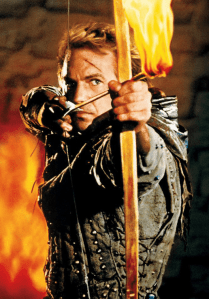
Robin is not dead. And he correctly suspects Will when he returns to camp. When asked why he hates Robin so much, Will reveals that he is the son of the peasant woman Robin’s father had spent time with. He is Robin’s half-brother. Robin is so pleased to have kin, he embraces his brother and swears that he will finish the fight he started. He comes up with a plan. Azeem knows how to make black powder (historically inaccurate for that time period; yeah, BBC’s Robin Hood also got that wrong), so he and the Friar set barrels of it around the scaffolding. Other men sneak in weapons and get into position. Will is flaming arrowrecognized and captured at the public hanging and gets tied to one barrel. The Sheriff orders the executions to begin, starting with Little John’s son. The first plan is now out the window, but Robin has to act. He shoots the rope strangling the boy, revealing himself to the guards. But Azeem is ready to light the powder kegs. Many awesome explosions and arrows flying, the theme plays in the background. Little John crashes into the scaffolding. Robin shoots a flaming arrow (the scene that’s in every promo) to save Will. Marion screams for Robin and he’s off to rescue his lady. Azeem rallies the English to fight back against the Sheriff’s troops, then joins Robin inside the castle.
Mortiana insists that the Sheriff wed and bed Marion immediately; the time is ripe. The bishop hurriedly performs the ceremony, while Azeem and Robin pound on the door. – There’s so many things wrong with that scene, mainly ‘let’s show a woman married against her will and what follows.’ [I know somewhere there is a medieval law that forbade women being married unwillingly.] Mortiana goes to stop the men and encounters Azeem. She stabs him, but he impales her in return. Robin takes an alternate route, swinging in through the window. The bishop rushes out, only to run into Friar Tuck who assists in packing his gold, then pushing him out a window. Robin and the Sheriff face off, the Sheriff gleefully using Robin’s father’s sword against him. Marion helps distract the Sheriff a little, but mainly stays out of the way. John eventually has Robin pinned; when he rears back for the fatal blow, Robin pulls out a dagger and stabs the Sheriff. It’s a slow death, the Sheriff even pulling out the dagger. When we think it’s all through, Mortiana pops back up (where did she come from, wasn’t she dead?). But Azeem to the rescue again, finally breaking in the door and throwing his sword. He has fulfilled his vow to save Robin’s life.

Robin and Marion kiss and we next see their wedding. When Friar Tuck gets to the “speak now” part, a man commands them to hold. Everyone turns; it’s Richard! (Cameo by Sir Sean Connery!) His only objection is that he gives away the bride. He thanks Robin, Lord Locksley, for without him, Richard wouldn’t have a throne. Very well, Friar Tuck announces them man and wife. The couple may kiss.

My take: the action is good, I mean, explosions make everything more exciting (when used in moderation). The Sheriff’s and Robin’s duel is not my favorite sword fight, but still decent. Alan Rickman plays an excellent villain; he’s just smarmy (a bit like Snape, though the Sheriff ranges between quiet and deadly and loud and demanding). Mortiana is creepy and can we get a decent portrayal of a complex witch? Are they all supposed to be creepy and pure evil, or simply funny? [I do have a fantasy series in very early development stages that will involve women using magic, so it’s topic that I take interest in]. Azeem is a well developed character, a bit ahead of the English characters in his thinking. Marion and Robin are a bit flat, and I wish they had delved more into the connection between Will and Robin.

There are funny bits, some superb one liners (mainly Alan Rickman’s). There are creepy bits. I don’t believe the Celts were well represented, but that was a standby enemy for storytellers to use for that time period; oh, the murderous Celts, wild animals they are. The Romans built Hadrian’s Wall for a reason. Sean Connery playing King Richard was cool. Though it was odd that Prince John was never mentioned; I guess they wanted to make the story more insular, keep it as trouble within Nottingham. Watching it now, as an adult, having come to age with growing special effects, I say “it’s okay.”

Next Time: Some humor with Men in Tights

Merry Olde England

The Adventures of Robin Hood

Nigel Cawthorne introduces his book Robin Hood: The True History Behind the Legend stating “some historians say that Robin Hood has no place in history, that he is a figure of myth made up by medieval balladeers. However, there are indications that such a person did exist and several real people may have contributed to the legend.”  [Still an academic at heart; I want books from his bibliography.]  I vaguely remember one of my Scottish romance series referring to Robert the Bruce as Robin Hood. The story of Robin Hood has evolved over time as has the character, starting as a simple thief and eventually becoming the “steal from the rich and give to the poor” persona we know and love today. It is set in a historical time period and brings light to the conflict between Saxon peasants and Norman nobles (who invaded the land…the whole William the Conqueror, 1066 business.) Sir Walter Scott draws attention to that conflict in his Ivanhoe [you know you’ve taken Historical Development of the English Language when you understand the bit about dialect in the beginning]. Robin Hood appears in Ivanhoe, briefly.

Alright, enough history, on with the movie!

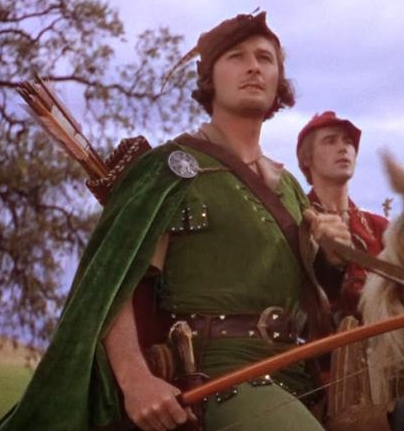
It stars Errol Flynn, a swashbuckling star of the thirties, Olivia de Havilland (who starred alongside Errol in several of his films, and was in Gone With the Wind) as Maid Marian, and Basil Rathbone (famous as Sherlock Holmes) as Sir Guy of Gisborne. It was directed by Michael Curtiz, who would later direct Casablanca and White Christmas. The opening writing states that the film is “based upon ancient Robin Hood legends” and places the story in 1191.

It opens with word that King Richard, on his way home from the Crusades, has been taken prisoner by Duke Leopold of Austria (that did happen). Prince John seizes control of the throne and taxes the peasant Saxons to collect “ransom” money. He and his henchman, Sir Guy toast to the hope that Richard never returns to England. Meanwhile, in the forest, a peasant, Much, shoots a deer (a real criminal act in that time; sections of land and forests were set aside for the royals to hunt. If anyone shot a deer, they’d be punished severely). Robin of Locksley and his trusty companion Will Scarlett, both in ridiculously bright capes, ride up and save Much from Sir Guy. Indebted, Much willingly follows Robin.

adventures_of_robin_hood_errol_flynn

Robin crashes the Sheriff of Nottingham’s feast for Prince John, stands up as a Saxon lord and argues that the Normans are mistreating their subjects. Lady Marion is in attendance as a royal ward and John attempts to arrange her marriage to Sir Guy. Robin charms John even when calling him a traitor, though the prince has the doors shut and silently orders his guards to attack Robin. Robin fights his way out and escapes, then calls together all the Saxon men who would follow him. Together, they’ll fight for loyalty to King Richard and take back their England. John declares Robin an outlaw. Sir Guy is free to capture and kill the pest.

In the meantime, Robin gathers more men to his cause, fighting Little John on a branch bridge with a staff. He loses, but they all have a good laugh about it. Later, they add Friar Tuck who is a great swordsman. With his band of merry men, garbed all in green and brown, Robin lays a trap for Sir Guy, the Sheriff, and the tax money. They spring it and take the loot to their hideout. Sir Guy and the Sheriff are divested of their fine garments and forced to wear rags. Robin treats Marion as a lady, though she has distain for him at first. Then he shows her the poor families that have been displaced by Sir Guy’s tax collectors. In good faith, Sir Guy and the Sheriff are led out; they must report their failure to John. Marion is also safely returned.

The trio of men: Prince John, the Sheriff, and Sir Guy, led by the Sheriff’s idea, plan an archery tournament as a way to draw out and capture Robin. Maid Marion will be the bait. Robin indeed shows, in disguise, and wins the tournament by his traditional split-the-arrow trick (which was actually performed by a professional archer). He tries to escape at the end but is overpowered. Sir Guy holds a tribunal, really more of a mockery of one. There were no witnesses to speak on Robin’s behalf, so he’s found guilty of all crimes and sentenced to hang. Marion, who has fallen in love with Robin, sends a message through her maid to the merry men. At the public hanging the next morning, they rescue him. That evening, Robin returns to the castle to climb up to Marion’s window. They exchange pleasantries and Marion admits she loves Robin; a few kisses, and Robin steals back out the window. He asked Marion to return to Sherwood with him, but she states that she will do more good watching for treachery amongst John and Sir Guy.

At a local tavern, a group of men are passing through. They briefly speak to a bishop in Prince John’s employ; the bishop overhears one of the men say “sire.” He leaves so he can report to John, which the men suspect. John, upon hearing the news that Richard is back in England, orders his brother to be killed, so he can be the new king. A disgraced knight offers to do the job. Marion is in the background and plans to get news to Robin. But Sir Guy guesses Marion’s loyalty and arrests her. John sentences her to death and Marion’s maid rushes off to get word to Robin.

The next morning, the group of men are riding and surrounded by the merry men. The leader reveals that he is a friend of Richard, so Robin lets him go, inviting him back to their hideout. On the way, the leader, disguised as an abbot, questions Robin on his actions. Robin reveals that he blames Richard for the trouble; his duty was to be home defending his people (historically, Richard barely spent any time in England. He was often on Crusade, or at his lands in France). At the hideout, Will Scarlett brings in Much, who he found injured in the woods. Much relays Marion’s danger and that a knight had orders to kill Richard. He handled the knight, but Richard must be found. The abbot casts off his cloak, revealing himself to be Richard. His other men wear the Templar cross. Robin has an idea.

They join the bishop’s retinue to get into the castle. Once there, the bishop starts the ceremony to crown John by asking him of his loyalty. Richard once more steps forward and a fight breaks out. Robin and Sir Guy duel (Basil was an expert swordsman). Sir Guy is ultimately bested and Robin rescues Marion. Prince John is deposed, Richard decrees that all Normans and Saxons will share the rights of Englishmen. He pardons the men of Sherwood and knights Robin. His first command is for Robin to marry Marion. The couple sneaks off to start their life and happily ever after.

After Disney’s animated adaptation, this would have been the next version of Robin Hood I learned. I also remember being really into swashbuckling films when I was in junior high (and being weird for knowing an actor from the thirties). This adaptation captures the carefree image of Robin; Errol laughs a lot. I feel it stems from a romantic view of history. I can handle the historical inaccuracies in this film a lot better than I handle them in BBC’s Robin Hood series from 2006. I chuckled when Will Scarlett and

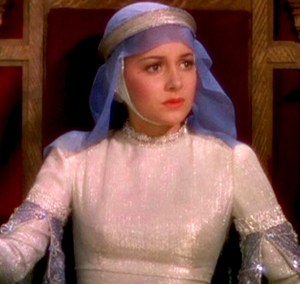
1938 maid marion
I will admit, it’s pretty. But try keeping white clean! They used jewels to sparkle, not glitter.

Robin Hood first appear on screen with colorful capes. Maid Marion has a different gown on every scene she’s in (ladies had grand wardrobes, but not that much). Some of the styles are based on period gowns, but not the fabric. And oh goodness, the clashing of colors in the nobles. But, in the 30s and 40s, studios were not worried about being “historically accurate.” It’s like the Romanticism of the Victorian era; “oh, times were simpler then and people were happier.” No, medieval times were filthy and dangerous. (And in regards to BBC’s attempt: they almost did worse with the costumes…I’ll simply mention the hot pink sweater).

The sword fights were excellent, though the style was not exactly what was used in the medieval time; it was adapted more towards a fencing style. But that’s what Errol and Basil were good at. The arrows and the armor: while arrows can fit through the links in chain armor, not like that they don’t. And most men don’t fall over instantly dead from one shot. Again, it’s romanticized. Overall, it’s a fun watch, but not my favorite rendition.

Next Time: Robin Hood: Prince of Thieves