
Episode III: Revenge of the Sith
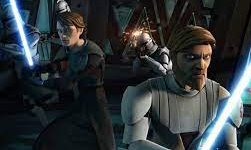
Let me include a few thoughts about Clone Wars first. While I have not watched the whole series (and not entirely sure if I want to due to some plot points I’m aware of), it does come up in fanfiction a lot. I watched most of the traditional animated series when it came out, and it was weird. So no, I did not want to watch the animated film that came out later and I objected to the idea that Anakin had a Padawan. And, by the way, the film is still weird. The series, once I gave it a chance, it better. I learned to like Ashoka and was pleased with elements they included in parts of Rebels that I happened to catch. I agree with some plot points that occur in the series (SPOILERS); I thought it was interesting to give Obi-Wan a possible love interest (and if you’ve read some of the Legends books, you know this isn’t the first time). I adore his sassiness; because my favorite characters tend to be snarky, so much fun! Anakin isn’t as whiny, huzzah. We see clones in action and bond with certain ones (which comes to bite us in the butt later). I was not fond of them bringing Maul back because, really! Obi-Wan sliced the guy in half and he fell down a shaft [I could make a comment regarding the sequel movies here…apparently that does not mean death in the Star Wars universe…I also disagree with that; more of that rant later]. Can we be nice to Obi-Wan, please? There are some plot lines that I understand needed to occur, but wish they hadn’t because we’d rather see our characters ultimately happy (after we whump them a bit)
I am interested in reading the Wild Space novel, which has been referenced in several stories (which will be listed at the end of the blog), but for now, on with the main event!
All the familiar faces are back: Ewan McGregor as Obi-Wan, Natalie Portman as Padmé, Hayden Christensen as Anakin, Christopher Lee as Count Dooku, Samuel Jackson as Mace Windu. Anthony Daniels as C-3PO and Kenny Baker as R2-D2 are the only two actors to appear in all of the original and prequel movies; in fact, the characters appear in all nine films, plus Rogues One, as well as two of the cartoon series, Clone Wars and Rebels. A fun note about the title of this episode; originally, Episode VI was supposed to be Revenge of the Jedi, but George Lucas decided that revenge was not the Jedi way, but completely acceptable for the Sith.
After the title crawl, the film opens with a huge space battle; you really get a feel for the scope; there are layers and levels and feels a bit like a roller coaster…so be careful if you have a bit of a squeamish stomach. Also, we now realize fully where the stylistic designs for the Empire originated; those certainly look like Star Destroyers and it doesn’t take much to see the similarity between clone troopers suits and stormtroopers. Our heroes are in the thick of it and Obi-Wan’s starship gets attacked by buzz droids, so he’s not happy. Anakin tries to help and R2 is cool; they ultimately end up crashing into General Grievous’ ship [I’m not a fan of Grievous; he was totally unnecessary, you’ve got Dooku]…Obi-Wan does a totally awesome flip out of his fighter and slashes through droids. Now, time to spring the trap and rescue Chancellor Palpatine.
Anakin and Obi-Wan confront Dooku together this time; Sith Lords are their specialty, but Dooku is quick to take Obi-Wan out of the picture, throwing him into a walkway. Anakin gets a bit cocky and Dooku can sense fear, hate, and anger in Skywalker, but he doesn’t use them. Anakin manages to disarm (literally) Dooku and crosses a red and blue blade at the Sith Lord’s neck. Palpatine orders Anakin to kill Dooku (Dooku was not aware that that was part of the plan); his Sidious voice comes out when he growls “do it” [and that throne looks awfully familiar…fast forward to Return of the Jedi]. Anakin decapitates the Sith Lord and frees Palpatine. [Ok, seriously, you’ve got Christopher Lee and you use him for about ten minutes, to make room for some mostly-droid being that should have been hacked to pieces the first time he crossed someone’s path] The Chancellor then tries to get Anakin to leave Obi-Wan (all part of his plan), but Anakin will not leave him. All three manage to get captured by Grievous, for about a minute, then Anakin and Obi-Wan escape their bonds. Grievous is a coward and abandons ship. Anakin manages to land the wreckage of the ship, or as Obi-Wan puts it, half a ship, and calls it “another happy landing.”
Obi-Wan leaves the politics to Anakin, who sneaks away as soon as possible to visit his wife. Padmé quietly reveals that she is pregnant. Anakin is happy (though note the brief hesitation). Their happiness is soon marred by nightmares Anakin has of Padmé dying in childbirth. He will not let what happened to his mother happen to the other woman he loves. Now he’s on a search to find a way to save her. He even seeks help from Master Yoda, with no details revealed. Yoda once again counsels Anakin that fear of loss will lead to the Dark Side; attachments lead to jealousy and greed. Anakin does not seek help from Obi-Wan.
Instead, the Council is concerned by the powers that Chancellor Palpatine is amassing. Palpatine puts the next step of his plan into action and appoints Anakin as his personal representative on the Jedi Council, planting doubt in Anakin’s head [along with the dream about Padmé, no doubt]. The Council reluctantly accepts the appointment, but will not grant Anakin the rank of Master. After the meeting, where Yoda states he will help the Wookies on Kashyyk, Obi-Wan and Anakin talk. Anakin may not have asked for the position, but it is something he has wanted and Obi-Wan tries to get his former Padawan to see that Palpatine is interfering with the Jedi. The Council, against Obi-Wan’s protests, are asking Anakin to spy on Palpatine (which is what Palpatine is asking of Anakin, but he’s too blinded by loyalty bought at a young age to see that…Palpatine tells Anakin what he wants to hear, so the young man keeps coming back).
Anakin visits Palpatine that evening. The Chancellor feeds the young Jedi the information on where Grievous is hiding. Then their conversation drifts to the Sith; Palpatine claims they are similar to the Jedi in their quest for greater power. “All who gain power are afraid to lose it.” He also knows a Sith legend on Darth Plageus, who could manipulate the midi-chlorians in a life form and create life [hmm, maybe that’s how Anakin came to fruition], and also, how to keep from dying. That perks Anakin’s ears, his thoughts are on Padmé. Palpatine claims that the Dark Side is a pathway to many abilities that would be considered unnatural (and Anakin is so consumed with thoughts of his wife he doesn’t question how the Supreme Chancellor knows Sith legends, or why, or why he’s telling him these things).
The Council decides to send Obi-Wan, who has more experience, to Utapau to capture Grievous. Former Master and Apprentice bid each other good-bye; Anakin apologizes and thanks Obi-Wan for his training and Obi-Wan declares his pride in Anakin; he’s a far greater Jedi than Obi-Wan could ever hope to be [we’ll get to some Obi-Wan appreciation in a bit]. “Good-bye, old friend,” Obi-Wan says in parting.
Obi-Wan engages in a duel with Grievous on Utapau, leaping down and quipping “hello there.” Grievous, proving to be a lazy coward, first instructs his guards to kill the Jedi (and weird opening lightsaber stance), Obi-Wan quickly rids himself of the pests. Then quickly removes two of Grievous’s extra limbs to even the fight. Obi-Wan’s division of clone troopers [the 212th] arrive to take on the droids, and Grievous runs off. Obi-Wan pursues him and loses his lightsaber. When the pair fall onto a platform, Obi-Wan first uses an electro-stave, then decides that hand-to-hand combat is a brilliant way to take on a heavily machined opponent (Obi-Wan, dear, don’t kick the droid) and he gets thrown around a bit. He manages to grab a hold of a blaster while he’s dangling and a few well-aimed shots ignite what is left of Grievous’s organs. “So uncivilized,” he quips when he regains his feet (call forward to A New Hope when he refers to a lightsaber as a weapon of a more civilized age).
Meanwhile, Mace Windu senses a plot to destroy the Jedi, the Dark Side surrounds Chancellor Palpatine and there is a fear that he will not set down the extra power he has been granted. Now the Jedi Council is treading a dangerous line, planning to take control of the Senate. At the same time, Palpatine is speaking to Anakin, making him believe that everyone else is out to get Palpatine and then he blatantly tells Anakin “only through me can you achieve a power greater than any Jedi,” only the Dark Side holds the power to save his wife. The young Jedi finally realizes that Palpatine is the Sith Lord they have been looking for all these years. He wisely goes to the Council. Windu orders Anakin to remain at the Temple while they arrest Palpatine; Anakin argues that the Masters will need him. Well, one point for Anakin for finally making a good decision and Windu has a point that Anakin would be comprised, facing Palpatine, but Anakin does not handle sitting still well.
Palpatine continues to weave his influence over Anakin and Anakin leaves the Temple for the Senate building, walking in on the arrest. Palpatine has finally drawn his own lightsaber and killed the three Masters who accompanied Windu. Windu has Palpatine cornered, Force lighting reflecting off his blade back onto the Sith Lord. Anakin pleads that he needs Palpatine in order to save Padmé. Palpatine pretends to be feeble and Anakin still argues to do the right thing, then takes off Windu’s hand when the Master goes to strike down Palpatine. Palpatine strikes back, shouting “unlimited power!” and tosses Windu out the window. Anakin realizes he’s made another mistake and promptly agrees to be Palpatine’s apprentice and turn to the Dark Side [because that’s very logical; let’s negate the good decision made with the worst possible alternative]. Palpatine is now fully Sidious, scarred face and deep voice. We hear the Imperial March when Sidious names his new apprentice Darth Vader.
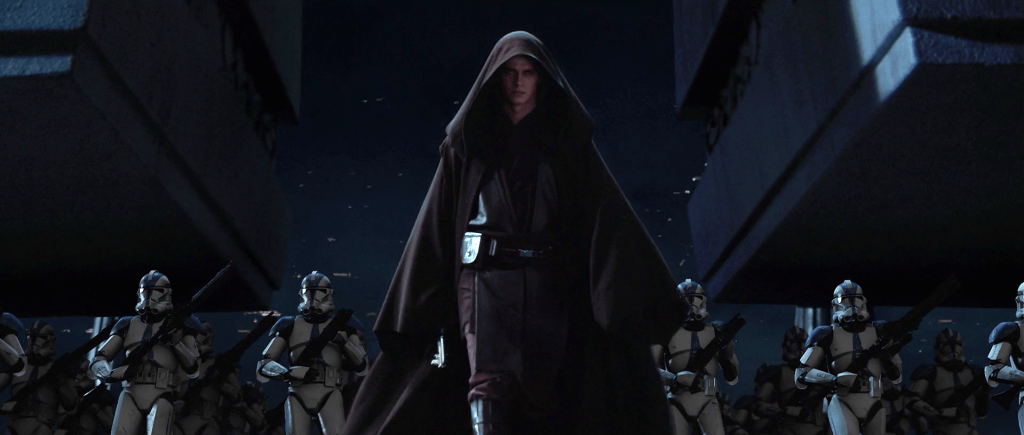
Sidious proclaims the Jedi an enemy of the Republic and sends Anakin to the Temple to kill all the Jedi there. Afterwards, he is to go to the Mustafar system and destroy the Separatists leaders. Anakin leads the 501st division of clones on the Temple, he’s gained the yellow eyes of the Sith, and they murder all there, including Younglings (our hearts start breaking). Sidious issues Order 66 and the clones turn on their Jedi generals [oh boy, after learning to love these clones and see that they love their Jedi commanders in Clone Wars, yeah, stomp on our hearts why don’t ya…we also discovered in the cartoon that this order is compulsory; the clones were essentially under mind control and didn’t have a choice…bar a few we find out later]. Yoda, already reeling from feeling Anakin, manages to sense his attack and escape, with the help of a familiar Wookie (Chewie!). Cody and his men fire on Obi-Wan, after he gave his general his lightsaber back. Obi-Wan falls into the water and does not emerge. We see him steal a fighter and escape.
Bail Organa investigates the commotion at the Temple and is lucky to escape alive after witnessing the clones kill a Padawan who tried to defend his home. He boards his ship (the Rebel runner we’ll see in the opening of A New Hope) and goes to rescue Jedi. He makes contact with Obi-Wan. Padmé cries when she sees the Temple in flames and is thankful that Anakin is alive. Anakin reports that there was a Jedi rebellion and they must stay loyal to the Chancellor [deleted scenes show that Padmé was already doubting Palpatine and was part of the group that would become the foundation of the Rebellion, including Mon Mothma and Bail Organa]. Obi-Wan joins Yoda at the Temple and they take down some clones and change the outgoing message to turn the Jedi away from the Temple [we eventually discover most notably in A New Dawn by John Jackson Miller that Caleb Dume/ Kanan Jarrus was the young Padawan who recommended this to Obi-Wan].
Palpatine calls a special Senate meeting that Padmé and Bail attend where he blames the Jedi who have left him scarred. But his resolve is stronger than ever. So, in the name of security and stability, he will dissolve the Republic and create the Galactic Empire! As Padmé puts it, “this is how liberty dies, with thunderous applause.” [There is a can of worms here that I am not brave enough to open.]
Obi-Wan doesn’t want to believe the security recordings when he discovers it was Anakin who marched on the Temple, or that he has turned. The two Jedi Masters must face the two Sith Lords; Obi-Wan begs Yoda to allow him to go after Sidious, he cannot go after Anakin. The young man is like his brother, he cannot kill him. But Yoda fears Obi-Wan would not survive Sidious, so Yoda takes on the Sith Master himself. Obi-Wan goes to Padmé; he must find Anakin. But Padmé won’t say where he husband has gone; and Obi-Wan knows she’s pregnant, and Anakin’s the father. [Side rant here, it’s made clear in Clone Wars that Anakin and Padmé are not as subtle as they believe they are; Obi-Wan has probably known for a while that there is something between them, maybe not marriage per say. And how does no one else know Padmé is pregnant! Look at how she dresses now! (Mind you, they are pretty gowns, and I love her more natural hairstyle, but that’s beside the point). And she’s have to be a far ways along; it’s stated at the beginning that Anakin and Obi-Wan have been gone for months in an Outer Rim Siege, meaning her baby was conceived the last time Anakin was home. How do her friends not guess?]
Padmé flies off to see her husband and Obi-Wan stows away on the ship; he knows his friends. Anakin has executed all the Separatists leaders but is still excited to see his wife. Until she questions his actions. Anakin now believes that Obi-Wan has turned her against him; it’s back to being all Obi-Wan’s fault. Then Obi-Wan reveals himself and Anakin turns on his wife. He chokes her (cause that’s a real smart idea with a pregnant woman) and Obi-Wan tries one last time to talk sense into his former Padawan, but his mind is lost to Palpatine’s machinations.
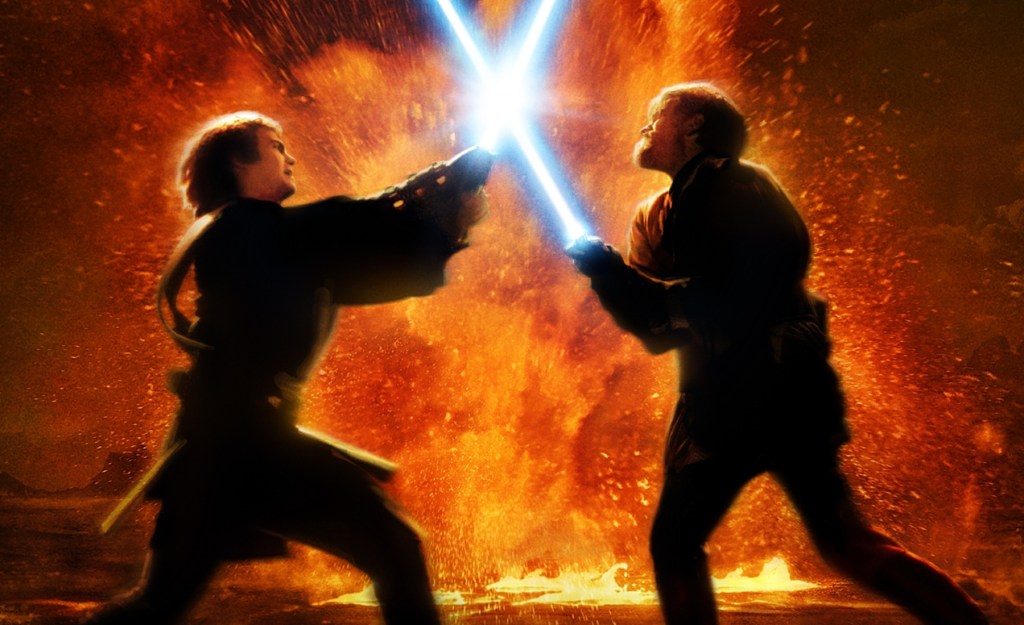
Thus begins the Battle of the Heroes [another stunning masterpiece composed by John Williams. I can remember Jimmy Smits introducing this piece at A Capitol Fourth, referring to the orchestra as “some friends,” I thought it was funny and totally cool that they played it in Washington D.C. for everyone]. It’s blue lightsaber versus blue lightsaber (a first for the series), brother versus brother. This is the most epic duel of the entire saga [I will fight you on this]. It is fast, and no, that was not digitally altered, Hayden and Ewan performed this duel themselves and are skilled enough now to fight at that speed. This is a fight between foes that know each other’s fighting styles intimately. They’re often a blur of blue and will use the same move against each other. Heck, they even throw in a bit of Duel of the Fates at one point.
At the same time, Yoda faces Sidious in the Senate building. Sidious resorts to throwing the Senate seats at the diminutive Jedi and it ends as a stale mate. Yoda escapes and tells Bail Organa he must go into hiding, failed, he has.
Obi-Wan expresses his own failure to Anakin. Anakin is now immersed in the Dark Side and feels that the Jedi are evil (goes back to everything Palpatine has fed him for over a decade). Obi-Wan gains the high ground and cautions Anakin to surrender. Anakin is still cocky and flips over his former master, but he’s still in reach of Obi-Wan’s blade and loses the rest of his limbs. The heat of the lava lands on him, burning and scaring him as Obi-Wan releases his pain: “You were the Chosen One! It was said that you would destroy the Sith, not join them! Bring balance to the Force, not leave it in darkness!” Anakin shouts his hatred at Obi-Wan. “You were my brother, Anakin. I loved you.” [Excellent acting by Ewan] Obi-Wan cannot bring himself to end his best friend (which could be argued was a mistake, but we love Obi-Wan too much to judge him too harshly), so takes his discarded lightsaber and walks away. He takes Padmé to Bail Organa where the medical droids deliver her twins (a bit of a shock to everyone, except us). Sadly, she’s lost the will to live but tells Obi-Wan as he holds newborn Luke that there is still good in Anakin.
Palpatine senses Vader is in trouble and saves him, but that necessitates a large black suit to keep him alive. This is where that iconic look comes from and that distinctive breathing. When Vader asks about his wife, Palpatine tells him that he killed her. Construction begins on the Death Star [why it takes nineteen years to build the first one, unless there were large-scale prototypes first…there are a few plot holes between the ending of III and beginning of IV]. Padmé’s family buries her on Naboo. Yoda recommends that the infants be split up for their protection; Bail offers to take Leia to Alderaan. Obi-Wan will take Luke to his family on Tatooine (cue theme from Episode IV). Yoda has one final lesson for Obi-Wan; Qui-Gon has kept his identity in the Force and offers to teach the remaining Masters. We also get a quick scene that shows C-3PO’s memory was wiped before working for Bail Organa, but R2-D2’s was not…meaning that little astromech knows everything.
So now, all we have to do is wait for the next generation to grow up.
This movie, like the other prequels, has its good and bad points. Anakin’s Heel-Face Turn was too sudden when it finally happened. Yes, the ground work has been laid, particularly since Attack of the Clones. But it seems within the space of a few hours, Anakin goes from ‘I trust the Jedi Council to handle this threat I discovered’, to ‘I kill the Jedi Master and boom, now I’m a Sith Lord’. And then he takes it out on his wife. Of course, this is majorly influenced by Palpatine’s schemes, but I really want to smack Anakin upside the head. [And this is why there exists many fix-it fictions]. And all Padmé does it sit around, being pregnant. She took charge and kicked butt in the previous two films and now, nothing. She loses the will to live after giving birth…yes, this obviously had to happen because she’s not around in the originals (and begs the question, how did Leia have memories of her…plot hole), but still disappointing. Grievous was an unneeded character; you already had an extra bad guy and why build up Count Dooku if you’re not going to use him.
The banter was fun; Anakin was a bit better, at least at the beginning of the film; not so whiny. The massive duel at the end was epic! That sells the entire film; it’s fraught with emotion. Obi-Wan may not have been planning on killing Anakin, but he did plan on stopping him. What makes it even more interesting is that the two characters (and actors) were evenly matched.
Up Next: Solo
I’ll put my musings on the Jedi Code here:
As the extended universe wrote out, the Jedi Code declares There is no emotion, there is peace. There is no ignorance, there is knowledge. There is no passion, there is serenity. There is no chaos, there is harmony. There is no death, there is the Force. I’m sure someone has done a paper somewhere comparing this to different philosophies or religious beliefs and this as it is written out is a mindful way to live. For a while, I felt that the Jedi Code was meant to make Jedi into unfeeling beings, which is the opposite of what humans are. As humans we have emotions, we are emotions. And as a teenager, just getting into the fandom, I went along with the idea that the Council was denying Anakin’s basic needs as a human; of course he should feel love. But there is a difference between love and attachment. It circles back to that saying “if you love something, let it go.” The attachment rule is to prevent the Jedi from putting one thing or being or whatever about another. Like Anakin putting the fate of Padmé above the rest of the galaxy. Of course Jedi should love and have a compassion, but they have a larger duty to the galaxy. In Clone Wars we see Obi-Wan tempted due to love, but he resists. Is the Council flawed? Yes. It’s a bit odd to look back and see that wise Master Yoda made some mistakes. Like, instead of simply telling Anakin over and over that fear leads to the Dark Side, how ’bout some actual help? And it pains me to say this, but technically Palpatine had a point in telling Anakin to completely understand a subject, he must study all aspects, not just the dogmatic, narrow view of the Jedi. There is obviously a fine line (and someone could make the connection between magic and the Force and compare Harry Potter to Star Wars…I do not have the time for that, lol), but simply excluding something because it is “dark” without understanding it is asking for trouble. Caution is urged, of course.
It is heavily implied within the extended universe that Qui-Gon Jinn loved a fellow Jedi Master, Tahl and his decisions regarding her were not wholly logical. It caused a rift between him and Obi-Wan more than once while Obi-Wan was a Padawan. …Yeah, I’ve come to realize that Qui-Gon was not the greatest Master and this is where fandom has declared Obi-Wan deserves hugs. I once thought Mace Windu cold and unfeeling. While he too was flawed, as is any good character, he also had his depths.

Some Obi-Wan Kenobi appreciation [can you tell he is my favorite character?]:
He’s referred to as the Ace on TV Tropes [a lot of this information came from there, but I certainly agree with their points]; one of the best Jedi that the Order ever had. Third strongest Council member after Windu and Yoda; tactical genius, top diplomat (Negotiator), expert pilot (out flew Jango Fett), master of multiple forms of lightsaber combat (particularly Form III [Soresu] and Ataru). Considered to be the single best defensive duelist in the galaxy in his prime. In canon, the only battle he loses is against Vader in A New Hope and he most likely threw that as a distraction to help Luke. He faced off against the Sith, killing an apprentice when he was only a Padawan and Grievous. Became a broken ace after the death of Qui-Gon and most of the Order, and (SPOILER) his love Satine by Maul [I disliked that bit]. Saw the death of Padmé and spent nineteen years in hiding on Tatooine with guilt and trauma.
Sees more combat that most of the other Jedi in canon. More of a brother relationship with Anakin, less of an age gap; bicker like siblings (and it is hilarious). The one who started the trend of Jedi generals wearing clone trooper armor in order to relate more closely to their troops. Primary enemy of Maul and Grievous, but greatest enemy was Anakin. Took a Level in Badass: goes from getting very lucky against Maul to a Master who defeated Grievous and bested the most powerful Force User in the galaxy. Badass Bookworm – intelligent, cultured gentlemen, who can kick a lot of ass when the time comes for it (love this!). Bash Brothers and Big Brother Instinct and Mentor with Anakin. The fandom is quick to point out that while Obi-Wan undoubtedly made mistakes in training Anakin (and he beats himself up for it), he went directly from being a Padawan to having a Padawan and one who was already too old to begin Jedi education yet young to be a Padawan. And had several members of the Council who disagreed with training the boy, so cut him a little slack.
Is described as “the ultimate Jedi” partially because he is modest, heroic, focused, and kind. Nevertheless, if you push him far enough (like taking part in the murder of almost his entire “family” aka Jedi Order, including innocent children) he is prepared to hack off your limbs and leave you alone to slowly burn to death. Calm facade breaks while fighting Anakin in Revenge. Anytime the emotionally controlled Obi-Wan get emotional, something is wrong.
Humble Hero [fanfic authors recognize this]: It seems that Obi-Wan is the only being who doesn’t understand how great a Jedi he is – when the Council proposes to send their ‘most cunning and insightful Master’ after Grievous, he has no idea who they mean. He’s also surprised when Mace Windu (the guy who created his own form of lightsaber combat) refers to him as ‘the master of the classic form,’ note, the master, not simply a master. He is easily the nicest and most immediately personable member of the Jedi Order in Prequels. Overall, maintains a kind demeanor and strong moral code in spite of the vast amount of hardship he faces. Slightly aloof and snarky and times, but also polite and compassionate. The Paragon: stands as pinnacle of heroism; selfless, morally upright, humble, and inspires others, in control of his impulses and emotions. Not perfect, but closest to embodying ideals of Jedi Order. Extremely clever, worldly, intelligent.
Does get beaten up at times (Attack of the Clones where he jumps out window and then the arena). Combat Pragmatist. Sharp wit and sardonically sarcastic sense of humor (could be a result of seeing death and destruction…I believe somewhere in Legends canon, young Obi-Wan suffered from visions). Gentleman Snarker [I love that]: Obi-Wan’s polite, diplomatic demeanor can mask some pretty biting snark. Poster boy for Snark Knight; he also likes to flirt with his enemies. Mainly meaningless, but still funny. Refuses to give up after learning about the occurrences of the Jedi Purge and Anakin’s betrayal of the Order. Still hurt years afterward, still believes Luke will save the Jedi. Jedi are fettered as a rule, but Obi-Wan explains the strength that comes from resisting the temptation of the Dark Side while confronting Maul later. Makes up for lack of character growth with the sheer amount of action he goes through.
Foil to Anakin, both skilled and famous Jedi with troubles love lives: Anakin and Padmé obviously. Obi-Wan and Duchess Satine (Legends: Siri). Obi-Wan takes firm hand training Anakin, more of a gentle touch training Luke. Throughout Prequels and Clone Wars, Obi-Wan has several good reasons to turn to the Dark Side, but resists. Cannot be corrupted. Has Innocent Blue Eyes that symbolize his heroic, righteous, and pure nature. Mentor Archetype. Morality Chain to Anakin: Anakin respected Obi-Wan enough that Palpatine had to get him off the planet before turning him to the Dark Side, and Anakin still tries to (threateningly) talk Obi-Wan out of fighting him. Morphs into dark version of Worthy Opponent. Dooku considers Obi-Wan a worthy opponent (Hardeen plotline; foil an attempted kidnapping by disguising himself as a bounty hunter and sabotaging the plot from the inside)
Implied friendship formed with Padmé and turned blind eye to her relationship with Anakin. Good is not Soft: prefers to settle conflict diplomatically. But will fight. Demonstrates some of the most powerful Psychic Powers in canon. Also prone to passively enhancing his physical strength and durability with Force; shot straight up four feet by arm strength to beat Maul; shook off blows from Grievous that sent him falling thirty feet; and fought Anakin within inches of lava.
Similar position to Han Solo in Prequel Trilogy; they both serve as older brotherly figures (Han to Luke, Obi-Wan to Anakin…I’ll get into more of the former when we hit the original trilogy because I love that part). Obi-Wan is Anakin’s Jedi Master and partner who Anakin also saw as a Parental Substitute while Han is Luke’s partner and closest friend, who later becomes his brother-in-law. Conversely, Anakin and Obi-Wan’s bond is destroyed, while Luke and Han have a rocky start but become family (even before marriage). Belligerent Sexual Tension with love interests (Satine, Leia). Obi-Wan Ideal Hero, Han Anti-Hero. (SPOILER): Both are murdered by someone they had a complicated father-son relationship with. Driving force behind the Prequels, but still major character in New Hope.
Disagrees with (SPOILER) dismissing Ahsoka [and another reason I’m not keen on finishing Clone Wars]. Also believes the Council should be more open with Anakin about their concerns over Chancellor Palpatine and the Sith, but overruled. The Stoic: has one of the most unpleasant lives (and afterlife?) of any character in fiction, but remains clam, never complains, and usually keeps his emotions well in check. You Didn’t Ask: rather sad one, only reason didn’t stay with Satine is she didn’t ask. Oh, and Leia is Luke’s sister.
Later in life, the Atoner for training the man who destroyed the Jedi Order and never recognizing the threat Anakin really represented. Will still cut off arms if need arises. Even after all the trauma he went through in his younger days and having spent almost twenty years living as a hermit, Obi-Wan is a remarkably kind and patient man. Explanation for fight against Vader; stalling and Vader’s powerful attacks. Starts off as a young and brash apprentice to Qui-Gon, becomes more wise and experienced Jedi Master, culmination in teaching Luke, his former pupil’s son.
And thus I am totally excited for the upcoming show on Disney+ and very glad they kept Ewan McGregor for the role.
Some fanfiction recommendations, all from AO3:
Check out
Both Lost Destiny and Crossroads by Nihes are interesting, but you end up wanting to punch something at the end. However, Jedi Babysitting for Professionals is hilarious
I certainly hope that Big Fat Bumblebee’s Found is continued because it is certainly time that someone takes care of Obi-Wan. Brothers care for brothers, Infuriating Man, Battle of Wills, and Enforced Convalescence are heartwarming (apparently the only thing Anakin and Mace Windu agree on is caring for Obi-Wan, not the Order, or the Republic, or even the Force, but yes to Obi-Wan).
Meysun’s There is no Pain is rather poignant, and you certainly want to wrap Obi-Wan up in a hug afterwards.
As I Fall and A Long Way Down by KCKenobi include some Obi-Wan whump. Some Things You Just Can’t Speak About is another one that makes you want to wrap Obi-Wan up in a hug. We get some protective Mace Windu in Old Wounds.
Must_Be _Thursday’s Just Surrender is rather good.
AndyHood’s Fought for Him really emphasizes why Obi-Wan needs some hugs.
Siri_Kenobi12 gives us some Obi-Wan whump in Tested. Memoirs of Kadavo is wonderful and I already told you I love It Takes a Village from the write-up on Phantom Menace.
You Are Wanted Obi-Wan Kenobi by allwalkfree is my new favorite story.


 through their father’s buildings. They cause mayhem and are chastised by Seti afterwards. He expects a lot from Rameses, who will succeed him as Pharaoh. Moses pleads for his father to not blame Rameses and suggests that his older brother only needs an opportunity to prove himself. Rameses is granted that opportunity at a banquet that night; Rameses in turn elevates Moses’ position. Priests Hotep and Huy are told to give the princes a gift; they have captured a foreign young woman. Moses is not the kindest to her upon meeting, but that night, he distracts guards to let her escape. He follows her to the slave quarters where he encounters Miriam and Aaron. Miriam thinks her brother has knowingly come, but he is unaware of his true heritage. Aaron pleads for mercy, but it’s not until Miriam repeats their mother’s lullaby that Moses realizes the woman speaks truth when she declares “I know who you are, and you are not a prince of Egypt.” She suggests he asks the man he calls father.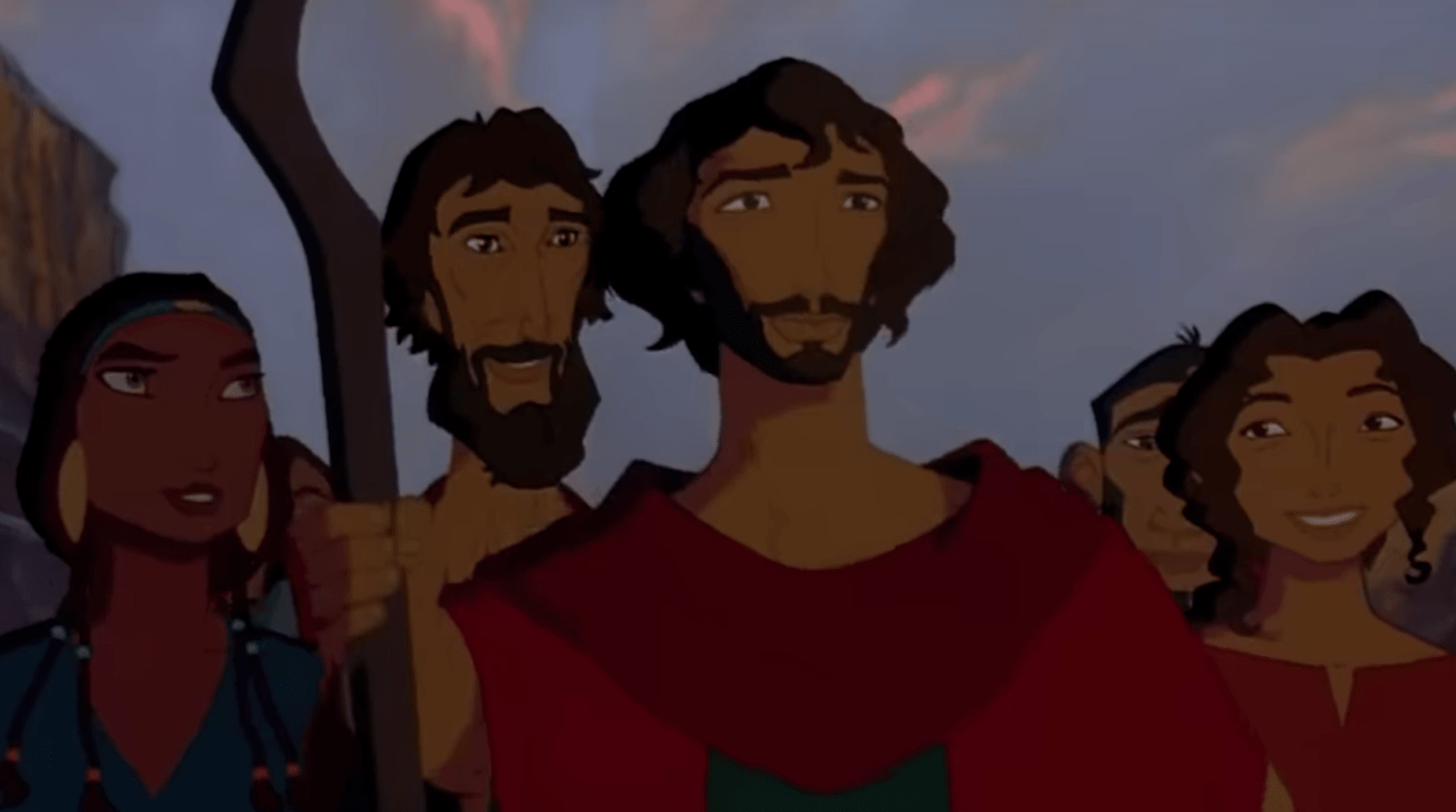
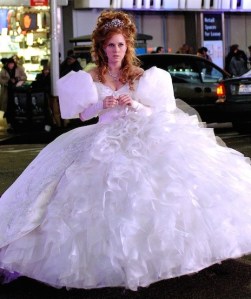 wedding. But she is waylaid by an old hag who wants to bestow a wedding wish. She pushes the maiden into the wishing well. The hag transforms into the queen and tells her stooge, Nathaniel, that she is sending Giselle to a world where there are no happy endings (similar to the premise of Once Upon a Time). The fall through the well transports Giselle to modern Times Square, in live action New York City. Giselle is terribly lost and confused. Help arrives in the form of Robert Phillip and his daughter, Morgan. He’s kind enough to take Giselle home with him, but on the condition that she calls for help. His resolve softens when Giselle falls asleep.

 The next morning Moana discovers a stowaway, Heihei the chicken (and the funny scene of the screaming and coconut). The journey is not easy. Her boat turns over again in a storm and she asks the ocean for help. She wakes on a shore – the island where Maui has been marooned. Moana meets the demi-god who insists that he stole the heart to help mortals, he’s their hero. He brought them fire and the breeze and the sun. You’re Welcome. Then he traps Moana in a cave and tries to steal her boat. Moana escapes and the ocean puts her on the boat, even after Maui tries to throw her off a few times. The stone is a magnet for danger, he claims. And they’re soon set upon by the Kakamora (which look like evil coconut people). Moana further demonstrates her cleverness and her determination to see the mission through.
 that the mission is truly hopeless and begs the ocean to choose someone else. The spirit of her grandmother comforts her; she should have never put all the pressure on Moana. If she wants to return home, her grandmother will help. “The people you love will change you, the things you have learned will guide you,” does Moana know who she is? “I am a girl who loves my island, I am the girl who loves the sea, it calls me.” Spirits of the old voyagers appear around her. “And the call isn’t out there at all, it’s inside me…come what may, I know the way. I Am Moana!” [that song gives me goosebumps] She swims down to the stone and when she pops back up, the spirits have vanished. But she knows what to do. She repairs her boat and sets off for Te Fiti again.
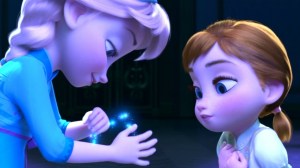 the palace and meet little princesses Elsa and Anna. Anna begs her older sister to “do the magic!” so they can play in snow. They sneak to a ballroom and Elsa freezes the floor. We briefly glimpse Olaf, who likes warm hugs. But Anna goes too fast jumping from snow mound to snow mound that Elsa creates. When Elsa trips, her shot goes too high and hits Anna. Their parents rush in from the commotion, their father demanding “Elsa, what have you done?” and they immediately head out of the capital, Elsa still trailing ice.
 generally postulated that the queen of Arendelle and queen of Corona are sisters. And the king and queen of Arendelle were heading to Rapunzel and Eugene’s wedding when their ship went down. This is supported by Rapunzel and Eugene showing up at Elsa’s coronation (if you’re watching closely, it is distinctly them) and further supported by Frozen releasing three years after Tangled, and Elsa comes of age three years after her parents’ death. It is further theorized that the Arendelle ship is the shipwreck Ariel is exploring at the beginning of The Little Mermaid. This stems from the fact that both original fairytales were written by Hans Christen Anderson and there is a statue of a mermaid in Denmark, which lies along the route Anna and Elsa’s parents would have taken from Norway to Germany (Rapunzel being a German tale). Another option is that the Arendelle ship was blown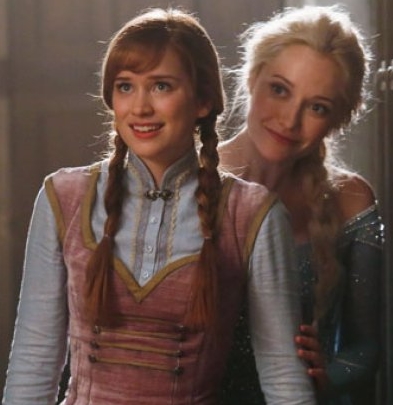
 don’t feel/ don’t let them know. Well now they know!” She Let[s] it Go. She’s able to use her power freely; and it’s beautiful. She creates a magnificent ice castle and to match her new mood, she creates a new (iconic) dress. The cold never bothered her, so she’s comfortable where she is. She’s never going back and tosses away her crown. According to Disney trivia, this song was the turning point the in the development of the film. At this point, the Snow Queen was not longer the villain. The song has also topped the Billboard list and that was the only song we heard on repeat for about a year, I think (Piano Guys did a beautiful crossover between this song and Vivaldi’s Winter; as I have often found, I prefer Piano Guys’ covers to the original). It was during this song that I figured out Idnia Menzel voiced Elsa, because the singing tone matches Defying Gravity from Wicked. I personally believe that the lyrics to this song are an aid to those who bottle up their emotions and worry about being themselves.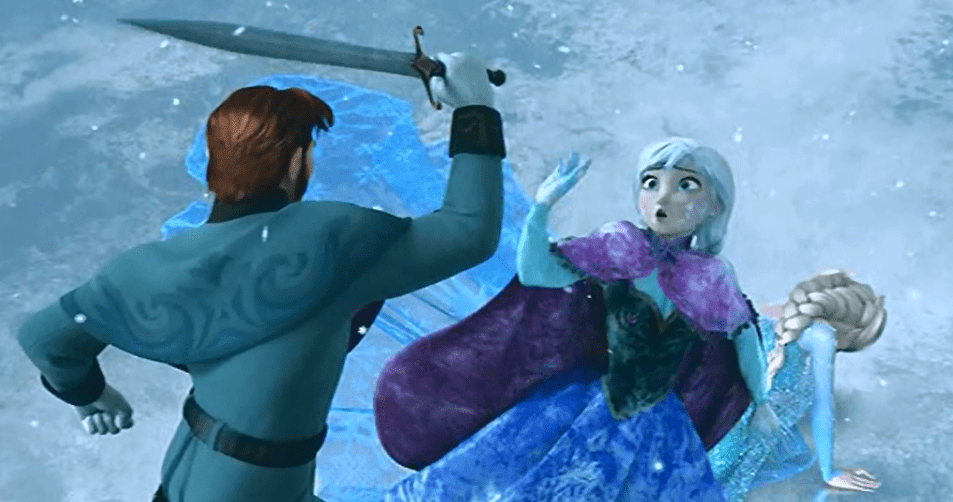
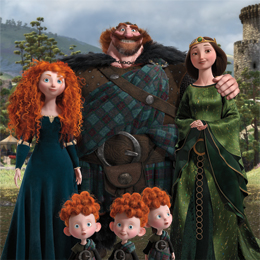
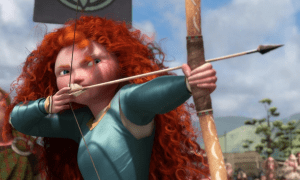 only to find her not there. Merida steps out, hair freed from its wimple, annoucning “I’ll be shootin for my own hand!” She has to tear the dress at the seams in order to allow arm movement, then proceeds to shoot three bull’s-eye in a row, splitting Dingwall’s arrow. Elinor is furious and throws Merida into a room in the castle. They shout at each other and Merida calls her mother a beast; she will never be like her, and slashes a tapestry. In retaliation, Elinor throws Merida’s bow into the fire. Merida rushes off in tears and Elinor realizes what she did. She pulls the bow out, but it’s too late; it’s cracked.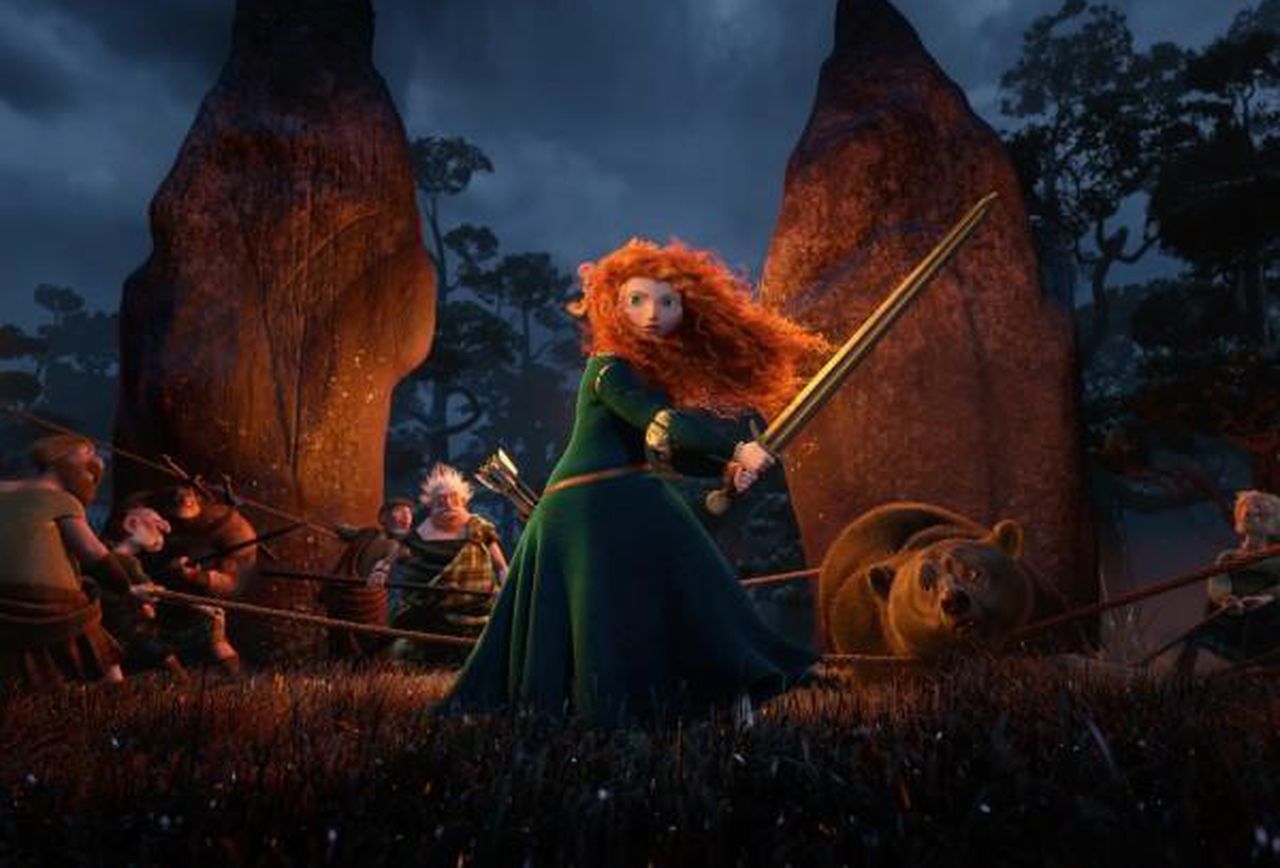
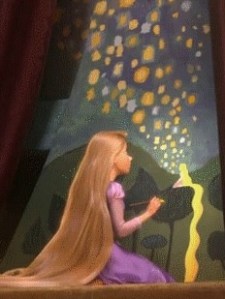 (sings) her daily schedule, which includes a lot of painting and brushing her hair, and wonders When Will My Life Begin? Mother Gothel returns home and calls for “Rapunzel, let down your hair!”, the classic line. And I further dislike the hag for her use of mean teasing; it’s a pet peeve of mine. One has to wonder how Rapunzel turned out sweet and kind with that kind of influence.
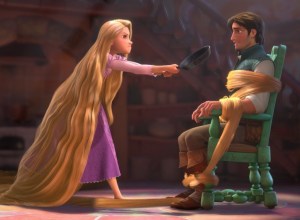 Once Gothel is gone, Rapunzel puts her plan into action. Flynn wakes thanks to Pascal’s tongue in his ear, to find himself strapped to a chair, by hair. Rapunzel reveals herself, asking “Who are you and how did you find me?”, believing that he is there for her hair. Flynn starts very charming, then falls into more modern flirting, which is a bit humorous (I do like that he is not like any other prince or leading man and he’s very sarcastic). But he’s concerned for his satchel. He guesses Rapunzel’s hiding spot, so she knocks him out again (that never gets old) and he’s woken by Pascal’s tongue again. Rapunzel feels that fate or destiny brought them together, Flynn cracks “a horse,” and points out that it’s terrible idea to simply trust him (works out this time, but not a theory to be tested often). She strikes a deal with Flynn once she finds out he’s not after her hair; he takes her to see the lanterns, she’ll return his satchel; without her help, he will never find it. Flynn attempts his “smolder” [I side with Rapunzel; not terribly impressed]. He agrees, Rapunzel drops him on his face: “You broke my smolder!” [ha ha! That is always funny].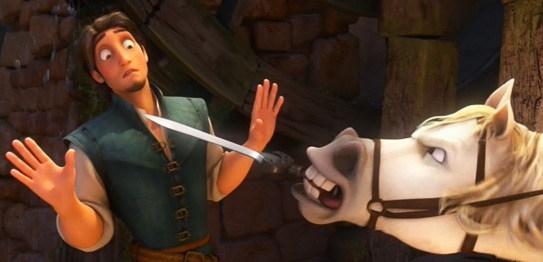
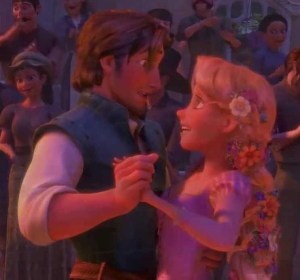 into the kingdom. It’s quickly discovered that incredibly long loose hair is not good in a town center; Eugene enlists the help of a few young girls to braid Rapunzel’s locks. They have wonderful little adventures throughout the day; Rapunzel showing off her art skills, reading books in the sunshine, learning about the lost princess in front of mosaic of the royal family, culminating in a dance [my favorite part of the soundtrack]. Eugene and Rapunzel finally end together at the end of the dance, but before they have a chance to act, the call goes out to head to boats for the lanterns.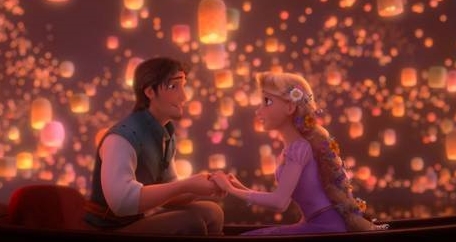
 Dreamer in the Mirror