A quick note first: this may seem to be posted early, but I’m attempting to increase the number of posts per week. I cannot guarantee strict consistency of two posts per week; I work in retail and we are coming upon a busy time of year. But I have so many more movies and some TV shows I’d like to get to!
Jungle Book
Based on the “Mowgli” stories of Rudyard Kipling (I think I tried to read Rikki-Tikki-Tavi when I was young; if I finished it, I didn’t like it). Based in India, it tells the story of a young “man cub” Mowgli who was lost as an infant in the jungle. He’s found by a panther, Bagheera, but taken to a family of wolves. Ten years later, a threat returns to the jungle; the tiger, Shere Kahn. The “man cub” must return to the “man village;” Shere Kahn fears and hates men and the tiger will not rest until Mowgli is dead and will kill any who protect the boy. Bagheera volunteers to lead Mowgli back to the village.
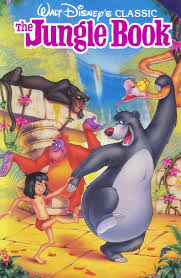
The cover I remember from video tapes
Mowgli does not understand why he has to leave the only home he’s ever known. Along the way, Bagheera and Mowgli run into Kaa, the snake, who attempts to hypnotize Mowgli in order to eat him. Then they meet a herd of elephants, under the leadership of Colonel Hathi (with a catchy marching cadence). Mowgli seems to enjoy copying other animals’ mannerisms and continues to put up a fuss about leaving. At the end of his patience, Bagheera first growls at the child, “you’re going if I have to drag you every step of the way” (I’m sure this is what every parent tells a wayward child at some point) and finally exclaims that Mowgli is on his own!
Well, Mowgli next meets Baloo, a sloth bear (I didn’t realize what sort of bear he was until recently; as a child, he was always a bear. Not the same as Winnie the Pooh, but a bear nevertheless; possibly classified as a “grey bear” compared to a “black bear” or “grizzly bear.”) And Baloo is the opposite of Bagheera, who seems practical, while Baloo sings about the Bare Necessities and a carefree lifestyle. I’m still not sure what a “paw paw” or “prickly pear” are, but they were fun as a kid. [Upon re-watching, he’s almost a prequel to Timon and Pumba: carefree life, no worries, eat bugs.] Baloo takes an instant liking to “little britches” and quickly adopts the boy as his own cub. He promises Mowgli that he can stay in the jungle with “good ol’ Papa Bear.”
“I Wanna Be Like You”
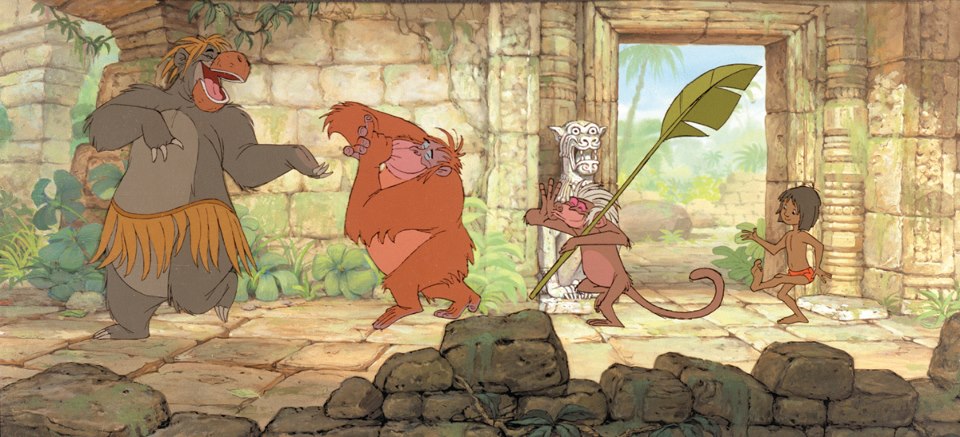
Until the monkeys nab him and take him to the ancient ruins to meet King Louie. The orangutan wants to Be Like You and makes a deal with the man cub; he’ll help Mowgli stay in the jungle in exchange for knowledge on how to make “man’s red flower” aka, fire. But Mowgli doesn’t know how to make fire, which we find out is one of Shere Kahn’s greatest fears (this may be why Louie wants to know how to create it). Mowgli is in fact rescued by Bagheera and Baloo and while he sleeps that evening, the two adults have a discussion; Mowgli must go back to the man village; he will be safer there, Baloo alone cannot protect him. When the bear tells the boy the news come morning, Mowgli runs…into Kaa again.
In the meantime, we are introduced to Shere Kahn. His deer hunt (yes, there are apparently deer in the jungle in India) is interrupted by the elephant brigade and he hears the news about a lost man cub. He was not aware that there was a man cub in the jungle. (Good going, heroes) So the tiger has joined the hunt for the man cub. Kaa has managed to hypnotize Mowgli again and prevent Shere Kahn from finding the boy, but Mowgli wakes and pushes the python out of the tree, again. Mowgli next comes across a group of vultures (nice ones, based off of the Beatles), but by this point, he’s depressed that none of his “friends” want to keep him around. All he wants to do is stay in the jungle and they keep making him leave. The vulture quartet explain What Friends Are For (they’ve never met an animal they didn’t like…adults get the double meaning), though they’re interrupted at the end with Shere Kahn’s appearance. Mowgli, being young and stupid, isn’t afraid of Shere Kahn and refuses to run, even when the tiger gives him a “sporting” head start. Luckily, Baloo arrives to grab the tiger’s tail and a rain storm picks up. Lightning strikes a tree, creating fire and the vultures urge Mowgli to act. The boy grabs a lit branch and ties it to Shere Kahn’s tail. The tiger runs off in fear; except he’s already struck down Baloo. Bagheera gives a touching eulogy…but Baloo’s not really dead.
Baloo declares “nothin or nobody gonna come between” him and his cub. Until they hear odd singing; a young girl is fetching water from the river. Mowgli wants a better look and (falls in love, I guess). Baloo urges him to come back to the jungle; Bagheera urges that he goes on to his own kind. Mowgli follows the girl into the village. The End.
In 2016, Disney re-made the animated tale into live action. I have seen it; though I haven’t been able to get my hands on it again. I do remember it being a more mature tale; Shere Kahn kills Mowgli’s wolf father. The film shows Mowgli as more human; using “tricks” to accomplish tasks rather than imitating other animals. I enjoy the jazzy soundtrack from the animated movie; they tried with Bare Necessities, but some of the charm was lost. The newer rendition of I Wanna Be Like You is dark and foreboding and Louie was large and definitely not Mowgli’s friend. The end is opposite from the animated; Mowgli does use fire to defeat Shere Kahn, but he stays in the jungle, rather than return to the man village.
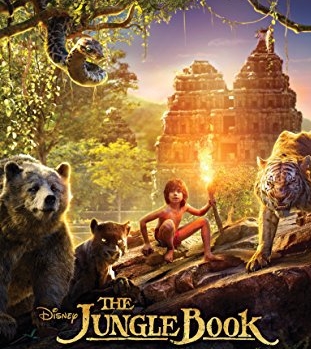
Cover of the 2016 live-action version
There is sequel planned for the live-action movie, and a movie titled Mowgli due out in 2019 (directed by Andy Serkis [Gollum/Smegol] and starring Cate Blanchett, Christian Bale, and Benedict Cumberbatch), though I’m not sure how closely it will resemble the Disney story. There was a direct sequel to the animated film – I saw it once and all I can remember is that Mowgli ended up in the jungle again, somehow, and there have been numerous other iterations of the Jungle Book story. I, however, remember the characters in the cartoon TaleSpin (I still have some of the episodes released on tapes), where Baloo is a pilot, Shere Kahn is a villainous business-tiger, and Louie runs a club. (I think some of my fondness stems from the fact that Baloo had a plane and my father loves flying and planes). [Fun note: the air pirates from TaleSpin show up in the rebooted DuckTales cartoon, with added singing. Further proof that I have not outgrown Disney]
TaleSpin logo
Oh, and if any of the voices from the animated film sound familiar; they are. Phil Harris was Baloo (Bill Murray in the live-action) and he went on to voice O’Malley in Aristocats and Little John in Robin Hood (the animation style of the bears are very similar as well). Sebastian Cabot was Bagheera (Ben Kinsgley’s role in the live-action) and we’ve previously heard him as Sir Ector in Sword in the Stone and the always trusty Narrator in several movies. Sterling Holloway was Kaa (Scarlett Johanson in the live-action) and he’s the ever lovable Winnie the Pooh [I try to ignore that fact because that just makes things a little creepy]. Colonel Hathi was voiced J. Pat O’Malley, who seems to have a long run with Disney. Mowgli and Christopher Robin share Bruce Reitherman as a voice. Idris Elba as Shere Kahn and Christopher Walken as King Louie are other big name stars in the live-action adaptation.
In the spectrum of “Disney movies I like,” Jungle Book falls in the middle. I’d probably watch it if it was on television and didn’t have other plans. As a child, I thought it was fun for another child to live with animals; we like imitating them anyway. And Mowgli at least tries to make friends with other animals. I sided with Baloo and wanted Mowgli to stay with his jungle buddies. And the girl’s actions, even to me as a child, were obvious that she was trying to get Mowgli to go with her.
As always, let me know if you have any comments, or questions. What was your favorite Disney cartoon?
Another classic fairytale, complete with a princess, a prince, fairies, magic, and a dragon. Disney’s animated film score is heavily based on Tchaikovsky’s ballet suite (I want to see the ballet), which is credited at the beginning of the film. Beyond that, is opens with a storybook and narration quickly filling us in on the backstory of King Stefan and his unnamed queen desperately hoping for a child, then – a princess is joyfully born! “Hail to the Princess” comes straight from the opening march of the ballet, and we’re introduced to neighboring King Hubert and his son, Prince Phillip, who is betrothed to infant Princess Aurora (this was a common occurrence during real life medieval royalty). And this prince actually shows some personality! His little nose wrinkle is adorable, because what boy is going to be pleased to be told, “this little baby is going to be your future wife”?
From left to right: my friend Dawn Winkler, Prince Phillip, my friend Krista Ivan, Princess Aurora, and myself. Same band trip 🙂 Apparently, Phillip and Aurora are hard to find; we stumbled upon them by accident, just wandering around the one morning.
The king and queen invited three “good” fairies, Flora, Fauna, and Merryweather to their pseudo-christening and they bestow (almost) three gifts. Flora gives the gift of “beauty” (because all fairytale princesses are beautiful). Fauna gives the gift of “song” (and the young woman does have a more mature singing tone, compared to previous princesses Snow White and Cinderella). Merryweather is about to give her gift when the “evil” fairy Maleficent appears. Oh dear, she’s not wanted. And the only line the queen has: “and, you’re not offended, your Excellency?” Oh no, and to show she bears no ill will, Maleficent too has a gift for the young princess. Aurora will indeed, grow in grace and beauty, beloved by all who know her, but on the evening of her sixteenth birthday, she will prick her finger on the spindle of a spinning wheel…and die! With a cackle, she fades away. Merryweather is able to soften the blow of the curse, instead of death, Aurora will merely sleep until she is waken by true love’s kiss (it’s always true love’s kiss…that plays a huge role in Once Upon a Time), for “true love conquers all”.
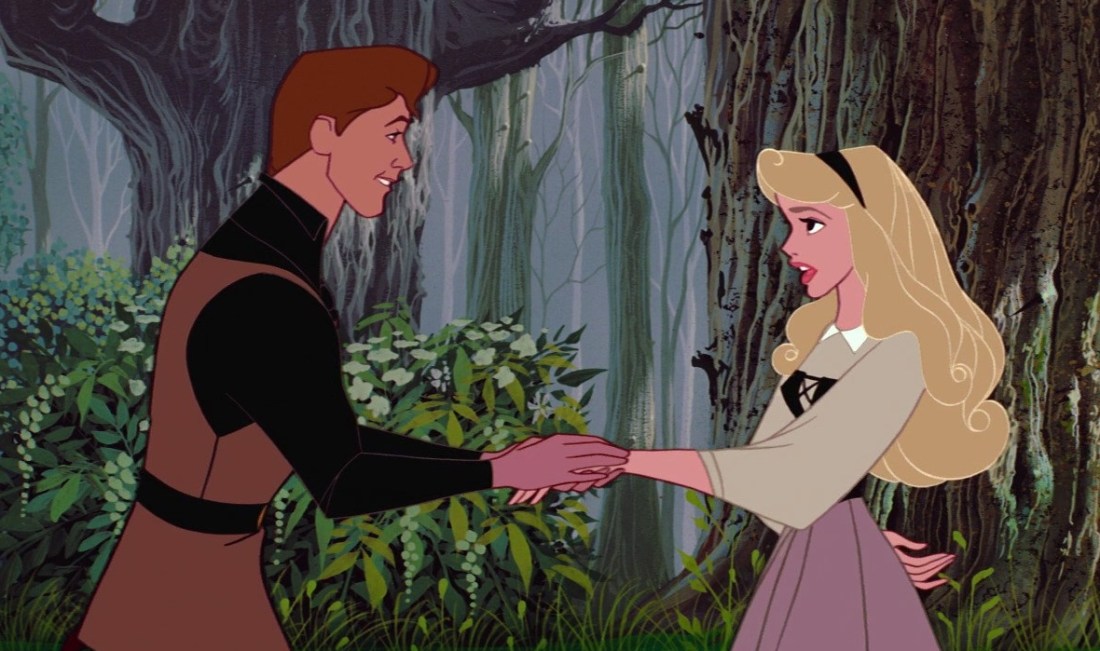
King Stefan and his queen reluctantly agree to Flora’s plan for the fairies to raise the princess until her sixteenth birthday in an attempt to protect her from the curse. Stefan also burns all of the spinning wheels in the kingdom (the historian in me wants to know how they make clothes after that). Time lapse: sixteen years have passed and the fairies are preparing for “Briar Rose’s” celebration. They send the young woman out, with the warning to not speak to strangers. Aurora tells her animal friends (I guess a requirement for Disney princesses is the ability to speak to animals) that she’s dreaming of a prince and the animals proceed to steal clothing from a strange man in order to create Aurora’s prince. “Once Upon a Dream” is the ballet’s waltz and the man appears and steps in to dance with the young woman. At first, Aurora tries to follow directions and leaves, but he’s dashing and charming and they stroll through the woods romantically.
Meanwhile, Maleficent is furious that her creepy demons haven’t located the princess in sixteen years. They truly are imbeciles and have been looking for a baby the entire time. Alas, I must agree with Maleficent that they are a “disgrace to the forces of evil.” Instead, she charges her trusty crow to find her prize and he discovers a cottage…pink and blue sparks shooting out of the chimney do not aid in secrecy. Inside, the fairies are continuing with their preparation and we must wonder how they survived for sixteen years; Flora is terrible at sewing and Fauna cannot bake. In a last-ditch effort, Merryweather retrieves their wands to help, sadly resulting in a fight primarily between her and Flora, thus generating the sparks. (To give them some credit, they had shut the doors and windows to prevent being discovered; they just forgot the chimney) Briar Rose arrives home to tell her guardians that she met a wonderful man and intends for him to visit that evening. They have to tell her the heartbreaking news that she’s actually a princess and already betrothed; everything she knows is changing.
At the castle, Stefan and Hubert drink “Scumps,” toasting to the future of their children. Which Phillip interrupts when he tells his father that he has found and fallen in love with a woman in the woods. When he arrives at the cabin that evening, Maleficent is waiting for him, not “Briar Rose.” She captures the prince, informing him that the peasant woman he met, by whim of fate, is the princess to whom he is betrothed, and sets about to see her curse through. The fairies have taken the princess back to the castle and leave her alone for a moment to gather herself. An eerie wail hypnotizes Aurora and lures her through a secret passage to an ominous spinning wheel, where she in fact pricks her finger and falls into a sleep. The three fairies put the rest of the castle to sleep until they can get the handsome man Aurora met and fell in love with to kiss her awake. To do so, they must venture to Maleficent’s castle, where the demons are dancing around the fire in a mimicry of Night on Bald Mountain (that little animation has in fact given me nightmares).
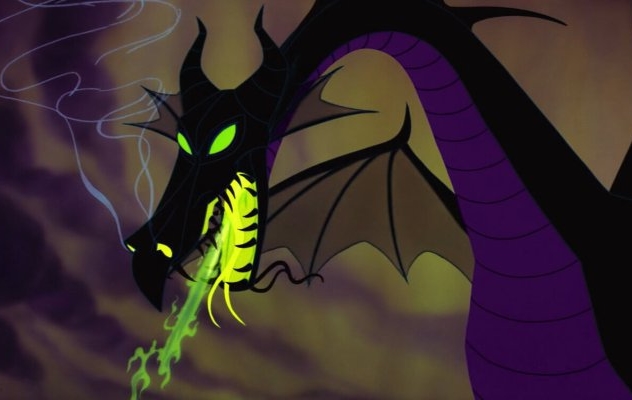
Maleficent’s plan is hold Phillip at her castle until he is too old to be a threat, then she’ll release him to kiss his princess awake (and promptly die, I’m sure). The three fairies sneak in afterwards and gift him the “enchanted shield of virtue” and “mighty sword of truth” (always important in a fairy tale). Phillip set about hacking his way through a forest of thorns, but soon he must “deal with [Maleficent]…and all the powers of Hell!” She transforms into a dragon (in a battle that is shorter than I remember) and is slain by Phillip’s sword (again, typical Disney death, she falls off the cliff). The fairies lead Phillip up to the tower where Aurora is sleeping. He kisses her awake and the kingdom wakes up. They appear before Hubert and Stefan (to one of my favorite Tchaikovsky pieces) and a reprise of the waltz.
[Fun note: if some of the voices sound familiar: the woman who voiced Lady Tremaine in Cinderella is Maleficent, and the woman who voiced the Fairy Godmother is Flora]
Maleficent is the live-action 2014 adaptation of Sleeping Beauty, except told from the point-of-view and including the backstory of the villainess. Angelina Jolie stars as Maleficent, Imelda Staunton (aka, Dolores Umbridge) is one of the pixies, among other stars (one of the other fairies was the Queen in an updated Musketeer movie, the king was Murdoch from the updated A-Team movie) and there is a sequel due out in 2020. The narrator announces “let us tell an old story anew and we will see how well you know it.” There were bordering kingdoms; one of humans, greedy, ruled by a terrible king, and the other; a magical realm of fairies and creatures, called the Moors. The human king envied the Moors wealth and wanted to conquer the land. But it has a protector, in a young girl with horns and wings: Maleficent.
One day, a human boy is caught stealing a crystal and Maleficent must pass judgment on him. The boy’s name is Stefan. They bond, as orphaned children, and become “unlikely” friends, and for a time, the old hatred was forgotten. On Maleficent’s sixteenth birthday, Stefan gives her [a supposed] “true love’s kiss.” But Stefan was like the king, jealous and conniving. He has managed to become a servant to the king and when the king is on his deathbed following an encounter with Maleficent and the Moors, he takes the chance at the king’s word, whoever can kill the “winged elf” will become the next king. Stefan sneaks into the Moors to “warn” Maleficent. She forgives him for his absence and for a night, all is as it was. However, Stefan sneaked a potion into her drink, putting her to sleep; yet, he cannot bring himself to kill her. Instead, he cuts off her wings. These are his proof to the king that he “killed” Maleficent. He is crowned and gains a queen, Leila [who resembles Keira Knightley, but is not] (I also wonder if this is the daughter that the previous king, Henry, mentioned and Stefan married her to aid his control of the throne).
Maleficent mourns the loss of her wings and that is how she gains her iconic staff. The next day, she saves a crow from being beaten to death, turning him into a man. In return for her rescue, Diaval will be Maleficent’s wings. The real turn in Maleficent’s character comes when she finds out that Stefan had done all that to her, just to become king (I have to admit, I understand her rage at this point). So, she becomes queen of the Moors (they never officially had a monarch previously) and her former friends now cower before her. We next witness the birth of Stefan and Leila’s daughter and once again, Maleficent attends the christening. Her speech to the assemblage is identical to that from the animated film, though her curse changes a little; the “true love’s kiss” is a dig at Stefan, and the “sleeplike death” will last for all time, “no power on Earth can change it.” Once again, Stefan orders all of the spinning wheels burned [and again, how do they make fabric after that? And what possesses one to leave the burned remains in the castle?]
The pixies, Flittle, Knotgrass, and Thistlewit, are charged to care for baby Aurora for sixteen years and a day. They prove to be truly incompetent and it is lucky for Aurora that Diaval and Maleficent found her, or she would have died; either from starvation or falling off a cliff. One day, toddler Aurora comes across Maleficent healing a tree in the forest and hugs the woman [she was played at this point by Angelina’s own daughter, because she was the only child not scared]. Throughout the years, she plays with the crow. At the same time, Stefan darkens with paranoia and vengeance and plots Maleficent’s demise (ignoring the fact that he wife dies). He sends soldiers to the wall of thorns that Maleficent has erected. They fail, and he remembers what he learned as a boy; iron burns fairies. He has a new idea.
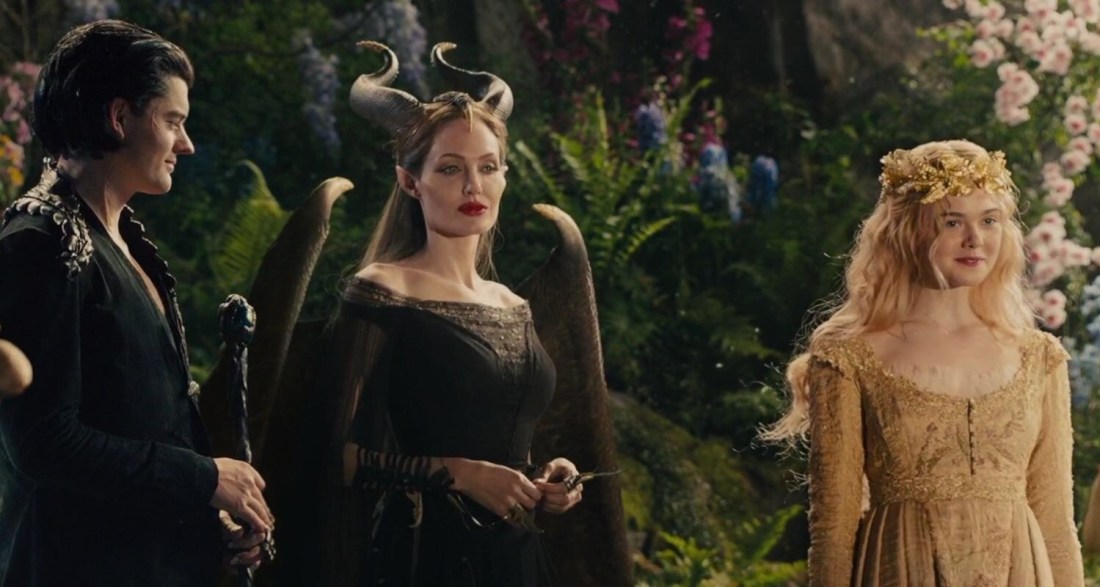
Maleficent shows Aurora the Moors and the young woman is fascinated. The creatures like her and she eventually lightens Maleficent’s heart. Aurora refers to Maleficent (not knowing her true identity at first) as her fairy godmother (a cute play on traditional fairy tale roles); she remembers the silhouette of Maleficent’s shadow from her childhood. Maleficent even attempts to remove the curse, but she recalls that she had included the clause that “no power on Earth can change it.” Not even Maleficent’s own magic can lift the curse. She continues to protect Aurora and tries to warn her about the evil in the world and Aurora expresses her wish to come live in the Moors. Maleficent agrees. Aurora encounters Prince Phillip on her way home to tell the three pixies her decision (witnessed by Maleficent and Diaval; Maleficent feels that Phillip could be the answer to “true love’s kiss,” even though she believes it does not exist).
At the cottage, the three pixies are forced to reveal that Aurora is the princess of the kingdom and she must go back to her father. (They get confused on the timeline and take her back on the day of her birthday, not the day after) Aurora confronts Maleficent about the curse and declares that she is the evil in the world. The young princess rides back to the castle alone. Stefan shows no emotion at seeing his daughter for the first time in sixteen years. He remarks she looks like her mother, but neglects to inform the lass that the woman is dead, and he stands still as Aurora hugs him. He locks her in her room so he can focus on a battle plan. None of it prevents Aurora from being hypnotized and led to the dungeon full of spinning wheels. She pricks her finger and falls asleep.
Maleficent knows the curse will come to fruition; she finds Prince Phillip and carts him off to the castle. Iron spikes impede her, but she manages to get Phillip to the hallway outside Aurora’s room. The pixies let him in and convince him to kiss the sleeping princess (and thank you, young prince, for resisting at least a little, calling to attention the fact that you’ve only met the one time). But the kiss fails. The pixies kick him out and leave to find someone else. Maleficent emerges from the shadows and apologizes to the young woman, but knows she cannot ask for forgiveness; what she did was unforgiveable. She places a gentle kiss on Aurora’s brow. That does the trick. Now they must escape the castle together and retreat to the Moors. Alas, Stefan and his soldiers are waiting for them. Maleficent turns Diaval into a dragon, setting the hall alight. An iron net deters Maleficent, but she eventually faces off against Stefan. Aurora discovers and frees Maleficent’s wings and that’s the real turning point. Stefan suffers a Disney death and falls off a tower during his duel.
Maleficent removes her crown and takes down the wall of thorns. The kingdoms are united under Aurora, who is crowned in the Moors (Phillip is in attendance) and they were brought together by one who was both hero and villain: Maleficent. The closing narration sums up that “the story is not quite as you were told. And I should know, for I am the one that they called Sleeping Beauty.” Our parting shots are of Diaval, as a crow, flying with Maleficent.
My mind-set on the animated Sleeping Beauty has been that it’s a typical fairy tale. There are a hundred ways to tell it and the characters are interchangeable. Princess Aurora doesn’t strike me as a “fight for yourself” princess. It has been noted that she doesn’t speak the entire second half of the film, even after she is woken by “true love’s kiss,” or when she meets her parents. Prince Phillip is admirable as a typical prince and this time, he actually does something. He fights the dragon; he rescues his damsel in distress; he speaks his mind to his father. Pity he’s not more remembered for that. Maleficent is intimidating visually. We are left to wonder why she suddenly appears at a celebration and randomly curses an innocent baby. I guess it’s hand waved as “she’s evil” and apparently the queen of all darkness.
Which is why when Maleficent was first announced, I didn’t plan on seeing it. But after watching the live action Cinderella, I decided to give it a chance. And I was pleasantly surprised. As a scholar with an interest in faerie lore and mythology, I was excited to see the added element of iron burning the Fae. Overall, I enjoyed how Maleficent was portrayed as a Fae, that not all fairies are tiny little creatures with wings. They have immense power and a tie to nature.
I enjoyed how Maleficent’s character was fleshed out and well rounded. Most of the characters were given greater detail (Phillip suffered, unfortunately). We now have a believable reason for Maleficent cursing Stefan’s child. I thought it was interesting that they expanded the crow character and he was a fun addition. I wonder if there’s a romantic inclination towards Maleficent or Aurora. He’s reasonably loyal to Maleficent and he seems attached to Aurora. For a moment, while re-watching, I thought it would be him that broke the curse by kissing the sleeping princess; but I content with the mother/daughter relationship emphasis instead. Phillip’s presence at the Moors at the end has me wondering if they’ll expand that tale in the sequel.
Again, there is a typical warning as in most fairy tales: “don’t talk to strangers.” There’s never really a bad consequence to those who do: in the animated, Briar Rose meets the man who will rescue her. In the live action, Aurora speaks to the woman she coins as her fairy godmother. In both cases, it ultimately turns out well for her. I appreciate in the live action that dragons are not painted as completely bad (considering my favorite movie is How to Train Your Dragon). In the animated, of course the powers of Hell will transform into a dragon. An element of dragon mythology is that dragons kidnap princesses and lock them away. Diaval as a dragon doesn’t get much action in the newer movie, but it’s understandable since the action should be focused on Maleficent’s struggle.
So…? Any questions? Comments? What’s your position on dragons?
Just about the most popular and well-known fairy tale. Lately, there has been an explosion, led by Disney, of modernizing the tale (often involving music) of an oppressed young woman becoming the star despite “step-sisters” getting in the way. There’s A Cinderella Story starring Hillary Duff, and Another Cinderella Story with Selena Gomez. Going back, there’s a twist to the tale, first as a book, then adapted to film starring Anne Hatahaway, Ella Enchanted (I enjoy the last song to the movie most since it’s Elton John). Rodgers and Hammerstein created a musical, entitled Rodgers and Hammerstein’s Cinderella and that has been performed countless times (recently revived on Broadway) and there are a couple movie versions; one starring Julie Andrews and another from the 90s starring Brandy. Cinderella even appears in Into The Woods.
I do not have a strong enough desire to delve that deeply into the tale and so I’ll focus on Disney’s 1950 animated classic and their 2015 live-action remake. And because I absolutely love Ever After, it will go with its sisters.
Disney’s version is a form of the traditional tale. After a completely forgettable opening song that I never remember, the story book opens and the narrator begins “Once Upon a Time.” The titular character gains a cruel stepmother who was jealous of her kind nature and forces Cinderella to become a servant upon her father’s death. Yet Cinderella has remained optimistic and dreams of a happier future, prompting “A Dream is a Wish.” She has friends in the birds and mice of the home and they help with her chores (keeping with the theme of helpful animals from Snow White).
The castle is visible from Cinderella’s room, where the king tells his Grand Duke that the prince has avoided his responsibilities long enough and it’s time for him to marry and settle down; he wants grandchildren. Since the prince is returning home (we never find out from where or why he was away or how long) it’s the prime opportunity to throw a ball, where a boy and girl can meet in the right conditions, prompting a proposal out of the son. Asserting that it “can’t possibly fail” the king orders all eligible maids invited.
Same Disney trip
Cinderella delivers the invitation to her stepmother and stepsisters (in this version, they are Lady Tremaine, Anastasia, and Drizella). She expresses a desire to attend the ball and Lady Tremaine agrees if she finishes all her chores. Of course, they give her so much to do, she does not have time to alter her mother’s old dress. Instead, during “Cindrelly” the mice and birds complete the alterations, making use of old articles from Anastasia and Drizella. Her stepfamily take their frustration out on the dress the night of the ball and Cinderella cries in the garden. Her fairy godmother appears and “Bibbidi Bobbidi Boo” she turns a pumpkin into a carriage, four white mice into horses, and transforms Cinderella’s tattered dress into a sparkling ball gown, complete with glass slippers with the warning that the magic will wear off at midnight. Cinderella entrances all at the ball, most keenly the prince; they share the only dance, then stroll about the castle pondering “So This is Love.” Just as they’re about the kiss, the clock chimes twelve and Cinderella rushes away, leaving a glass slipper in the stairs. The Grand Duke sends guards after her, but she evades them.
The news comes the next morning that the prince will marry whomever the glass slipper fits (the king does use this to his advantage, pointing out that it could fit any number of girls) and Lady Tremaine notices the daze that Cinderella is in and rationalizes that she was the mystery maiden. With glowing eyes (creepy), she locks Cinderella in the attic. When the Grand Duke is at the home with the slipper, Cinderella’s animal friends free her. Tremaine causes the slipper to be smashed, but Cinderella has the other slipper. There’s a wedding “and they lived happily ever after.”
In 2015, Disney re-made their tale with an all-star live action cast, featuring Lily James (Lady Rose from Downton Abbey) as Cinderella; Cate Blanchett as the Stepmother; Richard Madden (apparently a main character from Game of Thrones, I think. Still need to watch that!) as Prince Kit; Stellan Skarsgard (Bootstrap Bill Turner from Pirates of the Caribbean) as the Grand Duke; Sophie McShera (Daisy, also from Downton Abbey) as stepsister Drisella; Holliday Grainger was Anastasia; Hayley Atwell (Peggy Carter) briefly appeared as Cinderella’s mother, and the narration was provided by Helena Bonham Carter, who was also the Fairy Godmother. Kenneth Branagh directed (he directed the first Thor movie, but he’ll still always be Gilderoy Lockhart).
Lily James as Cinderella and Cate Blanchett as Lady Tremaine
Holliday Grainger as Anastasia and Sophie McShera as Drisella
The opening provides further backstory; we actually see Ella’s mother. It’s from her that Ella learned to “have courage and be kind” and to see the world as it could be, with magic, including believing in fairy godmothers. As “the most happiest of families” tragedy was bound to strike. Ella’s mother sickens and dies. Years later, her father remarries the widowed wife of a friend, Lady Tremaine. Anastasia and Drisella are horrible from the start, but Tremaine seems to attempt to be pleasant, supposedly desiring to restore life and laughter to the house by throwing parties. Yet she “temporarily” moves (read: banishes) Ella to the attic when the young woman is kind enough to offer her larger room to her bickering stepsisters. When Ella’s father dies unexpectedly on a trip, Tremaine dismisses the rest of the household and gives Ella more chores to “distract from her grief.” She is the one to coin “Cinderella” and has Ella remove her place setting at the table.
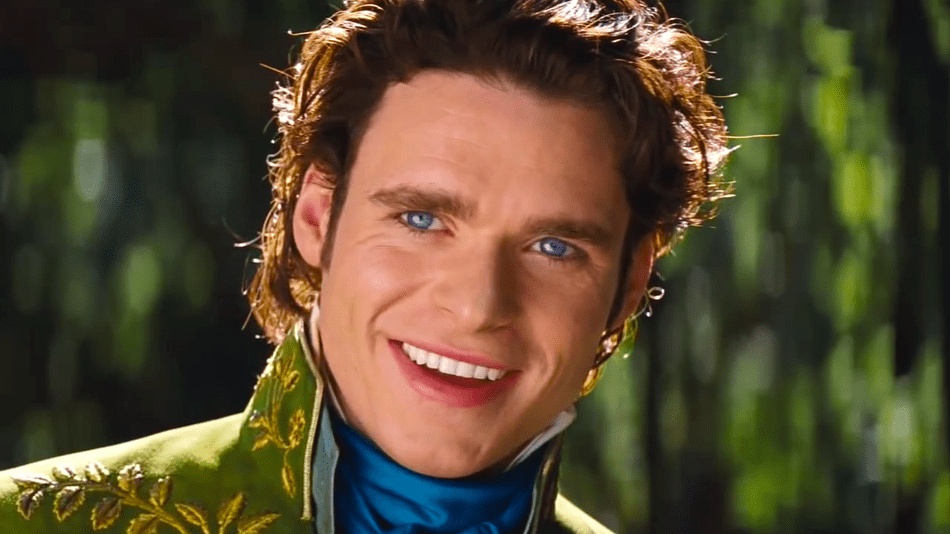
This prompts a distraught Ella to ride into the woods where she meets Kit, a kind “apprentice” at the palace. Kit is in fact the prince, hunting a stag. They circle their horses and actually have a conversation with each other. When Ella remarks that her family treats her “as well as they are able,” Kit replies with sympathy. Ella, ever sweet, tells him that others have it worse; Kit insists that her treatment is still not her doing. They both express an interest in seeing each other again. (Wow, he has blue eyes)
Richard Madden as Prince Kit
It is obvious Kit is taken with Ella (or a mysterious girl, as she never tells him her name). She gets him thinking on topics. The servant girl from the forest echoes his private sentiment that we must all simply “have courage and be kind,” and that “just because it’s what’s done, doesn’t mean it’s what should be done.” The Grand Duke I’m sure would consider it dangerous thinking. The King is ill and dying, putting the kingdom in peril and they are both encouraging Kit to marry, in tandem as tradition and to strengthen the kingdom. They will hold a ball, but Kit requests that invitations go to all maidens, noble and common. His captain points out that it’s Kit’s way of seeing his “good, honest country girl”.
Of course, Ella’s stepfamily still refuses to include her in their preparations. She still refurbishes her mother’s dress. Tremaine starts the tearing and spits that she “will not have her daughters associated with you.” Ella is a ragged servant girl and that is what she will remain. Ella’s once again in tears and this time, she has lost her belief. She apologizes to her mother that she doesn’t have courage any more. Yet, she’s still kind to the old beggar woman who requests some milk. The beggar woman transforms into a fairy godmother (in a very poofy white gown). A pumpkin is still transformed into a carriage and this incarnation has kept Cinderella’s animal friends (not my favorite animatronic animals) so four mice become four white horses, a goose becomes the driver, and two lizards become footmen (I kept expecting to hear “Bibbidi Bobbidi Boo”). A touch of magic conceals her identity from her stepmother.
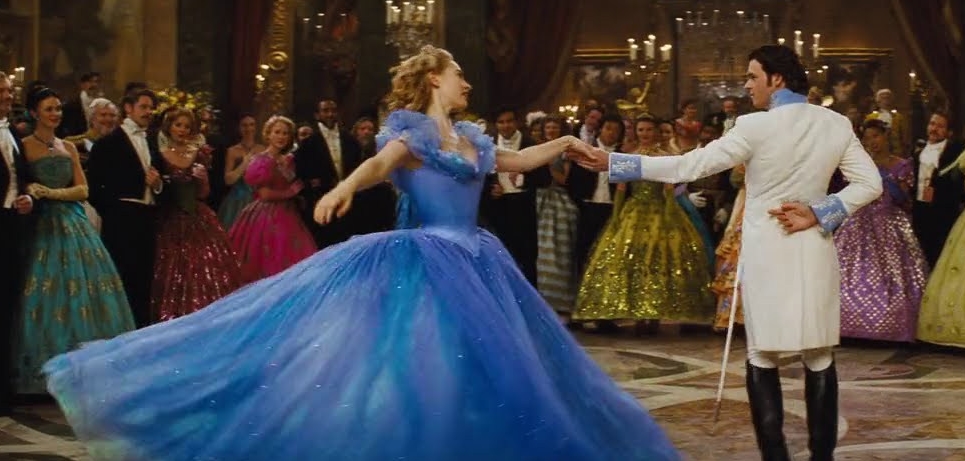
Dancing at the ball
Another grand entrance and Ella realizes that Kit is indeed the prince (he makes the argument that a prince is an “apprentice” monarch); they share a beautiful waltz. Afterwards, the couple sneaks off for a private conversation. Tremaine overhears the Grand Duke telling the captain that he has already promised the prince to Princess Shaleena. When midnight does strike, Ella must leave and the stairs claim another glass slipper, and she still manages to evade the Grand Duke.
The king sadly dies shortly after the ball. But he encourages his son on his death bed to find the mystery princess; he is to marry for love, not advantage, and to become his own man. Kit curls up against his father one last time, prompting tears on my part. After an appropriate mourning period (per the narration) the announcement is made that the new king will search for the woman who fits the glass slipper. He bargains with the Grand Duke that if she is not found, he will marry Princess Shaleena, but no effort will be spared in searching.
In the meantime, Lady Tremaine finds Ella’s matching glass slipper and confronts her. She proposes that she will support Ella’s claim to the prince, in exchange for marrying Anastasia and Drisella off to wealthy lords, and Tremaine will “manage that boy,” thus ruling the kingdom. Ella refuses; she couldn’t save her father from Tremaine, but she will protect the kingdom and the prince from her. Tremaine smashes the slipper and locks Ella in the attic. She then goes to the Grand Duke and reveals the identity of the mystery princess. In exchange for keeping the secret, she will be made countess, once again making advantageous marriages for her daughters, and as for the servant girl; the Grand Duke can do what he likes with her, she’s nothing to Tremaine.
So the Grand Duke purposefully makes Tremaine house last in the search and once the slipper refuses to fit either Anastasia or Drisella, he wants to make a quick getaway. But Ella’s animal friends manage to open her tower window so her singing (Lavender Blue – I have no idea why this song features so heavily in the movie; though it is a pretty rendition) reaches the soldiers. Kit is disguised amongst their ranks and demands to see the last girl. HIs trusted captain brings Ella before him where she finally admits that her name is Cinderella; she is not a princess, she does not have a dowry, or even knows if the shoe will fit. But if it does, will the king take her as she is, “an honest country girl who loves you?” Kit replies of course, but only if she will take him as he is, “an apprentice still learning his trade.” When the movie closes on their wedding, narration tells us that Kit and Ella were the fairest and kindest rulers of the kingdom, remembering to see the world as it could be, believing in courage, and kindness, and occasionally, magic.
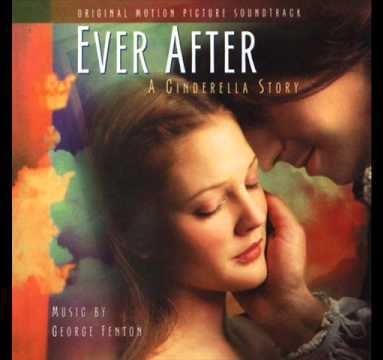
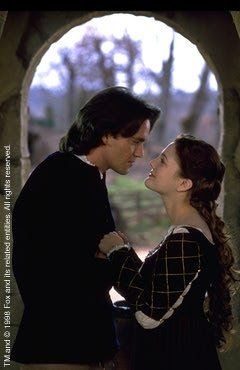
Ever After is a 1998 historical dramatic retelling of the Cinderella tale, starring Drew Barrymore as Danielle and Anjelica Houston as her stepmother. The story is set in 16th century France and includes special historical guest Leonardo da Vinci. The film opens with the Brothers Grimm invited to see “Your Majesty,” (the old woman is never named) who finds their collection of folk tales charming, but she would like to set the record straight on the “Little Cinders Girl,” who was in fact her great-great-grandmother, Danielle de Barbarac.
Her tale begins with eight-year-old Danielle happily gaining a new mother and two new sisters; the Baroness Rodmilla de Ghent,Marguerite, and Jacqueline. Her own mother has been dead for some time, the servants commenting that Auguste de Barbarac raised the girl on his own However, he must travel shortly after his marriage and tragically suffers a heart attack and dies in the drive.
Ten years pass, according to our narrator, before another man enters Danielle’s life. The King and Queen of France are discussing the arranged marriage of their son, Henry to the princess of Spain. But when they go to wake their son to join their discussion, they find he has run away, again. To continue with his flight, he must appropriate Danielle’s father’s horse, startling her during her chores. He’s cloaked, so she does not see until he dismounts that the thief she’s pelting with apples in her monarch. For her silence, a bag of gold coins. Danielle uses these to buy back an old servant, Maurice, the husband of one of the two women left. To do so, she must dress as a noblewoman (I assume she borrows gowns from her stepsisters), a great risk at this time period as such an act is punishable by death.
Henry runs into Leonardo da Vinci during his flight and is honor-bound to retrieve a painting a band of gypsies have stolen. Of course, it’s the Mona Lisa. This delay allows the royal guards to catch up with Henry, though they must stop at Danielle’s home first, to return the horse. The Baroness, while unaware of the earlier episode between Henry and Danielle (the apple throwing), wastes no time pushing Marguerite in front of the prince. After being pleasant to the self-serving woman, Henry arrives back at the palace in time to catch Danielle (dressed as a courtier and thus unrecognizable) arguing over freeing her servant. She is well spoken, impassioned, and obviously educated, prompting him to ask for her name. She gives him “Comtess Nicole de Lancret” (borrowing from her mother, whom she apparently resembles). They have quite a conversation and Danielle unknowingly echoes his parents’ words, that as a prince, he has been born to privilege and with that comes certain obligations. In her case, he has a duty to his country and the people in it, including the hard-working peasants.
In the King’s and Queen’s case, Henry has a duty to marry for political gain, never mind love or the fact that he doesn’t want the crown. King Francis compromises with his son; they will throw a masked ball “in honor of Senior da Vinci,” at which time, Henry will announce his engagement. Henry has until then to find a love match, or King Francis will announce the engagement to the Spanish princess. Queen Marie cautions that “divorce is only something they do in England (historical note: this is a call out to Henry VIII who famously divorced two of his wives: if you have any further questions on this matter, I will happily discuss!)
News of the ball that has been opened to all eligible maids of the kingdom has reached the Baroness (through a spy in the royal guard) and she begins scheming to pair Marguerite with Prince Henry. She shows her daughters Danielle’s dowry, a gorgeous gown of her mother’s; Rodmilla intends for Marguerite to wear it instead. Jacqueline protests, arguing they should include Danielle; she is the only family member to treat her stepsister decently. The Baroness is offended by Danielle’s manner, particularly after “all she’s done for her” and Marguerite is the one to coin the name “Cinderella.” Rodmilla dismisses Jacqueline’s suggestion, but changes her tune when Danielle enters.
The Baroness
Marguerite and Jacqueline
Over the course of the film, Henry spends time publicly with Marguerite (their scheming is unfortunately working), yet he also runs into “Nicole” several times. He takes her to the Franciscan Monastery to visit their library. They are embroiled in an adventure on their return, resulting in spending the evening with a band of gypsies. The next morning Henry informs his parents that he wishes to build a university with a vast library where anyone can study; oh, and he wants to invite the gypsies to the wedding. On the other end of the spectrum, the Baroness rudely wakens Danielle. demanding breakfast. “You have two hands, make it yourself.” This spurs Rodmilla to give Danielle’s dress to Marguerite (not that she needed much urging). Danielle is furious and when Marguerite mocks the fact that Danielle’s mother is dead; she retaliates with a richly deserved punch to Marguerite’s face. In the end, Danielle has to choose between her copy of Utopia from her father, or her mother’s shoes. She hands over the shoes, but Marguerite still drops the book in the fire. Rodmilla orders Danielle whipped (occurs off-screen) and we see Jacqueline tending to her stepsister after.
Rodmilla and Marguerite meet with Queen Marie and Rodmilla figures out that Danielle has been playing the comtess and seeing Henry. She spins the queen the lie that Nicole de Lancret is engaged to a Belgian. Meanwhile, Henry and “Nicole” meet alone again. Danielle tries to tell the truth, but it’s hard when the prince is declaring his love and seems so happy to have found freedom and purpose in his life; before, he had wanted to escape his gilded cage, but “Nicole” has opened his eyes to how he can care for his people and his country. Back at the house, Rodmilla confronts Danielle about her lie and about the dress she’s hidden. Danielle refuses to tell and angrily declares “I would rather die than see my mother’s on that cow!”
She’s locked in the cellar and the servants manage to get word to de Vinci to get her out. She wears her mother’s dress to the ball and arrives just as the prince was ready to announce his engagement. Rodmilla spoils their happiness, revealing Nicole as Danielle, a servant. Henry rejects her and she flees the ball in tears (leaving behind a shoe when she falls at one point). Da Vinci talks some sense into Henry and seeing how miserable the Spanish princess is during their wedding, the prince calls it off. Unfortunately Danielle has already been sold to another master; a leering landowner, Pierre le Peu. The snake would enjoy breaking Danielle, but her father taught his daughter how to use a sword. She threatens to slit her captor from navel to nose unless he releases her. She’s met outside by Henry, begging her forgiveness and proposing.
Baroness de Ghent and her daughters are called to appear in court, where Rodmilla is confronted with the fact that she lied to the queen. The monarchs first choice of punishment is to strip her of her title and ship her and Marguerite (Jacqueline is spared), to America; unless someone will speak for them. A freshly crowned Danielle appears and will speak for them, for Rodmilla is the only mother she has ever known; it is her wish that her family be treated with the same courtesy that they have treated her. Thus, Rodmilla and Marguerite are sent to be laundresses.
Henry and Danielle’s “happily ever after” features Da Vinci’s newest painting La Scapigliata (Head of a Woman) as a portrait of Danielle, a belated wedding present. Henry remarks that it looks nothing like his wife, to which Danielle rebukes “you, sire, are supposed to be charming.” We come back to the “present” where the old woman informs the Brothers Grimm that the portrait hung in the university until the French Revolution, but the most important point is that these people lived.
Re-watching Disney’s original animated movie, I don’t have anything specific against it beyond the typical comeback that you don’t fall in love with someone in an evening. At least this time the couple spoke to each other. Being an adult compared to a child, I see the king’s actions not as innocently. As a child: aww, he wants grandkids to play with; as an adult: you really shouldn’t be forcing your son into a marriage. It’s as bad as when stories attempt to marry the princess off just so she can produce heirs. Cinderella’s stepmother and stepsisters are just plain horrible. But it does have a cute little message about dreaming and hoping; except we don’t all have fairy godmothers to grant those wishes immediately.
I love that the live action remake included more backstory, for both Ella and Tremaine. I wouldn’t say we gain much sympathy for the woman, because she’s still cruel to a young woman who had nothing to do with the events that made her bitter. It’s tragic that the light and love of her life died and tragic still that her second marriage, which she understandably made to survive in the world, ended in death. But when Ella demands an answer from Lady Tremaine on why the woman is so cruel, in light of the girl being nothing but kind to her and no one deserves to be treated the way she was, all Tremaine can respond is that Ella is “young, and innocent, and good…” essentially boiling down to the excuse that she was jealous.
Cate Blanchett plays evil beautifully; the stepmother in the animated version is older, possibly attractive at one point, but those years are past. In the live-action, she still possess poise and grace and comes across with just enough gentility in public that her motivations are not questioned. She and the Grand Duke are well-matched; claiming that their actions and words are in the best interest of their charges, but really, it’s all self-serving. They come to an arrangement about Ella easily and even mutually chuckle at the fact that Tremaine is threatening the Grand Duke.
Ever After has Rodmilla explain to Danielle that her own mother was hard on her, making her strive for excellence; that is how she became a Baroness (and the mother to potentially the future queen). Immediately followed by her telling Danielle she looks so much like her father, and that’s why she’s well suited for hard labor. She later coolly remarks (the way that Anjelica Houston is so good at) to Danielle, when she begs if her stepmother ever loved her even in the smallest amount, “how can one love a pebble in their shoe?” Here, even more so than in the 2015 Disney production, the Baroness is jealous of how close her second husband was to his own daughter. Rodmilla admits to Danielle (still flippantly), she hardly knew her new husband before he died, how could she have had time to love him?
Both movies also flesh out the prince and their families. We actually have names! Kit is a very charming prince, someone I would honestly want to meet. He never treats Ella as a damsel in distress, beyond “rescuing” her from her runaway horse. Kit genuinely cares about his kingdom, mentioning that the war was hard on everyone in the kingdom; a trait I believe he picked up from his father. He accepts his role as future monarch. He is a more vibrant counterpart compared to his animated original. In a different characterization Henry does seem spoilt in the beginning of Ever After but that makes it a more interesting arc. He is educated and asks da Vinci for advice in progressive thinking. Henry displays some of his indulged princely airs at the ball, when he dismisses Danielle and later when he informs da Vinci “I will not yield!” But he’s humble when he asks for her hand.
And our princesses are far better role models in the live action films. Danielle rescues herself from le Peu. She has the idea to buy back her servant (truly more of a friend); she speaks directly to the prince and makes him see the truth, she defies her stepmother to keep her mother’s dress safe. In the end, she could even let the king and queen send her horrid family members to America, instead, she grants them some small measure of mercy. Ella is intelligent as well, proving her knowledge of French to her stepfamily (and confusing ditzy Anastasia and Drisella). She speaks quickly to the king as she’s leaving the ball, intrepidly informing the monarch of his son’s love. Her words leaves an impression with the king, which is why he urges Kit to find her and marry her, for love. These women truly show that hard work (which is dirtier than portrayed in animation) will be rewarded.
Baroness de Ghent’s gown
The Ever After ball gown
2015 ball gown
I adore the costumes in both the live-action films. The ballgown from the 2015 Disney re-make is simply gorgeous. That skirt is enormous and I’m certain that it was not easy to walk or dance in all those layers, but it had the right amount of sparkle. Ever After had a profound impact on me, setting the romance in a historical period, which historical clothes, and showing me a “modern” heroine in those times. (On a personal note: that’s the kind of heroine I am planning for my own fantasy series), making it my favorite version if I was forced to choose.
Questions? Comments? What’s your favorite version of Cinderella? Let me know!
Ah yes, Disney. I’m in the generation that grew up during the coined “Disney Renaissance,” the early nineties when they put out some of their best work. Hercules, Lion King, Little Mermaid, Aladdin all had cartoons on the Disney Channel. I love Winnie the Pooh to this day. I sing along with Disney songs almost anywhere. Very nostalgic.
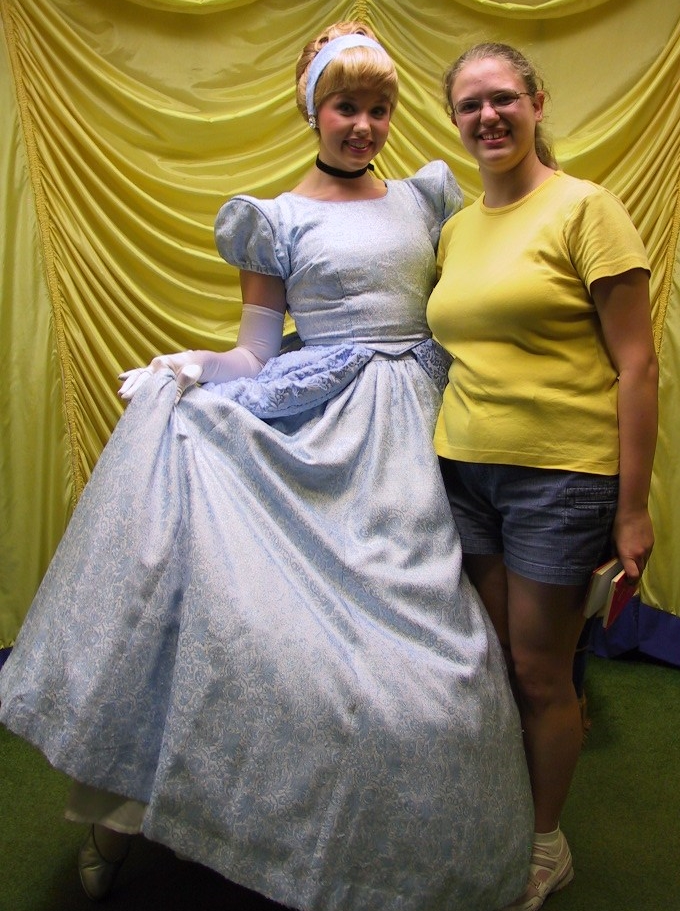
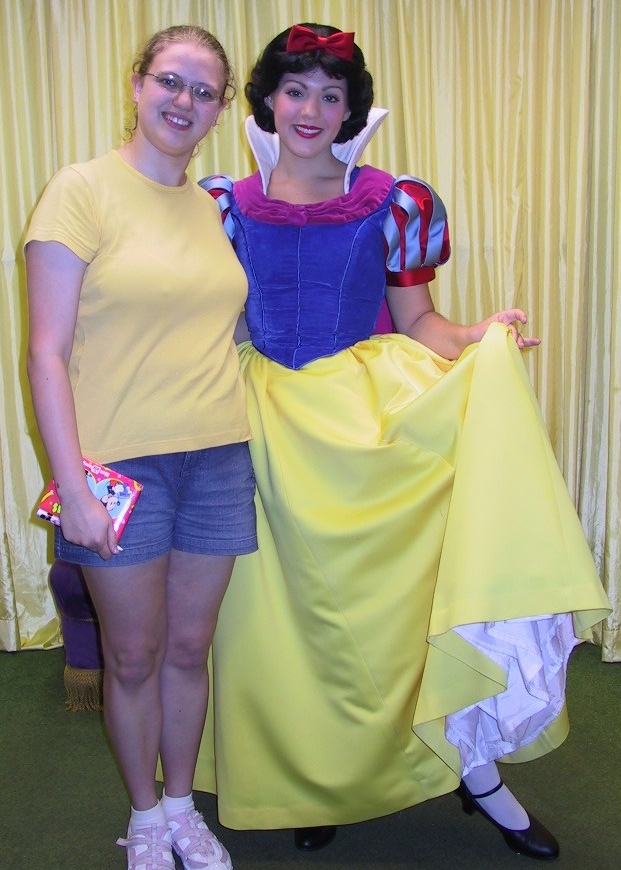
I’ve been to Disney World once, on a band trip my senior year of high school. This is at the Princess Meet-and-Greet
But, going to start with the first full length animated movie. Released in 1937, it retells a Brothers Grimm tale about an evil sorceress who becomes the stepmother to a beautiful princess, named Snow White due to her “skin as white as snow” (it’s a fairy tale, they can have…not normal names). But the queen is jealous and wants to be known as the fairest in the land (here, they use “fair” as a synonym for “beautiful” because the queen is certainly not kind.) When her magic mirror tells her otherwise, she orders a huntsman to kill Snow White and bring back her heart as proof. Because Snow White is the eternal optimist (her mannerisms remind me of Shirley Temple, a child star of the same era), the huntsman can’t bring himself to kill her. Instead, he tells her to run away into the forest and never return.
That forest has given children nightmares; falling in line with the purpose of original fairy tales to scare children into behaving. Snow’s fear fueled the terrifying images, until she calms down and sees it for cuddly woodland creatures. Those bunnies are absolutely huggable. They lead her to a filthy house in the middle of the woods and they all clean!
Okay, let’s interrupt the narrative a little further to discuss a few things. Modern women look back on this and huff about how the princess just wants to clean and take care of men/children. Let’s remember when this was produced; women were not a major part of the workforce yet. And, the original Grimm fairy tale was unlikely to be proponent for women’s rights. Re-watching this, I take it as, that’s what she wants to do, fine. I don’t have to. However, can someone explain to me when woodland creatures learned how to clean a house?
Returning to the story; they all whistle while they work and take a well deserved nap afterwards. The owners of the house, seven dwarfs, not orphaned children, return from their work in the mine. At first, they’re suspicious about having an intruder in their home, yet that melts away when they discover it’s a beautiful young woman.
They’re smart enough the next morning to warn Snow White that the queen will still be hunting her and to not let strangers in the house (good message for kids). Snow’s not the smartest apple in the barrel and willingly talks to a haggard old woman (personal vendetta: not all witches are evil, and why do they have to be ugly? The queen goes through all that work just to be known as the prettiest? Alas, those all fall into traditional fairy tale tropes). When the birds try to warn Snow White, she takes pity on the woman – and does the thing that the dwarfs just told her not to do! Proving that animals are smarter than humans, the woodland creatures fetch the dwarfs. Sadly, it’s too late. Snow White has fallen prey to the Sleeping Death, though not permanent death, since the queen cackled the dwarfs would bury her alive.
Classic Disney death, the queen falls off a cliff followed by a boulder (though not every death is accompanied by creepy vultures). The dwarfs hold vigil for months; we witness the changing seasons. And the prince has been searching for months for this young woman. Yep, that classic trope of love at first sight, and love’s first kiss. “And they lived happily ever after” completes the fairy tale.
I can understand “I’m Wishing;” she’s a fourteen-year-old princess from some undetermined historical period. Entirely accurate to be wishing for a handsome prince to marry (doesn’t quite jive with modern viewpoints, again, it’s the thirties). Young girls and tweens still wish for a prince to see them off their feet. Fully grown women still secretly wish for love (we just know it’s a lot harder to acquire).
Snow White’s song is interrupted by a strange prince coming up to her, then serenading her. I reiterate my question: how do you love her if all you’ve done is listen to her and see her for thirty seconds? Later, Snow White tells her new dwarf friends she dreams of her prince returning. Okay, first issue, how do you honestly know he’s a prince? He could be lying, a vagabond that stole the prince’s clothes. And you know you’ll be happy, how? We keep circling back to the fact that you’ve known each other all of a minute. That is not love, that’s barely infatuation or a crush. One is essentially saying, “oh he/she is cute.” It means nothing. You’ve never spoken to each other. This is not how marriages worked even in the medieval or Renaissance time. Arranged marriages were negotiated. Royalty had to go through a rigmarole to get married. Guess we’ve got to chalk it up to “because it’s a fairy tale.”
The seven dwarfs of Disney
Tolkien’s Company of Thorin Oakenshield
I’ve gotta to compare the dwarfs here to the dwarves of Tolkien, brought to life by Peter Jackson. There are some similarities; they have memorable names: Happy, Sleepy, Bashful, Doc, Sneezy, Grumpy, and Dopey vs Balin, Dwalin, Bifur, Bofur, Bombur, Oin, Gloin, Ori, Dori, Nori, Fili, Kili, and Thorin. They’re all miners, though, the Tolkien dwarves are far more traditional. Children, that is not how gems are mined and smart people do not throw away the slightly imperfect ones. They’ve got fun songs: Heigh-Ho vs Blunt the Knives (those dwarves clean up similar to woodland creatures). And they’ve all got beards, for the most part and color-coded garments. However, Tolkien created a wonderful history for the dwarves, rich in culture. His are characters that take part in the grand scheme of things. Disney’s are…lifelike garden gnomes. And would you really want to go up against the dwarves from the Hobbit?
In conclusion, Snow White has never been a favorite Disney movie of mine, but re-watching it, it’s not too bad. Fine watching if there’s not much else on TV, but not something I would be in a hurry to elect to put on. Kids, do not talk to strangers or accept food from strangers or let them in your house. Most of the other views are honestly outdated, but if you don’t let yourself get distracted…. I respect it for being groundbreaking for animation. I do have to say, I enjoyed the recharacterization that Once Upon A Time made to Snow. I can totally get behind a woman who takes her destiny into her own hands and kicks butt at the same time.
I do not intend to do an analysis on Once Upon a Time. I love the show, but it’s seven seasons.
Questions? Comments? Want me to do OUAT? Let me know.
This is the product of “I have a writing degree, I should be using it!” and being a proud fangirl. You get me hooked on a show, I will watch it and then read fanfiction and read behind-the-scenes about it (i.e. Supernatural, thanks to you-know-who-you-are). Yes, I read fanfiction. I’ve learned a fair bit from fanfiction; there’s good and bad. If it’s badly written, I skip. But there are some amazing ones that will actually confuse me on whether it’s canon or not.
Given a day off, I prefer to sit and read, or write, or watch a movie or show (or re-watch for the twelfth time). And having the background of both a history and English major, I pick up on things. Recently while watching How to Train Your Dragon, I got to thinking that “Hiccup resembles a typical hero path from Hero with a Thousand Faces“, a book I am familiar with from reading for an assignment in college. So, since the student hasn’t completed faded from me and boiling down to “because I can” I started to write a paper analyzing that very thought. Which was followed by “I love this episode most” or “that’s really interesting from a story perspective.” I also get really excited talking about movies or shows or books that interest me, in a “hey, did you know this?” way. For instance, me figuring out at ten o’clock at night and loudly exclaiming that Il Duce from Boondock Saints (played by Billy Connolly) “Oh my god, that’s Dain!” (Thorin’s cousin, Lord of the Iron Hill Dwarves from Battle of the Five Armies). And he voices Merida’s father in Brave.
Also, I have an amazing friend who began her own blog recently [go check out closetwarrior and discover casual cosplay] and that urged my brain “hey, if she can do it, so can you!”
While my some favorites are How to Train Your Dragon and Lord of the Rings, those can get incredibly in depth; thus, it will be a while before I dive into those worlds. In the meantime, I’ll begin exploring the range of my other interests, from musicals to period pieces to action/adventure and even a few cartoons.
Standard Disclaimer: First, here, there be spoilers! Second, this is my opinion on a show or movie; people can have different opinions (my friend loves Nightmare Before Christmas, I have not seen it). I am welcome to discussion; not name-calling. Please be considerate and kind.
Next Time: Starting off with Avatar: The Last Airbender










 Dreamer in the Mirror