“Turn to page 394”

Prisoner of Azkaban

First, apologies that this is so late in coming; life got a little topsy turvy at the end of 2023; though hopefully it will settle into something manageable now – I have a regular schedule and have left retail behind.  So, let’s jump back into our journey with my favorite Harry Potter.  I adore the book, the film, even the soundtrack.  I also remember a birthday party my best friend threw that was Harry Potter themed, and she had a sweatshirt that looked like Hermione’s.  There’s a picture somewhere.  I think that party even including going to see the film in IMAX at the Carnegie Science Center in Pittsburgh.

Gary Oldman (he finally won an Oscar in 2018 for portraying Winston Churchill in Darkest Hour, but he’s also been James Gordon in Christopher Nolan’s Dark Knight movies.  He was in Tinker Tailor Solider Spy [which I know by name only and all the commercials about it], he was also in Red Riding Hood, the voice of the villain Ruber in Quest for Camelot, starred as Dracula in Bram Stoker’s Dracula [I’ve seen scenes from, courtesy of my college roommate], but I will always first remember him as Ivan Korshunov in Air Force One) is brought in as Sirius Black.  David Thewlis (he’s been playing bad guys lately, but we love him as Lupin; he was Grail in Enola Holmes 2, Sir Patrick/Ares in Wonder Woman, though he was in Kingdom of Heaven) as Remus Lupin.

Emma Thompson (P.L. Travers [the author of Mary Poppins, in Saving Mr. Banks, the voice of Elinor, the mother in Brave, and she voiced Captain Amelia in Treasure Planet; she met back up with Emma Watson in the live action Beauty and the Beast as Mrs. Potts.  She’s the titular Nanny McPhee, and starred opposite Alan Rickman in Sense and Sensibility,and I find this hilarious; she’s Trunchbull in the film on Matilda the Musical…considering she was in this film with the one who was Trunchbull in the film) as Sybil Trelawney, and Michael Gambon (he is often mistaken for Ian McKellan [there was a running gag between the two, which I’ll get into when we go behind the scenes in Hobbit and Lord of the Rings], though he has also appeared in The Hollow Crown, a few episodes of Doctor Who, The King’s Speech, and Amazing Grace, and sadly passed away last September) takes over as Albus Dumbledore. 

We’ve seen Timothy Spall in Sweeney Todd (Alan Rickman is also in the film; which I’ve watched once and don’t intend to watch again), Nathaniel in Enchanted, and Simon in Last Samurai (we blame this on my high school boyfriend); here, he’s Peter Pettigrew.  Pam Ferris (she was in the Tolkien movie [which we will cover], and I will always remember as Trunchbull in the 1996 Matilda film with Danny DeVito and Mara Wilson) makes an appearance as Aunt Marge and Julie Christie is Madame Rosmerta.  There is also a new director, and this was the last Harry Potter film that John Willams composed [who just won his 26th Grammy for Best Score for the latest Indiana Jones film at the age of 92].

We start back in Privet Drive for summer holidays, which Harry is not enjoying.  He has to do his homework at night because Aunt Petunia and Uncle Vernon tried to lock his school supplies away, but Harry snuck some out and keeps them hidden in his bedroom.  Ron attempted a phone call, but that did not end well.  Harry does manage to hear about an escaped prisoner, Sirius Black, but doesn’t think much about it.  Vernon’s sister, Marge comes for a visit and she delights in hearing how Harry attends St. Brutus school for criminal boys.  Harry has to stay on his best behavior so Vernon will sign his permission slip to visit Hogsmeade village.  But she goes too far in insulting Harry’s parents and in his anger, Harry manages to blow Aunt Marge up like a balloon.  He grabs his stuff and makes a run for it, “anywhere is better than here.”  He does spot a dark dog in the shadows while he escapes, but is almost flattened by a purple triple-decker bus; the Knight Bus, which rescues stranded witches and wizards.  Harry has it take him to the Leaky Cauldron in London.  In the film, it’s a harrowing ride, zooming between traffic with a fast-paced soundtrack.  Onboard, Harry catches a glimpse of Sirus Black in the Daily Prophet and finds out he’s wanted in the wizarding world for being a supporter of Voldemort and murdering thirteen people with a single curse and is the only prisoner to have successfully escaped Azkaban prison.

Harry meets Minister of Magic Cornelius Fudge at the Leaky Cauldron, who is just glad that Harry has arrived safely and waves away the matter with using magic on his aunt.  “We have a killer on the loose.”  Harry gets to explore Diagon Alley in the meantime and eventually meets up with the Weasleys and Hermione.  Scabbers, Ron’s pet rat, is looking off, and Ron is not pleased when Hermione buys a cat, Crookshanks.  Harry overhears Arthur and Molly Weasley talking about Sirius Black being after Harry.  He later convinces Mr. Weasley that he won’t go looking after Black; “why would I go looking for someone who wants to kill me?”

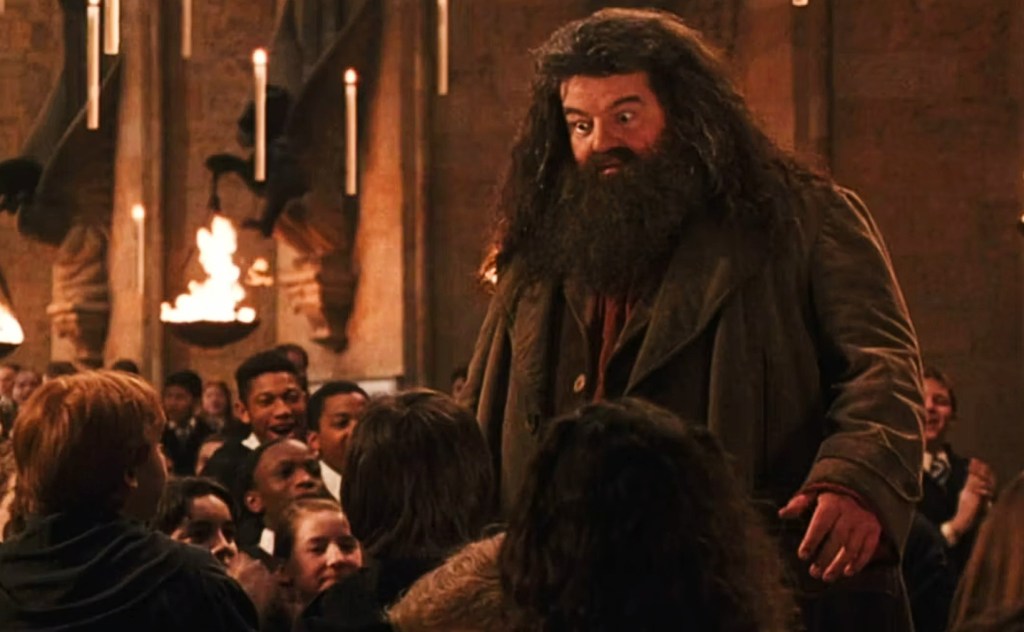
The kids return to Hogwarts and there is a man sleeping in the compartment our trio sits in, Professor R.J. Lupin according to his luggage.  They figure he is the new Defense Against the Dark Arts professor.  The train makes an unplanned stop, becoming freezing cold as the Azkaban guards, dementors, enter, searching for Black [they do look a bit like the Nazgul from Lord of the Rings].  Harry hears screaming and passes out; the dementors are chased away by Lupin, who then feeds Harry chocolate to combat the after effects.  Harry notes that Snape seems to loathe Lupin upon sight, but the trio are happy for the new teacher and that Hagrid is the new Care of Magical Creatures professor; which also explains the Monster Book of Monsters that tries to bite your hand when you open it.  Harry feels home at last in his dormitory.  The track Double Trouble from the soundtrack, performed by a student choir, has lyrics based on the witches from Shakespeare’s MacBeth: “Double, double, toil and trouble/fire burn and cauldron bubble” etc. (which is why I wanted to read that section when we read it in AP English senior year of high school).

I think Michael Gambon gives an excellent start-of-year speech, balancing sternness one expects from a headmaster, and the quirkiness who know the character to has, ending with “you know, happiness can be found, even in the darkest of times, if only remembers, to turn on the light.”

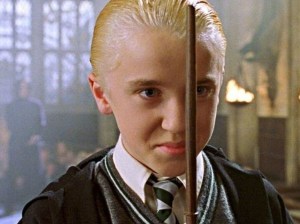
The friends start their new classes, though Ron and Harry wonder how Hermione is attending all of hers.  In addition to Care of Magical Creatures, they’ve signed up for Divination, where Professor Trelawney is quick to determine that Harry’s teacup shows the Grim, a large black dog, an omen of death.  Hermione is not keen on the subject.  In the book, McGonagall is quick to inform her third years students “Sybill Trelawney has predicted the death of one student a year since she arrived at this school.  None of them has died yet.  Seeing death omens is her favorite way of greetings a new class (pg. 109).”  But they’re soon distracted by meeting hippogriffs in their first class with Hagrid.  Hagrid has Harry ride Buckbeak to show the other kids he’s not dangerous (accompanied by a brilliant Willams’ soundtrack).  Draco, trying to prove his bravery, insults the hippogriff and gets scratched, which puts a damper on everything. 

Defense Against the Dark Arts becomes an exciting class.  Lupin shows them how to defeat boggarts, which shows people their greatest fear.  But they are defeated by laughter and the spell Riddikulus; one must imagine how to turn their fear into something funny.  Lupin’s first student is Neville, who fears Professor Snape [we’ll get into why this is a mark against Snape down the road].  He imagines Snape in his grandmother’s clothing, and it is rather funny (and kudos to Alan Rickman for wearing that).  Lupin prevents Harry from facing the boggart.  Later, Harry asks him why (and I love this scene in the film; set on a bridge and accompanied by a bittersweet theme).  Lupin admits he figured that Voldemort would appear.  Harry first thought of Voldemort, but then remembered the dementors.  Lupin commends Harry; what Harry fears the most is fear; it’s very wise.  Harry admits he heard screaming and has figured out it was his mother screaming, the night she was killed.  Lupin explains that dementors force a person to relive their very worst memories; “our pain becomes their power.”  And Lupin knew Harry’s mother; she was a gifted witch, but also an uncommonly kind woman.  She could see the beauty in others, particularly when they couldn’t see it themselves.  Lupin also knew James and comments he had a talent for trouble, which rumor has it, Harry has inherited.  “You’re more like them than you know, Harry.”

The film uses the Whomping Willow to track the seasons, which is a beautiful imagery.  Halloween evening, the portrait of the Fat Lady is attacked by Sirius Black.  Dumbledore has the castle searched and the students sleep in the Great Hall.  When Snape expresses concern to the headmaster that Black may have inside help, Dumbledore responds “I do not believe a single person inside this castle would have helped Black enter it (pg. 166).”  Harry also overhears Snape ask Dumbledore if Harry should be warned.  The headmaster responds “perhaps, but for now, let him sleep.  For in dreams, we enter a world that is entirely our own.  Let them swim in the deepest ocean, or glide over the highest cloud.”  (Again, wonderfully written and wonderfully spoken.)  Sir Cadogan is the temporary portrait and delights in changing the password constantly.

One day, Snape has to fill in for Lupin in Defense Against the Dark Arts, which is a position he covets.  He elects to teach the class about werewolves, which they’re not supposed to be studying yet.  “Turn to page 394,” he directs (who knew that line would become iconic?)  Hermione attempts to answer Snape’s questions, but he ignores her and when she persists, he rounds on her, “are you incapable of restraining yourself or do you take pride in being an insufferable know-it-all?” [let’s point out this is another point against Snape as a good guy]

In Quidditch, the Gryffindor team is determined to win the Cup this year.  They play against Hufflepuff and their seeker, Cedric Diggory, in a torrential downpour.  However, when Harry is about to get the Snitch, a chill comes over him and he hears his mother’s screams.  He falls off his broom, slowed only by Dumbledore.  They lose the match and Harry’s broom had flown into the Whomping Willow, and is now in pieces.  Afterwards, Harry goes to Lupin for help; Lupin was able to make the dementors on the train leave and he wants to learn.  Lupin accepts, and stresses that Harry is not weak.  He has true horrors in his past.  But lessons will have to wait until he is feeling better.

Fred and George Weasley decide to help Harry get into Hogsmeade undetected, and pass along the Marauder’s Map, created by Messrs Moony, Wormtail, Padfoot, and Prongs.  It can be opened with the phrase “I solemnly swear I am up to no good” [just about the most iconic phrase of the entire series] and closed with “Mischief Managed.”  It shows where everyone is within Hogwarts, every minute of every day.  Allowing Harry to sneak around.  Harry’s able to visit the Three Broomsticks and order butterbeer, and Honeydukes, the sweet shop, and take a look at the Shrieking Shack, which is supposed to be the most haunted spot in Britain. 

While sitting with Ron and Hermione in the Three Broomsticks, they see Minister Fudge enter with Hagrid and McGonagall.  They hear the phrase “Sirius Black,” and Harry sneaks up to overhear their conversation.  He discovers that Sirius was best friends with his father, James, and to this day, remains Harry’s godfather.  The story is that Sirius was serving Voldemort and led him right to the Potters the night they were killed.  McGonagall remarks in the film, “Sirius Black may not have put his hands to the Potters, but he’s the reason they’re dead.”  Harry is upset and Ron and Hermione rush after him.  “He was their friend, and he betrayed them….I hope he finds me, because when he does, I’m going to be ready.  When he does, I’m going to kill him!”

In the book, Harry receives the new Firebolt broomstick for Christmas.  He’s thrilled, but Hermione reports it to McGonagall because she believes that it was sent by Sirius Black.  The broomstick is confiscated and Ron is furious with Hermione.  He’s already mad at her because Crookshanks keeps trying to get to Scabbers.  Later, when Scabbers goes missing and there’s blood on Ron’s sheets, he yells at Hermione.  “It looked like the end of Ron and Hermione’s friendship.  Each was so angry with the other that Harry couldn’t see how they’d ever make up (pg. 252).”  Part of this is dropped in the film.

Harry starts attending lessons with Lupin to learn the Patronus charm to repel dementors.  It creates a Patronus, which acts as a barrier.  But it’s conjured by thinking of a happy memory.  Harry has few of those.  He tries thinking of the first time he rode a broom, but it wasn’t strong enough.  They use a boggart for practice.  Now Harry has started to hear his father’s voice as well when the dementors come near.  In the film, he succeeds by recalling a distant memory of his parents talking.  And for some reason, I love the imagery of him playing with the flame of the candle.

The next Quidditch match is against Ravenclaw; their seeker is Cho Chang, whom Harry couldn’t help but notice is pretty.  Wood shouts at him “this is no time to be a gentleman!  Knock her off her broom if you have to (pg. 291)!”  Three dementors come on to the field and Harry executes a corporeal Patronus and chase them off.  Except, they weren’t real dementors, they were Draco Malfoy and some of his cronies.  McGonagall enjoys setting a punishment on the Slytherins.  This part is left out of the film.  Also left out is an attack on Ron in the Gryffindor dormitory by Sirius Black.  He had a list of the passwords, which had been lost by Neville.

The movie and book differ a little on one incident.  Harry does play a prank on Malfoy while in Hogsmeade, under the Invisibility Cloak.  In the book, the cloak slips and Draco sees Harry, then reports it to Snape.  When Snape demands Harry turn out his pockets, he finds the Marauder’s Map.  He demands it reveals it’s secrets.  Its answer is to insult Snape and tells him “to keep his abnormally large nose out of other people’s business.”  In the film, Harry is looking at the map at night and notices someone walking around by the name of Peter Pettigrew, another of James and Sirius’ friends, whom Sirius supposedly killed.  So how can he be on the map?  Harry goes to investigate and comes across Snape.  Both the book and film do include the line “my dad didn’t strut, and neither do I,” as Harry’s comeback to Snape.  Lupin happens upon them and the map and confiscates it.  To Harry, Lupin admits he knows it’s a map and is astounded that Harry didn’t turn it in.  In the wrong hands, it’s a map to Harry.  It’s a poor way to repay his parents’ sacrifice.  Lupin won’t cover for Harry again.  As he leaves, Harry points out that the Map may be wrong, because he saw someone’s name on it that he knows to be dead; Peter Pettrigrew.

At the same time, Hagrid is preparing for a trial about Buckbeak for attacking Draco.  Hermione has been helping, and Harry eventually takes over because she’s getting stressed by all the coursework (they still haven’t figured out how she’s making it to all her classes).  She has dropped Divination, after getting into a disagreement with Trelawney.  Ron finally apologizes to Hermione, who accepts.  But the trial does not go well (helped to that end by Lucius Malfoy) and Buckbeak is sentenced to death.

The final Quidditch match of the season is between Slytherin and Gryffindor and the student body is in on the rivalry.  In the book, Lee Jordan gets in some good quips about the teams, remarking that Slytherin goes for size, rather than skill, and Gryffindor’s team is one of the best Hogwarts has seen in many years.  Penalties go against both teams; it’s a dirty match, but Harry prevails against Malfoy and Gryffindor wins.  Then the students begin studying for their tests.  Fifth years take OWLS (Ordinary Wizarding Levels) and seventh years have to pass their NEWTS (Nearly Exhausting Wizarding Tests).  During Harry’s final with Divination end with Trelawney going into a weird state and declaring that the “servant will break free and set out to rejoin his master.  The Dark Lord will rise again with his servant’s aid, greater and more terrible than ever before (pg. 324).”

The trio head down to comfort Hagrid over the pending execution of Buckbeak.  On the way, they run into Malfoy and Hermione does the best thing in the entire movie, and punches the “foul, loathsome evil little cockroach” in the face.  We agree with Ron when he remarks after Hermione says “that felt good,” “not good, bloody brilliant.”  They also manage to find Scabbers, but then have to hide from Dumbledore, Fudge, and the executioner.  Scabbers makes a run for it and they encounter a large, black dog.  Ron’s leg is injured in the process and the dog drags him under the Whomping Willow.  Hermione and Harry follow.  At the other end, they wind up in the Shrieking Shack and face Sirius Black.  The dog is an Animagus – Black.  Harry attempts to attack Black, for betraying his parents.  Black doesn’t help his case, when he declares “there’ll be only one murder here tonight.”  Harry confronts him; “you killed my parents.”  “I don’t deny it.  But if you knew the whole story (pg. 342).”

Lupin enters the Shack, then embraces Black like a brother, quipping back and forth.  Hermione shouts that Lupin is a werewolf, he’s been helping Black.  She’s known since Professor Snape set the essay.  Lupin admits he is a werewolf and he knows how to use the Marauder’s Map because he’s one of the ones who wrote it: Moony.  James was Prongs, Sirius Padfoot, and Petter Pettigrew was Wormtail.  James, Sirius, and Peter became Animagus while in school to be with Remus during the full moon.  The Shrieking Shack and Whomping Willow were put in place for Remus to hide while he was as werewolf during school.  Lupin declares that Scabbers is actually an Animagus and is Peter Pettigrew.  He insists to Sirius that they have to explain and owe Harry the truth.  “I did my waiting…twelve years of it…in Azkaban!” Sirius shouts (Gary Oldman is excellent in this scene; fans have declared that Sirius was the dramatic one of the group, but we love him for it)

And then Snape enters.  But he won’t listen to anything Remus or Sirius have to say.  Snape and Black snipe back and forth at each other, not ones to let go of their school-born animosity; “brilliant Snape, once again you put your keen and penetrating mind to the task and as usual, come to the wrong conclusion.”  Harry stands in front of him.  All three students shout Expelliarmus and knock out Snape (in the film, it’s just Harry).  Sirius finally gets the chance to explain that he saw a picture of Scabbers on Ron’s shoulder from an article in the Daily Prophet the previous summer from their trip to Egypt.  And it had mentioned that the boys were attending Hogwarts, where Harry is.  So Sirius escaped as a dog and set out to hunt Peter down.  He admits to Harry he as good as killed his parents, because it was Sirius’s idea to switch to Peter as the Secret Keeper at the last minute.  It was Peter who betrayed the Potters.  The night they died, after Sirius saw, he went after Peter and confronted him.  Peter blew the street up as a distraction and changed back into a rat, cutting off a finger to prove his death; that’s why Scabbers is missing a toe.  Remus and Sirius force Peter to transform back into a man, and he cries and corroborates their story, but begs for his life.  Harry stops Sirius and Remus from killing him, because he figures James wouldn’t want his two best friends to become killers.  But the dementors can have Peter.  Peter proves to be the embodiments of sniveling coward, only interested in saving himself.  Sirius declares that any of the other friends would have died standing against Voldemort, protecting their friends.

That will free Sirius.  Sirius approaches Harry as they exit the Whomping Willow; as Harry’s godfather, would Harry want to live with him?  Harry eagerly accepts, and the tide turns when everyone realizes it’s a full moon.  Remus transforms and Sirius heads the wolf off as Padfoot.  Peter also manages to transform and scampers off.  Snape exits the Willow and first starts to yell at Harry, but turns and shields the trio from the werewolf [ok, to be fair, a point towards the he’s a decent guy column].  He’s pushed aside and Padfoot jumps back in.  Harry runs after Sirius and encounter dementors.  His thought of living with his godfather works for a minute; for half an hour, he believed he would live with his parents’ best friend and that would have been the next best thing to having his own father back.  But Harry collapses; the dementors are close to sucking out Sirius’s soul.  Someone else comes to their rescue.

He wakes to find that Snape has recovered and it’s his word against the teenagers and any minute, the dementors will perform their kiss and suck out Sirius’s soul.  Dumbledore tasks Hermione and Harry with saving two innocent lives and suggests three turns to Hermione.  She has a Time Turner, which is how she attends her lesson, by turning it back in time.  So she and Harry go back three hours, meaning they can free Buckbeak.  They watch her punch Draco and Harry comments, “good punch.”  Then Hermione figures out how to get the trio out of Hagrid’s hut.  Things are tense in the forest when Lupin transforms into a werewolf and comes after Harry and Hermione; Hermione had to make a wolf call to distract him from killing the other Harry, then Buckbeak swoops in to save them.  Harry also wants to see who rescued him from the dementors, thinking maybe it was his dad.  Actually, it was Harry, but his Patronus takes the form of a stag; Prongs, his father’s Animagus form. Then it’s time to fly up to Sirius and rescue him.  Sirius bids the children goodbye; Harry wants to go with his godfather, but Sirius tells Harry he’s meant to be at Hogwarts.  Besides, his life will be too unpredictable for now.  “It’s cruel, that I got to spend so much time with James and Lily, and you so little.  But know this, the ones who love us never really leave us.”  He climbs up on Buckbeak and flies away.  The two teens then race back to the hospital wing, confusing Ron. 

Snape is furious. In retaliation, he tells his students that Lupin is a werewolf, which means Lupin has to leave Hogwarts again.  Parents wouldn’t approve of a werewolf teaching their children.  Remus returns the Map to Harry, who is disappointed because their actions didn’t make a difference.  Remus points out that Harry helped uncover the truth of his parents’ betrayal, he saved an innocent man from a terrible fate.  Harry does reveal Trewlaney’s prediction to Dumbledore, who points out that Voldemort will now have a servant who is in Harry’s debt.

The school year ends and the trio return to their homes for the summer.  Hermione has dropped Muggle Studies, meaning she’ll have a normal year next year.  On the train ride home, Harry receives a letter from Sirius.  The tiny owl becomes Ron’s new pet, since he no longer has Scabbers.  Sirius admits he was the dog Harry glimpsed when he ran away; Sirius wanted to check in on him before he went north.  And it was Sirius who sent the Firebolt, consider it thirteen birthday presents from his godfather, and he also includes his signed permission for Harry to visit Hogsmeade.

The credits roll over the Marauder’s Map and if you’re watching closely, you can see pawprints shift into footprints at one point.  And again, the soundtrack is marvelous, blending all the themes from the film.  Again, this is my favorite book and film of the series.  I think the acting was superb in this film; yes we poke fun at Gambon in the next film, but this film showed him as a worthy successor to Richard Harris.  I like that there are no spiders or snakes in this film.  This is a personal story for Harry.  Yes, Voldemort is mentioned and he remains a threat, but he doesn’t actively show up (only time in the series).  We’re introduced to friends of Harry’s parents…we want more Marauders stories!  (Which is what fanfiction is for).  People who can connect Harry to these figures whom he desperately misses.  Sirius Black is one of my favorite characters and Gary Oldman plays him to perfection.  We wish alongside Harry for Sirius to take him away from the Durselys.  Each book reinforces that these people don’t want him, mistreat him; his only home is Hogwarts.  And here comes his father’s best friend; the man his parents chose to look after him, and if he’s freed, Harry is free, and we mourn alongside Harry when that’s not allowed to happen.  This also was one of the best twists I recall reading; Rowling having us think that Sirius Black is the mass murderer and then he turns out to be innocent and someone else is responsible, who was hiding all along.  And fans wish that Sirius was a little less impulsive that night and could have raised Harry.  And we’ll throw Remus in there as well.

Up Next: Goblet of Fire
“Fear of a name only increases fear of the thing itself.”

Harry Potter and the Chamber of Secrets

Harry and his friends are back for another year at Hogwarts.  Our main cast is still young and are joined by Mark Williams (he’s Rory Willaims’ father in Doctor Who, made other appearances in BBC shows, as well as Billy in Stardust, Wabash in Shakespeare in Love, and Horace in the live action 101 Dalmatians) as Mr. Arthur Weasley, Jason Isaacs (he voiced the Inquisitor in Star Wars Rebels and Zhao in Avatar: The Last Airbender) as Mr. Lucius Malfoy, and the voice of Toby Jones (most recently he was Basil Shaw in Indiana Jones and the Dial of Destiny, Arnim Zola in the MCU, and voiced Owl in Christopher Robin.  He was Culverton Smith in an episode of Sherlock, appeared in the Hunger Games movies, Doctor Who, Amazing Grace, and Snow White and the Huntsman, as well as the royal page in Ever After) as Dobby.  Kenneth Branagh (he is now Hercule Poirot in the recent Agatha Christie movies [which he also directed]: A Haunting in Venice, Death on the Nile, and Murder on the Orient Express.  He was Cherevin in Jack Ryan: Shadow Recruit with Chris Pine [he also directed], and is very famous for his acting and directing work in productions of Shakespeare, notably Hamlet and Henry V.  We’ve also noted he’s directed the live action Cinderella film and the first Thor film of the MCU) is Gilderoy Lockhart and Miriam Margoyles (she was in an episode of Merlin, and was the voice of the Matchmaker in Disney’s animated Mulan, as well as the grandmother in Balto) is Professor Sprout.

A trend we will see throughout the series is that Harry starts each new adventure back at the Dursleys for summer break, missing Hogwarts.  This year, so far he has not heard from any of his friends; his school things are locked away.  The Dursleys are preparing for a dinner party and Harry is to “be in my bedroom, making no noise, pretending I’m not there (pg. 6).”  Except, he has an unexpected guest in his bedroom, a creature he finds out is a house-elf, named Dobby, who warns Harry not to return to Hogwarts, there is a “plat to make most terrible things happen (pg. 16).”  Harry insists he will return to the magic school.  It comes out that Dobby has been stopping his mail and he won’t return the letters until Harry promises he won’t go back.  The house-elf takes off running and floats dessert over the guests’ heads, getting Harry in trouble, both with the Ministry of Magic and the Dursleys; “Dobby must do it, for Harry Potter’s own good.”  Vernon takes great delight in putting bars on the window of Harry’s room, ranting he’ll never go back to school or see his friends again.  

Harry is luckily rescued by Ron, Fred, and George Weasley in their father’s flying car and we all get to witness our first magical home, where the dishes wash themselves and knitting needles turn out work by themselves.  Molly is furious with her son, “beds empty, no note, car gone!” but pleased to see Harry.  We meet Arthur Weasley when he returns home from work at the Ministry, the Office of the Misuse of Muggle Artifacts; he only berates his sons when his wife glares at him.  He turns to Harry and eagerly asks “what is the function of a rubber duck?”  Dumbledore even sends Harry’s school list to the Burrow.  Harry accompanies the Weasley family to Diagon Alley for school supplies.  He’s introduced to Floo Powder as a method of travel; he ends up in Knockturn Alley and luckily Hagrid shows up to lead him where he wants to go.  He, the Weasleys, and Hermione run into Draco Malfoy and his father, Lucius, in the bookstore, where they also meet their new Defense Against the Dark Arts teacher, Gilderoy Lockhart.  There’s a scuffle between Lucius and Arthur, then Harry spends the rest of the summer at the Burrow, referring to it as the happiest in his life.

They take Arthur’s car to the train station, but are running late, so Ron and Harry will be the last through.  Except, when they try to get on to the platform, the barrier is sealed.  They reason they’ll wait by the car, then Ron suggests they fly the car to Hogwarts.  There’s an Invisibility Booster, so they shouldn’t be seen, but it malfunctions.  The film shows a more exciting ride, though the big finish is landing on the Whomping Willow at the school and the car getting pummeled.  It ejects the two boys and their things, then drives off into the Forbidden Forest.  Snape gets ahold of them first and informs them they were seen, and put the whole Magical World at risk of being discovered.  If it was up to him, they’d both be on the train home that evening.  However, their fate lies with Professor McGonagall.  They won’t be expelled, yet, but their actions were very serious, so they will both serve detention.

Their first lesson as second years is Herbology, where they repot Mandrakes, which look like babies in the roots, and they scream very loudly.  Neville faints at the sound.  Harry also meets an eager first year, Colin Creevy, who is fascinated with Wizarding photographs and wants some of Harry.  Which leads to Lockhart finding out and attempting to give Harry advice about fame; Harry would rather run away.  Lockhart introduces his class: “be warned!  It is my job to arm you against the foulest creatures known to wizard kind!  You may find yourselves facing your worst fears in this room.  Know only that no harm can befall you whilst I am here.  All I ask is that you remain calm (pg. 101).”  Then he sets loose Cornish Pixies and is ineffective and capturing them again, leaving Harry, Ron, and Hermione to finish the job.

Harry runs into Draco again on the way to Quidditch practice and finds out that Draco is the new Seeker for Slytherin, and his father donated new brooms to the team.  Hermione remarks that all the players on Gryffindor got in on pure talent; no one had to buy their way onto the team.  Draco retorts the no one asked for the opinion of a filthy Mudblood.  Ron tries to stand up for Hermione and tells Draco to eat slugs, but his wand was damaged by the Willow and the spell backfires on Ron, causing him to belch up slugs.  Harry is informed what a Mudblood means (dirty blood, magical child of Muggle parentage), then has to spend his detention with Lockhart. 

As the hours wain on, he hears a strange voice.  But Lockhart doesn’t.  Harry hears it again as he heads to the common room and follows it to discover a pool of water and Mrs. Norris hanging on the wall with the ominous phrase “The Chamber of Secrets has been opened.  Enemies of the Heir, beware” on the wall.  (In the book, this is preceded by Nearly Headless Nick’s Deathday party, but that was omitted in the film).  Harry is discovered at the scene, and Filch wants to condemn him, but Snape actually points out that Harry might just be in the wrong place at the wrong time.  However, what brought him there?  Harry does not admit that he heard a strange voice (Snape instead tries to get Harry off the Quidditch team in the book, but McGonagall sees through that).

Hermione speaks up in class (Transfiguration with McGonagall in the film, History of Magic with Professor Binns in the book) to ask about the Chamber of Secrets.  The students learn a little more about the Founding of Hogwarts by Rowena Ravenclaw, Helga Hufflepuff, Salazar Slytherin, and Godric Gryffindor.  Slytherin wanted to be more selective on who was taught at school, keeping it to pureblood families.  The rest of the Founders disagreed and so legend states that Slytherin built a secret chamber and housed a monster that could rid the school of non-pureblood students.  (Mrs. Norris’ owner, Argus Filch, is shown to be a Squib, a non-magical child of magical parents).  The trio of course decide to investigate and reason that Malfoy is the Heir of Slytherin, with his family history in Slytherin and stance on purebloods.  Hermione figures the best way to question him would be to use Polyjuice Potion, so they could transform into other Slytherin students and find out.  The film doesn’t show that they have to get Most Potente Potions from the Restricted Section; they trick Lockhart into signing a permission form (Hermione is one of the students who is in awe of Lockhart).

Harry faces Draco on the Quidditch field first, Wood telling him “get to that Snitch before Malfoy, or die trying (pg. 167).”  Well, during the game, a Bludger goes rogue and only follows Harry.  Draco calls out “training for the ballet, Potter?” while Harry tries to dodge the heavy ball.  Then it’s a race between the two of them to catch the Snitch.  The Bludger finds it mark and breaks Harry’s arm, but he manages to catch the Snith.  Then Lockhart runs over to help Harry and instead of mending his broken bones, makes them disappear.  Harry ends up in the Hospital Wing to regrow his bones.  Dobby the house-elf appears again and Harry finds out it was the elf who stopped the barrier and set the Bludger to attack him.  We do manage to feel bad alongside Harry when we find out how Dobby is treated, but their conversation is cut short by teachers arriving with a frozen Colin Creevey.  Dumbledore is sure now that the Chamber is indeed open.  But the question is who, not how.  In the film, he admits to McGonagall that the students are in danger and Hogwarts is no longer safe.  [But he doesn’t send them home yet.]

So, the Headmaster allows Lockhart to start a Dueling Club for the school and Snape somehow becomes Lockhart opponent [how did that happen?  Did he volunteer?  Was he asked?  By whom?].  The opponents trade salutes like in a saber duel and Snape manages to teach the students a useful spell: Expelliarmus, and make a fool of Lockhart at the same time.  Lockhart nominates Harry as the next student and Snape brings up Draco Malfoy.  “Scared, Potter?”  “You wish.”  They attempt more than disarming and Draco fires a snake at Harry.  But before the professors can banish it, Harry speaks to it and orders it away from another student.  However, everyone is in shock and a little afraid (look at Snape’s expression in the movie; he was certainly not expecting that and probably brings up a whole host of questions).  Ron questions Harry about the ability and reveals that Harry can speak another language: Parsletongue.  It was an ability Slytherin himself prized.  So now everyone is going to think Harry is the Heir of Slytherin, and many students do.  The Weasley twins try to make a joke of it, but it wears on Harry.  And as Hermione points out, Harry doesn’t know that much about his family in order to dispute it.  Then, another student is attacked, through Nearly Headless Nick.  Dumbledore finally asks Harry if there is anything he’d like to share with the older wizard.  Harry keeps quiet, especially after questioning the Sorting Hat and finding out the Hat still thinks Slytherin would have been a good fit.  He also meets Dumbledore’s phoenix, Fawkes, in the Headmaster’s office.  [I notice a similarity between Fawkes’ theme and the love theme from Attack of the Clones, both written by John Williams and both films came out in 2002.  That is also why a lot of the themes from the first film were reused in this film.]

There are some deleted scenes from the film that show the other students; mainly Hufflepuff, discuss Harry as the Heir of Slytherin.  One surmises that maybe Voldemort went to kill Harry because he didn’t want another Dark Wizard competing against him.  There’s also a beautiful scenic shot of Harry and Hedwig, sitting away from the castle and looking back at it.  Harry asks his companion, “who am I, Hedwig?  What am I?”

The Polyjuice Potion is ready at Christmas; Ron and Harry manage to transform into Crabbe and Goyle, but Hermione can’t join them.  They find their way to Slytherin’s Common Room and talk to Draco.  Luckily, Crabbe and Goyle are already a little dim, so Draco readily tells them again, he doesn’t know who the Heir is; his father won’t tell him.  But the last time, someone died.  Ron and Harry report back to Hermione and find out that the hair she used was cat hair.  She goes to the Hospital Wing to get transformed back.  Harry also finds a book thrown through Myrtle; when he examines it, it’s blank, but it belonged to a T.M. Riddle.  Ron recognizes the name from an award he had to polish, from fifty years ago.  They had discovered the last Chamber of Secrets attacks were fifty years ago.  Harry examines the diary further and attempts writing in it: it writes back.  Tom shows Harry his memory of catching the culprit; Hagrid.  But Harry refuses to believe Hagrid is truly at fault.  Before he can get more information, his room is trashed and the diary is gone.

Harry hears the voices again on the way to a Quidditch match and Hermione heads to the library; “because that’s what Hermione does, when in doubt, go to the library (pg. 255).”  The match is canceled and McGonagall informs Ron and Harry that it was Hermione and another girl who were attacked, holding a mirror.  New rules are set in place and everyone is under a curfew.  Harry drags his dad’s Invisibility Cloak out again and he and Ron sneak down to Hagrid’s.  But they’re not the only ones to show up.  Dumbledore and Cornelius Fudge, the Minister of Magic show up to arrest Hagrid, even though Dumbledore vouches for him.  Then Lucius Malfoy shows up with a letter from the school governors to suspend Dumbledore.  Fudge even protests, but Dumbledore goes peacefully and says in parting “I will only truly have left this school when none here are loyal to me.  You will also find that help will always be given at Hogwarts to those who ask for it (pg. 264).”  Hagrid drops the loud hint that answers lie with following the spiders.

Ron’s not keen on following the spiders into the Forbidden Forest.  And they run into a test of huge spiders [I refuse to watch the scenes in the movie; they creep me out].  But they find out, while this was the pet Hagrid kept in the school, it is not the monster from the Chamber.  Hagrid was innocent.  They still try to eat Harry and Ron, luckily, the old car comes to their rescue and drives them out of the forest.  The two boys also deduce, that if the girl who died was found in the bathroom, it may be Moaning Myrtle.  Their next clue comes from a piece of paper grasped in Hermione’s hand, a page detailing a basilisk; the King of Serpents “of the many fearsome beasts and monsters that roam our land, there is none more curious or more deadly (pg. 290).”  Spiders flee from it and the cry of a rooster is fatal, which is why Hagrid has been finding the roosters dead.  Hermione also wrote “pipes” on the page.  Harry figures it out; it’s a snake, so that’s why only he is hearing it.  It’s slithering through the pipes in the school and no one has died from its gaze because they only saw reflections. 

Before they can act on their knowledge, the school goes into lockdown.  They hide in the teachers’ lounge and discover that Ginny Weasley was taken into the Chamber.  The other professors dispense with Lockhart, claiming he can use his experience he’s written about to rescue the girl (of course, not believing anything of the sort).  Ron and Harry still go to him with their information and find him packing.  They force him to Myrtle’s bathroom, where Harry asks about how she died.  One of the sinks has a carved snake on the faucet and Harry uses Parsletongue to open the Chamber of Secrets.  The boys force Lockhart down.  The man faints at the sight of a snake skin, then tries to wipe their memories.  That’s his actual expertise; he wrote about what other people did and took the credit, but wiped their memories so they couldn’t blab, all so he could become famous.  And he’ll do the same again.  Except, he took Ron’s wand and the spell backfires and also causes a cave in.  Harry goes on alone.

He finds an unconscious Ginny and a very solid looking Tom Riddle, out of the diary.  He reveals that Ginny had been writing in the diary all year, pouring her soul out to an invisible stranger.  Which is exactly what he wanted; he has grown stronger while Ginny has grown weaker and soon, he’ll be alive again and Ginny will be dead.  He also very much wants to talk to Harry; “how is it that you – a skinny boy with no extraordinary magical talent – manage to defeat the greatest wizard of all time (pg. 313)?”  Harry wants to know why Tom is interested in Voldemort, he’s after his time.  Voldemort is Tom’s past, present, and future.  The letters in Tom Marvolo Riddle rearranged create I am Lord Voldemort.  Tom refused to keep the name of his filthy Muggle father, when the blood of Salazar Slytherin runs in his veins.  Dumbledore suspected him in school, so he locked his memories away in the dairy so someone later could finish his work.  Harry corrects Tom that Dumbledore is the greatest wizard of all time.  A strange tune comes to them and Fawkes appears, bringing the Sorting Hat.  Tom is prepared to kill Harry, though notes there are similarities between them; both half-blood, both orphans, both Parslemouths, and they even look a bit alike.  Still, Harry has to die.  He calls forth the basilisk.  Harry goes running, but Fawkes attacks the serpent, blinding it, which allows Harry to now see where the snake is.  He begs the Hat for help, and pulls out a sword.  When the basilisk strikes, Harry stabs it through it’s mouth, but he gets a fang in the arm.  Before Harry can succumb to the wound, Fawkes sheds a few tears.  Phoenix tears have healing properties.  Harry decides to stab the diary with the fang in order to stop Tom.  The memory disappears and Ginny wakes.  Harry gets everyone together and Fawkes flies them out to McGonagall’s office.

Arthur and Molly Weasley are waiting for Ginny.  Arthur tells her off; she should know better than to “trust anything that can think for itself if you can’t see where it keeps its brain (pg. 329)” [and that is Arthur Weasley’s best line].  Dumbledore insists that Ginny will face no punishment; older and wiser wizards have been hoodwinked by Voldemort.  Ron is sent with a letter to get Hagrid back.  Dumbledore also explains that Tom Riddle disappeared after school and travelled far and wide.  He “sank so deeply into the Dark Arts, consorted with the very worst of our kind, that when he resurfaced as Lord Voldemort, he was barely recognizable.  Hardly anyone connected Lord Voldemort with the clever, handsome boy (pg. 329).”  Dumbledore thanks Harry for the loyalty he showed the Headmaster; that was why Fawkes came.  Harry brings up the similarities Tom pointed out between the two boys.  Dumbledore admits that there are similarities, but it is their choices that “show what we truly are, far more than abilities (pg. 333).”  Also, Voldemort managed to transfer some of his powers to Harry the night he attempted to kill him.  Though only a true Gryffindor could have pulled Godric Gryffindor’s sword from the Sorting Hat. 

Lucius Malfoy shows up, with Dobby in tow, demanding why Dumbledore returned.  The older wizard explains that the other governors wrote to him, asking him back, when they found out Arthur Weasley’s daughter was taken.  Seems Lucius threatened to curse their families if they didn’t dismiss Dumbledore in the first place.  Harry figures out that Lucius slipped Ginny the diary the day they ran into each other in Flourish and Blotts.  Harry can’t prove it and Lucius warns him he’ll meet the same sticky end as his parents.  “Let us hope Mr. Potter will always be around to save the day.”  “Don’t worry, I will be.”  He runs after Lucius to return the diary and when the man tosses the disgusting book to Dobby, he doesn’t realize it has one of Harry’s socks in it.  He’s presented Dobby with clothes; Dobby is free!  Lucius tries to attack Harry [possibly starting the Killing Curse], pulling his wand from his cane (like nobles used to with their swords…totally cool!) but Dobby protects Harry Potter.  Harry is grateful, but asks the elf to never try to save his life again.

Everyone who was Petrified is revived.  Hermione rushes to give Harry a hug, then awkwardly shakes hands with Ron.  School exams are cancelled as a treat.  And Hagrid returns to Hogwarts, stopping to thank the trio.  Harry stands and tells the man, “there’s no Hogwarts without you, Hagrid.”  [And I shed a tear watching this, remembering that Robbie Coltrane is no longer with us.]  He hugs the man and Dumbledore is the next to stand and begins clapping [and that actor is no longer with us, either; he passed away before the film premiered].  McGonagall is the next to join in and soon most of the Great Hall is applauding Hagrid (accompanied with the sweeping theme from the ending of the first film).

Next Time: Prisoner of Azkaban

“Maybe we could get back to saving the day”

Season Four

The Library and its Librarians has survived the ultimate battle against Apep.  Now, they’re past the point of prophecy; anything could happen.  Like odd priests (led by John Noble, best known as Denethor) uncovering large stones in Dark Secret.  These turn out to be the original cornerstones of the Library of Alexandria.  Flynn and Eve are practicing a bonding ceremony, led by Jenkins; they will tether the Library to this world and also gain immortality.  An alarm warns them of the cornerstones and Jenkins leads them to a cell beneath the Library, holding Nicole Noone; Flynn’s Guardian from  Quest of the Spear.  Turns out, they she got thrown back in time during that mission at the end of the film and at some point along the way, gained immortality herself.  Jenkins [rightly] does not trust her, but Flynn wants to speak to her alone.  She tries to get Flynn to doubt the Library; it’s keeping him prisoner.

In the meantime, the other Librarians track down the cornerstones before the Heretic Church of Shadows can plunge the world into another Dark Age.  Stone is excited to visit the Paris Opera House and a brief shout out to Phantom of the Opera.  But, they lose the stone and the Shadows try to bring the Library back to this world in order to destroy it.  Nicole ends up helping out and Flynn has to save her.  But she disappears at the end.

In Steal of Fortune, one of Jake’s friends gets a bad string of luck at a horse track.  Actually, a lot of people have been experiencing bad luck.  The Librarians figure out it is the statue of “Lady Luck” come to life.  They manage to rig the casino and she begins to lose her powers and revert back to a statue.  We meet Ezekiel Jones’ family in Christmas Thief.  They had no clue he was a world-class thief.  He accidentally shows his mother the Annex and the Magic Door globe, which she uses to rob the Bank of Thieves.  Ezekiel gets found out and they’re about to be terminated; for it is run by the patron saint of thieves, who happens to be Santa’s brother.  Yes, Santa has entrusted the three Librarians to guard his sleigh, which of course, they take out for a spin. Christmas is almost ruined, but Jenkins saves the day.  And Ezekiel reveals that he would steal things so he could donate the profits; roads, schools, and hospitals got built.  It is far better to give, than to receive.

Silver Screen is rather fun; Flynn and Eve go on a date to see one of her favorite black-and-white detective films.  And end up sucked in.  They have to play out the rest of the story in order to leave; and it’s a bit hilarious at times, and they enjoy themselves.  But the film does not end the way Eve remembers.  Jenkins tracks down the solution; the writer’s secretary had written the story in order to reveal her own daughter, but it got covered up (mother and daughter are reunited in the end).  And the other three Librarians travel through other films (Stone gets to sing, and then they end up in space).

A town turns old in Bleeding Crown and a former Librarian jumps through time to help.  Flynn fanboys for a bit over Darrington Dare, which is rather sweet.  But Darrington warns Flynn that the Library can only have one Librarian; more than one and the in-fighting will destroy the Library.  And say hello to Porthos again (Howard Charles); he plays the villainous wizard .  Their relationship apparently inspired Holmes and Moriaty; they are nemesis, and the only people in each others’ lives.  The wizard is attempting to create clones, but they age really quick, so he plans to steal the souls of others to stabilize his creations.  Darrington is willing to let the other Librarians die, but Flynn will not.  They are his friends and just as important as the Library.  And his talk to Darrington actually influenced Darrington’s life; he was fated to die the day he returned to the past, but they discover that he changed his ways and lived a longer, fuller life.  But he still warns Flynn there can only be one Librarian.

Eve meets up with Nicole in Graves of Time; she wants to help a fellow Guardian.  Nicole has been using her graves (she faked her death every twenty years to avoid suspicion) to hide an artifact.  Flynn and Jenkins follow them; Jenkins still does not trust Nicole.  Eve and Jenkins get captured by the old man [if he looks familiar, he’s played by Christopher Heyerdahl {Thor Heyerdahl was his father’s cousin; blame my brother for me recognizing the surname} and he’s appeared in Scorpion, MacGyver, Castle.  He’s Marcus in Twilight and oh yeah, Alastair in Supernatural] following Nicole, who claims that Nicole was a follower of Rasputin and caused the downfall of the Romanov family.  Actually, he was Rasputin and immortal.  He stabs Nicole, but Flynn feeds Rasputin radiation in order to kill him.  Jenkins believes that Nicole was protecting the Library, so he siphons off his immortality to save her.  Sadly, the episode ends with Flynn gone and his tethering ring left behind.  Jenkins feels Flynn has resigned and now the fate of the Library is in question.

The team finds a mystery in Disenchanted Forest; people have been disappearing.  The neighboring team-building camp plans to expand and this forest is connected to all other forests.  It finds its mouthpiece through Jacob.  DOSA even agrees to help protect the land, granting it “Area 51 Status.”  Jacob had also befriended a reporter who got fired for writing about magic and the Library.  So she doesn’t feel like a complete lunatic, Jacob shows her the Library, but she cannot reveal the secret and Jacob cannot be with her.  In Hidden Sanctuary, Cassandra leaves the Library for the safest town in America; she froze during a recent mission and it’s been haunting her.  So now, she wants a safe life without people depending on her.  And she enjoys her life, but she also uncovers a mystery.  The town councilman had once made a wish after saving a fairy that no one would have accidents again.  Cassandra’s arrival through the Magic Door weakened the spell containing the fairy, but she talks the fairy down, with some help, from wreaking vengeance upon the town.  Cassandra luckily returns to the Library.

Town Called Feud hosts a Civil War reenactment, focused on brothers who served on both sides, then ended up killing each other.  During this year’s event, a ghost appears and says “the brothers are rising.”  Cassandra stays back with Jenkins, to have high tea and some research (it’s rather adorable), so Eve takes Jake and Ezekiel to investigate.  A locket played into the legend, supposedly broken and will now be attached.  Jake and Ezekiel start arguing, like brothers do; there’s also the underlying tension that one of the three remaining Librarians will need to tether to Eve to protect the Library.  The two brothers’ ghosts indeed rise, as do their armies, and take over the town.  Jack and Ezekiel aim guns at each other, but miss.  As do the armies.  Turns out, the brothers had reconciled on the battlefield, to protect their families.  “The world needs brothers being brothers.”

Jenkins faces his own trials with Some Dude Named Jeff.  Jeff bought a grimoire online and used a spell to trade places with Jenkins.  He and his friends play a D&D campaign as the Librarians and Jeff wanted to have a cool life.  So Jenkins must get out of Jeff’s body and back into the Library.  He reluctantly recruits Jeff’s friends to get him in the back door.  The other Librarians eventually figure out that Jeff is not Jenkins, but before they could do anything, the grimoire released Asmodeus [yep, character appeared in Supernatural as well, a prince of Hell].  Jeff and Jenkins battle side-by-side and trap the prince again.  And Jenkins has gained some new friends, who are very interested in his tales of Arthur’s Court.  As long as he gets to be the dungeon master do they do it right.  A fairly light-hearted episode.  Which is good because…

Events begin to come to a head in Trial of the One.  The Library is reverting to protecting only its artifacts, since Eve has not chosen a Librarian to tether with.  It takes over Jenkins and has the three Librarians fight to the death to decide who will tether.  Eve fights back and brings the Librarians together again, but Jenkins is mortally wounded.  The three Librarians all resign over Jenkins’ death.  Stone no longer trusts the Library; for Ezekiel, the Library crossed a line; and Cassandra hates the Library now.  Nicole pops in and circles a grieving Eve.  This was all Nicole’s plan (we knew Jenkins was right not to trust her) to destroy the Library.  She feels the Library betrayed her.  The Library fades around Eve.  She arrives in a black and white world in Echoes of Memory.  She uses the memory palace technique to focus on specific aspects of the Library to keep it in tact; the Spear of Destiny, the Ark of the Covenant, and the lion statues.  Flynn’s tethering ring gives her a clue and she stumbles across a recorded message from Flynn.  He did not leave the Library of his own violation; Nicole kidnapped him.  Flynn loves Eve and was ready to tether.  But now Eve has to find Flynn; and the other Librarians.

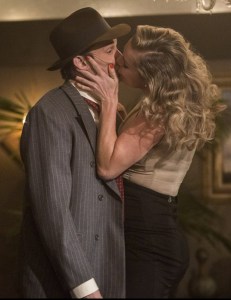
This world is run by “the Company” [and reminds me a lot of 1984; I hated that book] and everything is blah.  No one seeks knowledge.  Eve finds Jake selling beige cars, but sparks his memory of the Library.  They find Cassandra next, still working complex math problems.  Ezekiel runs the only show in town, but still likes to pick locks.  Eve is captured by Nicole and put in a mental hospital, where everyone else who questions things is put.  Eve finds Flynn who has held on to his own memories, despite several attempts by Nicole to wipe his mind.  She’s trying to hang on to the man she had fallen in love with and had hoped for centuries would rescue her.  Eve finds Flynn and they share a kiss.  Eve remembers the Library now and Flynn vows to never leave her or the Library ever again.  And she still loves this nice, cute, and completely crazy man.

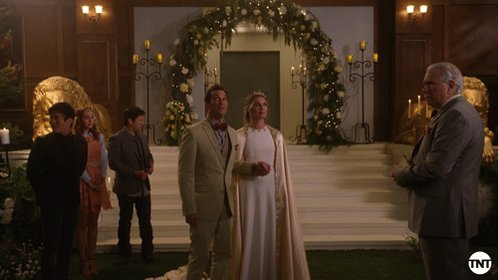
The other three begin to remember their gifts and mount a rescue for Eve and Flynn.  They’re soon trapped however, but Eve encourages them to manifest the Library where they stand.  It’s full of art, science, and magic and it values each Librarian.  It lives in each of them and Flynn is the heart and soul of the Library.  Nicole can only watch as the Library returns and her plan fails.  While our heroes are back in the Library, Jenkins is still dead.  But Flynn won’t give up; he has a crazy idea to rewrite history just enough.  He jumps through a portal to the moment when Nicole will take the immortality potion and he begs her to help the Library.  He cannot rescue her, but she is still the Library’s Guardian.  She agrees and Flynn wakes up back at the tethering ceremony rehearsal, from the beginning of the season.  He re-wrote everything that happened.  Eve remembers, but the other three don’t.  The couple asks Jenkins (who is alive, huzzah!) to perform the ceremony now, don’t wait for the solstice.

I’m glad things worked out alright, but I’m not fond of the Nicole plot.  I wasn’t terribly fond of her in Spear of Destiny because she was often dismissive of Flynn.  This season was a bit of a letdown after the previous season.  I know there was no big bad to defeat, but there are plenty more stories and artifacts to explore.  This felt a bit like a cop-out.

There have been a few tie-in novels published: The Lost Lamp, The Mother Goose Case, and The Pot of Gold.  I recommend them all!

And of course, there is some rather good fanfiction stories out there.

Check out Hedgehog-O-Brien on AO3 for some trio Librarian fluff.

And icarus_chained weaves in some mythology and introspection on Jenkins.

Up Next: Air Force One

Time Travel Gives You a Headache

Season Two

Drowned Book starts with a flashback to the beginning of season one, when magic surges back through the ley lines.  An older man summons a character from Sherlock Holmes; “I have need of your genius, sir.”  Fast forward to present day, everyone ends up invited to the same New York museum, but on different cases.  Eve suggests working together, but they’ve all gotten used to doing their own thing.  A strange storm blows in and Eve and Flynn meet James Worth (played by the dashing David S. Lee; he’s been in episodes of Castle, NCIS and NCIS:LA), head of antiquities from Oxford.  James charms Eve and can match Flynn for deducting.  The three younger Librarians end up teaming up again to solve their problems and Flynn realizes that Worth is a fictional.  His first guess is Sherlock Holmes (and he’s ever so excited), but Worth is actually Moriarty.  But he’s not the true mastermind connecting all the artifacts.  That would be Prospero, Shakespeare’s wizard from The Tempest.  Prospero is a Fictional so powerful, he rose from his own tale.  But he wants to control his own story, not be bound by what Shakespeare wrote.  He and Moriarty manage to disappear, but the Librarians have to deal with the storm that is spiraling out of control.  They end up using a sun from the Library to burn off the cold air and save New York.  Flynn sulks that he liked being able to do things his way, but Eve points out that pooling information works just as well.

In Broken Staff, Flynn and Eve follow up clues to keep Prospero from regaining more of his power, while Prospero and Moriarty manage to make it into the Library.  They hold Jenkins hostage for a bit, asking about the Heart of the Library, the Tree of Knowledge.  Again, it takes all of the Librarians, including Flynn and Eve to defeat the traps Prospero has laid.  Flynn burns a Tree to thwart Prospero (not actually the Tree of Knowledge, he hopes it wasn’t important).  But the Library has also been re-arranging itself and sixteen artifacts are missing.  Eve again suggests that Flynn carry on searching for the artifacts alone while she helps the other three Librarians settle the Library.

The three younger Librarians head to Jacob’s home state to solve a rift in the Earth in What Lies Beneath the Stone.  Jacob’s not thrilled about returning home; he kept his academic life very secret at home and he’s been saying “family ain’t easy” for a while.  He has strong disagreements with his father, but the Librarian job is more important.  They pass Ezekiel off as the expert since Stone’s father is dismissive of him and eventually work out that it’s a Native American trickster who has been set free and causing chaos; feeding off lies.  It looks like Jacob reconciles with his father for a moment, but it was the shapeshifter.  Jacob fights him off and locks him away again.  He still does not tell his father the truth, because he has realized that he doesn’t need his father’s approval.  So he signs his own name to the academic paper he is writing.  The team heads to Wexler University in Cost of Education, where people are strangely disappearing.  Cassandra meets another girl who is tracking magic and linking it with science.  A tentacle monster from another dimension is stealing people who are full of ego.  Cassandra follows her new friend into the wormhole to rescue her, but is stopped for a brief moment by the ladies of the Lake Foundation, interested in combining science and math.  Cassandra is content with being a Librarian, but the invitation stands.  She disagrees with Jenkins on whether magic should be studied or not.  Ezekiel sadly loses his new gargoyle friend, Stumpy.

In Hollow Men, Flynn pops back in to find the Eye of Zarathustra, which “is the key to the door of Lost Knowledge, the Staff summoned by Sun and Rue.”  But he’s quickly separated from the rest of the Librarians, held by a strange man who somehow knows Flynn, but not really.  Prospero is also after the staff and Moriarty still flirts with Eve.  She ends up having to team up with the antagonist in order to find Flynn.  And it turns out, Flynn is traveling with the intelligence of the Library.  Meanwhile, the other three work with Jenkins to keep the Library from completely dying.  Ray regains his memories, though Moriarty has to take the staff to save him. The Library is wholly restored.  Baird visits an old friend in Infernal Contract; Sam Denning (Michael Trucco, he’s appeared in several TV shows, including Castle as a similarly named Detective Tom Demming that was interested in Kate) is running for mayor in a small town.  But turns out that his opponent’s family has had a long running deal with a devil (played by John de Lancie, a few episodes of Charmed and Stargate SG-1, and Q in Star Trek); a bit like crossroad demons in Supernatural.  Eve, Jenkins, and the Librarians manage to trick the devil and rescue Sam and the town.  Jenkins sweetly takes care of the three ill Librarians at the end and points out that Eve’s job as Guardian is to save the Librarians’ souls.

The team gets to go clubbing in London in Image of Image, trying to figure out how people are mysteriously dying from something they weren’t doing.  They’re all connected to Club Effigy, where pictures mark them as the next victim.  There’s a charming Englishman who turns out to be Dorian Gray.  Any of his vices are passed onto his victims, keeping him young and beautiful.  Until Ezekiel and Cassandra turn the tables on him.  Jenkins once again counsels Eve on the upcoming battle between good and evil.  Jenkins goes to a Fae for information on Prospero at the beginning of Point of Salvation.  The rest of the team gets stuck in a video game scenario at a DARPA lab.  Ezekiel is the only one who remembers each pass and gets tired of seeing his friends die.  He forces them to believe him and follow him, even sacrificing himself at the end.  Jacob and Cassandra figure out a way to bring him back and now he doesn’t remember his heroic deeds [or does he?].  Prospero attacks in the final moments.  He created a spell that wiped the memory of Eve, Cassandra, Ezekiel, and Jacob from Jenkins’ mind in Happily Ever After.  Flynn heads off to find them and discovers they’re leading new, but similar lives together on a small island.  Eve is the sheriff, dating Moriarty.  Cassandra has been to the moon, Jacob teaches eleven different classes at the university, and Ezekiel is an FBI agent, but their home base seems to resemble a library.  Flynn teams up with the sprite, Ariel [she is adorable] to bring his family’s memories back.  Eve has to do the same for Flynn at the end because his perfect life is one puzzle after another that he solves by himself.  But they’ve been under the spell for three weeks, Jenkins reports.  The ley lines have been supercharged by Prospero; it means the end of the world.

A giant forest begins to cover the earth in Final Curtain.  Due to a wet hand, Flynn and Eve finally realize the strange note they found in John Dee’s estate in Drowned Book was written by Flynn in his left hand.  They use time travel to go back to when Shakespeare wrote The Tempest, but it breaks upon their departure.  Now Jenkins and the other three Librarians have to follow the rest of the clues to stop Prospero in the present.  Prospero has one final task for Moriarty and sends him back in time as well.  But Moriarty wants vengeance on his taskmaster for holding him prisoner and decides the best way to do that is to try to kill Shakespeare.  Obviously, that does not work out, but Flynn and Eve discover that Prospero is Shakespeare transformed.  His quill is magical, part of the Tree of Knowledge gifted to him by John Dee.  With it, Shakespeare transforms into the wizard so he can escape a failure in his career.  Moriarty is swiftly dealt with by Prospero, and he almost drowns Eve.  She rises out of the water, like the Lady of the Lake (aided by the ladies of the Lake), throwing Excalibur to Flynn to defeat Prospero.  So it follows that old adage of King Arthur, that he who wields Excalibur will do so once more and save England.  The other three turn Prospero back into Shakespeare in the present, using some of Shakespeare’s’ work to define themselves.  A portal opens that can send Shakespeare back to his time, but Flynn and Eve cannot come forward.  However, they figure out how to do time travel the long way round, leaving the notes they need for themselves and asking Shakespeare to use his magic quill one last time to make them into a statue that is delivered to the Library for safekeeping.  The other three free them from their very long kiss and heck, even Cal is back.

It’s adorable how much this team continues to become a family.  Since I am not fully versed in Shakespeare, I probably miss some of the nuisances of Prospero being the villain, but Moriarty is excellent; almost sympathetic at times.  I’m glad that Flynn takes Eve with him to defeat Prospero, rather than leaving her behind and handling the mission on his own; and I’m even happier that they don’t stay stuck in Elizabethan England forever.

Next Time: Season Three

Be Safe. Don’t Get Killed. Save Your Receipts.

The Librarian

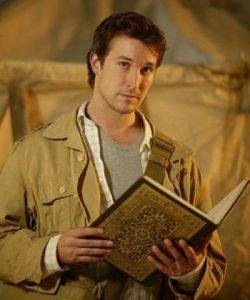
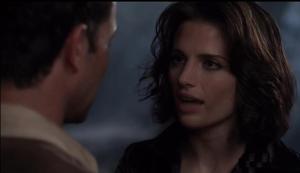
First, a trilogy of movies put out by TNT; then developed into a television series.  It stars Noah Wyle (he was on E.R. for many years [no intention of watching] and he briefly appeared in an episode of Lab Rats) as Flynn Carson. Jane Curtin is Charlene and Bob Newhart (he’s popped up in other television shows like Big Bang Theory, and I had no idea he was the voice of Bernard in Disney’s The Rescuers movies) is Judson.  There’s a familiar face, David Dayan Fisher (bad guy in NCIS and National Treasure) in the first film, Quest for the Spear; and Gabrielle Anwar (the Queen in The Three Musketeers with Chris O’Donnell, Princess Margaret [Henry VIII’s sister] in The Tudors, Fiona in Burn Notice, and Victoria Belfrey/Lady Tremaine in Once Upon a Time) joins the second film Return to Solomon’s Mines as Emily Davenport.  The third film, Curse of the Judas Chalice, brings in Stana Katic (briefly glimpsed at the end of Quantum of Solace, and opposite Nathan Fillion in Castle) as Simone Renoir.

Quest for the Spear introduces us to Flynn Carson, who holds 22 degrees and intends to be a lifelong student.  Until his professors agree to cut him off and force him out into the big, bad, real world to find a job.  An invitation arrives at his home (he doesn’t see it until a pile of books drops on his head), to interview for a prestigious position at the Metropolitan Public Library.  He’s not the only applicant, the line wraps down the staircase.  He faces Charlene, who wants to know “what makes you think you could be the Librarian?”  And she means more than knowing the Dewey Decimal system; what makes him different than every other librarian.  His observational skills rival Sherlock Holmes and he can tell when Charlene broke her nose, when she divorced, and how many kinds of cats she owns.  Then another voice calls out “what’s more important than knowledge?”  Flynn echoes his mother’s statement that the things that make life worth living are not thought (in his head), but felt (in his heart).  Flynn wins the position and will begin a wondrous new adventure, from which he will never be the same.  Judson appears and leads Flynn downstairs, through a secret door and security guards, opening to a grand hall filled with shelves and display cases.

Judson explains that magic exists, but it is dangerous and must be kept out of the wrong hands.  That is the Librarian’s job.  And he must keep it secret [so I object to his mother’s dismissal of his job as simply shelving books…I wanted to become a traditional librarian at one point.]  That evening, Judson is knocked out at the Library; Charlene and Flynn find him the next morning and discover that the Serpent Brotherhood has stolen a piece of the Spear of Destiny.  The Serpent Brotherhood opposes the Library and wants to use magical artifacts to rule the world.  And the Spear was used by Charlemagne and Napoleon; Hitler had one piece; so if the Serpent Brotherhood has it, they can certainly control the fate of the world.  Flynn, as Librarian, is the only one who can go after them (which Flynn points out is a little sad).

Clues to the other pieces are in a book, written in the Language of the Birds, the universal language all people spoke before the Tower of Babble.  Flynn has to decipher it on his flight to the Amazon.  He succeeds in 7 hours and 26 minutes.  And the beautiful woman he meets on the plane is Nicole Noone (so when Judson says to “trust no one”…that’s what he meant), whose job is to protect the Librarian.  Nicole is a bit dismissive of Flynn at first, bodily dragging him out of danger, since the Brotherhood is chasing them.  But Flynn proves his brilliance; he memorized the globe as a child.  They uncover the second piece of the Spear, but are met by the Brotherhood outside, including the previous Librarian whom Nicole saw die.  He desires power now and plans to wield the Spear.  But he can’t read the Language of the Birds, so Flynn argues Edward needs him.  Oh, and the final piece of the Spear is in Shangri-La.  Edward forces Flynn to grab the spearhead, then the monastery begins to collapse.  Nicole grabs the spearhead and escapes with Flynn (and the helicopter is “horrible, horrible, high velocity pie of death!” Flynn discovers while trying to fly it).  Nicole kisses Flynn in his room in Mongolia, but she is gone when he wakes up. He has a brief discussion with Judson and realizes that the Brotherhood has to fuse the Spear back together at the pyramid display with the golden capstone that Flynn was working on at the university in the beginning.  “Call the Marines, Judson.  I’m coming home.”  But, clothes first.

Edward does manage to fuse the Spear and tests it on his minion [that bad guy we see a lot].  Nicole and Judson take on the other mooks, though Flynn does get to punch his former professor in the nose.  Flynn goes after Edward and gets beaten up a bit.  But as Flynn pointed out to the students earlier, if one stone is out of line be even one inch, the whole pyramid collapses; and Edward has been hitting stones trying to get Flynn.  Edward is crushed by the capstone and the Spear floats to Flynn.

Back at the Library, Flynn is worthy enough to pull out Excalibur and there is a new portrait hanging, featuring Flynn with the Spear.  Three months later, Flynn’s mother is still trying to hook his son up, despite hearing Nicole on the phone earlier.  Nicole zooms in on a motorcycle and kisses Flynn hello, then briefly introduced to his mother.  But they have to go (time-traveling ninjas are on the loose).

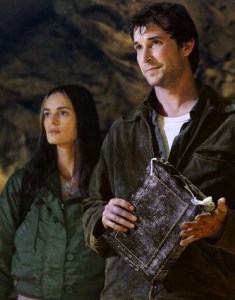
The opening of Return to Solomon’s Mines is very similar to the opening of Last Crusade; it takes place in Utah and Flynn interrupts someone digging up something that doesn’t belong to them.  Back at the Library, he receives a package while Judson instructs him that he has a lot to learn and that to be a truly great Librarian, one must sacrifice what one wants for the greater good.  Flynn stops by his mother’s house for a surprise birthday party for him and briefly speaks to his father’s best friend, Jerry.  Flynn’s father passed away when the man was thirty-two, which is the age Flynn is now.  His mother has saved some of his old drawings from bedtime adventures his father told him.  She pulls out a [Masonic-looking] medallion, which his father used to joke was their family crest.  At Flynn’s apartment, he discovers that he was mailed an odd-looking scroll, then is knocked out.  Judson wakes him and realizes that the symbol Flynn saw on the scroll leads to Solomon’s Mines, holding great treasure.  It also holds the Key of Solomon which can summon the undead.  Judson sends Flynn to Morocco.

Flynn meets Emily at her Roman dig in Morocco; she’s searching for evidence of the Queen of Sheba’s (the wife of King Solomon) rule there.  They discover the secret tomb and are briefly attacked after finding the legend piece.  But their attacker recognizes the medallion Flynn wears; it symbolizes a society bound to protect Solomon’s Mines.  More bad guys come and they are sent to Kenya to find the second piece.  Emily insists on accompanying Flynn; if she can find more items like the legend piece, her own research will be funded for years.  Emily also has 25 degrees (to Flynn’s 22), so they spend a great deal of their journey arguing history and archeology.  Then they come across a man buried in the sand.  For freeing him, he will take them to Gedi.

Bad guys have followed them to Gedi, but luckily they run into Jerry boarding a train.  He treats them to dinner, then Flynn and Emily discover the key to the map is playing the legend pieces like an instrument; the map is music notes.  It comes to life and leads them to another mountain.  Judson pops into instruct Flynn to return home; but Flynn and Emily continue on.  Flynn’s father’s bedtime stories lead the way to the oldest tree in Africa, underneath which is a temple.  They find the treasure, but bad guys interrupt their exploration, led by Jerry.  Jerry wants the Key, which Flynn found, so he can re-write history.  Jerry blames Flynn’s father for stealing his mother’s heart; Jerry should have had the family; and he was responsible for the father’s death.

Jerry incants from the book, opening a portal and beginning to raise the dead.  Flynn goes after Jerry and threatens to destroy the book, but Jerry tempts him with the idea that Flynn can bring his father back.  Flynn takes over the chanting, but Emily manages to distract him.  Flynn throws the book into the lava and Jerry jumps in after it.  Emily, Flynn, and the man they saved all manage to escape the explosion and Flynn is left to return home alone.  Judson encourages Flynn that he did the right thing in destroying the Key of Solomon; only a great Librarian would have done so.

Flynn is at an auction in the beginning of Curse of the Judas Chalice on Library business, but also trying to keep his girlfriend happy.  He battles against another collector to retrieve the Philosopher’s Stone.  He wins, but his girlfriend leaves him.  He’s depressed once he returns to the Library and Judson’s comment that he’s a celibate monk does not help.  When Flynn looks around the Library he doesn’t see artifacts anymore, he sees the bits of his life he gave up to retrieve them, like his college reunion.  Charlene suggests that Flynn use a few vacation days, then stops by his apartment later (a little drunk) to drop off travel brochures.  Flynn dreams of New Orleans and decides to give it a try (a woman called to him in his dream).  He hears the same voice singing and meets Simone.

Meanwhile, a former KGB Russian, Kubichek meets up with a Romanian history professor.  The professor is teaching a lesson on Prince Vlad Dracul, known as the Impaler, but all his students want to know is whether the man was a vampire.  Kubichek is interested instead with the Judas Chalice.

The Russians end up chasing after Flynn in New Orleans and Simone helps him escape, such as hitting a high C in an echo chamber.  Simone takes Flynn out for a night on the town and he perks up a bit.  Judson appears to Flynn (again; he has a habit of doing that) and explains that Flynn needs to go after the Judas Chalice.  The Chalice has the power to resurrect vampires, because apparently, Judas was the first vampire, cursed to walk the Earth for all eternity after he was hung for his transgressions.  Oh, and Dracula’s tomb has been stolen.

The bad guys grab Flynn, explaining that they want to use the army of the undead to bring Russia back to its former glory [seems like lots of Russians want to do that in these types of movies].  Flynn happens to know the Romanian professor and they decipher the lens that was found.  Simone drops in to help rescue Flynn, except she’s shot.  Flynn drags her out and briefly mourns her…turns out she’s not dead.  She’s a vampire.  She was turned in Paris in 1603 where she had been an opera singer for the royal court.  Now, she’s trying to hunt down the vampire who turned her and kill him.  (She also hints that Judson is a lot older than he appears and there is a larger battle to be had with the Library, between good and evil).

Flynn and Simone find the Chalice aboard Lafitte’s shipwreck [no, not Lafayette that many now know from Hamilton.  Lafitte was French as well, but was a smuggler based out of New Orleans in the early nineteenth century.  He did aid America in the Battle of New Orleans.]  The Russians interrupt the couple and Simone seems to know the professor.  The Russians trap them, but Flynn rigs a cannon to blow open a way out.  Simone leaves him behind and Flynn fears she wants the Chalice for herself.  When they meet up at the plantation again, turns out, no, she recognized the professor as the vampire who turned her.  And who turns out to be Dracula.  And he has no intention of actually helping the Russians.  Sure, he’ll raise the undead, but so he can rule the world.  Flynn goes after Vlad and the Chalice.  Simone helps fight Vlad, who drops the Chalice.  Flynn stabs him with a stake from an aspen tree.  Simone then watches the sun rise with Flynn, one last time.  Her duty to protect the Chalice is done now; she’s gotten her vengeance.  But she encourages Flynn to live out his destiny as the Librarian.

Flynn returns to the Library in a better mood and ready to fight the larger battle that is coming.  As he and Judson walk away, it is revealed that the walkways of the Library create the Tree of Knowledge.

I love these movies.  I want the Librarian job.  Again, it makes learning fun.  History is not dry and dull [well yes, at times it is], but hunting for artifacts uses so many aspects of knowledge.  And I appreciate that the three different women who help out Flynn are all strong, independent women.  Yes, they have brief romances with the lead man, but they are also smart in their own right.  Nicole is the one to kick butt.  And they don’t look down on Flynn for being a bookworm.  Being a bookworm actually saves their butts occasionally.

Next Time: The adventure continues with the first season of The Librarians

“Cry God, for Harry, England, and St. George!”

Partaking in something that satisfies both the historian in me and the English major: Shakespeare.  Now, I believe I have mentioned before that I am not a dutiful English major; I don’t like Shakespeare, well, I don’t like reading Shakespeare.  It’s boring and most teachers pound it into our skulls by analyzing it to death.  I hate that.  But, BBC put together a phenomenal cast and put Shakespeare’s histories on screen (which I am aware has been done before, heck, I tried to watch a version of Macbeth starring Patrick Stewart and couldn’t make it through it.  Now, there was a slightly modern version of Hamlet done with David Tennant that was fantastic).  They timed the first arc to coincide with the 2012 London Olympics; this arc included Richard II, Henry IV parts I and II, and Henry V.  Their second arc included Henry VI and Richard III in 2016.

Gut reactions?  Richard II was a bit odd.  Henry IV was wonderful to see and Henry V is utterly magnificent.  Henry VI is simply everyone changing sides and the start of the War of the Roses and is interesting to see from this perspective.  As for Richard III; I remember doing a segment on the historical accuracy of the play in a British history course in college and I can certainly see the Tudor propaganda in the play (oh, they all cut out and condense history, but then, these are plays, not true histories…actually, I’d like to see historical documentaries on these people), yet I now see what all the hype is about.

Above all, these are a veritable who’s who in British acting.

Richard II stars Ben Whishaw (Q in Craig’s James Bond and Michael Banks in Mary Poppins Returns) as the king.  Opposite him is Rory Kinnear (also appears with Whishaw in Skyfall, and Spectre as Bill Tanner, which he briefly played in Quantum of Solace as well) as Bolingbroke, who goes on to be crowned Henry IV.  The great Patrick Stewart appears as John of Gaunt.  If Thomas Mowbray, who argues with Bolingbroke, looks familiar, that’s because he’s played by James Purefoy, who portrays Colville aka Edward, the Black Prince of Wales in A Knight’s Tale [making this a bit funny to a historian, because Edward, the Black Prince of Wales was Richard II’s father: his father was King Edward III, but he died before his father did and so thus, his son inherited the throne].  David Morrissey appears as the Earl of Northumberland.  He’s also been the Duke of Norfolk in The Other Boleyn Girl [uncle to Anne], and has appeared in a 2008 episode of Doctor Who, “The Next Doctor”.  We briefly see David Bradley (Filch in Harry Potter and Walter Frey in Game of Thrones) as the gardener and Lindsay Duncan (also appeared in a 2009 episode of Doctor Who, “Water of Mars,” she was the mother in Tim Burton’s Alice in Wonderland, a queen in two episodes of Merlin, and Lady Smallwood in several episodes of Sherlock) as the Duchess of York.

The very gifted Jeremy Irons (Scar in The Lion King [the animated classic], Tiberius in Kingdom of Heaven, Brom in Eragon, Aramis in The Man in the Iron Mask, and Alfred in several of DC’s newer Batman movies) takes over as the older Henry IV.  Tom Hiddleston (we love him as Loki in the MCU) shines as Prince Hal.  Julie Walters (Mrs. Wealsey in Harry Potter and Rosie in both Mamma Mia movies) is Mistress Quickly, Robert Pugh (he’s Craster in Game of Thrones, amongst other roles in Kingdom of Heaven, The White Queen [which also depicts the War of the Roses], and Master and Commander) is Owain Glyndŵr [that is the proper spelling, IMDB lists him as Owen Glendower; a real Welsh rebel that I’ve got a book on].  Oh hey, there’s Michelle Dockery (Mary in Downton Abbey) as Kate Percy, and Harry Lloyd (Baines in 2007’s Doctor Who “Human Nature” and “The Family of Blood,” Will Scarlett in BBC’s Robin Hood, and insane Viserys Targaryen in Game of Thrones) is Mortimer, and Joe Armstrong (Allan a Dale in Robin Hood) is Hotspur.  His father, Alum Armstrong (he’s had roles in Van Helsing, Braveheart, and Patriot Games amongst others) plays Hotspur’s father Northumberland, and Iain Glen (Jorah Mormont in Game of Thrones, Sir Richard Carlisle in Downton Abbey, and 2010’s Doctor Who “The Time of Angels” and “Flash and Stone”) pops up as Warwick.

Of course, Prince Hal graduates to King Henry V in the next installment.  This was the bit that makes me almost like Shakespeare.  Tom Hiddleston delivers some of the best known speeches with such quiet passion.  “Once more unto the breach,” stirs my blood, and he got the role of Henry V with “St. Crispin’s day,” which includes that famous line: “we few/ we happy few/ we band of brothers.”  One almost cries.  And his wooing of Katherine…if a dashing man ever said those words to me, I’d be weak-kneed.  I remember rehearsals for faire, male cast members are encouraged to woo female patrons (worked on me when I was a patron), and so they practiced on female cast members; I was just happy some guy was saying nice words to me, I didn’t really care what he was saying.

If Corporal Nym [grrr, I hate his name’s “Nym,” because I want to use it for a headstrong female character in my saga] looks familiar, he’s Tom Brooke and he’s appeared briefly in a few Sherlock episodes.  And look, there’s Richard Griffiths (Vernon Dursely in Harry Potter, King George in On Stranger Tides) as the Duke of Burgundy [this was one of his last roles].  The ever talented John Hurt (the dragon Kilgarah in Merlin, the War Doctor of Doctor Who, Ollivander in Harry Potter, Professor Oxley in Kingdom of the Crystal Skull, Montrose in Rob Roy, and other roles going back to the 60’s)  acts as the chorus [and he just passed away in 2017].  Some other familiar faces join us in Henry V; Anton Lesser (Qyburn in Game of Thrones, an episode of The Musketeers, Harold Warne in Miss Potter, and other roles) as Exeter [he’ll stay on through Henry VI and Richard III] and Owen Teale (part of some older Doctor Who episodes, The Last Legion, and the Headmaster in Tolkien, but I’m sure we recognize him as Thorne in Game of Thrones ) as Captain Fluellen.

Tom Sturridge takes up the mantle of Henry VI.  Sophie Okonedo (Liz Ten in “The Beast Below” and “The Pandorica Opens” in 2010’s Doctor Who) joins him as Margaret of Anjou, and Hugh Bonneville (Robert Crawley in Downton Abbey, Monuments Men, several episodes of Doctor Who as a pirate captain, he was even in Tomorrow Never Dies) is so encouraging as Gloucester.  Michael Gambon (Dumbledore in Harry Potter, Lord Charles Fox in Amazing Grace, and he’s even appeared in Doctor Who 2010’s “A Christmas Carol”) briefly appears as Mortimer.

In the second part, Benedict Cumberbatch (Doctor Strange, Sherlock, Khan in Star Trek: Into Darkness, amongst other roles) pops up as the Duke of York [called Plantagenet in Shakespeare as a claimant to the old royal dynasty]’s son Richard.  Phoebe Fox (the Duchess of Savoy in The Musketeers) is Anne Neville.  James Fleet as Hastings has been in several period pieces.  And say hello to the appearance of Andrew Scott (C in Spectre and Moriarty in Sherlock) as King Louis of France.  Somerset is played by Ben Miles (Peter Townsend in The Crown), and George, the Duke of Clarence is played by Sam Troughton (Much in BBC’s Robin Hood).

Benedict takes center stage in Richard III.  He is brilliant in the role.  I dislike the character of Richard, but Benedict delivers exquisitely.  Let me go on a little historical accuracy rant: historical evidence proves that Richard was not a hunchback; he may have had a slight difference in shoulder height, but is regarded to have been a tall, broad-shouldered man.  Nor was he the “Machiavellian villain” Shakespeare depicts him as, at least, no more than any other man of that time.  Shakespeare wrote him as a villain to please the Elizabethan court in order to paint her grandfather as a benevolent conqueror.  As another historian pointed out to me, if Richard had the princes of the tower in his custody, he could have produced them in order to throw suspicion off himself.  We also get the addition of Judi Dench as Richard’s mother, Cecily.

Historical note: there are several “Duke of Gloucester” throughout the plays and throughout history, because it is a title, typically a relative of the monarch.  Same as the Duke of York, and Mortimer is a title (which I got confused a bit, seeing a Mortimer in Henry IV and one in Henry VI.)  I swear, one needs a family tree to reference when watching these histories.  I’ll try to explain the central plot of the War of the Roses as best I can.  Edward III had several sons, the eldest of which was Edward, the Black Prince of Wales.  His third son (his second died young-ish) was John of Gaunt, Duke of Lancaster, his fourth son was Edmund, holding the title Duke of York, and his fifth son was Thomas, the Duke of Gloucester.  The Black Prince’s son was Richard II.  The way that Bolingbroke claimed the throne was that he had a right to it as the son of Edward’s third son (hence, Richard and Bolingbroke were cousins and until Bolingbroke’s exile, they were close).  Bolingbroke became Henry IV [Lancaster], who has at least four sons, the eldest of whom became Henry V.  Henry V died tragically young and his son, Henry VI, assumed the throne incredibly young, only nine months old.  England was ruled by the Lord Protector, his uncle, Humphrey, Duke of Gloucester (one of Henry V’s brothers).

Then along comes Richard, Duke of York (the great-great-grandson of the Edward III’s second son by way of Lionel, Duke of Clarence’s daughter, then grandson, then great-granddaughter).  Just like Bolingbroke challenged Richard II for the throne due to ineptitude, the Duke of York [white rose] challenged Henry VI [followers wore a red rose].  The Duke of York’s son, Edward took the throne, becoming King Edward IV.  He had three children with Elizabeth Woodville; Elizabeth of York, Edward (briefly Edward V), and Richard (also holding the title Duke of York).   Edward IV has several younger brothers, including George, the Duke of Clarence, and Richard, the Duke of Gloucester.  Once Edward IV and George were dead, Richard declared Edward IV’s marriage to Elizabeth Woodville unlawful, making his offspring with her illegitimate.  He took the throne as Richard III.  There’s the York contingent.

But back with John of Gaunt, Duke of Lancaster, his second marriage produced several generations, to John Beaufort, the Earl of Somerset, then his son John, then his daughter Margaret Beaufort, who married Edmund Tudor, the Earl of Richmond, and then had Henry, who in Shakespeare was called Richmond, thus making him the Lancastrian claimant.  [Edmund Tudor was the son of Owen Tudor (a Welshman), who married the widowed Katherine (wife of Henry V)…as for Henry V’s claim of “I am Welsh, as you know,”…well, he was Prince of Wales and born there, but not actually Welsh by blood; I would guess it was a line Shakespeare inserted to play to Queen Elizabeth’s Welsh ancestry].  Henry Tudor became Henry VII and he married Elizabeth of York (remember, Edward IV’s eldest daughter) and uniting the Lancastrians and Yorkists and ending the War of the Roses  From here, we should know how things go from there for a bit.

This is the sort of stuff that fascinates me as a historian; how the different lines come together and play out.  And I understand Shakespeare’s language a bit better watching it performed, more of a dialogue rather than verse.

On a different note: I highly recommend Netflix’s Enola Holmes film.  Millie Bobby Brown is precisely the female heroine we need; smart and not afraid of action.  Henry Cavill is a calmer Sherlock Holmes, but I greatly desire to see more of these characters.  I may just check out the novels the film was based on.

Are They Fighting or Are They Dancing?

The Mask of Zorro

Another of the swashbuckling movies produced in the nineties, like Three Musketeers and Prince of Thieves and like those two, it’s very well done.  Stars Anthony Hopkins (a classic Welsh actor who is Odin in MCU Thor, famous as Hannibal Lecter in Silence of the Lambs [and I refuse to watch that movie, I do not need the nightmares], was Van Helsing in 1992’s Bram’s Dracula, was in A Bridge Too Far with the other great actors of that time) as Don Diego de la Vega, Stuart Wilson (an older Robin Hood in Disney’s Princess of Thieves) as Don Rafael Montero, Tony Amendola (Marco/Geppetto in ABC’s Once Upon a Time series amongst other TV series) as Don Luiz, Antonio Banderas (this is probably his most famous role) as Alejandro Murrieta and Catherine Zeta-Jones (who is actually Welsh, and married to Michael Douglas since 2000; this was her breakthrough role, and she went on to win an Academy Award for Best Supporting Actress in 2002’s Chicago) as Elena.  This is not the first appearance of the character Zorro; he dates to 1919 and was originally supposed to be a one-time character, then the popularity of the 1920 movie had the author create dozens of further stories.  However, this is probably one of the more well-known iterations.

The story begins in 1821 as Spain is leaving Mexico due to a rebellion led by General Santa Anna.  The last governor, Don Rafael Montero is ordered to leave, but has one last piece of business to take care of.  He gives his friend Don Luiz orders to distribute the Spanish land amongst themselves and pay taxes to Santa Anna, thereby maintaining their wealth.  Montero is planning to execute three innocent men amidst a protest.  Two boys are waiting for the legendary Zorro to appear and he does not disappoint.  The boys even save Zorro from a trap and in return, he gifts them with a medallion.  The crowd cheers for their hero and protects him from the guards.  He confronts Montero and marks his neck with a “Z”, three slashes for three men.  Montero would murder a hundred innocent men in order to kill Zorro.  But Zorro rides away.

There is a lair beneath his estate (the original Bat cave; in fact, Zorro is considered an influence to Batman); Zorro remarks to his faithful black steed that they are both getting too old for their activities.  Zorro without the mask is Diego de la Vega and he visits his infant daughter in her nursery and tells her stories about his escapades.  His wife, Esperenza joins the pair.  They are interrupted by Montero and his guards.  Montero has an inkling at this point that de la Vega is Zorro and pressing on his arm reveals a bloody scratch de la Vega received during the fight that day.  He attempts to arrest de la Vega as a traitor to both his country and his class, and oddly apologizes to Esperenza.  Turns out, Montero loves Esperenza and is upset that she married de la Vega; but now, he probably is thinking with de la Vega out of the way, he can claim Esperenza.  But Esperenza tries to protect her husband during his duel with Montero and a guard accidentally shoots her.  Montero dispatches the guard, and de la Vega goes for his crying daughter; a fire has started during the scuffle.  Montero knocks de la Vega out, puts him in chains, and claims his daughter.  Montero leaves with young Elena for Spain and de la Vega is taken away to prison to rot; Montero’s parting words to de la Vega: you must “live with the knowledge you have lost everything you hold dear,” and “your child should have been mine.”  (This of course, takes away the notion of Esperenza’s own choice; she seems very happy with de la Vega and aware of his secret, most likely meaning it was a love match, so no, Elena should have never been Montero’s child.)  de la Vega swears to Montero, “you will never be rid of me!”

Twenty years later: the Murrieta brothers have been caught…well, actually, they were in on their capture so they could steal the guard’s money and redistribute it to the poor (a la Robin Hood).  But there is a new Captain in town, Captain Love from Texas; he ends up shooting Joaquin and capturing Jack.  Alejandro escapes, but watches his brother shoot himself instead of being captured.  Alejandro collects his brother’s medallion, then tries to barter it away for a drink.  In the meantime, Montero has returned to California.  His first stop is the prison, in order to be sure that Zorro is dead.  Several prisoners claim they are Zorro (like the famous “I’m Spartacus” scene), but Montero doesn’t believe any of them.  He walks right by an old man with an eye patch, pauses for a moment, but dismisses him.  He deduces Zorro is dead.

Wrong.  That old man is de la Vega and he manages to free himself and get smuggled out of the prison by impersonating a dead body; meaning he then digs himself out of the grave.  He will exact his revenge on Montero.  He attends Montero’s official arrival the following day, where Montero plays to the crowd, insulting the other Dons so he can claim he works for the people.  Obviously, de la Vega knows better and starts to make his way to the former governor, until Montero’s “daughter” arrives, Elena.  This halts de la Vega.  He must rethink his plan.  On his way to his hideout, he comes across Alejandro and his old medallion as Alejandro prepares to barter it away.  He easily bests Alejandro in a fight, but offers to train the young man.

mask of zorroAlejandro is eager to start fighting, though his answer of “the pointy end goes in the other man, [sounding like Jon Snow or Arya Stark]” shows de la Vega that he must start with the basics.  The master has a new apprentice.  de la Vega has Alejandro bathe and trim his hair.  After disarming the old fox once, Alejandro figures he is skilled enough to capture a black Andalusian, like Zorro’s Tornado.  Alejandro, in a mask, encounters Elena and she is quite taken by the dangerous man.  When his plan goes a bit awry, Alejandro hides in the church and ends up hearing Elena’s confession, that she is starting to have thoughts about the masked man and her heart is too wild for her father’s liking.  Alejandro manages to escape before Captain Love appears, but he leaves the “Z” mark to let them know Zorro has returned.

de la Vega, expertly using a whip to extinguish candles (Hopkins could do that trick and was added into the movie), is not pleased with Alejandro; Zorro serves the people, not himself.  Alejandro is tired of the lectures and demands de la Vega duel him.  The older man holds up a spoon.  Alejandro must have the polish of a proper gentleman, and needs to spy on Montero.  The two men attend a gala held at the estate, de la Vega masquerading as Alejandro’ s servant, who goes by the title Don de Castilio.  Alejandro is properly presented to Elena, but his gentleman charm does not impress her, though he is impressing Montero.  However, when Alejandro has to stall Montero, he dances quite passionately with Elena (it is a wonderful and lively dance).  Alejandro gains an invitation with the rest of the Dons and Montero reveals his plan; he means for the Dons to claim California.  They will buy it from Santa Anna with gold from a mine on his own land that he is unaware of.  Santa Anna will take the gold because a war with the United States is expensive.  Montero shows off the mine the next day and Alejandro discovers that poor Mexicans who have gone missing have been taken to the mine.

Elena has a conversation with de la Vega the next day in the stables, only knowing him as Alejandro’s servant.  But de la Vega remarks that she looks like her mother.  Elena has been told that her mother was very proper.  And de la Vega’s voice is familiar.  Then, in the market, her former nursemaid makes a gift to her, recognizing her as the daughter of Esperenza de la Vega.  Elena tries to tell the woman she is mistaken and that she was born in Spain.  But she’s already encountered native Californian flowers she remembers the scent.  Montero’s tale is starting to unravel.

de la Vega gifts Alejandro with a proper Zorro mask and instructs him to sneak into Montero’s office; they need the location of the mine.  de la Vega sets a flaming “Z” on the hillside as a distraction, but Alejandro still encounters Captain Love and Montero and even duels them both.  he escapes through the stables and faces off with Elena, who is skilled in sword fighting as well (I love that she’s an action woman).  He does delicately cut her clothes off her as a way to stop her (her hair covers her top).  Alejandro still has hilarious issues with his new horse, but does demonstrate that he is a good rider.  de la Vega returns that evening to confront Montero and demands that Elena be brought out.  Montero’s tale fully unravels; the name “de la Vega” is a clue from the woman in the marketplace and the truth comes out.  She persuades de la Vega to put down his sword to save himself from being shot.  At this point, Elena must be wondering what did Montero do that he was able to take her from de la Vega and what truly happened to her mother.  Then she later frees him from the cellar he’s been thrown into and they race off to help Zorro.

zorro dance

Zorro sneaks into the mine and discovers the people are locked in.  Captain Love’s suggestion is to blow up the mine once all the gold is out and kill the people as well so there are no witnesses.  But when Zorro shows up, Love cuts the fuse so he has time to deal with the nuisance.  de la Vega confronts Montero again as Elena watches.  Montero seems willing to kill her to stop de la Vega, but he wouldn’t actually hurt the woman he views as a daughter, though it gives him the chance to shoot de la Vega.  Zorro dispatches Love, even after being stabbed and unmasked, then Montero is caught behind the wagon as it falls.  Elena goes to rescue the trapped people and the fuse has restarted.  Zorro helps her with the last cells and they save the day!  Alejandro holds de la Vega as he bids his daughter farewell; she has the same spirit as her mother.  He even blesses Alejandro and Elena, then passes away.  Elena mourns de la Vega; not Montero.

There must always be a Zorro; it is a destiny and a curse, for there is always another battle.  But both Zorros have loved Elena.  And now Alejandro tells the story to his son.

In 2005, there was a direct sequel to this film, The Legend of Zorro, bringing back both Antonio Banderas and Catherine Zeta-Jones to reprise their roles.  Rufus Sewell (Knight’s Tale, Tristan and Isolde, Victoria) joins as Armand, a former friend of Elena de la Vega’s when she grew up in Spain.  This film is not nearly as good as Mask of Zorro.  The premise is that California is voting to become part of the United States in 1850, but there is a secret organization attempting to block it.  Zorro is doing his best, but since he is gone often, his marriage is strained and he’s missing out on seeing his son grow up.  His secret is found out by mysterious men, who blackmail Elena into working undercover for them.  She divorces Alejandro and he must make a choice between being Zorro and saving his family.

Of course, several of the fight scenes are still good and Elena retains some of her action-girl status.  But there are several glaring errors.  California at that time was Catholic; divorce was not allowed and Elena’s status would have surely suffered.  Mentions of the Confederacy are inaccurate since it didn’t form until 1861.  The inclusion of nitroglycerin is just barely factual; it was invented in 1847 as an explosive, but to me, still seems a bit farfetched.  The overall feeling I get from the film is that they were trying too hard.  The villains are flat.   Of course, the son learns who his father is, and the marriage is put to rights.  I argue how could Elena say to Alejandro “we were never meant to be together?”  You married him knowing full well who he was and what he did.  That was what attracted you to him.  There was a more logical way to deal with the matter.

So, definitely watch Mask of Zorro, it is a classic.  Hopkins is excellent and I actually would love to see more of him in that role.  Antonio is charming and this is why Puss in Boots in Shrek is a takeoff on Zorro, since Antonio voiced the cat (despite the tale being French).  As I’ve stated before, I love a good sword fight.

Next Time: Top Gun

She has a Friend, Every Time She Paints

Miss Potter

A romantic bopic of children’s author, Beatrix Potter. It stars Renee Zellweger as Beatrix, Ewan McGregor as Norman Warne, her publisher (the two appeared opposite each other in Down With Love, which is coming up soon in my posting schedule). Emily Watson (she was in Testament of Youth [that WWI movie I watched with Kit Harrington] and War Horse) plays his sister, Millie. Beatrix’s father, Rupert, is played by Bill Paterson; we’ve seen him in Amazing Grace and Outlander.

This film beautifully showcases the Lake District of England and is a huge reason why I want to personally visit the scenery at some point in my life. It opens with Beatrix’s voice-over telling us when writing the first words of a story, one never knows where one will end up. We see her struggle to publish a children’s book and be taken seriously as a single, unmarried woman in 1902 London. Her publishers fob her off onto their younger brother who is making a nuisance of himself; if it gets mucked up, it’s no real loss. However, she is determined to look upon this as an adventure and encourages her illustrated animal friends to do the same. There is a flashback to her childhood, showing that she was a talented artist and making up stories even then.

Luckily, Norman loves Beatrix’s book and quite enthusiastic to work with her on it; everything can be done to her specification. Another flashback shows us that when Beatrix was young, her family started vacationing in the Lake District, where Beatrix got a lot of her inspiration. There was even a young man in the area who liked her stories, Willie Heelis. But Beatrix’s mother despairs of her ever marrying, or at least, marrying properly. She has introduced a string of suitable suitors to her daughter, but Beatrix wants none of them. Meanwhile, she and Norman make a good team publishing her book, and Norman encourages her to produce more stories. The first book, Peter Rabbit, is a success. Norman takes Beatrix to meet his mother and sister and Millie is determined to be fierce friends with Beatrix, bonding over their unmarried states.

In turn, Beatrix invites Millie and Norman to her family’s annual Christmas party. Her father comes to her rescue when her mother disapproves of their “tradesman” status. Beatrix’s present for Norman is a new Christmas story, which the party insists she share. She is a bit scandalous, showing Norman her bedroom, but they are chaperoned and Norman leads her in a sweet dance [I saw this movie before Down With Love or Moulin Rouge and was unaware that Ewan could sing]. Norman proposes, but Beatrix’s answer is interrupted. Then she confers with Millie if she minds. Millie encourages her friend to take a chance on love. Beatrix tells Norman yes. The next day, he visits her father. Unfortunately, Beatrix’s parents disapprove, her father mainly on the point that it is too sudden. They compromise; Beatrix can accept in secret. Their family will vacation in the Lake District for the summer again. If the couple still wants to marry at the end after some time, they will give their blessing. Norman bids farewell to Beatrix at the train station in the rain and they send letters back and forth.

Then, Norman’s letters stop coming. Millie writes, informing Beatrix that Norman is ill. She returns to London, sadly to discover that Norman has died. Millie was the only one who knew Norman and Beatrix were engaged. Oh, I cry every time during this part of the movie. Beatrix returns home, utterly depressed. She tries to draw, but her friends run from something. Millie comes to her rescue. Beatrix must get out of the house. She ispotter cottage quite wealthy now with the royalties from her books; she buys Hill Top Farm in the Lake District, from her old friend, William Heelis. Slowly, Beatrix comes back to life. She draws again and has new stories buzzing about. She reconnects with William, and they share the notion that the landscape of the Lake District needs preserved, farms should be kept farming, not bought out by developers.
The film ends back at the beginning, with Beatrix sitting down to write. We are told that eight years after moving to the Lake District, Beatrix married William Heelis and she donated 4,000 acres of farmland to the British people through a land preservation trust.

Miss Potter is not a terribly dramatic movie, which makes it a good movie to put on when I don’t want to have to think too hard on something. The scenery is gorgeous and I love Millie Warne’s views on unmarried ladies. I want a home someday like Beatrix’s cottage; it’s so cute. I have always loved bunnies (though I am quite content to let the bunnies that live in our backyard be as close as I get to having a pet), so I’ve always liked Beatrix’s illustrations.

Up Next: Titanic

A Tale of Woe

Jane Eyre

Another classic novel that has had many film versions made of it; I’ve only ever watched the 2011 film, and that was due to the cast. Mia Wasikowska (opposite Johnny Depp in Disney’s live-action Alice in Wonderland movies) is the titular Jane Eyre. Michael Fassbender (young Erik Lensher/Magneto from the prequel X-Men films) is Mr. Rochester. Judi Dench is Mrs. Fairfax. Holliday Grainger (we saw her in Disney’s live-action Cinderella movie as one of the stepsisters) is Diana Rivers alongside Tamzin Merchant (Georgiana Darcy) as her sister Mary Rivers. And if Mr. Brocklehurst, the overseer of that horrid boarding school looks familiar, he is played by Simon McBurney. He wasn’t terribly nice as Father Tancred in Robin Hood and not exactly nice as Charles Fox in The Duchess. Harry Lloyd (Will Scarlet in BBC’s Robin Hood series, Viserys Targaryen in Game of Thrones, and he appeared in two episodes of Doctor Who as well during David Tennat’s tenure) is Richard Mason. This film did encourage me to read the novel and it wasn’t too bad. Charlotte Brontë is not an author I will rush to read more of, but I see why it is renowned.

The film jumps around the timeline; we begin with Jane running away, laying down and crying when she sinks to the depths of despair, and being taken in by the Rivers, headed by their brother John. Then Jane recalls her childhood, brought up in her aunt’s house after the death of her parents and uncle. Her aunt cannot stand to have her in the house, so makes it out that she is a wretched child and sends her to a boarding school that encourages beating the girls. Jane makes one friend, who comments that Jane is surrounded by an invisible kingdom of spirits. Sadly, the other girl dies. When we jump back to the present, Jane is looking for work. John Rivers finds her a small parish school and Jane recalls fondly her farewell from school and her beginning at Thornfield Hall.

The house is kept by Mrs. Fairfax and Jane is the new governess for Mr. Rochester’s ward, a young French girl, Adele. Jane settles into Thornfield rather well, but still wishes for some adventure. Mrs. Fairfax sends her on an errand, and Jane manages to startle a man and his horse on the road. When Jane returns to the house, she discovers the injured man is her master, Mr. Rochester. Rochester asks if she was looking for her people, the fairies. He is intrigued by Jane and they speak frankly with each other. He toils alongside his help, but is changeable. One night, Jane hears something outside her door. She goes to investigate and discovers smoke in Rochester’s room and saves him from being burned alive. He thanks her, but also cautions her to say nothing. The next morning, he has left again. Then abruptly returns with wealthy guests. Mrs. Fairfax surmises that he will propose to Miss Ingram soon.

After enduring the wealthy guests, Jane leaves the drawing room. Rochester follows, but their conversation is interrupted by a visitor from Jamaica, Mr. Richard Mason. Rochester oddly asks Jane if she would remain his friend even if he faced disgrace. She would. Richard greets Rochester warmly and the two men speak. Jane is woken that night by a scream, as are the other guests. Rochester sends them back to bed, but asks for Jane’s help. She is to keep an eye on Mr. Mason while Rochester fetches the doctor; Mason has been stabbed. But both are ordered to not speak to each other. Jane discovers a hidden door in Rochester’s room, but the man returns before she can investigate further.

Come daylight, Rochester opens up to Jane about a woman who revives him. Jane believes he speaks of Miss Ingram. In truth, “what would Jane Eyre do to secure myjane eyre happiness?” He tucks a small flower in her hair. Later, news comes that Jane’s cousin has committed suicide and her aunt requests she return home. Jane acquiesces, only for her aunt to reveal that she lied to Jane’s other uncle when he inquired of her whereabouts, wishing to bequeath his estate. Jane returns to Thornfield Hall in good spirits, though she is greeted by the rumor of Rochester’s engagement to Miss Ingram. She informs him she will seek a job elsewhere. She and Rochester share a confusing conversation about their souls before Rochester asks her plainly to be his wife. The sun shines brightly and the couple are happy.
Unfortunately, their happy day is interrupted by Richard Mason again. Rochester pulls Jane back to Thornfield and reveals that behind the hidden door is a hidden room containing his wife, Bertha, Richard’s sister. He had married her fifteen years prior in Jamaica, but she turned wild. Jane returns to her room and removes her wedding gown. Rochester pleads with her that night, but she will not marry him while he is married to Bertha. She flees come morning, bringing us back to the beginning. Rochester’s shout of “Jane” echoes through the rest of the film.

Jane imagines in her little cottage that Rochester has been searching for her and finds her, planting a searing kiss on her. Sadly, no, ’tis only John Rivers with news of Jane’s uncle. He has since passed and left her a considerable inheritance. Jane desires to share the money with the Rivers who were kind enough to save her life. But John wants more than friendship and a sibling relationship. He wants her to marry him and become a missionary wife in India. She refuses to marry him and goes searching for Rochester. In her absence, Thornfield has burned. Mrs. Fairfax informs Jane that Bertha lit another fire and Rochester wouldn’t rest until everyone had been rescued. He even went back in for Bertha, but couldn’t prevent her from jumping from the roof. Jane searches for her dear Rochester. She finds him underneath a tree, now blind, but he recognizes her hands. Jane kisses him, the sun shines again, and the movie ends.

While the tale is relatively depressing most of the time, there are some rather tender moments between the two main characters. The film is well acted. We can see how Jane wants Rochester, even before she knows his feelings, without her having to say anything. Not the most romantic movie, but there are others that get me feeling all warm and fuzzy inside.

Next Time: Miss Potter

“Your Hands are Cold”

Pride and Prejudice

Again, this is the 2005 rendition of Jane Austen’s most famous work and is full of familiar faces. Keira Knightley (Pirates of the Caribbean) leads as Miss Elizabeth Bennett. Rosamund Pike (the femme fatale of Die Another Day) is her elder sister, Jane. Jena Malone (one of the contestants in The Hunger Games series) is one of the younger sisters, Lydia. Donald Sutherland (who also appears in The Hunger Games and the original MASH movie amongst his illustrious career) is their father, Mr. Bennett. Opposite Keira is Matthew Macfadyen (Athos in 2011’s The Three Musketeers, star of BBC’s Ripper Street [which I have only caught commercials of during Sherlock and The Musketeers, don’t really have a desire to watch], The Sheriff of Nottingham in Robin Hood with Russell Crowe, and also starred opposite Keira Knightley in Anna Karenina in 2012 [my mother and I sat through that movie, neither of us ever having read the book and were thoroughly confused. That is the movie that led us to creating our twenty-minute rule with any movie; if we are not interested in the movie within the first twenty minutes, we shut if off; because that was three hours of our lives we will never get back]) as Mr. Darcy.

Kelly Reilly (Mary Morstan in Robert Downey Jr’s Sherlock Holmes movies) is Caroline Bingley.  Darcy’s younger sister, Georgiana is played by Tamzin Merchant (she was the young Catherine Howard fated to be beheaded as Henry VIII’s fifth wife in The Tudors series, and even shows up in our next film, Jane Eyre).  The Bennett’s cousin, Mr. Collins is played by Tom Hollander (he showed up in two of the Pirates of the Caribbean movies as Cutler Beckett).  The formidable Lady Catherine de Bourgh is played by the as formidable Dame Judi Dench (M in several of the more recent James Bond films).  And another relative of the Bennett’s, Mrs. Gardiner, is played by Penelope Wilton (Harriet Jones in Doctor Who and Isobel Crawley in Downton Abbey).

The story opens with Mrs. Bennett informing her husband, and her daughters overhearing, that Netherfield Park, a grand estate, has been let at last to a very wealthy young aristocrat. He must see that one of their daughters should marry this Mr. Bingley, but first, Mr. Bennett must visit Mr. Bingley so the women may then visit. Mr. Bennett has already visited Mr. Bingley. There is a ball, where the Bennetts are enjoying themselves when Mr. Bingley arrives, with his sister Caroline, and dear friend, Mr. Darcy. Mr. Bingley is immediately taken by Jane. Elizabeth seems a little interested in Mr. Darcy; her sister has just warned her “one of these days Lizzie, someone will catch your eye, and then you’ll have to watch your tongue,” but Elizabeth then overhears Mr. Bingley and Mr. Darcy speaking and Darcy comments that Jane is the only pretty girl in the assembly, Elizabeth is passing enough. She lets on she overheard him when they speak later. Elizabeth also has to put up with her mother speaking rather crassly.

The next day, a letter arrives for Jane, from Caroline, inviting her over. Mrs. Bennett, hoping it was from Mr. Bingley, insists Jane ride instead of taking the carriage to Netherfield. It begins to rain and Jane falls ill. Elizabeth walks over herself to check on her sister. Mr. Bingley already seems taken by Jane. Caroline attempts to make friends with Elizabeth and is quite comfortable around Mr. Darcy. They discuss women’s accomplishments and Darcy reveals that one of his faults is “my good opinion, once lost, is lost forever,” but Elizabeth cannot fault him for that. Then her mother and younger sisters traipse in for a visit and all return home. Mrs. Bennett is quick to point out the expensive furnishings and young Lydia insists the Bingley’s hold a ball. Mr. Bingley helps Jane into the carriage and Darcy helps Elizabeth, though he quickly walks away after.

Mr. Collins, the cousin who will inherit, visits. He is a preacher and his rectory lies near the estate of Lady Catherine de Bourgh, who acts as his patroness. He reveals to Mrs. Bennett he intends to marry one of her daughters. She informs him that Jane is expected to be engaged soon, so he settles for Elizabeth. Though it looks like Mary wouldn’t mind marrying Mr. Collins. Meanwhile, the young ladies meet the officers of the regiment that is lodging in town, a Mr. Wickham in particular. Elizabeth is charmed by the young officer, but it quickly becomes known that he and Mr. Darcy have a past. Wickham tells Elizabeth that Darcy’s father loved Wickham better and Darcy never got past that and threw him out.

The Bingleys do hold a ball at Netherfield. Elizabeth hopes to see Wickham, but gets stuck with Mr. Collins who stares at her and bluntly states he intends to remain close to her for the evening. Mr. Darcy surprises Elizabeth and asks her for a dance. She is trying to overcome the different accounts of Darcy she has heard in order to make out his character. He hopes he can provide more clarity in the future. There is an interesting part of the dance when the other dancers seem to disappear and it is just Darcy and Elizabeth together. Mr. Collins, who just interrupts Mr. Darcy, reveals that Darcy is Lady Catherine’s nephew (see the similarities with Becoming Jane? A nephew to a powerful patroness). We also witness the rest of Elizabeth’s family in a competition to make fools of themselves; Mary would rather play piano than socialize, Mrs. Bennett speaks loudly that she is sure Jane will be engaged shortly, Kitty and Lydia are rather too social, and Elizabeth’s friend, Charlotte Lucas remarks that Jane needs to pluck Mr. Bingley up; being too shy will not let him know she is interested.

Mr. Collins asks for an audience with Elizabeth the following morning. She mouths to her father to stay, but they all abandon her. Mr. Collins proposes. Elizabeth heartily declines and firmly tells the man that she will not make him happy and she is certain he will not make her happy. This puts Mrs. Bennett in a kerfuffle, she enlists her husband’s help in making Elizabeth change her mind and accept, in order to keep the house, or else she will never speak to her daughter again. Mr. Bennett tells Elizabeth that she will have to be a stranger to one of her parents then, for he will not see her if she does marry Mr. Collins. Turns out, Charlotte Lucas accepts Mr. Collins, figuring she will get no other proposal (after Collins has already insinuated to Elizabeth that she will receive no better offer). Sadly, the Bingleys have left as well.

It seems some time has passed; Jane visits their aunt and uncle and Elizabeth accepts a visit to Charlotte. There, she meets and dines with the great Lady Catherine. Darcy is there, as well as a Colonel Fitzwilliam. Elizabeth is seated next to Mr. Darcy, and then Lady Catherine quizzes her on her accomplishments. After dinner, she is ordered to play the piano (she does so poorly, as she told the lady.) Darcy visits Elizabeth briefly, and awkwardly the next day. But Fitzwilliam informs Elizabeth that it was Darcy who split Mr. Bingley from Jane, due to objections to the family. Darcy finds Elizabeth in the rain and proposes, well, not the best proposal. Not wise to start it with saying you love someone against your better judgment. Elizabeth questions him on Jane and Bingley and informs Darcy that Jane is shy; she doesn’t even always reveal her heart to her sister, let alone a man. Darcy throws back that the rest of Elizabeth and Jane’s family are fools, but the two eldest daughters are excluded. Elizabeth also questions him about Wickham. They part angry, but Darcy leaves a letter. He (somewhat) apologizes for separating Bingely and Jane and tells Elizabeth what really happened with Wickham; he essentially gambled his inheritance away and when Darcy refused to give him more money, seemed to fall in love with Darcy’s very eligible younger sister and planned to elope. Darcy informed him he wouldn’t receive a penny of the dowry and so Wickham left, and Darcy’s sister was broken hearted. Elizabeth returns home very confused.

Lydia is invited to go to Brighton with family friends and Elizabeth’s aunt and unclepeak district invite her to accompany them to the Peak District (which seems absolutely stunning). Elizabeth attempts to persuade her father to not let Lydia go or else she will become the most determined flirt. Mr. Bennett simply wants peace and feels that Lydia is too poor and insignificant to get into too much trouble. Elizabeth and her relatives break down near Pemberly (where Mr. Darcy lives) and decide to visit. Elizabeth wanders and discovers Georgiana playing, and Mr. Darcy. She flees, but Darcy follows. He then calls at their lodgings and invites them over the following day. Georgiana is a cheerful young lady and is determined to be friends with Elizabeth; it is clear Darcy dearly loves his sister. Their lovely day ends in despair when news arrives that Lydia has run off with Mr. Wickham. Darcy feels it is his fault for not outing Wickham sooner; Elizabeth feels at fault for not sharing her knowledge with her family. The men of the family set out after Lydia. News returns home that Wickham will marry Lydia for a pittance.
She flounces in as a happy bride, showing off her ring to her family. Lydia inadvertently reveals to Elizabeth that it was Mr. Darcy who discovered her and Wickham and paid for everything; “he’s not half as high and mighty as you,” she remarks to her elder sister. Shortly after, Darcy and Bingley return to the Bennetts. After their brief visit, Elizabeth is on the verge of telling Jane she may like Darcy. We see Bingley rehearse, then he bursts back in and requests and audience with Jane: “first, I must tell you I have been the most unmitigated, incomprehensive ass…” Jane accepts his proposal: “yes, a thousand times yes” (which is what I imagine the most romantic proposals end with). Jane wants her sister to be as happy as her, but Elizabeth cannot bring herself to tell Jane of what almost was with Mr. Darcy. Their night is interrupted by a visit from Lady Catherine de Bourgh, who speaks to Elizabeth, demanding she does not accept any proposal from her nephew, Mr. Darcy. He is intended to marry her daughter, a match planned since infancy. Elizabeth then orders Lady Catherine out and runs from her family, refusing to speak on the matter.

darcy mistShe takes another early morning walk and meets Mr. Darcy in the mist (an utterly breathtaking scene). She attempts to make amends, for judging him so harshly. Darcy tells her, she must know, it was all for her. His affections have not changed; she has bewitched him body and soul [another line I desire in my own proposal]…”I love, I love, I love you and never wished to be parted” (and this is why we love Jane Austen). Elizabeth gently kisses his hands and their foreheads meet as the sun rises. They return to the Bennett household to get permission from Mr. Bennett. He is confused; they all thought she didn’t like him. Elizabeth tells her father she was utterly wrong about him; they are so similar, and so stubborn. In short, she loves him. She also explains how Mr. Darcy has already helped their family, but he would not want Mr. Bennett to respond.
I adore the ending of this film, even though it is not how the book ended. Elizabeth and Mr. Darcy are enjoying an evening together and discuss what endearments Mr. Darcy may use. he inquires when he may call her Mrs. Darcy, when he is cross? No, “only when you are completely, perfectly, and incandescently happy.” He proceeds to kiss her, murmuring “Mrs. Darcy,” he time, until their mouths meet. …sigh, swoon!

In truth, I believe I fell asleep the first time I watched the movie; it is one that needs time and a few watching’s to grow fond of. Mr. Darcy improves with each viewing. I did manage to read the novel after watching the film in college. A quick skimming of the ending enforces why I prefer it in film format; it is much easier to digest, dispensing of some of the flowery language. But as Becoming Jane comments, both sisters ended up with good matches and lived happily. The visual artistry of the film is gorgeous. I do like the soundtrack to this film, much better than the last batch of movies; I actually own it. It is mainly piano pieces, which are played by various characters throughout the film. And the dance tracks are lively pieces.

Up Next: The Gothic romance Jane Eyre


jane austen dressAn added treat: this is me in a Jane Austen inspired gown that I wore for Halloween one year at college; made by my talented mother (I did not inherit that talent).  I still have the dress.