“No, it’s about your good heart.”

So, I have finished Reign, which has kept me from several other projects (such as Season Four of Race to the Edge), but mainly because it’s lead me to writing my longest story yet and the greatest interest I’ve had in writing something in years.

So here are some of my thoughts and reactions to the show:

First, what many people argue and what kept me from watching it for several years (the show is older than I originally thought; but I wasn’t really watching CW as a channel when it was on), is the historical inaccuracy.  They’re right.  A great many liberties are taken.  There’s an age lift (though they might be portraying them at the correct age, but since the actors are older, I tend to read it as the characters are older…and considering some of the scenes shown, the network should believe the characters are older).  I’m personally fine with the age lift. 

The costumes…I tried watching the show once about a year ago and couldn’t get past the first episode because the dresses were so wrong.  I’ve since read that the budget was tight the first season, so they literally used prom dresses…we can tell.  The men’s costumes are fairly typical for a historical series, lots of leather, but female viewers tend to like that (guilty).  Costumes did get better as the series went.  I do rather like some of Lola’s dresses.  Catherine has some gorgeous dresses and Mary’s get better in season four.

In addition to historical inaccuracy, they forget about geography some times.  They never actually name what castle the French court is residing in; I think the fandom has named it Fontainebleau.  It’s often commented to be about two or three days from Paris.  Fine.  Then, in season four, the writers claim that men can make it from Edinburgh in Scotland to London in England in a single night.  Even more, they can get there, kidnap someone, and return to Edinburgh by morning.  Then return him the same day.  Nope.  Not possible.  (And we are expected it’s supposed to be a single night because Elizabeth is not more concerned, nor sent search parties after the man.)

As for characters, Francis and Sebastian quickly became my favorite.  I quickly loved their brotherly relationship; they’re close despite one being legitimate and the other illegitimate (they will certainly make it into my brothers in fiction essay).  And Bash never truly wants to usurp Francis’s place.  (As noted below, I disliked the love triangles.)  They’re best when they’re working together and supporting each other.  That hug at the end of Season 1!  Loved by all! 

I have mixed feelings about Catherine.  The actress did a superb job, because you root for her, even though she does absolutely terrible things.  Her love for her children triumphs over all.  As with many other relationships in this show; I like it when the characters work together.  She’s a nicer character when she supports Mary.  Still does horrible things because she thinks it’s helping, but they often come back to bite her.

Clarissa is not my favorite character and it’s more the working in the shadows.  I’m not sure how she’s motivated; I don’t think you can trust her.  Mary seems to, but that’s not a smart idea; don’t trust someone you don’t know or can’t see.  Of course, she tries to hurt her younger brothers after gaining their trust.  I also don’t always trust Nostradamus.  He has good intentions, but relying so heavily on visions and prophecies brings chaos.  I certainly don’t trust Diane, especially when she’s trying to get Bash legitimized. 

There are times I like Mary; she’s a strong queen and someone who doesn’t take what is thrown at her lying down.  However, she also makes some dumb choices.  I am not fond of any of the love triangles that pop up throughout this show.  Mary can’t seem to make up her mind on whom she wants to love.  She and Francis work well together, when they actually decide to work together.  I would have been happy to watch just their love story; and once Francis was crowned, there’s plenty of political drama that they did not need to add personal drama.  King and queen can disagree about how they want things done and that’s suspense.

An argument I have between Mary and Francis; Mary doesn’t like that Francis wants to put the needs of France first.  However, she does the same thing for Scotland.  Honey, you can’t have it both ways.  You’re each the sovereign of a different country, so your priorities are going to differ.  As with Bash, Francis makes a great team with Mary when they settle down, but the show is determined to throw hurdles in their way constantly.  The scene in the field where Francis proposes is utterly romantic.  Several of their scenes get hot and heavy.  And then it all goes to pot shortly after that.
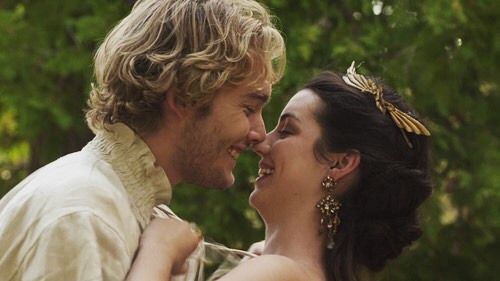
The plotline with Lola and Francis comes out of nowhere and is a monumentally dumb idea.  They both know things are out of whack at the moment, but let’s do this thing that has potential consequences.  And now they have to deal with those consequences.

The first episode feels off from the rest of the show at times.  They had Bash give odd looks to the camera that made one wonder if he was plotting something as well.  That luckily went away.  I was utterly taken by the show by the fourth episode, when Bash came back wounded (don’t ask).  I was intrigued by the pagan plotline and think they could have done more with it, but the show had too many storylines they were trying to juggle.  (However, gives me lots of ideas for stories of my own.)

Henry going mad was an interesting plotline because it brings added danger to everyone.  He tries to kill Bash, more than once.  He oddly ends up working well with Catherine, which is nice, but still odd because we don’t know what’s going on.  And there are dead girls to contend with.  He’s so consumed with glory and gaining control of England.  Then he wants to kill Francis, his heir, and marry Mary.  So Catherine and Mary want to put an end to him.  Franics argues, until he realizes how dangerous his father is and takes the responsibility himself and rides against his father.

I have mixed feelings about the pairing of Bash and Kenna.  They seem good for each other, because Bash comes to care for her, even though he’s also focused on defeating the Darkness.  Some of their scenes are steamy.  And Kenna encourages Bash that he is enough, just himself; he doesn’t always have to prove himself.  Having Pascal around humanizes her, because she’s typically selfish.  Then…that plotline gets destroyed in the second season.

I never trust Narcisse, even when he tries to do something good.  I almost want the relationship between him and Lola to work out, because maybe she’ll bring the good out in him.  Nope.  Still is a complete jerk.  Yet, he oddly pairs with Catherine well.  Except they can’t trust each other enough to go far.

The triangle with Louis of Conde was unneeded.  A love triangle almost destroyed Francis and Mary before, so what do they do?  Bring in another one.  I mean, at first, I thought he was a nice guy, helping out his cousin.  But then I want to hit him as the season goes on.

The rape scene and plotline in the second season was unnecessary.  Yes, it brings drama, but all it does it throw Mary towards Louis.  She already has the mindset that if Francis won’t do what she wants, she’ll go to Louis to get it.  Not a good idea.  The only decent thing out of that scene was Catherine’s support of Mary.  I don’t know if it could have been avoided if Francis had told Mary the truth about his father’s death earlier; he was on the cusp of it at the end of season one when Mary sent him to Lola.  And he was on the cusp of it when he broke her heart by telling her he was upset she wasn’t pregnant.

I expected Mary’s pregnancy to Francis to last longer than one episode. Even though I knew, historically, Mary and Francis never had children, I was still happy that Mary was pregnant. And to have her miscarry so suddenly and so soon after it’s introduced was a bit heartbreaking. Catherine’s response was a bit funny, barging into their room with things for Mary.

Claude was genuinely affectionate with Francis and I wish we saw more of that.  And not the weird previous relationship between her and Bash.  However, her storyline with her mother was interesting, and played into the ghosts Catherine started seeing, same as Henry.  Once Claude settled down from trying to make Bash uncomfortable, they worked well together uncovering the truth of her sisters’ death.  And Diane’s back, and still making a mess of things.  Am I surprised that Catherine took the opportunity to kill her?  No.  I do like that we start seeing Bash and Catherine work together and be nice to each other.  (Diane’s death will surely become a problem later.)

Louis has a brother Antoine, who also needs hit.  The whole issue with their oldest brother being killed, they think by Bash, is never fully solved.  They think it’s Bash.  Bash admits it may have been him, but I’m not wholly convinced.  Antoine also tries to break up Bash’s marriage.  So it’s not wholly Kenna’s fault, but she’s still fairly selfish and is more concerned with nice things.  She also did not trust Bash enough at the end to be honest with him and instead tries to trick him.  Like, she had to have known it wouldn’t work well.  I had wanted the marriage to go well for Bash, for his sake.  For something happy and good in his life.

Which leaves the door open for Delphine.  Who I also don’t trust.  I am grateful for her powers when she saves Bash; which that scene was a total shock and I just sat silently for a few minutes when it went to commercial (and wished my mother would stop talking.  I have not recovered emotionally yet, leave me be).  But she strongly claims she is not a witch.  Honey, you can mystically heal people; yes it has a price, but magic often does.  You have visions.  You can bind yourself to someone, which was just a bit creepy.  I have no problem with you being a witch, just, admit it.  Don’t be frightened of it, but take advantage of the power.  You can’t have it both ways.  Is she a better match for Bash than Kenna?  Maybe.  That plotline needed better developed just the two of them.  But Bash is so often investigating things for Francis.

Odd as it sounds, Catherine kidnapping Lola and John and making Francis think John is dead goes a long way in bringing Mary and Francis back together.  Mary doesn’t attempt to take to Louis’ side and is instantly by her husband’s side and quite willing to help in whatever way she can.  Thankfully, John is safe, and Narcisse finds Lola and her child.  Though I do think the reveal that Franics is still not wholly well goes far in Francis’s desire to easily reconcile with Mary.  And a pairing between Catherine and Elizabeth I is not for anyone.

Catherine gets her comeuppance for that in the beginning of season three, easily getting captured and taken back to France to be thrown in the dungeon.  But Francis’s lingering illness makes that beginning of the season heartbreaking.  Charles has certainly grown up in the few intervening years and then grows up with the events of the season.  Hurrah for Narcisse doing the decent thing and helping Charles and Claude.  Now he has Francis’s permission to pursue Lola.

I like that England began to play more of a role in the politics and drama of the series.  There are still some historical inaccuracies, but Elizabeth I did have a very well-known affair with Robert Dudley.  (I don’t think it resulted in a child, miscarried or not.)

That dance in episode three is utterly beautiful and utterly heartbreaking.  The tune is Stay with Me, which suits the mood, and is so pretty played on violin.  The choreography is perfection.  I wish we had more scenes like that throughout the show.

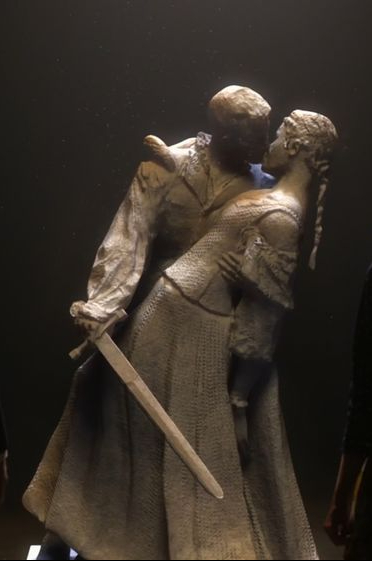
Delphine saving Francis, even at the possible expense of Marie de Guise, gives us a spot of hope.  We’re happy; Bash has a love interest, Francis and Mary can plan a future.  Even Greer is happy with her new career, and having favor at court again.  Francis plans to whisk Mary away to Paris for a romantic getaway, then they stop to be a happy couple.  And it’s utterly ruined by the attack.  Even though I knew it was coming, I cried when Francis died.  The heartbreak that everyone plays; gosh, look at Bash’s face, and having to carry his brother away.  Placing the sword and crown on his casket.  Mary kissing the casket farewell, after her screams.  Not a dry eye at the end of that episode.  Then a few episodes later for Catherine and Bash to bring his casket back in order to clear Catherine’s name.  The audience knows that Catherine would never kill Francis.  And Catherine telling Mary not to look.  We’re not so happy with Narcisse after that.

Now Mary has to marry again, for the sake of her crown and country.  Most of the French court is still nice to her, even Catherine.  A pox on Narcisse for trying to force her out.  Don Carlos is kind for a moment, then manipulative.  I didn’t initially trust Gideon Blackburn, but he turns out so kind, and Mary is so sweet to his daughter.  Mary even saves Elizabeth’s life from a Vatican plot and gives Robert Dudley back to Elizabeth, even at the expense of sending Gideon.  Mary just needs a hug at the end.

It’s a tangled mess when Catherine takes a lover who turns out to be a killer, but being blackmailed into nonaction.  Her actions against Claude are terrible, but at least Charles is behind Claude (and Claude using what she learned from Leith was great).  Christophe was creepy from the moment he came on screen.  He attacks Delphine and later kills her.  I may not have trusted Delphine, but I didn’t want her dead; poor Bash.  Then he has to confront her killer.  And then confront Catherine.  Gosh, the heartbreak for him.  He’s already confessed he still has feelings for Mary, and will follow her to Scotland to continue to be in her service and protect her.

They’re shipwrecked on the shores of Scotland and Narcisse is not impressed and leaves Mary as soon as he honorably can.  Bash is almost killed, but we get to meet the Druids.  (Though that bit with the snakes was…gross and a bit weird.)  And find out that Bash may have a connection to them as well.  Mary gets revenge for Francis by killing the clan leader (John Barrowman, who is Scottish and is Captain Jack Harkness in Doctor Who).  Except, now she has to deal with John Knox, who dislikes female monarchs (not something I knew about the man) and even tries to get James to disband the monarchy.

James Stuart is probably portrayed nicer than he was in life.  I was fine that; I’m familiar with the actor from Good Witch and several other Hallmark movies where he tends to play royalty.  Actually, the number of Hallmark men who are in this show is just shy of absurd.  Torrance Coombs (Bash) is in Royally Ever After, Jonathan Keltz (Leith) is in Once Upon a Prince.  Will Kemp (Darnley) is in three movies with Lacey Chabert: Love, Romance, & Chocolate, The Christmas Waltz, and The Dancing Detective: A Deadly Tango, amongst others.  Steven Lund (Luc Narcisse) is in three of the Heart Around the Table movies [fairly new, and Torrance Coombs is the male lead in the fourth] and at least three other Hallmark Christmas movies.

It’s Knox who arranges word to get to Lola that Mary wants Elizabeth assassinated.  Mary gave no such word, but Knox doesn’t care; he just wants both women off their thrones and Protestant men put in their places.  Lola is caught and her friendship with the queen does not save her from being executed.  Narcisse was there, hoping to rescue his wife, and is forced to watch her beheading.  Mary is devastated.  Her only companion left is Greer, who returns to Scotland after Lola’s death.  She brings her young daughter (from a fling with a privateer.  Her husband is rescued from prison, but ultimately finds other companionship.)

I was terribly sad when Bash left.  I understand the actor left to pursue another show, but story wise it seems so odd for him to travel all the way to Scotland to be by Mary’s side, then leave her.  I mean, at least, they try to explain it with him pursuing his own supernatural talents.  Then, he’s mentioned in the fourth season that he’s had a vision, which he passes on to David Rizzio that Mary may have love, or an heir that will unite Scotland and England, but not both.  David oddly comments that it’s Bash’s spirit that leads him to Mary.  Uh, does that mean Bash is already dead?

This news just affirms that Mary will marry Darnley, who has a claim to the English throne himself.  Elizabeth fears this and even allows Gideon to return to Mary and propose marriage.  Again, they’re so sweet together and happy.  But Mary is afraid that the match will make her a prisoner in England.  So she breaks Gideon’s heart.  In England, Gideon ends up close to Elizabeth and the queen is kind to his daughter, particularly her last few days before she passes. 

I want to smack Darnley on a constant basis.  He’s arrogant and flippant and a jerk.  He’s only concerned with his position and not helping Mary as the current monarch.  He has a few charming moments, which is how Mary is able to conceive a child, but then the man goes along with a plot to rid the court of Bothwell, whom Mary has grown close to (admittedly, the man is handsome, and a right spot kinder than Darnley).  When the council can’t get their hands on Bothwell, they stab Rizzio in front of a pregnant Mary (that is historically accurate).  Mary does help Darnley escape the castle because she figures the other members won’t stand behind him long.  Then, the man, after several pledges to protect her, leaves his pregnant wife in the woods, alone. 

Meanwhile, in France, Catherine’s eldest daughter, Leeza (actually Elizabeth, but goes by a nickname so as not to be confused with Elizabeth Tudor) visits from Spain.  Yet, she wants Spain to have more influence in France and since Charles has been traumatized by an attack from the Red Knights, he’s not a strong king.  He gets better, with a bit of help from Claude’s new husband, Luc Narcisse.  Luc is actually a decent guy, unlike his father.  He tries to be understanding of Claude’s state of mind after Leith was killed.  Though, Leith returns, briefly.  He survived, but can’t stand that Claude is now married, so he leaves, hoping they all might find new happiness.  (Nothing can be straightforward, can it?)

Catherine is not happy that Leeza is home, or what changes she tries to make.  Catherine is trying to keep hold of the regency, though that too slips from her grasp.  Leeza eventually leaves, but also has instructions that Charles’ younger brother, Henry (who oddly looks older than Charles now), should take the throne.  That pits the two brothers against each other.  Further complicated by Charles’ female companion, Nicole.  Nicole is fairly kind, but wants more out of life than her humble beginnings.  She pursues Narcisse, who goes along with the affair so she’ll help control Charles.  Then, Henry arrives and is interested in Nicole, who is interested in return.  Then…Charles wants to marry her.

Catherine arranges for her death so the boys will unite against Spain.  Which involves making a deal with a witch…you know, for someone who spouts that France must remain Catholic, Cathreine sure makes use of magic a lot.  That whole deal, and Narcisse’s involvement just becomes last episode weirdness.  We finally see Catherine’s other daughter, Margot.  They almost seemed to be setting up another season, but the show definitely ended.

Narcisse briefly returns to Scotland to exact his revenge on those responsible for Lola’s death.  He castrates Knox, especially angry that Mary is not able to legally capture him for his wrongdoing.  He also arranges for Gideon Blackburn to die in Elizabeth’s arms, so the queen will know the loss of love.  Elizabeth is still not keen on marrying, so she makes use of Francis Drake (that is partially historically accurate; they mess with timelines again).  Then she has to prepare for the Spanish Armada.

Mary continues to have problems in Scotland; she almost dies in childbirth, but Bothwell calls her back.  That tender scene with Bothwell, Mary, and her newborn son is sweet.  And interrupted by Darnley doing something stupid.  A little later, what do we expect from the man who abandoned his pregnant wife in the woods?  He leaves his newborn son in the woods, on the word of the vision of his dead lover.  Darnley was killed and history points to Bothwell, possibly with Mary’s knowledge.  Just, not only a few days after her son’s birth.  Hurrah for seeing her brother again, for about ten minutes.  Mary asks for Elizabeth’s help and the time skip of two decades shows that that did not end well.  Yes, Mary was prisoner in England for many years before she was ultimately executed.

I do love the final scene, reuniting Mary and Francis.  Since this show portrays their love story, as up and down as they wrote it, I was happy to see Francis again.  Maybe their time in the afterlife will be better.  There’s a montage of bits through the seasons while Mary smiles to be back with her love.

In general, I liked the show.  I have to suspend my knowledge of history for a bit.  But the characters are compelling.  And I wanted to know how the twists and turns worked out.  I agree with a comment I read that the show might have done better if they had tossed the historical connection out and just placed it all in a fantasy universe.  Will I watch it again?  Yes.
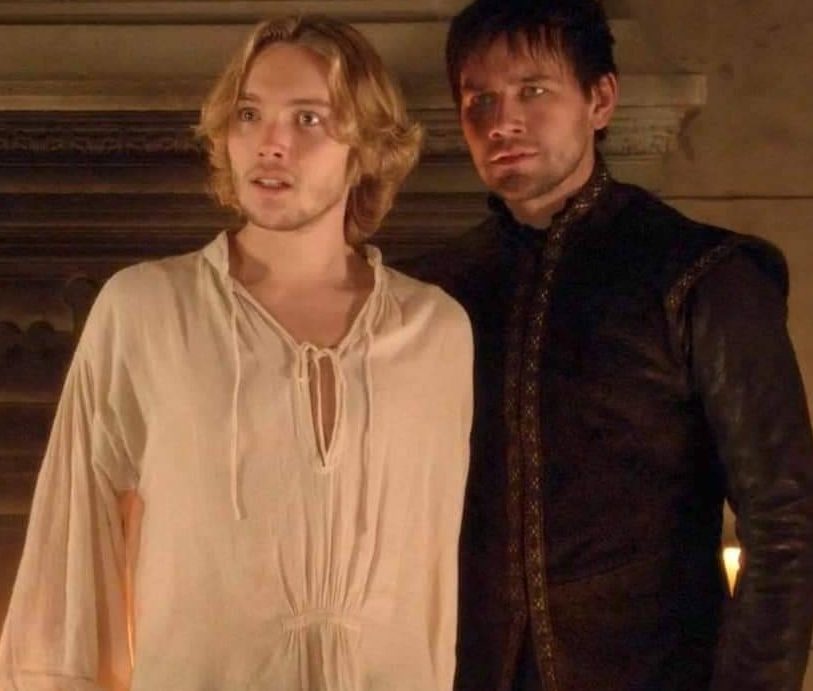
There are some YouTube mixes that I keep going back to, that mainly deal with the brotherly relationship between Bash and Francis; they do tend to be a bit bittersweet, considering how their stories end.

Say Something by Ariana moreau

See You Again by LongMayYouReign

Brother (Kodaline) by Julia Defávari is wonderful.  The music has been used in other videos for other brotherly relationships [which leads to more videos and all influence the essay I will someday write]

Hey Brother by Dragon Wishes is also in that category.  [Side note: there’s an excellent version of this song done by D’Artagnan]

Some of the fanfiction stories I keep going back to:

The Favourite Son by Beserk

I really like It takes a boy to live but it takes a man to pretend he was there by lorarawr

I’ve Got You, Brother by MarieBloom is rather nice

My Brother’s Keeper by OUATLovr is good as well, there are more chapters in the version on fanfiction.net.  The author has several other stories for Reign as well.

I have read several of MissWhitneyBex’s stories, which are modern takes and they’ve honestly given me ideas for modern takes on my story, but I usually end up wanting to hit her characters for being making consistently stupid choices.
A Continuing Historical Fandom Update

First, another apology for the delay in posting Season Three of Race to the Edge. It will actually be posted imminently. However, as stated in the last Random Fandom Update, I’ve been distracted by Reign. About halfway through the series at this point (I’m aware of most of the highlights.) However, it sparked a massive amount of inspiration and creativity with certain elements. Love several of the characters and some of the fantasy elements play well with ideas in my head. And thus is born the longest piece of fiction I have ever written (actually, longest anything I’ve written). At the time of this posting it is 37,000 words. Making it officially novella length. And it’s not complete. It’s shaping up to be the sequel to the book that I should be working on, which itself is the fourth in a series. – I cannot explain how my brain works, I just go with it. It’s a continuing saga.

“Diabolical combination of Lancelot and Superman”

A Random Fandom Update

I always manage to lose track of how many posts I’ve made and how long I’ve been blogging.  I’m now over two hundred and twenty posts and coming up on my six-year anniversary and it remains incredible to me.  I recently had to look back through my posts for something and was shocked at how much I’ve actually covered.  When I started, I didn’t really think I would be blogging for this long.  I’ve got some topics I want to do deeper dives on because I’m really passionate about them, so those will take more time.  But this is also a thank you to everyone who has joined on this journey.

In between blog posts, I’ve been working, of course, but I’ve also been reading and watching other shows. 

I’ve been reading some mystery series, mostly book-centric.  There’s the Secret, Book and Scone Society series by Ellery Adams, though I’ve only gotten through two so far.  And A Scottish Bookshop Mystery by Paige Shelton (not surprised I’m liking those).  And I’m almost caught up with the Bibliophile Mystery Series by Kate Carlisle.  I’ve read some memoirs as well, but I still have a lengthy list of to-be-read books as well.

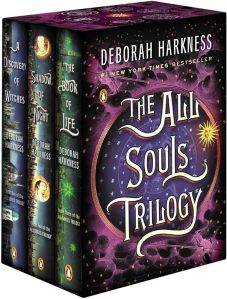
I recently finished the All Souls’ Trilogy by Deborah Harkness, which contains A Discovery of Witches, Shadow of Night, and The Book of Life (gifted to be by a family member) and recommended by said family member and another friend (who got me started on the show).  And I 10/10 would highly recommend these books [that is where this post’s title came from]!  They are a wonderful tapestry of science, magic, and history.  My cousin has lent me the next book about Marcus and the guide that Harkness has published; that will be fun to dive into.  I’m sure I’ll get even more ideas and help for my series.  I’m eager to get back to the show.

In the meantime, my thoughts on the most recent season of Bridgerton: SPOILERS for the book series!

Well, it’s certainly deviated from the book, which is the growing trend in Netflix’s adaptation.  Colin and Penelope’s story is fourth in the series, but they’ve upstaged Benedict (also a consistency in the show).  They increased the drama of the secret of Lady Whistledown’s identity.  I’m obviously not opposed to the match between Colin and Penelope and I’m glad that someone appreciates Penelope for herself.  I’m not opposed to her wardrobe this season, that was even part of the book.  But the costumes became a bit much this season.  Cressida is like a Regency Barbie.  The shapes are shifting very far from Regency era (i.e. Kate’s dresses were not always flattering and yet she was stunning in what they put her in last season).  I also don’t mind the arrangements of pop songs into string pieces.

As much as we find Lady Featherington annoying and blind to her youngest child, she did make points that were historically accurate.  As harsh as the remark she made to Penelope that “ladies do not have dreams,” it’s not that outrageous for that period.  A woman’s duty was to marry and care for her husband.  Her husband has dreams and she supports them.  We, as modern watchers, want Penelope to have her own dreams, and for her husband to care about them just as much and to support her.  And I don’t mind that the family becomes more supportive and happier at the end.  Lady Featherington admits she is proud of Penelope and Penelope even supports her sisters.

And sadly, Benedict keeps getting sidelined and they took away his art.  I certainly hope his story is next (which we have to wait two years for).  It was nice to visually see Francesca and John meet and I was looking forward to her tale with her second husband, but not sure how that will go with changing the gender (the sticking point is going to be, Francesca wanted children and John died young, so Michael was eventually able to give her children).  Overall, I’m game for genderbending characters and the trio that Benedict ended up in worked.  I’m a bit upset of how far the show is stepping away from the books.  However, his talks with Eloise are adorable.

Dear Netflix, we like Jane Austen etc, so the formula works, why are you changing it?

For now, I am going to work on my fantasy series (hopefully aided by some ideas that have popped in my head recently), and then jump into How To Train Your Dragon (it’s hard for me to pick between this series and Lord of the Rings which series I love the best).

We Have Claimed These Characters as Our Own

The series as a whole is the best-selling book series of all time and the movie series is the third highest-grossing in history behind Star Wars and the MCU.  Single books held records for being the fastest selling.  With Harry Potter being around for over twenty years and the kind of people who got interested in the universe, there should be no surprise that there are a lot of fan theories out there.  Same as Marvel, I’ve got a whole board on Pinterest devoted to “Potterverse”

These are the headcannons that fans have created that I totally support:

We want a Marauders movie, or story, or book…anything.  What was the last straw that made Sirius run away?  How did they make the map?  How did Filch get it?  What made Sirius tell Snape about the Whomping Willow?  What made Lily agree to date James?  Proof they weren’t just a bunch of jerks.  When did Peter switch sides?  Proof he was a friend and not a tagalong fanboy.  (Cast: Ben Barnes as Sirius, Andrew Garfield as Remus, Karen Gillian as Lily, Aaron Taylor Johnson as James)

What name did baby Harry say first?  (It’d be hilarious if it was Sirius or a version of Padfoot)

They became Animagus for their friend and told no one.

Prank wall covered in notes and photos

Pairing Sirius and Remus

James covers for Remus as prefect during full moons.  McGonagall totally supports this.

Sirius and Lily friendship.  Lily and Remus friendship

Lily’s friendship with all the Marauders, and individually

The Potters taking Sirius in

How did James and Lily fall in love?

James and Lily’s Patronus are complimentary (stag/doe), while Severus and Lily’s are same (doe).  Love and obsession are not the same.

James Potter was more than a bully.  A fully fledged person with a host of emotions.  James changed for Sirius when he ran away, it just so happened that it coincided with Lily noticing and agreeing to go on a date.

When Lily Evans told James Potter she wouldn’t go out with him because he was a bully, he stopped bullying people and redeemed himself.  When Lily told Severus Snape she wouldn’t go out with him because he called her a racial slur, he went and joined a racist terrorist group.  Conclusion: James Potter handled rejection much better than Severus Snape did.

The bravest things James Potter did were secrets

What if James had transformed into his stag form to take on Voldemort on Halloween night, and trampled him to death.

The novel idea that Severus and James actually work together so no one else can ask Lily out; they take care of the competition.

Or Severus and Regulus stand in front of Remus when other students try to mess with him (for instance, the other Marauders are serving detention)

We respect McGonagall.  She is as golden as her reputation.  Imagine if she had raised Harry; he’d be super polite and probably managed to kill Voldemort when he was eleven.  She also cares greatly about her students.  The Marauders would have had Transfiguration questions about becoming Animagus and posed them to McGonagall.  Yes, she got Harry a broom first year and just told Ron to replace his wand second year; but it was more giving a gift to a child who had been neglected and trying to get a family to recognize their youngest son.  She’d be a more reasonable and responsible headmaster than Albus.  Also, her sass to Umbridge.

McGonagall mothering students who need her, like Sirius.

An idea that McGonagall and the Weasleys start a program for students who are not safe at home.

Note that students get out of McGonagall’s way when she draws her wand.

James standing up to McGonagall for Sirus and Remus when Severus makes a crack that they’re privileged, and James hit Severus for it.

Harry being raised by Sirus and Remus [there are wonderful fanfiction stories out there]

We all hate Umbridge, even more than Voldemort.  (Because we know people as bigoted as Umbridge)

Dumbledore knowingly put children in danger.  And we realize that Dumbledore is manipulative and abusive, and not infallible. 

I thought Albus was a great mentor the first time I read the books; I cried at his death in Half-Blood Prince.  By Deathly Hallows, I was probably starting to lose faith.  But as I’ve matured and thought of other points of view, I’ve changed my mind.  No, he’s not a terrible person.  He was just convinced he was right and he was the only one who knew what was right and what needed to be done.  And he failed Harry.  He allowed a child to be miserable to years when he could have changed the situation and then let the child go back, so that by the time the child has grown up, he doesn’t know how to be around his blood family because they’ve hurt and dismissed him.  Great for self-esteem; but maybe that was what Dumbledore needed in order for Harry to willingly allow himself to die.  Keep him dependent on Dumbledore for information and answers, but limit how much he’s allowed to know.  Dumbledore is by far not the most evil character in the story, that lies with Umbridge and Voldemort, but he’s not a shining gold star.

Dumbledore collects outcasts: expelled half-giant, young werewolf, repentant Death Eater.  But Sirius was a rebel, not an outcast.  He knowingly chose his path and chooses the price, refuses to be used.  So Dumbledore abandons him.  Knows Sirius loyalty lies with Harry, not Dumbledore, and has no use for someone not willing to follow his orders without question.  Harry is outcast because of abusive family, which is where Dumbledore knowingly placed him.

What if Remus yelled at Dumbledore for Sirius and then quit?

An AU where Remus keeps his job.  When Umbridge comes to make rounds two years later, no one will say a bad word.  Draco won’t mess up his OWL.  Snape won’t say anything against his potion making.  Everyone behaves because the student to get Lupin tossed out will be ruined and face the wrath of Hermione Granger.

I’m on the side of Severus Snape was not the greatest guy.  He bullied a child for many things that were not that child’s fault.  You think Harry can help he looks like James?  Or he has his mother’s eyes?   Snape only cared that Voldemort was going to murder a family and one-year-old boy when he found out it was Lily.  He only wanted to rescue Lily, not her family.  He was Neville’s worst fear.  He got Remus fired and also set an essay while he was off hoping that the students would realize he’s a werewolf.  He may have had a hard job, being a spy in two camps and keeping his true allegiance a secret, but he damn well could have been a nicer person!  Saying he did it all for Lily doesn’t really absolve him of treating her son and other students abysmally.  And admittedly, Alan Rickman portrayed the man splendidly and actually made us feel sorry for the man.  No one could have played Snape better (and we have lost a gifted actor).  Snape is a complicated man, period.

Lily kicking Severus’ butt in the afterlife.  And probably Petunia’s as well

Fred Weasley joins the Marauders in the after life

Gordon Ramsey would be a better Potions professor than Snape.  He’d support kids and call Dumbledore an “idiot sandwich”

There are dozens of other options Harry should have named his son rather than Albus Severus.  For instance, Remus Arthur “you were named after two men who looked out for my safety and cared about my well-being out of altruism and decency rather than because I was a tool for them to use or because I was someone’s son.  And one of them is your grandfather and presumably you mother got some influence on naming you.”

(And seriously, this whole business of the Slytherin one being the bravest man you’ve ever known?  Like, what about Remus, who taught you the Patronus Charm?  Or Sirius breaking out of prison to save you?)

Or, if they had triplet boys and name them James, Sirius, and Remus.  That would be the last straw for McGonagall.  She’s McGonagone.

Decent Slytherins: Slughorn, Andromeda Tonks, Narcisa Malfoy…none of them bullied children

Magical Home Ec

Muggleborn witches and wizards bringing Muggle ideas to school, pop culture.  Pens.  Coffee.

The Houses: “Luna Lovegood did not confront and suffer at the hands of Death Eather for Ravenclaw to be the House of smart snobs.  Cedric Diggory did not die for Hufflepuff to be a forgotten House of underappreciated witches and wizards.  Regulus Black did not sacrifice himself for Slytherin to be condemned as the House from which all evil and selfish wizards and witches come from.  Peter Pettigrew did not sell out his long-had friends to Lord Voldemort for Gryffindor to become the golden House wherein no one can do wrong.”

Separated into Houses due to learning styles.

Remember, Slytherins value traditionalism, Hufflepuffs value hard work, Ravenclaws value creativity, wit, individuality, and Gryffindors value chivalry.

Gryffindors use magic as a weapon, but responsibly.  Hufflepuffs share magic to benefit others.  Slytherins are cautious, keep magic to selves.  Ravenclaws push the boundaries of magic.

Hufflepuffs find beauty in life.  Ravenclaws find wonder in life.  Gryffindors find excitement in life.  Slytherins find hope in life.

Gryffindors don’t care about rules, they care about justice.  Slytherins are ruthless, but they care about rules.  Ravenclaws hate rules, they prevent creativity.  Hufflepuffs emphasize equality.

House bravery: Gryffindor is doing the thing, suppressing the fear and overcoming it.  Slytherin is doing the thing because the goal outweighs the fear and risk.  Ravenclaw is doing the thing because it makes sense despite the risk.  Hufflepuff is forgetting to be afraid because the thing is so important that the risk doesn’t even matter.

Helga Hufflepuff created a secret room which would help all students, called many things, today known as the Room of Requirement

Slytherins protect younger students during the battle since their common room is removed from the fighting.

House unity.  Playing evening Quidditch games against each other.  Mixing tables after the war.  Slytherins have comfort Hufflepuffs.  House exchange programs.

Slytherin Triwizard champion.  Slytherins stand up to Umbridge.  Join Dumbledore’s Army.  Fight against Death Eaters in the Ministry.  Take in Muggleborns.

Harry is intelligent.  He’s good at magic.  Perfectly capable of becoming a terrifying Dark Wizard, times when he seems alarmingly near that point.  But he chooses not to.  Ability to love, accept love, understand love, yes, all important.  But it’s not because he’s an incorruptibly pure hero with an unprecedented fountain of love in his heart, in the end he chooses friendship and family.  Deliberately exchanges his life for the people of Hogwarts.

Harry is more sarcastic in the books

Harry’s life summarized: “Harry then did something that was both very brave and very stupid.”

Ron truly outdid his brothers.  Bill’s a curse breaker, Ron destroyed a Horcrux.  Ron freed the dragon from Gringotts.  Ron rose in status due to being friends with Harry, then married Hermione, literal Minister of Magic.  Ron drove a car to school one year, helped discover the entrance to the Chamber of Secrets, meetings in Room of Requirement.

Ron offered a stranger half a sandwich.  He sacrificed himself for Harry and Hermione at 11 because even then he thought they were more important.  He was Harry’s first friend, the first thing Harry ever had resembling a family.  He took care of Harry and Hermione when they were too busy taking care of the rest of the world to worry about themselves.

“Shoutout to George, Fred, and especially Ron Weasley for realizing that Harry was stuck in abusive and unhealthy household, and in spite of massive trouble they knew they could get in, taking immediate steps to personally see him removed from that environment, something no adult in Harry’s life did.”

Charlie Weasley the next Care of Magical Creatures teacher.

Charlie Weasley bringing dragons to the final battle

Weasley appreciation: Try having a couple Weasleys illegally on the airwaves, one destroying Voldemort’s Horcruxes, one protesting at Hogwarts, one running loose in the government, one housing escaped prisoners, and one getting foreign support!  More children than they can afford?  Try more children than you can effectively stop!  Would you like to pick an opponent based on which Quidditch position they excel at, or do you wanna roll the dice and go with one of the brothers who got 12 OWLs?  Those are your only two options because the Weasleys are EVERYWHERE and the weak link is NO ONE.  Glorious.  Iconic.  Every Weasley has red hair, freckles, and a drive to destroy the concept of blood purity at all cost!!

Characters (particularly the Weasleys and Hermione) recognizing and helping Harry out with PTSD

We want Harry to be the Defense Against the Dark Arts professor, not Auror.  All of them becoming professors; Hermione starts as Transfiguration, then becomes Headmistress.  Ron is the new Flying Instructor.

Hermione returned to Hogwarts to complete her seventh year [this might have actually be verified by Rowling; I don’t remember.  Don’t care.  We claim it]

Nine-year-old Hermione reading Matilda

What if when Scabbers was stuck as a cup, he transformed back into Peter Pettigrew?  McGonagall would have had that handled.

Where do you think magical blood came from?  Cross humans with Fae and other magical beings.

Hagrid appreciation: He’s a better person than Snape; even after having his secret revealed without his consent, and taking the fall for Tom Riddle’s crime in school, was still a good man and supported the trio.

Similarities to James and Sirius’ friendship and Harry and Ron’s: Dursleys abused Harry, Blacks abused Sirius; Weasleys loved and cared for Ron, Potters loved and cared for James; Harry runs away from Privet Drive hoping never to return again, Sirius runs away from Grimmauld Place hoping never to return; Harry basically moves in with Weasleys, Sirius moves in with James while still in school; Whalburga Black blasted Sirius off the family tapestry, Dursleys wanted to erase Harry from lives and memories; Ron comes from old pureblood Gryffindor family, same with James; Harry didn’t want to be in Slytherin and ended up in Gryffindor, same with Sirius.  Harry and Sirius are lost boys and James and Ron are their anchors and support systems.

Note, Sirius did not know the Dursleys were abusive.  And Sirius grew up in an abusive house and if he had known for a single second that his godson was facing the same thing, he would have rescued Harry.  And Harry was more worried about his godfather’s safety and freedom than his own health.  To Dumbledore: “people don’t like being locked up!”

Sirius has PTSD

Don’t think about the fact that Sirius saw James’ and Lily’s bodies

Don’t think about the fact that Sirius spent more time in Azkaban than he did with James

Sirius fell behind the veil; but before his body hit the ground, a set of strong and familiar hands caught him.  Beyond-the-veil James like “What in the world are you doing that you’re falling into the afterlife.”  Sirius like “…definitely not battling Death Eaters with your kid…”

Bellatrix used red light: Stupefy.  If Sirius had not fallen through the veil he would have lived.  Hence why Harry can’t come to terms with his death (in the books; in the movie she does use Avada Kedavra and it’s a green blast).

Someone pointed out that Helena Bonham Carter played the moment after Sirius’ death with remorse for a second.  We applaud her

Dapper and suave Sirius, a gentleman who looks good in full black tail, a charmer

Sirius is the one adult in Harry’s life that prioritizes Harry’s safety and happiness over literally anything else.  In turn, Harry is far more open with Sirius than any other adult.  Sirius listens to Harry’s thoughts and feelings patiently and without judgment. [And this is why I hate that Rowling killed him off…well, if you think about it, with Dumbledore being the paragon of good in her eyes, there’s no room for an actual decent character who would help Harry and not kill him]

Harry knew what he was losing when he lost Sirius.  His parents were abstract; he was too little when they died to fully remember them.  A dull ache.  Sirius was someone who loved him, rooted for him, always come to help, the beginnings of a home and proper family.

If Hagrid and Dumbledore had let Sirius take Harry, Sirius would have never gone after Peter.

Headcannons about Regulus.  Having a complicated relationship with Sirius, still caring about his brother.  Coming out of the cave in Half-Blood Prince thinking Harry is James and wondering about Dumbledore.

Sirius protecting Regulus as a child

Regulus keeps an eye out on Sirius after his death.  Tries to talk sense into him during the whole Pettigrew debacle.  “You do not want to duel Bellatrix!”

What if Regulus was the Death Eater spy turned potions master instead of Snape?  Seeing Remus again.  Seeing Sirius in the third book.

What if Malfoys found Harry at platform, rather than Weasleys.  But Harry still manages to make Draco and Ron friends.

Draco and Harry pairing

Draco and Harry the two sides to the same coin, caught up in something much bigger than themselves, as children.

Draco refusing Dark Mark after fourth year.  Running away.  Lupin finds him and rescues him from danger, brings him to Sirius.  At first Sirius angry for treatment of Harry, but recognizes himself in Draco.

Teddy Lupin’s Patronus is a werewolf

Harry meets Susan Pevensie

Harry and possibly Nevill converting Grimmauld Place into a children’s home.

What if Petunia, or both Dursleys had cared a little more about their nephew?

What if Petunia was magical (and hid it)?  Or if Dudley had a magical child?

Harry fights the Dark Lord, but still scared by angry women…well, when those women are Hermione Granger and Ginny Weasley.  If you manage to make Luna mad, watch out.

Mary Poppins attended Hogwarts.  Mentions Walt and Wonka.

The funny notion that Voldemort made a seating chart for the Death Eaters

Hermione creates Lupin’s Law that helps werewolves.

3 things the Harry Potter fandom universally agree on: 1) Umbridge is awful.  2) Maggie Smith is the perfect McGonagall.  3) Everyone should be slightly bothered by DID YOU PUT YOUR NAME IN THE GOBLET OF FIRE

In addition; book Ginny is 100 times better than movie Ginny.  Where was Peeves in the movies?  And Voldemort’s death in the movie was stupid [the battle in Order of the Phoenix was more interesting]

Why the readers disliked the Nineteen Years Later epilogue: we’re millennials; we were satisfied that our young heroes won.  But then there’s a time skip and they’re all happily married with children; they’re financially stable and content, and that is not something we can honestly believe.  We don’t see that in our own futures and we’ve grown up with these characters, we don’t see that happening for them.  An aftermath where they deal with the trauma and fallout, we can believe.  Trying to make it and discover what the future holds; we’re on board.  Trying to fix society, we know all about that.  But who says we want to be exactly like our parents?  “In a world about magic, JK Rowling finally broke our suspension of disbelief by having them all hit middle-class and middle-age contentment and expecting a fanbase of teenagers to accept it.”

Honestly, the book would have been alright ending right before the epilogue, with Harry repairing his wand, planning to get some sleep, hoping that Kreacher will bring him a sandwich, saying “I’ve had enough trouble for a lifetime.”  Satisfying and hey, you let your readers come up with their own endings.  Fans do that for every other book and movie.  There will always be more to the story, but the epilogue just made us mad.

People talk a lot about how Harry Potter taught them about friendship and bravery and love overcoming evil, etc, and of course that is important.  But, Harry Potter taught an entire generation of kids that news media can’t always be trusted to tell the truth, that the government can often be corrupt or incompetent, that the legal system isn’t always right, that the people in power don’t always have your best interests at heart.  That bad things sometimes happen to good people, that your heroes aren’t always as perfect as you think they are, that even those with the best intentions can be wrong, that everyone can make mistakes and that often in order to make things right, it takes a lot of hard work and sacrifice.

I’ve also found as I read fanfiction and see all the headcanons that have emerged on Pintrest about this fandom: Rowling, we have claimed your characters.  They are ours now.  And we will continue to create a more in-depth world for them.  And answer the questions you left dangling.

I have read supplemental material over the years; Harry Potter and Philosophy got me interested in the Pop Culture and Philosophy series and I went on to buy several other editions.  There was even a second Harry Potter edition put out.  The Magical World of Harry Potter is an excellent reference book for general magical research.  Harry Potter’s Bookshelf and Harry Potter and History were not as interesting as I hoped.  Calling All Witches! is a cute book about the women of Harry Potter.  Because of Harry Potter, I did read Alan Rickman’s memoir, which was a bit eye-opening, and Tom Felton has put out a memoir as well.  There are countless other guides out there and “unauthorized” companions and such that the sheer volume makes me shy away.  I’ve also read my companions and that is quite enough for me, thank you.

Again, there will always be a place in my heart for Harry Potter.  I’ve enjoyed re-reading the books, listening to the soundtracks again, watching the movies again and seeing the actors grow up.  There are iconic characters now that are not leaving culture anytime soon.  A whole generation was introduced to the likes of Alan Rickman, Robbie Coltrane, Maggie Smith, and the other adults.  We are sad at the passing of each actor and actress that was involved with the movies as they pass.  These books gave me hope of publishing my own series.  It was fun to read a series about someone my age being the hero.  I was enraptured by the world-building as a teenager.  I still would love to visit the Wizarding World of Harry Potter in Orlando, Florida (okay, I’ll visit while I stop at the How to Train Your Dragon land they’re opening soon).  I will never say I hate Harry Potter, though I may be disappointed with the direction things have gone.  We’ll file this under “childhood nostalgia” with Free Willy and Incredible Journey.

There are of course other Harry Potter fanfictions that I’ve read, such as

Erasing the Future by moxteminator, where Harry goes back in time to change events after things go wrong against Voldemort.  It does not include information found out in Deathly Hallows.

There’s also An Aunt’s Love and What’s Right (and partially year two, but I believe it’s been abandoned by this point) by Emma Lipardi.  In An Aunt’s Love, Petunia actually cares about Harry and makes some changes after Sirius’ death.  What’s Right is another time-travel fic, where Harry goes back in time to set things right and it’s got the interesting addition of becoming friends with Draco and his family; they’re a little more sympathetic.  And some hilarious quotes!  I do recommend them.

There was a site when I first got into fanfiction called The Sugar Quill.  It is no longer active, but there is supposedly an archive of their stories done as captures.  Most of the stories are not canon compliant and go off the beaten path, but they’ve got some zingers.

But I still hold that the best Harry Potter fanfiction I have personally read (and was so happy to find out my cousin has also read it, yay, share the love!) and is miles better than Cursed Child is A Marauder’s Plan.  Warning, if you do plan on reading this, there are SPOILERS Ahead!  As already mentioned, it involves Sirius a lot more.  He makes the decision to stay and help Harry during the events of the Triwizard Tournament (yes, he still gets entered, no way out of that).  Sirius gets custody and gives Harry a loving home.  We learn so much more about the Wizarding World (and yeah, it makes better sense than Rowling’s version).  We learn more about Sirius’ backstory and even James’.  There are more character dynamics and different character relations, like pairing Harry with Hermione.  It incorporates all the vital information from later books (like Horcruxes and Hallows) and the Voldemort issue gets resolved.  The issues with Dumbledore get addressed, Snape remains enigmatic, and other side characters get to step into the spotlight more, like McGonagall.  Draco gets an attitude adjustment.  We see more of Remus and Tonks.  Heck, even Bill is more in this story.   Harry gains power, magical and political, but also gets to be a teen at times.

“It does not do to dwell on dreams and forget to live.”

To open, let me just say that I am including Harry Potter in my blog series since it was a big part of my childhood and growing up.  This is all nostalgia for me.  But, taking into account the controversy surrounding J.K. Rowling at the moment, please enjoy second-hand copies or borrowed copies if you have not read the books or watched the movies yet.

A bit of background; I think most people are aware of how J.K. Rowling came up with the story and how many publishers declined at first.  Then, it became a global phenomenon.  Personally, I didn’t get into Harry Potter until I received the first three books in hardback for my birthday from family members.  So I figured I should give them a try since they were a gift and hardback.  I got into the first chapter of the first book and fell in love.  I was the right age for the series; I was probably 11 when I received my gift and the books start with the main characters at 11.  By the time the fourth book came out in 2000, I was part of the group that would pre-order the book.  I read that one in a day and a half and I was good for nothing else.  I went to the movies with friends in high school and even into college.  I got in trouble for reading the fifth book while on vacation with a friend.  I re-read the first four books so often I broke the spine on the hardbacks and I’ve had to replace them (and specifically, when I replaced Sorcerer’s Stone, I found the anniversary edition, though I don’t think it really throws page numbers off).  Hence, I literally grew up with these characters, and it will always hold a place in my heart.

Anyway, on with: Harry Potter and the Sorcerer’s Stone

(In Britain, the first book and movie are the Philosopher’s Stone, but changed since American audiences would not be as familiar with Philosopher’s stone)

The bulk of the cast includes:

Daniel Radcliffe as the titular Harry Potter (he’s gone on to do some comedic roles, along with stage roles).

Rupert Grint as Ron Weasley

Emma Watson as Hermoine Granger (we saw her in the live action Beauty and the Beast and she was Meg March in 2019’s Little Women)

Richard Harris in Albus Dumbledore in the first two films, then he passed away in 2002 and was replaced by Michael Gambon (who very recently passed away).  Richard was King Arthur in the 1967 movie Camelot, then played Marcus Aurelius in Gladiator [though, I did fall asleep during that movie], and he had a brief appearance in Patriot Games.

The indomitable Maggie Smith is Professor Minerva McGonagall.  She’s now equally well known for her quips in Downton Abbey, but I also knew her as Mother Superior in Sister Act.  She was Lady Gresham in Becoming Jane.

The very talented and dearly missed Alan Rickman (he passed away in 2016 from pancreatic cancer) brings us Professor Severus Snape.  He was Judge Turpin in Sweeney Todd, part of Galaxy Quest and Alice in Wonderland, shined as the Sheriff of Nottingham in Robin Hood: Prince of Thieves, wooed us in Sense and Sensibility and was even alongside Liam Neeson in Michael Collins.  He was handpicked by J.K. Rowling and was the only one informed on some of Snape’s background.

Robbie Coltrane is Rubeus Hagrid (he also passed away in 2022) and occasionally helped Pierce Brosnan’s James Bond out in The World is Not Enough and GoldenEye.  He was also the voice of Lord Dingwall in Brave (how did I miss that?)

Fiona Shaw is Aunt Petunia Dursley (she was Miss Harrison in the first Enola Holmes movie)

Richard Griffiths was Uncle Vernon Dursley (he also passed away in 2013).  He appeared as the Duke of Burgundy in BBC’s Hollow Crown productions and King George in Pirates of the Caribbean: On Stranger Tides.

Harry Melling plays their son, Dudley Dursley.  He portrays Cadet Edgar Allan Poe (alongside Christian Bale) in The Pale Blue Eye [which was filmed about an hour down the road from me].  He also appeared in an episode of BBC’s The Musketeers and Merlin.

Warwick Davis portrays several of the goblins (mainly Griphook) and Professor Flitwick.  We should recognize him from Willow, Maleficent: Mistress of Evil, Wicket in the Star Wars universe (and other roles in that galaxy).  He’s been in Doctor Who, Merlin, and Prince Caspian.

John Hurt is Ollivander (he passed away in 2017) and is also the voice of Kilgarrah in Merlin, the War Doctor in Doctor Who, voices part of The Hollow Crown, Professor Oxley in Indiana Jones and the Kingdom of the Crystal Skull, and appeared in Rob Roy.

Julie Walters is Mrs. Molly Weasley; we’ll see her later in both Mamma Mia movies; she also briefly appears in Mary Poppins Returns and BBC’s Hollow Crown.  She voices the witch in Brave (missed that one as well), but she’s the mother in Becoming Jane.

We’re introduced to Bonnie Wright as Ginny Weasley

As well as actual twins James and Oliver Phelps as Fred and George Weasley

Chris Rankin portrays older brother Percy (he’s worked as production coordinator on Discovery of Witches and Downton Abbey and is Mycroft Holmes in the Hillywood Sherlock Parody)

Tom Felton is Draco Malfoy.

Can’t forget John Cleese as the ghostly Nearly Headless Nick.  He’s part of the Monty Python group, has become a narrator for Winnie the Pooh, and was Q in several James Bond films (most of Pierce Brosnan’s).

Alfred Enoch, who plays Dean Thomas, is in an episode of Sherlock

David Bradley, who plays Argus Filch, pops up as Walder Frey in Game of Thrones and is briefly seen in Captain America: The First Avenger.

Filming took place at Christ Church, Oxford, Durham Cathedral, Gloucester Cathedral, and Alnwick Castle (that’s the main one we see)

The first and second films were directed by Chris Columbus.  And the brilliant John Williams scores the first three films, though his main theme, titled Hedwig’s Theme is used in the rest of the films and is iconically linked to the Harry Potter universe (and those whimsical chimes that start the piece are played on a celesta).

We open the film a little later than the book; where we’ve already been introduced to Vernon and Petunia Dursely; very normal people, and the “last people you’d expect to be involved in anything strange or mysterious, because they just didn’t hold with such nonsense (pg.1).”  But their greatest secret was the Potters.  Which lands on their doorstep one evening, delivered by an old man in a robe and a lady who was at one point a cat reading the sign to Privet Drive.  These are Albus Dumbledore and Minerva McGonagall we find out, and they are delivering infant Harry to his only living relatives.  Something has occurred that his parents are dead and he now bears a lightning-shaped scar.

Harry is delivered by a large man, Rubeus Hagrid, on a flying motorcycle, lent to him by a young Sirius Black.  Harry dreams of this incident when he wakes to his cousin Dudley’s eleventh birthday, a very selfish boy who argues about how many presents he gets, regardless of size.  Harry goes to the zoo with his cousin, aunt, and uncle, though Vernon makes sure to warn Harry off of any funny business.  When they come to the reptile house, Dudley gets bored by a snake, and Harry strikes up a conversation with the snake and to his surprise, the snake responds.  Glass disappears and Dudley falls into the enclosure.  Harry can’t explain how it happened, but he gets punished for it anyway.

More strange things begin to happen, such as mail coming for Harry, addressed to the cupboard under the stairs, his bedroom.  Vernon won’t let Harry have his letter, nor the multitude that begin to arrive each day.  Even when they move bedrooms.  Harry knows that his aunt and uncle know something; he can hear Vernon telling Petunia “I’m not having one in the house, Petunia!  Didn’t we swear when we took him in we’d stamp out that dangerous nonsense (pg. 36)?”  Vernon is very pleased when Sunday comes, for “no post on Sunday.”  Then their house is flooded with letters, shooting out of the chimney.  Vernon forces them to leave, to a hut on a rock in the middle of nowhere.

But not far enough away that Hagrid can’t return and knock down the door right after Harry turns eleven on July 31st.  He informs the young lad, “yer a wizard, Harry.”  Harry is disbelieving, but Petunia finally speaks up and recounts that her sister, Lily was indeed a witch.  Well, Petunia calls her a freak, but it doesn’t negate the truth that Harry is a wizard.  And he was lied to about how his parents died.  Hagrid gives Dudley a pig’s tail and he and Harry leave.

Hagrid takes Harry to London to buy his school supplies for Hogwarts School of Witchcraft and Wizardry.  If one knows where to look, one can find the Leaky Cauldron, which leads to Diagon Alley, full of magical shops and Gringotts, the wizarding bank.  There, Harry finds a fortune left to him by his parents.  They also stop at vault 713 to retrieve an object for Dumbledore [magical symbolism runs rampant in the series, for both the numbers 7 and 13 have magical influence, some of which we discover later; and there are books devoted to pointing out all the magical influence Rowling wove in].  In the book, Harry meets a young blond boy also attending Hogwarts, but they don’t get on.  In the movie, they meet later at school.  Hagrid buys Harry an owl for school, snowy white, that he later names Hedwig.  Harry also purchases his own wand from Ollivander who spouts “the wand chooses the wizard.”  And it’s very curious that Harry’s wand, holly and phoenix feather, eleven inches, the phoenix who gave his feather gave only one other.  And that feather was the core in the wand that gave Harry his scar.  For “He-Who-Must-Not-Be-Named did great things, terrible, but great,” and they should expect great things from Harry as well.

Harry bemoans to Hagrid, “Everyone thinks I’m special…. How can they expect great things?  I’m famous and I can’t even remember what I’m famous for (pg. 86).”

Hagrid explains as best he can what happened to Lily and James and to Harry as a baby.  No one had been able to stand against Voldemort once he wanted them dead.  True, some fought him, including Harry’s parents, but he went after them and killed them anyway.  Until he reached Harry.  Something about the baby stumped him and when he went to kill the infant, the spell rebounded and possibly killed the man.  Hagrid reasons there wasn’t enough human left in the man to actually kill him, and he’s still lurking out there.  That’s why Harry’s famous; he’s the Boy Who Lived.

At King’s Cross Station, Harry has to catch the Hogwarts Express from Platform 9 ¾.  Except, Hagrid didn’t tell him how to access the platform.  Luckily, a family of red-heads arrive, talking about Muggles (non-magic folk) and Harry works up the courage to ask the mother, who explains to run at the barrier between platforms nine and ten.  One of the boys is Harry’s age and they ride the train together, and we’re introduced to Ron Weasley, his younger sister Ginny briefly, and his older brothers Fred, George, and Percy.  The boys share sweets Harry buys, then get introduced to Hermoine Granger, who is helping a boy named Neville find his toad.  In the book, Draco Malfoy returns to introduce himself and try to become friends with Harry.  But Harry sticks up for his new friend, and tells the other boy, “I think I can tell who the wrong sort are for myself, thanks (pg. 109).”

When the train reaches the station, the first years are led to boats by Hagrid and ride up to the castle (and can we ever forget the first time we saw the castle, lit up against a dark sky?)  McGonagall greets them and informs them about the Houses (Hufflepuff, Ravenclaw, Gryffindor, and Slytherin) and Sorting.  A hat is placed upon their head, which then shouts which House they will join (in the book, the hat sings a song).  When it comes to Harry’s turn, the hat ponders for several moments; there is plenty of courage in the young boy, not a bad mind, talent, but also “a thirst to prove yourself.”  Harry pleads, “not Slytherin.”  Really, the hat questions.  Slytherin can help Harry on the way to greatness.  Harry asks “anything by Slytherin.”  Very well, Gryffindor!  Ron, Hermione, and Neville join Harry in Gryffindor.  Draco is placed in Slytherin.

Harry spies an odd teacher up at the Head Table, speaking to Professor Quirrell, whom Harry already ran into in the Leaky Cauldron.  There’s a sharp pain in Harry’s scar when he spots the dark-haired man, Professor Severus Snape, who teaches Potions.  As Percy informs him, Snape is more interested in Quirrell’s job as Defense Against the Dark Arts.  Harry also finds out about Filch and his cat, Mrs. Norris.  Then it’s off to their dormitories (after another song in the book).  And soon classes begin, and Harry meets Snape again.  As Alan Rickman expertly delivers in the film:

There will be no foolish wand waving, nor silly incantations in this calls. As such, I don’t expect many of you to appreciate the subtle science and exact art that is potion-making. However, for those select few, who possess the predisposition…I can teach you how to bewitch the mind and ensnare the senses. I can tell you how to bottle fame, brew glory, and even put a stopper in death.

He spots Harry and announces him “our new celebrity,” then proceeds to ask questions.  Harry doesn’t know the answer, but Hemione has memorized the textbooks, hoping to give herself a leg up, but Snape won’t call on her.  “Clearly, fame isn’t everything.”  [And it’s a little bittersweet to hear that voice and that dialogue after several years; I don’t think I have read the books or watched the movies since Alan Rickman passed away.  The eighth movie came out and I watched it, and then, got busy with other fandoms and ideas.]

Yes, Snape has a great dislike for Harry and Harry’s not too keen on Snape either.  He’s happier about flying lessons, even if it is with the Slytherins and Draco.  Neville gets into a mishap and Madam Hooch has to take him to the Hospital Wing.  She’s warned the students not to fly, but Draco finds Neville’s Rememberall and taunts Harry that he’ll put it on the roof.  Harry discovers he’s a natural flyer, “a rush of fierce joy he realized he’d found something he could do without being taught – this was easy, this was wonderful (pg. 148),” and goes off after Draco, successfully catching the small ball feet in the air.  And in front of McGonagall.  However, instead of getting expelled, he’s introduced to Oliver Wood, the captain of the Gryffindor Quidditch team.  “I’ve found you a Seeker.”  He’s compared to Charlie Weasley (another of Ron’s older brothers) and McGonagall even comments that Harry’s father would be proud, he was an excellent Quidditch player.  This makes Harry the youngest House player in a century. 

In the book, Malfoy challenges Ron and Harry to a wizard’s duel, but it was just an effort to get them caught by sending Filch after them.  It’s at this point that Harry, Ron, Hermione, and Neville find the out-of-bounds third floor corridor and a humungous three-headed dog guarding something.  In the film, it’s a case of the stairs moving when the trio was not expecting and depositing them on that floor; but we do learn Alhoamora.  When the three return to Gryffindor tower, Hermione remarks “I’m going to bed before either one of you gets another clever idea to get us killed, or worse, expelled” [another iconic line from the film that I remember my friends and I trying to imitate].

Classes continue; the students learn the levitation spell in Charms class, Wingardium Leviosa, where Hermione excels and Ron struggles.  He makes a crack that she doesn’t have many friends, which sends her to the girls’ bathroom to cry (she’s eleven and he hurt her feelings).  The Halloween feast is interrupted by Quirrell running in, exclaiming there is a troll in the dungeon and passing out for good measure.  The teachers are to follow Dumbledore to the dungeons, prefects are to take the students to their dormitories.  Ron and Harry realize that Hermione is still in the bathroom and doesn’t know about the troll.  She knows soon enough when the troll lumbers into the bathroom.  Ron and Harry run to rescue her, Harry leaping on to the troll as distraction (as described in the book as “something both very brave and very stupid (pg. 176)”…and honestly, that is Harry’s style) and Ron getting the levitation spell correct in order to knock the troll out with its own club.  McGonagall, Snape, and Quirrell find the trio and McGonagall takes five points from Hermione, who lied and said she went looking for the troll, then awards ten points to Ron and Harry “for sheer dumb luck.”  The three become friends after the adventure. 

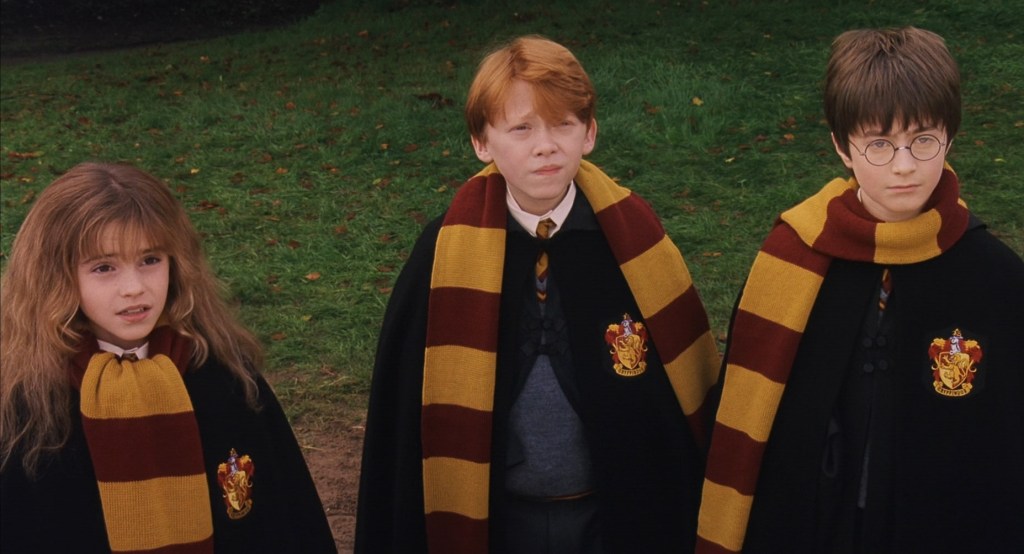
They’re so young here!

However, Harry notices that Snape’s leg is bloody and theorizes that he went to the three-headed dog instead of the dungeon.  Now a proper mystery is underway; he knows that there was an attempted robbery at Gringotts, but nothing was taken since the vault had been emptied the same day, the day he and Hagrid were there.  So, the massive dog is guarding whatever Hagrid grabbed for Dumbledore; Hagrid had even mentioned that Hogwarts is safer than Gringotts.

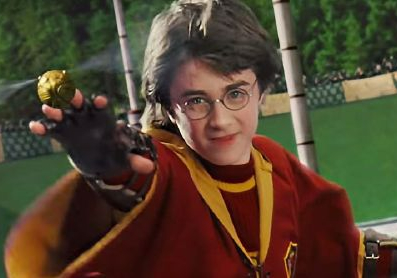
But Harry soon has his first Quidditch match to contend with.  He already received a new broomstick, courtesy of McGonagall.  The first match is against Slytherin and at first, all goes well.  But Harry’s broom begins to buck him off.  Hermione spots Snape eyeing the broom and muttering, and figures he is jinxing the broom.  In her haste to light his robes on fire, she bumps Quirrell and Harry manages to get back on the broom and even catch the Snitch…well, swallow it, but it still counts.

While spending time with Hagrid, the large man slips to the kids that Dumbledore’s friend Nicholas Flamel has something to do with what the dog (named Fluffy) is guarding.  So the kids begin researching and Ron and Harry promise to research while Hermione goes home for Christmas break.  Harry is very pleasantly surprised Christmas morning to receive presents, including a sweater from Mrs. Weasley to match her sons’, and a gift handed down from his father from a mysterious sender: an Invisibility Cloak, with the note “use it well.”  He decides to try the Restricted Section for information on Flamel, but a screaming book sends him off [and made me jump in my seat the first few times I watched the film].  While running from Filch and Snape, he discovers a room with a strange mirror in it.  When Harry stands in front of the mirror, he can see his parents.

He later returns with Ron to show him, but Ron sees himself as Head Boy and Quidditch Captain.  On his third visit, Harry discovers Dumbledore, who explains the secret of the Mirror of Erised; it will show someone’s desire.  But not truth, nor knowledge, and Dumbledore warns Harry against looking for the mirror again.

The kids eventually discover that Flamel was the one who made the Philosopher’s/Sorcerer’s Stone, which can turn any metal into gold and produce the Elixir of Life, which grants immortality.  They eagerly pass along their findings to Hagrid and their theories that Snape is after it.  Nonsense, Snape helped protect the stone, he wouldn’t steal it, Hagrid argues.  And revealing that there is more guarding the stone.  “I should not have said that, I shouldn’t have said that.” 

In the book, they also have to contend with the dragon egg Hagrid won, which hatched into a Norwegian Ridgeback Hagrid names Norbert.  Harry comes up with the plan to send the dragon to Charlie Weasley, except he and Hermione are caught by McGonagall, along with Malfoy and Neville, who was trying to warn them (Ron had been bitten by Norbert, and so was in the hospital wing).  In the movie, Ron hasn’t been bitten, so he gets in trouble as well when they are discovered returning to the castle well after dark.  They lose a whole mess of points and have to serve detention, with Hagrid, in the Forbidden Forest.  He has them searching for an injured unicorn, which Harry and Malfoy come across, along with a cloaked figure.  Harry’s scar begins to pain him, but before the cloaked figure can come after the boy, a centaur rescues him.  In the book, they’re more concerned with what the stars are foretelling, but Firenze is helpful.  He explains that only those truly desperate will kill and unicorn and drink its blood; it will save one from death, but it will be a half life, a cursed life.  Until they can retrieve something in the castle that will grant immorality. 

Harry figures Voldemort has returned and is after the stone.  And he jumps to the conclusion that Snape is helping Voldemort and they both want to kill Harry.  But he’s not as concerned about that; he’s determined to protect the stone.  Ron and Hermione willingly join him.  Neville tries to stop them from leaving and getting in more trouble when they go to sneak out, but Hermione full-body binds him with apologies.

And three eleven-year-olds manage to get past Fluffy, falling into a Devil’s Snare.  Hermione pays attention in Herbology and remembers it hates sunlight and uses a spell.  Next, they get the correct flying key and unlock the door to a chess match.  Ron shows off his strategist brain and helps them play across, and then sacrifices his piece so Harry can checkmate the king.  Harry then tells Hermione he has to go on alone; she should take Ron and go get help.  Hermione remarks that Harry is a great wizard.  “Not as good as you,” he replies.  “Books, cleverness, there are more important things.  Friendship and bravery.”  In the book, there is another task that Hermione helps Harry with; the enchantment Snape set with Potions.  She figures out his riddle and sends Harry forward and herself back to Ron.  This is left out in the film.

Then Harry faces not Snape, but Quirrell, in front of the Mirror of Erised.  He is trying to get the stone out of the mirror.  When Harry is forced in front of it, he sees himself with the stone in his pocket and it appears there.  He tries to lie his way out, but a high voice catches him and orders Quirrell to reveal him.  Voldemort has been inhabiting Quirrell’s body and now appears on the back of his head (now we know why he wore a turban).  He tries to get Harry to join him, promising they can bring his parents back.  “There is no good nor evil, only power, and those too weak to seek it.”  But Harry resists.  Quirrell attempts to grab the boy, but his hands burn when he touches Harry.  Harry uses this to his advantage and grabs Quirrell.  He blacks out when helps arrive.

And awakens days later in the hospital to see Dumbledore.  He informs Harry that his efforts to hold off Quirrell almost killed him.  And the events are a secret, so naturally, the whole school knows, and sent their well-wishes.  He’s spoken to Flamel, and the stone will be destroyed.  Though after six hundred years, “death is but the next great adventure” [this is a similar sentiment we will come upon in Lord of the Rings from Gandalf].  Harry attempts to ask why Voldemort wants him dead, but Dumbledore is not ready to reveal that answer yet; when Harry is older.  He does explain that Quirrell couldn’t touch him because of his mother’s sacrifice, due to her love.  In the books, Ron brings up whether Dumbledore meant for the events to happen as they did, particularly by sending Harry the cloak.  Hermione pipes up that that is a terrible notion, but Harry sticks up for his mentor, that Dumbledore was giving them an opportunity and as kids, we want the chance to get into things and figure things out for ourselves.  [As adults, we realize this is terrible.]

At the end of year feast, Dumbledore passes out a few last-minute points to Ron, Hermoine, Harry, and then Neville, for having the courage to stand up to his friends, which causes Gryffindor to win the House Cup over Slytherin.  The students pack up and head to the station to return home.  Hagrid gives Harry another gift; a photo album with pictures of his parents.  He remarks to his friends “I’m not going home, not really.”  Throughout the series, Harry will constantly refer to Hogwarts as his real home, not the house on Privet Drive with his abusive relatives.

The first two movies stay fairly close to the books.  I will commend Rowling for her writing; hints are placed throughout the book that build to the end, and throughout the series.  For instance, she has McGonagall comment to Dumbledore on page 11 that “Everyone knows you’re the only one Voldemort was frightened of.”  “Voldemort has powers I will never have.”  “Only because you’re too noble to use them.”  This will get expounded upon later in the series.  But first chapter of the first book, and the groundwork is laid.  This is why I admired Rowling for years.  (Not so much now, due to things that have come out recently), but I will give credit where it is due, and state some differing opinions when they come up.  No, I do not think that Dumbledore is the paragon of wizards; that will come up later in the series.

Overall, it’s a good children’s book and a good movie for kids.  We’re introduced to a young boy who is a bit of an outsider, like many of us feel, and he finds out he is someone special.  He goes away to find out more about himself and makes friends and has adventures.  It’s everything I wanted in a book when I was that age.  We might delve more into how this is an excellent example of the typical hero’s path in a later blog, but comments have been made on that fact.

Also, let me gush about the music for a minute.  Again, I haven’t really listened to this music in close to a decade I’d say, but it brings back so much nostalgia.  Each track is a theme that gets used over and over again in later scenes and movies.

Up Next: Chamber of Secrets

And finally, an apology for how long this took to be posted; life has a habit of getting in the way (I also briefly worked on another fun writing project)

A Wee Bit of Fandom

I promise, I have not dropped off the face of the Earth! Life is just…hectic, chaotic, all those words. I most certainly will continue with my blogs on Star Wars (I want to share some of my favorite Extended Universe [now termed Legends; we’ll get into that later] novels). Sadly, those will most likely come after the new year. I don’t know what it is these past few months, but free time has floated by. I’m sure it’s a trait of adulthood, that when a day off rolls around, it gets filled with errands and chores and everything else; it’s just getting annoying.

On a happy note, I did accomplish some writing that made me happy…nothing publishable because my brain still refuses to concentrate on that work. Nevertheless, the stories have made me happy and a few plotlines are still floating about in my head. Heavily influenced by re-watching Disney XD’s show Lab Rats. [If adults can like Spongebob (I hated that show when it was out and I still don’t get it), then I can like Lab Rats 🙂 ] The show featured three bionic siblings who saved the world on missions. Adam, the eldest, had super strength, Bree, the middle child, had super speed, and Chase, the youngest, had super intelligence. The show ran for three years, and there was a half season of a spin off Lab Rats: Elite Force which added characters from another show, Mighty Med. The show was just getting interesting when it was cancelled. Chase is my favorite character; I like smart guys, though he could be egotistical at times and could probably use a smack upside the head.

I just needed something fluffy to occupy the time after work and before I fall asleep. It works.

If you happen to be interested in Lab Rats fanfiction, I can recommend: “A Slow Poison and a Final Straw” by WolfenM on AO3 and a whole slew of works by MoonlightMystery13.3 over on Fanfiction.net. 88keys has some good stories as well and “Because Family Matters” by Scribbler123 is worth a read.

I do want to thank everyone who has continued reading these blogs! And I hope everyone has a Happy Halloween! (One of my favorite holidays; I love dressing up in costumes, but kindly keep your gore and horror far away from me. You’re lucky I managed to watch Supernatural.)

I promise, Empire Strikes Back is coming!

You’ve Become the Very Thing You Sought to Destroy

Episode III: Revenge of the Sith

Let me include a few thoughts about Clone Wars first.  While I have not watched the whole series (and not entirely sure if I want to due to some plot points I’m aware of), it does come up in fanfiction a lot.  I watched most of the traditional animated series when it came out, and it was weird.  So no, I did not want to watch the animated film that came out later and I objected to the idea that Anakin had a Padawan.  And, by the way, the film is still weird.  The series, once I gave it a chance, it better.  I learned to like Ashoka and was pleased with elements they included in parts of Rebels that I happened to catch.  I agree with some plot points that occur in the series (SPOILERS); I thought it was interesting to give Obi-Wan a possible love interest (and if you’ve read some of the Legends books, you know this isn’t the first time).  I adore his sassiness; because my favorite characters tend to be snarky, so much fun!  Anakin isn’t as whiny, huzzah.  We see clones in action and bond with certain ones (which comes to bite us in the butt later).  I was not fond of them bringing Maul back because, really!  Obi-Wan sliced the guy in half and he fell down a shaft [I could make a comment regarding the sequel movies here…apparently that does not mean death in the Star Wars universe…I also disagree with that; more of that rant later].  Can we be nice to Obi-Wan, please?  There are some plot lines that I understand needed to occur, but wish they hadn’t because we’d rather see our characters ultimately happy (after we whump them a bit)

I am interested in reading the Wild Space novel, which has been referenced in several stories (which will be listed at the end of the blog), but for now, on with the main event!

All the familiar faces are back: Ewan McGregor as Obi-Wan, Natalie Portman as Padmé, Hayden Christensen as Anakin, Christopher Lee as Count Dooku, Samuel Jackson as Mace Windu.  Anthony Daniels as C-3PO and Kenny Baker as R2-D2 are the only two actors to appear in all of the original and prequel movies; in fact, the characters appear in all nine films, plus Rogues One, as well as two of the cartoon series, Clone Wars and Rebels.  A fun note about the title of this episode; originally, Episode VI was supposed to be Revenge of the Jedi, but George Lucas decided that revenge was not the Jedi way, but completely acceptable for the Sith.

After the title crawl, the film opens with a huge space battle; you really get a feel for the scope; there are layers and levels and feels a bit like a roller coaster…so be careful if you have a bit of a squeamish stomach.  Also, we now realize fully where the stylistic designs for the Empire originated; those certainly look like Star Destroyers and it doesn’t take much to see the similarity between clone troopers suits and stormtroopers.  Our heroes are in the thick of it and Obi-Wan’s starship gets attacked by buzz droids, so he’s not happy.  Anakin tries to help and R2 is cool; they ultimately end up crashing into General Grievous’ ship [I’m not a fan of Grievous; he was totally unnecessary, you’ve got Dooku]…Obi-Wan does a totally awesome flip out of his fighter and slashes through droids.  Now, time to spring the trap and rescue Chancellor Palpatine.

Anakin and Obi-Wan confront Dooku together this time; Sith Lords are their specialty, but Dooku is quick to take Obi-Wan out of the picture, throwing him into a walkway.  Anakin gets a bit cocky and Dooku can sense fear, hate, and anger in Skywalker, but he doesn’t use them.  Anakin manages to disarm (literally) Dooku and crosses a red and blue blade at the Sith Lord’s neck.  Palpatine orders Anakin to kill Dooku (Dooku was not aware that that was part of the plan); his Sidious voice comes out when he growls “do it” [and that throne looks awfully familiar…fast forward to Return of the Jedi].  Anakin decapitates the Sith Lord and frees Palpatine.  [Ok, seriously, you’ve got Christopher Lee and you use him for about ten minutes, to make room for some mostly-droid being that should have been hacked to pieces the first time he crossed someone’s path]  The Chancellor then tries to get Anakin to leave Obi-Wan (all part of his plan), but Anakin will not leave him.  All three manage to get captured by Grievous, for about a minute, then Anakin and Obi-Wan escape their bonds.  Grievous is a coward and abandons ship.  Anakin manages to land the wreckage of the ship, or as Obi-Wan puts it, half a ship, and calls it “another happy landing.” 

Obi-Wan leaves the politics to Anakin, who sneaks away as soon as possible to visit his wife.  Padmé quietly reveals that she is pregnant.  Anakin is happy (though note the brief hesitation).  Their happiness is soon marred by nightmares Anakin has of Padmé dying in childbirth.  He will not let what happened to his mother happen to the other woman he loves.  Now he’s on a search to find a way to save her.  He even seeks help from Master Yoda, with no details revealed.  Yoda once again counsels Anakin that fear of loss will lead to the Dark Side; attachments lead to jealousy and greed.  Anakin does not seek help from Obi-Wan.

Instead, the Council is concerned by the powers that Chancellor Palpatine is amassing.  Palpatine puts the next step of his plan into action and appoints Anakin as his personal representative on the Jedi Council, planting doubt in Anakin’s head [along with the dream about Padmé, no doubt].  The Council reluctantly accepts the appointment, but will not grant Anakin the rank of Master.  After the meeting, where Yoda states he will help the Wookies on Kashyyk, Obi-Wan and Anakin talk.  Anakin may not have asked for the position, but it is something he has wanted and Obi-Wan tries to get his former Padawan to see that Palpatine is interfering with the Jedi.  The Council, against Obi-Wan’s protests, are asking Anakin to spy on Palpatine (which is what Palpatine is asking of Anakin, but he’s too blinded by loyalty bought at a young age to see that…Palpatine tells Anakin what he wants to hear, so the young man keeps coming back).

Anakin visits Palpatine that evening.  The Chancellor feeds the young Jedi the information on where Grievous is hiding.  Then their conversation drifts to the Sith; Palpatine claims they are similar to the Jedi in their quest for greater power.  “All who gain power are afraid to lose it.”  He also knows a Sith legend on Darth Plageus, who could manipulate the midi-chlorians in a life form and create life [hmm, maybe that’s how Anakin came to fruition], and also, how to keep from dying.  That perks Anakin’s ears, his thoughts are on Padmé.  Palpatine claims that the Dark Side is a pathway to many abilities that would be considered unnatural (and Anakin is so consumed with thoughts of his wife he doesn’t question how the Supreme Chancellor knows Sith legends, or why, or why he’s telling him these things).

The Council decides to send Obi-Wan, who has more experience, to Utapau to capture Grievous.  Former Master and Apprentice bid each other good-bye; Anakin apologizes and thanks Obi-Wan for his training and Obi-Wan declares his pride in Anakin; he’s a far greater Jedi than Obi-Wan could ever hope to be [we’ll get to some Obi-Wan appreciation in a bit].  “Good-bye, old friend,” Obi-Wan says in parting.

Obi-Wan engages in a duel with Grievous on Utapau, leaping down and quipping “hello there.”  Grievous, proving to be a lazy coward, first instructs his guards to kill the Jedi (and weird opening lightsaber stance), Obi-Wan quickly rids himself of the pests.  Then quickly removes two of Grievous’s extra limbs to even the fight.  Obi-Wan’s division of clone troopers [the 212th] arrive to take on the droids, and Grievous runs off.  Obi-Wan pursues him and loses his lightsaber.  When the pair fall onto a platform, Obi-Wan first uses an electro-stave, then decides that hand-to-hand combat is a brilliant way to take on a heavily machined opponent (Obi-Wan, dear, don’t kick the droid) and he gets thrown around a bit.  He manages to grab a hold of a blaster while he’s dangling and a few well-aimed shots ignite what is left of Grievous’s organs.  “So uncivilized,” he quips when he regains his feet (call forward to A New Hope when he refers to a lightsaber as a weapon of a more civilized age).

Meanwhile, Mace Windu senses a plot to destroy the Jedi, the Dark Side surrounds Chancellor Palpatine and there is a fear that he will not set down the extra power he has been granted.  Now the Jedi Council is treading a dangerous line, planning to take control of the Senate.  At the same time, Palpatine is speaking to Anakin, making him believe that everyone else is out to get Palpatine and then he blatantly tells Anakin “only through me can you achieve a power greater than any Jedi,” only the Dark Side holds the power to save his wife.  The young Jedi finally realizes that Palpatine is the Sith Lord they have been looking for all these years.  He wisely goes to the Council.  Windu orders Anakin to remain at the Temple while they arrest Palpatine; Anakin argues that the Masters will need him.  Well, one point for Anakin for finally making a good decision and Windu has a point that Anakin would be comprised, facing Palpatine, but Anakin does not handle sitting still well.

Palpatine continues to weave his influence over Anakin and Anakin leaves the Temple for the Senate building, walking in on the arrest.  Palpatine has finally drawn his own lightsaber and killed the three Masters who accompanied Windu.  Windu has Palpatine cornered, Force lighting reflecting off his blade back onto the Sith Lord.  Anakin pleads that he needs Palpatine in order to save Padmé.  Palpatine pretends to be feeble and Anakin still argues to do the right thing, then takes off Windu’s hand when the Master goes to strike down Palpatine.  Palpatine strikes back, shouting “unlimited power!” and tosses Windu out the window.  Anakin realizes he’s made another mistake and promptly agrees to be Palpatine’s apprentice and turn to the Dark Side [because that’s very logical; let’s negate the good decision made with the worst possible alternative].  Palpatine is now fully Sidious, scarred face and deep voice.  We hear the Imperial March when Sidious names his new apprentice Darth Vader.

That’s not terrifying at all

Sidious proclaims the Jedi an enemy of the Republic and sends Anakin to the Temple to kill all the Jedi there.  Afterwards, he is to go to the Mustafar system and destroy the Separatists leaders.  Anakin leads the 501st division of clones on the Temple, he’s gained the yellow eyes of the Sith, and they murder all there, including Younglings (our hearts start breaking).  Sidious issues Order 66 and the clones turn on their Jedi generals [oh boy, after learning to love these clones and see that they love their Jedi commanders in Clone Wars, yeah, stomp on our hearts why don’t ya…we also discovered in the cartoon that this order is compulsory; the clones were essentially under mind control and didn’t have a choice…bar a few we find out later].  Yoda, already reeling from feeling Anakin, manages to sense his attack and escape, with the help of a familiar Wookie (Chewie!).  Cody and his men fire on Obi-Wan, after he gave his general his lightsaber back.  Obi-Wan falls into the water and does not emerge.  We see him steal a fighter and escape.

Bail Organa investigates the commotion at the Temple and is lucky to escape alive after witnessing the clones kill a Padawan who tried to defend his home.  He boards his ship (the Rebel runner we’ll see in the opening of A New Hope) and goes to rescue Jedi.  He makes contact with Obi-Wan.  Padmé cries when she sees the Temple in flames and is thankful that Anakin is alive.  Anakin reports that there was a Jedi rebellion and they must stay loyal to the Chancellor [deleted scenes show that Padmé was already doubting Palpatine and was part of the group that would become the foundation of the Rebellion, including Mon Mothma and Bail Organa].  Obi-Wan joins Yoda at the Temple and they take down some clones and change the outgoing message to turn the Jedi away from the Temple [we eventually discover most notably in A New Dawn by John Jackson Miller that Caleb Dume/ Kanan Jarrus was the young Padawan who recommended this to Obi-Wan].

Palpatine calls a special Senate meeting that Padmé and Bail attend where he blames the Jedi who have left him scarred.  But his resolve is stronger than ever.  So, in the name of security and stability, he will dissolve the Republic and create the Galactic Empire!  As Padmé puts it, “this is how liberty dies, with thunderous applause.”  [There is a can of worms here that I am not brave enough to open.]

Obi-Wan doesn’t want to believe the security recordings when he discovers it was Anakin who marched on the Temple, or that he has turned.  The two Jedi Masters must face the two Sith Lords; Obi-Wan begs Yoda to allow him to go after Sidious, he cannot go after Anakin.  The young man is like his brother, he cannot kill him.  But Yoda fears Obi-Wan would not survive Sidious, so Yoda takes on the Sith Master himself.  Obi-Wan goes to Padmé; he must find Anakin.  But Padmé won’t say where he husband has gone; and Obi-Wan knows she’s pregnant, and Anakin’s the father.  [Side rant here, it’s made clear in Clone Wars that Anakin and Padmé are not as subtle as they believe they are; Obi-Wan has probably known for a while that there is something between them, maybe not marriage per say.  And how does no one else know Padmé is pregnant!  Look at how she dresses now!  (Mind you, they are pretty gowns, and I love her more natural hairstyle, but that’s beside the point).  And she’s have to be a far ways along; it’s stated at the beginning that Anakin and Obi-Wan have been gone for months in an Outer Rim Siege, meaning her baby was conceived the last time Anakin was home.  How do her friends not guess?]

Padmé flies off to see her husband and Obi-Wan stows away on the ship; he knows his friends.  Anakin has executed all the Separatists leaders but is still excited to see his wife.  Until she questions his actions.  Anakin now believes that Obi-Wan has turned her against him; it’s back to being all Obi-Wan’s fault.  Then Obi-Wan reveals himself and Anakin turns on his wife.  He chokes her (cause that’s a real smart idea with a pregnant woman) and Obi-Wan tries one last time to talk sense into his former Padawan, but his mind is lost to Palpatine’s machinations.

Thus begins the Battle of the Heroes [another stunning masterpiece composed by John Williams.  I can remember Jimmy Smits introducing this piece at A Capitol Fourth, referring to the orchestra as “some friends,” I thought it was funny and totally cool that they played it in Washington D.C. for everyone].  It’s blue lightsaber versus blue lightsaber (a first for the series), brother versus brother.  This is the most epic duel of the entire saga [I will fight you on this].  It is fast, and no, that was not digitally altered, Hayden and Ewan performed this duel themselves and are skilled enough now to fight at that speed.  This is a fight between foes that know each other’s fighting styles intimately.  They’re often a blur of blue and will use the same move against each other.  Heck, they even throw in a bit of Duel of the Fates at one point.

At the same time, Yoda faces Sidious in the Senate building.  Sidious resorts to throwing the Senate seats at the diminutive Jedi and it ends as a stale mate.  Yoda escapes and tells Bail Organa he must go into hiding, failed, he has.

Obi-Wan expresses his own failure to Anakin.  Anakin is now immersed in the Dark Side and feels that the Jedi are evil (goes back to everything Palpatine has fed him for over a decade).  Obi-Wan gains the high ground and cautions Anakin to surrender.  Anakin is still cocky and flips over his former master, but he’s still in reach of Obi-Wan’s blade and loses the rest of his limbs.  The heat of the lava lands on him, burning and scaring him as Obi-Wan releases his pain: “You were the Chosen One!  It was said that you would destroy the Sith, not join them!  Bring balance to the Force, not leave it in darkness!”  Anakin shouts his hatred at Obi-Wan.  “You were my brother, Anakin.  I loved you.”  [Excellent acting by Ewan]  Obi-Wan cannot bring himself to end his best friend (which could be argued was a mistake, but we love Obi-Wan too much to judge him too harshly), so takes his discarded lightsaber and walks away.  He takes Padmé to Bail Organa where the medical droids deliver her twins (a bit of a shock to everyone, except us).  Sadly, she’s lost the will to live but tells Obi-Wan as he holds newborn Luke that there is still good in Anakin.

Palpatine senses Vader is in trouble and saves him, but that necessitates a large black suit to keep him alive.  This is where that iconic look comes from and that distinctive breathing.  When Vader asks about his wife, Palpatine tells him that he killed her.  Construction begins on the Death Star [why it takes nineteen years to build the first one, unless there were large-scale prototypes first…there are a few plot holes between the ending of III and beginning of IV].  Padmé’s family buries her on Naboo.  Yoda recommends that the infants be split up for their protection; Bail offers to take Leia to Alderaan.  Obi-Wan will take Luke to his family on Tatooine (cue theme from Episode IV).  Yoda has one final lesson for Obi-Wan; Qui-Gon has kept his identity in the Force and offers to teach the remaining Masters.  We also get a quick scene that shows C-3PO’s memory was wiped before working for Bail Organa, but R2-D2’s was not…meaning that little astromech knows everything.

So now, all we have to do is wait for the next generation to grow up.

This movie, like the other prequels, has its good and bad points.  Anakin’s Heel-Face Turn was too sudden when it finally happened.  Yes, the ground work has been laid, particularly since Attack of the Clones.  But it seems within the space of a few hours, Anakin goes from ‘I trust the Jedi Council to handle this threat I discovered’, to ‘I kill the Jedi Master and boom, now I’m a Sith Lord’.  And then he takes it out on his wife.  Of course, this is majorly influenced by Palpatine’s schemes, but I really want to smack Anakin upside the head.  [And this is why there exists many fix-it fictions].  And all Padmé does it sit around, being pregnant.  She took charge and kicked butt in the previous two films and now, nothing.  She loses the will to live after giving birth…yes, this obviously had to happen because she’s not around in the originals (and begs the question, how did Leia have memories of her…plot hole), but still disappointing.  Grievous was an unneeded character; you already had an extra bad guy and why build up Count Dooku if you’re not going to use him.

The banter was fun; Anakin was a bit better, at least at the beginning of the film; not so whiny.  The massive duel at the end was epic!  That sells the entire film; it’s fraught with emotion.  Obi-Wan may not have been planning on killing Anakin, but he did plan on stopping him.  What makes it even more interesting is that the two characters (and actors) were evenly matched.

Up Next: Solo

I’ll put my musings on the Jedi Code here:

As the extended universe wrote out, the Jedi Code declares There is no emotion, there is peace.  There is no ignorance, there is knowledge.  There is no passion, there is serenity.  There is no chaos, there is harmony.  There is no death, there is the Force.  I’m sure someone has done a paper somewhere comparing this to different philosophies or religious beliefs and this as it is written out is a mindful way to live.  For a while, I felt that the Jedi Code was meant to make Jedi into unfeeling beings, which is the opposite of what humans are.  As humans we have emotions, we are emotions.  And as a teenager, just getting into the fandom, I went along with the idea that the Council was denying Anakin’s basic needs as a human; of course he should feel love.  But there is a difference between love and attachment.  It circles back to that saying “if you love something,  let it go.”  The attachment rule is to prevent the Jedi from putting one thing or being or whatever about another.  Like Anakin putting the fate of Padmé above the rest of the galaxy.  Of course Jedi should love and have a compassion, but they have a larger duty to the galaxy.  In Clone Wars we see Obi-Wan tempted due to love, but he resists.  Is the Council flawed?  Yes.  It’s a bit odd to look back and see that wise Master Yoda made some mistakes.  Like, instead of simply telling Anakin over and over that fear leads to the Dark Side, how ’bout some actual help? And it pains me to say this, but technically Palpatine had a point in telling Anakin to completely understand a subject, he must study all aspects, not just the dogmatic, narrow view of the Jedi. There is obviously a fine line (and someone could make the connection between magic and the Force and compare Harry Potter to Star Wars…I do not have the time for that, lol), but simply excluding something because it is “dark” without understanding it is asking for trouble. Caution is urged, of course.

It is heavily implied within the extended universe that Qui-Gon Jinn loved a fellow Jedi Master, Tahl and his decisions regarding her were not wholly logical.  It caused a rift between him and Obi-Wan more than once while Obi-Wan was a Padawan. …Yeah, I’ve come to realize that Qui-Gon was not the greatest Master and this is where fandom has declared Obi-Wan deserves hugs. I once thought Mace Windu cold and unfeeling.  While he too was flawed, as is any good character, he also had his depths.

Some Obi-Wan Kenobi appreciation [can you tell he is my favorite character?]:

He’s referred to as the Ace on TV Tropes [a lot of this information came from there, but I certainly agree with their points]; one of the best Jedi that the Order ever had.  Third strongest Council member after Windu and Yoda; tactical genius, top diplomat (Negotiator), expert pilot (out flew Jango Fett), master of multiple forms of lightsaber combat (particularly Form III [Soresu] and Ataru).  Considered to be the single best defensive duelist in the galaxy in his prime.  In canon, the only battle he loses is against Vader in A New Hope and he most likely threw that as a distraction to help Luke.  He faced off against the Sith, killing an apprentice when he was only a Padawan and Grievous.  Became a broken ace after the death of Qui-Gon and most of the Order, and (SPOILER) his love Satine by Maul [I disliked that bit].  Saw the death of Padmé and spent nineteen years in hiding on Tatooine with guilt and trauma. 

Sees more combat that most of the other Jedi in canon.  More of a brother relationship with Anakin, less of an age gap; bicker like siblings (and it is hilarious).  The one who started the trend of Jedi generals wearing clone trooper armor in order to relate more closely to their troops.  Primary enemy of Maul and Grievous, but greatest enemy was Anakin.  Took a Level in Badass: goes from getting very lucky against Maul to a Master who defeated Grievous and bested the most powerful Force User in the galaxy.  Badass Bookworm – intelligent, cultured gentlemen, who can kick a lot of ass when the time comes for it (love this!).  Bash Brothers and Big Brother Instinct and Mentor with Anakin.  The fandom is quick to point out that while Obi-Wan undoubtedly made mistakes in training Anakin (and he beats himself up for it), he went directly from being a Padawan to having a Padawan and one who was already too old to begin Jedi education yet young to be a Padawan.  And had several members of the Council who disagreed with training the boy, so cut him a little slack.

Is described as “the ultimate Jedi” partially because he is modest, heroic, focused, and kind.  Nevertheless, if you push him far enough (like taking part in the murder of almost his entire “family” aka Jedi Order, including innocent children) he is prepared to hack off your limbs and leave you alone to slowly burn to death.  Calm facade breaks while fighting Anakin in Revenge.  Anytime the emotionally controlled Obi-Wan get emotional, something is wrong.

Humble Hero [fanfic authors recognize this]: It seems that Obi-Wan is the only being who doesn’t understand how great a Jedi he is – when the Council proposes to send their ‘most cunning and insightful Master’ after Grievous, he has no idea who they mean.  He’s also surprised when Mace Windu (the guy who created his own form of lightsaber combat) refers to him as ‘the master of the classic form,’ note, the master, not simply a master.  He is easily the nicest and most immediately personable member of the Jedi Order in Prequels.  Overall, maintains a kind demeanor and strong moral code in spite of the vast amount of hardship he faces.  Slightly aloof and snarky and times, but also polite and compassionate.  The Paragon: stands as pinnacle of heroism; selfless, morally upright, humble, and inspires others, in control of his impulses and emotions.  Not perfect, but closest to embodying ideals of Jedi Order.  Extremely clever, worldly, intelligent.

Does get beaten up at times (Attack of the Clones where he jumps out window and then the arena).  Combat Pragmatist.  Sharp wit and sardonically sarcastic sense of humor (could be a result of seeing death and destruction…I believe somewhere in Legends canon, young Obi-Wan suffered from visions).  Gentleman Snarker [I love that]: Obi-Wan’s polite, diplomatic demeanor can mask some pretty biting snark.  Poster boy for Snark Knight; he also likes to flirt with his enemies. Mainly meaningless, but still funny.  Refuses to give up after learning about the occurrences of the Jedi Purge and Anakin’s betrayal of the Order.  Still hurt years afterward, still believes Luke will save the Jedi.  Jedi are fettered as a rule, but Obi-Wan explains the strength that comes from resisting the temptation of the Dark Side while confronting Maul later.  Makes up for lack of character growth with the sheer amount of action he goes through.

Foil to Anakin, both skilled and famous Jedi with troubles love lives: Anakin and Padmé obviously.  Obi-Wan and Duchess Satine (Legends: Siri).  Obi-Wan takes firm hand training Anakin, more of a gentle touch training Luke.  Throughout Prequels and Clone Wars, Obi-Wan has several good reasons to turn to the Dark Side, but resists.  Cannot be corrupted.  Has Innocent Blue Eyes that symbolize his heroic, righteous, and pure nature.  Mentor Archetype.  Morality Chain to Anakin: Anakin respected Obi-Wan enough that Palpatine had to get him off the planet before turning him to the Dark Side, and Anakin still tries to (threateningly) talk Obi-Wan out of fighting him.  Morphs into dark version of Worthy Opponent.  Dooku  considers Obi-Wan a worthy opponent (Hardeen plotline; foil an attempted kidnapping by disguising himself as a bounty hunter and sabotaging the plot from the inside)

Implied friendship formed with Padmé and turned blind eye to her relationship with Anakin.  Good is not Soft: prefers to settle conflict diplomatically.  But will fight.  Demonstrates some of the most powerful Psychic Powers in canon.  Also prone to passively enhancing his physical strength and durability with Force; shot straight up four feet by arm strength to beat Maul; shook off blows from Grievous that sent him falling thirty feet; and fought Anakin within inches of lava.

Similar position to Han Solo in Prequel Trilogy; they both serve as older brotherly figures (Han to Luke, Obi-Wan to Anakin…I’ll get into more of the former when we hit the original trilogy because I love that part).  Obi-Wan is Anakin’s Jedi Master and partner who Anakin also saw as a Parental Substitute while Han is Luke’s partner and closest friend, who later becomes his brother-in-law.  Conversely, Anakin and Obi-Wan’s bond is destroyed, while Luke and Han have a rocky start but become family (even before marriage).  Belligerent Sexual Tension with love interests (Satine, Leia).  Obi-Wan Ideal Hero, Han Anti-Hero.  (SPOILER): Both are murdered by someone they had a complicated father-son relationship with.  Driving force behind the Prequels, but still major character in New Hope.

Disagrees with (SPOILER) dismissing Ahsoka [and another reason I’m not keen on finishing Clone Wars].  Also believes the Council should be more open with Anakin about their concerns over Chancellor Palpatine and the Sith, but overruled.  The Stoic: has one of the most unpleasant lives (and afterlife?) of any character in fiction, but remains clam, never complains, and usually keeps his emotions well in check.  You Didn’t Ask: rather sad one, only reason didn’t stay with Satine is she didn’t ask.  Oh, and Leia is Luke’s sister.

Later in life, the Atoner for training the man who destroyed the Jedi Order and never recognizing the threat Anakin really represented.  Will still cut off arms if need arises.  Even after all the trauma he went through in his younger days and having spent almost twenty years living as a hermit, Obi-Wan is a remarkably kind and patient man.  Explanation for fight against Vader; stalling and Vader’s powerful attacks.  Starts off as a young and brash apprentice to Qui-Gon, becomes more wise and experienced Jedi Master, culmination in teaching Luke, his former pupil’s son.

And thus I am totally excited for the upcoming show on Disney+ and very glad they kept Ewan McGregor for the role.

Some fanfiction recommendations, all from AO3:

Check out

Both Lost Destiny and Crossroads by Nihes are interesting, but you end up wanting to punch something at the end.  However, Jedi Babysitting for Professionals is hilarious

I certainly hope that Big Fat Bumblebee’s Found is continued because it is certainly time that someone takes care of Obi-Wan.  Brothers care for brothers, Infuriating Man, Battle of Wills, and Enforced Convalescence are heartwarming (apparently the only thing Anakin and Mace Windu agree on is caring for Obi-Wan, not the Order, or the Republic, or even the Force, but yes to Obi-Wan).

Meysun’s There is no Pain is rather poignant, and you certainly want to wrap Obi-Wan up in a hug afterwards.

As I Fall and A Long Way Down by KCKenobi include some Obi-Wan whump.  Some Things You Just Can’t Speak About is another one that makes you want to wrap Obi-Wan up in a hug.  We get some protective Mace Windu in Old Wounds.

Must_Be _Thursday’s Just Surrender is rather good.

AndyHood’s Fought for Him really emphasizes why Obi-Wan needs some hugs.

Siri_Kenobi12 gives us some Obi-Wan whump in TestedMemoirs of Kadavo is wonderful and I already told you I love It Takes a Village from the write-up on Phantom Menace.

You Are Wanted Obi-Wan Kenobi by allwalkfree is my new favorite story.

Time Travel Gives You a Headache

Season Two

Drowned Book starts with a flashback to the beginning of season one, when magic surges back through the ley lines.  An older man summons a character from Sherlock Holmes; “I have need of your genius, sir.”  Fast forward to present day, everyone ends up invited to the same New York museum, but on different cases.  Eve suggests working together, but they’ve all gotten used to doing their own thing.  A strange storm blows in and Eve and Flynn meet James Worth (played by the dashing David S. Lee; he’s been in episodes of Castle, NCIS and NCIS:LA), head of antiquities from Oxford.  James charms Eve and can match Flynn for deducting.  The three younger Librarians end up teaming up again to solve their problems and Flynn realizes that Worth is a fictional.  His first guess is Sherlock Holmes (and he’s ever so excited), but Worth is actually Moriarty.  But he’s not the true mastermind connecting all the artifacts.  That would be Prospero, Shakespeare’s wizard from The Tempest.  Prospero is a Fictional so powerful, he rose from his own tale.  But he wants to control his own story, not be bound by what Shakespeare wrote.  He and Moriarty manage to disappear, but the Librarians have to deal with the storm that is spiraling out of control.  They end up using a sun from the Library to burn off the cold air and save New York.  Flynn sulks that he liked being able to do things his way, but Eve points out that pooling information works just as well.

In Broken Staff, Flynn and Eve follow up clues to keep Prospero from regaining more of his power, while Prospero and Moriarty manage to make it into the Library.  They hold Jenkins hostage for a bit, asking about the Heart of the Library, the Tree of Knowledge.  Again, it takes all of the Librarians, including Flynn and Eve to defeat the traps Prospero has laid.  Flynn burns a Tree to thwart Prospero (not actually the Tree of Knowledge, he hopes it wasn’t important).  But the Library has also been re-arranging itself and sixteen artifacts are missing.  Eve again suggests that Flynn carry on searching for the artifacts alone while she helps the other three Librarians settle the Library.

The three younger Librarians head to Jacob’s home state to solve a rift in the Earth in What Lies Beneath the Stone.  Jacob’s not thrilled about returning home; he kept his academic life very secret at home and he’s been saying “family ain’t easy” for a while.  He has strong disagreements with his father, but the Librarian job is more important.  They pass Ezekiel off as the expert since Stone’s father is dismissive of him and eventually work out that it’s a Native American trickster who has been set free and causing chaos; feeding off lies.  It looks like Jacob reconciles with his father for a moment, but it was the shapeshifter.  Jacob fights him off and locks him away again.  He still does not tell his father the truth, because he has realized that he doesn’t need his father’s approval.  So he signs his own name to the academic paper he is writing.  The team heads to Wexler University in Cost of Education, where people are strangely disappearing.  Cassandra meets another girl who is tracking magic and linking it with science.  A tentacle monster from another dimension is stealing people who are full of ego.  Cassandra follows her new friend into the wormhole to rescue her, but is stopped for a brief moment by the ladies of the Lake Foundation, interested in combining science and math.  Cassandra is content with being a Librarian, but the invitation stands.  She disagrees with Jenkins on whether magic should be studied or not.  Ezekiel sadly loses his new gargoyle friend, Stumpy.

In Hollow Men, Flynn pops back in to find the Eye of Zarathustra, which “is the key to the door of Lost Knowledge, the Staff summoned by Sun and Rue.”  But he’s quickly separated from the rest of the Librarians, held by a strange man who somehow knows Flynn, but not really.  Prospero is also after the staff and Moriarty still flirts with Eve.  She ends up having to team up with the antagonist in order to find Flynn.  And it turns out, Flynn is traveling with the intelligence of the Library.  Meanwhile, the other three work with Jenkins to keep the Library from completely dying.  Ray regains his memories, though Moriarty has to take the staff to save him. The Library is wholly restored.  Baird visits an old friend in Infernal Contract; Sam Denning (Michael Trucco, he’s appeared in several TV shows, including Castle as a similarly named Detective Tom Demming that was interested in Kate) is running for mayor in a small town.  But turns out that his opponent’s family has had a long running deal with a devil (played by John de Lancie, a few episodes of Charmed and Stargate SG-1, and Q in Star Trek); a bit like crossroad demons in Supernatural.  Eve, Jenkins, and the Librarians manage to trick the devil and rescue Sam and the town.  Jenkins sweetly takes care of the three ill Librarians at the end and points out that Eve’s job as Guardian is to save the Librarians’ souls.

The team gets to go clubbing in London in Image of Image, trying to figure out how people are mysteriously dying from something they weren’t doing.  They’re all connected to Club Effigy, where pictures mark them as the next victim.  There’s a charming Englishman who turns out to be Dorian Gray.  Any of his vices are passed onto his victims, keeping him young and beautiful.  Until Ezekiel and Cassandra turn the tables on him.  Jenkins once again counsels Eve on the upcoming battle between good and evil.  Jenkins goes to a Fae for information on Prospero at the beginning of Point of Salvation.  The rest of the team gets stuck in a video game scenario at a DARPA lab.  Ezekiel is the only one who remembers each pass and gets tired of seeing his friends die.  He forces them to believe him and follow him, even sacrificing himself at the end.  Jacob and Cassandra figure out a way to bring him back and now he doesn’t remember his heroic deeds [or does he?].  Prospero attacks in the final moments.  He created a spell that wiped the memory of Eve, Cassandra, Ezekiel, and Jacob from Jenkins’ mind in Happily Ever After.  Flynn heads off to find them and discovers they’re leading new, but similar lives together on a small island.  Eve is the sheriff, dating Moriarty.  Cassandra has been to the moon, Jacob teaches eleven different classes at the university, and Ezekiel is an FBI agent, but their home base seems to resemble a library.  Flynn teams up with the sprite, Ariel [she is adorable] to bring his family’s memories back.  Eve has to do the same for Flynn at the end because his perfect life is one puzzle after another that he solves by himself.  But they’ve been under the spell for three weeks, Jenkins reports.  The ley lines have been supercharged by Prospero; it means the end of the world.

A giant forest begins to cover the earth in Final Curtain.  Due to a wet hand, Flynn and Eve finally realize the strange note they found in John Dee’s estate in Drowned Book was written by Flynn in his left hand.  They use time travel to go back to when Shakespeare wrote The Tempest, but it breaks upon their departure.  Now Jenkins and the other three Librarians have to follow the rest of the clues to stop Prospero in the present.  Prospero has one final task for Moriarty and sends him back in time as well.  But Moriarty wants vengeance on his taskmaster for holding him prisoner and decides the best way to do that is to try to kill Shakespeare.  Obviously, that does not work out, but Flynn and Eve discover that Prospero is Shakespeare transformed.  His quill is magical, part of the Tree of Knowledge gifted to him by John Dee.  With it, Shakespeare transforms into the wizard so he can escape a failure in his career.  Moriarty is swiftly dealt with by Prospero, and he almost drowns Eve.  She rises out of the water, like the Lady of the Lake (aided by the ladies of the Lake), throwing Excalibur to Flynn to defeat Prospero.  So it follows that old adage of King Arthur, that he who wields Excalibur will do so once more and save England.  The other three turn Prospero back into Shakespeare in the present, using some of Shakespeare’s’ work to define themselves.  A portal opens that can send Shakespeare back to his time, but Flynn and Eve cannot come forward.  However, they figure out how to do time travel the long way round, leaving the notes they need for themselves and asking Shakespeare to use his magic quill one last time to make them into a statue that is delivered to the Library for safekeeping.  The other three free them from their very long kiss and heck, even Cal is back.

It’s adorable how much this team continues to become a family.  Since I am not fully versed in Shakespeare, I probably miss some of the nuisances of Prospero being the villain, but Moriarty is excellent; almost sympathetic at times.  I’m glad that Flynn takes Eve with him to defeat Prospero, rather than leaving her behind and handling the mission on his own; and I’m even happier that they don’t stay stuck in Elizabethan England forever.

Next Time: Season Three

Offering You the Chance to Save the World, Twice Before Friday

Season One

Flynn Carson is back, still protecting the world from dangerous magical artifacts (Noah Wyle is billed as “special guest star” since he couldn’t star in two television shows at the same time).  He’s been doing the job, alone, for eleven years.  Though it turns out that the Library wants to add to the team.  It recruits Colonel Eve Baird (played by Rebecca Romijn, who was Mystique/Raven in the 2000’s X-Men trilogy), head of a NATO terrorist task force, to become Flynn’s Guardian.  As Charlene points out, Flynn hasn’t had a proper Guardian since Nicole (in the first movie).  We also find out that Judson passed away five years previous, though his spirit still speaks to Flynn in a mirror (and Flynn’s mother apparently had passed as well).

In The Crown of King Arthur, Eve helps Flynn solve the mystery of why experts are being killed; one professor had been trying to reach Flynn regarding a painting.  The connection?  He had been invited to interview at the Library the same day Flynn was hired; the professor was only a few people behind Flynn.  There are a few top candidates left alive.  Cassandra Cillian (played by Lindy Booth who has starred in a few Hallmark movies, including playing a librarian falling in back in love with a football star) is startlingly brilliant with math and science, but they sometimes get cross-wired with her other senses and a brain tumor pushes her death sooner rather than later.  Ezekiel Jones (John Harlan Kim, he has appeared in a few episodes of NCIS: LA and Hawaii Five-0) is a master thief, and Jacob Stone (Christian Kane, previously starred in Leverage, and I absolutely loved his appearance as an old friend of Dean’s in Supernatural; complete with singing Good Ol’ Boys [one of my favorite scenes of the entire show]) is a genius art historian who hides out in his hometown.  Yes, apparently ninjas do pop up in Oklahoma, sent by the Serpent Brotherhood. 

Eve and Flynn bring the other three to the Library to keep them safe.  One of them excitedly asks if vampires are real.  Flynn answers yes to vampires, no to Dracula, because he killed him (call back to the third movie).  Cassandra is glad to have lived long enough to find out magic is real, but Jacob wants to know why no one sees is.  Response: it’s buried in ley lines.  Long ago, the world was filled with magic, but it was drained off and stored in artifacts; which is why the Librarian travels the world to collect the artifacts and house them safely in the Library.  As technology has risen, magic has faded away.  Stone helps solve the mystery of the painting; it’s The Crown of King Arthur.  The actual crown was apparently created by Merlin to allow Arthur to control the magic of Camelot in order to rule.  Hence why the Serpent Brotherhood wants it; they want to release wild magic back into the world and create chaos; that they will rule.

Flynn catches up to Eve and the trio in Munich.  The painting supports the Roman hypothesis of Arthur [we’ve seen that in a few of the prior Arthurian legend movies], but the painting is actually a fake, Stone points out.  They quickly discover that the museum was built around the painting; it’s a clue (after arguing for a bit, it’s like the inside of Flynn’s mind has spilled out, but louder).  It leads outside to a sundial, which leads to a henge in the German forest.  All the while, trying to keep ahead of the Brotherhood, led by Lamia, a skilled female fighter.  The good guys recover the crown with a bit of shenanigans. 

Flynn intends to send the three newcomers home, but an alarm is set off.  The Serpent Brotherhood has gotten inside the Library.  But with the security upgrade, someone would have had to let them in.  Sadly, it was Cassandra.  The Brotherhood promised her magic would cure her brain tumor.  Lamia gains the crown and calls Excalibur to her, though Flynn puts up a fight.  He’s stabbed with Excalibur, and even though he takes a healing tonic, it cannot cure wounds dealt by a magical weapon.  Flynn will die.

The adventure immediately picks up in Sword in the Stone.  Judson and Charlene work together to protect the Library, meaning they lock it into its own pocket dimension.  Flynn mourns the their loss and the loss of his home.  Eve and the three men are met by an elderly gentleman who agrees to help them and takes them to the Library’s Annex.  You can still access any of the books from the Library.  Its’ caretaker is Jenkins (the veteran John Larroquette, got an early start with Black Sheep Squadron, then broke out in Night Court amongst his long career), who is eager to send them on their way so he can return to his peace and research.  Jenkins encourages Eve to help Flynn; she gives him a pep talk so he will save the world one last time.

Meanwhile, Cassandra meets, Dulaque (Matt Frewer, who provided several animated voices to various series and appeared as Pestilence in Supernatural), the leader of the Serpent Brotherhood.  Excalibur is the key to unlocking the Stone, which will release magic.  And the stone is in London.  Through a secret entrance in Buckingham Palace, the royal family has been guarding it for years.  Cassandra helps the Brotherhood, until she discovers their true purpose and is then locked up for her troubles.  She does aid her new friends; Flynn understands why she chose to initially help the Brotherhood, to save herself.  Lamia places Excalibur back in the Stone, but distractions help Flynn gain the Crown and regain Excalibur.  The Brotherhood runs off, but Flynn is still dying and now so is Excalibur.  He offers the sword to heal Cassandra, it has that much magic left.  With Judson and Charlene gone, and Cal dying, it’s Flynn’s time.  Instead, Cassandra chooses to save Flynn.

Flynn feels it is safer for the three young adults to leave, but he vows to find the Library and bring it back.  Though he begins thinking; if he’s in charge now, he can change the rules.  There can be more than one Librarian.  And they can train the Librarian instead of throwing them into sink or swim situations.  He tells everyone to open their envelopes; there are new invitations inside.  Flynn will go off by himself, he’s used to it, but Eve will stay and protect the new Librarians, with Jenkins’ help.  He’s offering them a life a mystery and misery, of loneliness and adventure.  A chance to save the world, twice before Friday.  Flynn bids farewell to Eve who makes him promise not to die, and there is a parting kiss (squee!) [And I still totally want this job!]

The new crew continues their adventures in Horns of Dilemma, where they have to solve the labyrinth of the Minotaur and recover the twine.  (Familiar face is Tricia Helfer, who has been in several Hallmark Channel movies).  And yes, Santa Claus is real (and played by Bruce Campbell, who played Sam Axe in Burn Notice) in Santa’s Midnight Run.  The Serpent Brotherhood plans to kill Santa and the Librarians must stop them.  Eve ends up taking on the role of spreading goodwill back to the human race on Christmas Eve.  She was in fact named “Eve,” for being born on that night.

Ezekiel and Jenkins have to team up and entertain a conclave of magical beings in Apple of Discord while Stone, Cassandra, Eve, and even Flynn shows up to retrieve the dragon’s pearl.  Except hidden inside the pearl is the Apple of Discord, which brings out the worst in everyone.  And Dulaque wants the conclave to vote to disband the Library.  Of course, the heroes prevail and point out that the world needs the Library to protect it from harmful artifacts.  Eve permanently transfers to the Library and sends Flynn back out to do his thing (of course, with a parting kiss).  The Librarians’ next case is the Fables of Doom, where fairytales are coming to life in a small town.  Eve does ask Ezekiel to not antagonize local law enforcement, though he argues it is fun.  An old book, the Librus Fabula brings fairytales to life, but will re-write reality and sucks life from those trapped in its stories.  The local librarian is using it on a young girl and our heroes slowly turn into archetypes: Jacob is the Huntsman, Cassandra is Prince Charming, and Eve is the Princess (their clothing and hairstyles change throughout the episode).  Ezekiel is what he always is, the Lucky Thief and he helps the girl recover and rewrite the story so the good guys win.

They encounter magic occurring at a STEM fair in Rule of Three.  Someone has created an app that doubles as a focusing spell, so when the students all imagine beating the leader, bad luck will befall them three times over.  Cassandra gets to shine by combining science and magic.  And they encounter a new foe; Morgan le Fay (played by Alicia Witt, another actress who has appeared in Hallmark Channel movies, and even an episode of Supernatural [I think I may have figured out why so many Hallmark stars are in Supernatural; they both film in Canada]).  Jenkins is furious to encounter her (she calls him Galais) and warns Eve that there is a larger battle coming.  The Librarians save the day, but hints are dropped that something bigger is coming.

Heart of Darkness reminds me of a Supernatural episode.  There is a haunted house that traps people inside.  Eve keeps trying to protect Cassandra, but it is ultimately Cassandra who faces off against Katie.  The house is actually the House of Refuge, until a family of serial killers, the Bloody Benders, moved in [yep, really sounds like a Supernatural episode].  Jacob befriends the local archivist in City of Light.  It is ultimately a town designed by Tesla, but the citizens got trapped between worlds and the streetlights are the only thing tying them to this world.  They try to recreate Tesla’s plan to bring everyone back, but Cassandra works out that too much could go wrong and harm too many people.  Mabel sacrifices herself to shut it off.  Though there is a ray of hope at the end; Jenkins has Eve write down an appointment for future Librarians, so maybe there will be a way to bring them back.

The season ends with Loom of Fate.  It begins with Flynn meeting the team at an Egyptian tomb; he has an idea on how to bring the Library back.  The team helps out with the artifacts they have recovered throughout the year.  But just when Flynn is about to succeed, Dulaque enters and kills Lamia so he can view the Loom of Fate.  Eve and Flynn jump through and Dulaque cuts the Loom at the spot where Camelot fell.  Eve and Flynn then bounce through different timelines, where Flynn did not become the Librarian.  In each case, one of the junior Librarians took the job and they all lost Eve.  In one case, it’s Jacob Stone and Eve who pair up, instead Flynn.  In Cassandra’s case, she studied under Morgan and has a few more clues.  Camelot was the height of magic and power, but with the Loom cut, time is fraying and it will require all three Librarians to get Eve and Flynn back to the Annex and then to the River of Time.  Flynn reweaves the Loom with the labyrinth twine, while Jenkins faces off against a younger Dulaque…as in Lancelot du Lac (played by Jerry O’Connell, among his many television and movie roles, he does play Sheldon’s older brother in Big Bang Theory [Rebecca Romijn’s real-life husband].  Jenkins is actually Galahad [the son of Lancelot and Elaine of Corbenic] and argues against Lancelot wanting to return to Camelot; it wasn’t as great as Lancelot remembers and mortals have earned the right to rule themselves.  Jenkins bests Lancelot and Flynn reverts to his usual self.  They have to get Eve help; Lancelot stabbed her.  But first, Flynn has to finish bringing back the Library.  The Library holds the solution for curing Eve…the same potion Flynn took in Sword in the Stone will actually work on Eve’s wound, though it’s a close thing.  Flynn refused to let Eve die like she had in all other timelines; he does not believe in Fate.  But he’s glad to be home in his Library.  They send the three young Librarians off on their own adventures, and Eve will accompany Flynn on his adventures.

I adore the show even more than I love the movies.  With a television show, there is more time to develop characters and plot lines further.  And of course, I love the integration of Arthurian legend into the story.  Cassandra is a sweetheart, Jacob is the big brother, Ezekiel is the annoying little brother, and Eve just tries to keep them all together.

Up Next: Season Two

Be Safe. Don’t Get Killed. Save Your Receipts.

The Librarian

First, a trilogy of movies put out by TNT; then developed into a television series.  It stars Noah Wyle (he was on E.R. for many years [no intention of watching] and he briefly appeared in an episode of Lab Rats) as Flynn Carson. Jane Curtin is Charlene and Bob Newhart (he’s popped up in other television shows like Big Bang Theory, and I had no idea he was the voice of Bernard in Disney’s The Rescuers movies) is Judson.  There’s a familiar face, David Dayan Fisher (bad guy in NCIS and National Treasure) in the first film, Quest for the Spear; and Gabrielle Anwar (the Queen in The Three Musketeers with Chris O’Donnell, Princess Margaret [Henry VIII’s sister] in The Tudors, Fiona in Burn Notice, and Victoria Belfrey/Lady Tremaine in Once Upon a Time) joins the second film Return to Solomon’s Mines as Emily Davenport.  The third film, Curse of the Judas Chalice, brings in Stana Katic (briefly glimpsed at the end of Quantum of Solace, and opposite Nathan Fillion in Castle) as Simone Renoir.

Quest for the Spear introduces us to Flynn Carson, who holds 22 degrees and intends to be a lifelong student.  Until his professors agree to cut him off and force him out into the big, bad, real world to find a job.  An invitation arrives at his home (he doesn’t see it until a pile of books drops on his head), to interview for a prestigious position at the Metropolitan Public Library.  He’s not the only applicant, the line wraps down the staircase.  He faces Charlene, who wants to know “what makes you think you could be the Librarian?”  And she means more than knowing the Dewey Decimal system; what makes him different than every other librarian.  His observational skills rival Sherlock Holmes and he can tell when Charlene broke her nose, when she divorced, and how many kinds of cats she owns.  Then another voice calls out “what’s more important than knowledge?”  Flynn echoes his mother’s statement that the things that make life worth living are not thought (in his head), but felt (in his heart).  Flynn wins the position and will begin a wondrous new adventure, from which he will never be the same.  Judson appears and leads Flynn downstairs, through a secret door and security guards, opening to a grand hall filled with shelves and display cases.

Judson explains that magic exists, but it is dangerous and must be kept out of the wrong hands.  That is the Librarian’s job.  And he must keep it secret [so I object to his mother’s dismissal of his job as simply shelving books…I wanted to become a traditional librarian at one point.]  That evening, Judson is knocked out at the Library; Charlene and Flynn find him the next morning and discover that the Serpent Brotherhood has stolen a piece of the Spear of Destiny.  The Serpent Brotherhood opposes the Library and wants to use magical artifacts to rule the world.  And the Spear was used by Charlemagne and Napoleon; Hitler had one piece; so if the Serpent Brotherhood has it, they can certainly control the fate of the world.  Flynn, as Librarian, is the only one who can go after them (which Flynn points out is a little sad).

Clues to the other pieces are in a book, written in the Language of the Birds, the universal language all people spoke before the Tower of Babble.  Flynn has to decipher it on his flight to the Amazon.  He succeeds in 7 hours and 26 minutes.  And the beautiful woman he meets on the plane is Nicole Noone (so when Judson says to “trust no one”…that’s what he meant), whose job is to protect the Librarian.  Nicole is a bit dismissive of Flynn at first, bodily dragging him out of danger, since the Brotherhood is chasing them.  But Flynn proves his brilliance; he memorized the globe as a child.  They uncover the second piece of the Spear, but are met by the Brotherhood outside, including the previous Librarian whom Nicole saw die.  He desires power now and plans to wield the Spear.  But he can’t read the Language of the Birds, so Flynn argues Edward needs him.  Oh, and the final piece of the Spear is in Shangri-La.  Edward forces Flynn to grab the spearhead, then the monastery begins to collapse.  Nicole grabs the spearhead and escapes with Flynn (and the helicopter is “horrible, horrible, high velocity pie of death!” Flynn discovers while trying to fly it).  Nicole kisses Flynn in his room in Mongolia, but she is gone when he wakes up. He has a brief discussion with Judson and realizes that the Brotherhood has to fuse the Spear back together at the pyramid display with the golden capstone that Flynn was working on at the university in the beginning.  “Call the Marines, Judson.  I’m coming home.”  But, clothes first.

Edward does manage to fuse the Spear and tests it on his minion [that bad guy we see a lot].  Nicole and Judson take on the other mooks, though Flynn does get to punch his former professor in the nose.  Flynn goes after Edward and gets beaten up a bit.  But as Flynn pointed out to the students earlier, if one stone is out of line be even one inch, the whole pyramid collapses; and Edward has been hitting stones trying to get Flynn.  Edward is crushed by the capstone and the Spear floats to Flynn.

Back at the Library, Flynn is worthy enough to pull out Excalibur and there is a new portrait hanging, featuring Flynn with the Spear.  Three months later, Flynn’s mother is still trying to hook his son up, despite hearing Nicole on the phone earlier.  Nicole zooms in on a motorcycle and kisses Flynn hello, then briefly introduced to his mother.  But they have to go (time-traveling ninjas are on the loose).

The opening of Return to Solomon’s Mines is very similar to the opening of Last Crusade; it takes place in Utah and Flynn interrupts someone digging up something that doesn’t belong to them.  Back at the Library, he receives a package while Judson instructs him that he has a lot to learn and that to be a truly great Librarian, one must sacrifice what one wants for the greater good.  Flynn stops by his mother’s house for a surprise birthday party for him and briefly speaks to his father’s best friend, Jerry.  Flynn’s father passed away when the man was thirty-two, which is the age Flynn is now.  His mother has saved some of his old drawings from bedtime adventures his father told him.  She pulls out a [Masonic-looking] medallion, which his father used to joke was their family crest.  At Flynn’s apartment, he discovers that he was mailed an odd-looking scroll, then is knocked out.  Judson wakes him and realizes that the symbol Flynn saw on the scroll leads to Solomon’s Mines, holding great treasure.  It also holds the Key of Solomon which can summon the undead.  Judson sends Flynn to Morocco.

Flynn meets Emily at her Roman dig in Morocco; she’s searching for evidence of the Queen of Sheba’s (the wife of King Solomon) rule there.  They discover the secret tomb and are briefly attacked after finding the legend piece.  But their attacker recognizes the medallion Flynn wears; it symbolizes a society bound to protect Solomon’s Mines.  More bad guys come and they are sent to Kenya to find the second piece.  Emily insists on accompanying Flynn; if she can find more items like the legend piece, her own research will be funded for years.  Emily also has 25 degrees (to Flynn’s 22), so they spend a great deal of their journey arguing history and archeology.  Then they come across a man buried in the sand.  For freeing him, he will take them to Gedi.

Bad guys have followed them to Gedi, but luckily they run into Jerry boarding a train.  He treats them to dinner, then Flynn and Emily discover the key to the map is playing the legend pieces like an instrument; the map is music notes.  It comes to life and leads them to another mountain.  Judson pops into instruct Flynn to return home; but Flynn and Emily continue on.  Flynn’s father’s bedtime stories lead the way to the oldest tree in Africa, underneath which is a temple.  They find the treasure, but bad guys interrupt their exploration, led by Jerry.  Jerry wants the Key, which Flynn found, so he can re-write history.  Jerry blames Flynn’s father for stealing his mother’s heart; Jerry should have had the family; and he was responsible for the father’s death.

Jerry incants from the book, opening a portal and beginning to raise the dead.  Flynn goes after Jerry and threatens to destroy the book, but Jerry tempts him with the idea that Flynn can bring his father back.  Flynn takes over the chanting, but Emily manages to distract him.  Flynn throws the book into the lava and Jerry jumps in after it.  Emily, Flynn, and the man they saved all manage to escape the explosion and Flynn is left to return home alone.  Judson encourages Flynn that he did the right thing in destroying the Key of Solomon; only a great Librarian would have done so.

Flynn is at an auction in the beginning of Curse of the Judas Chalice on Library business, but also trying to keep his girlfriend happy.  He battles against another collector to retrieve the Philosopher’s Stone.  He wins, but his girlfriend leaves him.  He’s depressed once he returns to the Library and Judson’s comment that he’s a celibate monk does not help.  When Flynn looks around the Library he doesn’t see artifacts anymore, he sees the bits of his life he gave up to retrieve them, like his college reunion.  Charlene suggests that Flynn use a few vacation days, then stops by his apartment later (a little drunk) to drop off travel brochures.  Flynn dreams of New Orleans and decides to give it a try (a woman called to him in his dream).  He hears the same voice singing and meets Simone.

Meanwhile, a former KGB Russian, Kubichek meets up with a Romanian history professor.  The professor is teaching a lesson on Prince Vlad Dracul, known as the Impaler, but all his students want to know is whether the man was a vampire.  Kubichek is interested instead with the Judas Chalice.

The Russians end up chasing after Flynn in New Orleans and Simone helps him escape, such as hitting a high C in an echo chamber.  Simone takes Flynn out for a night on the town and he perks up a bit.  Judson appears to Flynn (again; he has a habit of doing that) and explains that Flynn needs to go after the Judas Chalice.  The Chalice has the power to resurrect vampires, because apparently, Judas was the first vampire, cursed to walk the Earth for all eternity after he was hung for his transgressions.  Oh, and Dracula’s tomb has been stolen.

The bad guys grab Flynn, explaining that they want to use the army of the undead to bring Russia back to its former glory [seems like lots of Russians want to do that in these types of movies].  Flynn happens to know the Romanian professor and they decipher the lens that was found.  Simone drops in to help rescue Flynn, except she’s shot.  Flynn drags her out and briefly mourns her…turns out she’s not dead.  She’s a vampire.  She was turned in Paris in 1603 where she had been an opera singer for the royal court.  Now, she’s trying to hunt down the vampire who turned her and kill him.  (She also hints that Judson is a lot older than he appears and there is a larger battle to be had with the Library, between good and evil).

Flynn and Simone find the Chalice aboard Lafitte’s shipwreck [no, not Lafayette that many now know from Hamilton.  Lafitte was French as well, but was a smuggler based out of New Orleans in the early nineteenth century.  He did aid America in the Battle of New Orleans.]  The Russians interrupt the couple and Simone seems to know the professor.  The Russians trap them, but Flynn rigs a cannon to blow open a way out.  Simone leaves him behind and Flynn fears she wants the Chalice for herself.  When they meet up at the plantation again, turns out, no, she recognized the professor as the vampire who turned her.  And who turns out to be Dracula.  And he has no intention of actually helping the Russians.  Sure, he’ll raise the undead, but so he can rule the world.  Flynn goes after Vlad and the Chalice.  Simone helps fight Vlad, who drops the Chalice.  Flynn stabs him with a stake from an aspen tree.  Simone then watches the sun rise with Flynn, one last time.  Her duty to protect the Chalice is done now; she’s gotten her vengeance.  But she encourages Flynn to live out his destiny as the Librarian.

Flynn returns to the Library in a better mood and ready to fight the larger battle that is coming.  As he and Judson walk away, it is revealed that the walkways of the Library create the Tree of Knowledge.

I love these movies.  I want the Librarian job.  Again, it makes learning fun.  History is not dry and dull [well yes, at times it is], but hunting for artifacts uses so many aspects of knowledge.  And I appreciate that the three different women who help out Flynn are all strong, independent women.  Yes, they have brief romances with the lead man, but they are also smart in their own right.  Nicole is the one to kick butt.  And they don’t look down on Flynn for being a bookworm.  Being a bookworm actually saves their butts occasionally.

Next Time: The adventure continues with the first season of The Librarians