A not-as-popular re-telling of the Three Musketeers story; it focuses primarily on D’Artagnan’s story, even more so than traditional versions. The iconic three musketeers are barely side characters in this tale. It has a decent plot, but it also heavily relies on action and fight scenes. I don’t know most of the actors, though Tim Roth (Emil Blonsky from 2008’s The Incredible Hulk) is the villainous Febre, or “Man in Black.” Rochefort is an entire other character, and very minor [to the point that I didn’t know that was him until reading the credits]. Porthos’s Steve Speirs has had bit parts in other movies I’ve seen.
The movie, like a lot of the ones based on a legend, has an introductory card giving the back story; the English and Spanish are threatening France with war and King Louis XIII is a weak man, easily manipulated by Cardinal Richelieu. The Musketeers oppose the Cardinal. Next, we’re at a country home, a young boy sparring with his father; ’tis young D’Artagnan. A man in black rides in to demand taxes for the church, D’Artagnan’s father has nothing left to give. When D’Artagnan tries to stand up for his father, Febre kicks him. The father goes for his sword, but he’s cut down, as is his wife. D’Artagnan takes up his father’s sword and catches the man across his eye. Near dusk, an older man picks up D’Artagnan, Planchet. He will teach the boy.
Fourteen years later, Planchet and D’Artagnan stop at a tavern. They run into Rochefort (looking far fancier than I have ever seen Rochefort) and trouble. D’Artagnan shows off his skills fighting several guards at the same time; a vastly different fighting style than traditional swashbuckling films – a lot of martial arts mixed in. He and Planchet continue to Paris while Febre stops the Spanish envoy and slaughters them, leaving behind a Musketeer tunic. At the headquarters in Paris, D’Artagnan discovers from Porthos and Aramis that the Musketeers have been suspended, per the Cardinal’s orders and Treville is detained in one of his prisons. Meanwhile, Febre mocks confessing to the Cardinal, who is displeased he continues killing people. He wants political tension, not war. Buckingham is arriving soon and the Cardinal cannot have the king make peace with England. Without killing anyone, Febre is to make the king a fool in front of Buckingham. But, if needs must, Febre may kill.
D’Artagnan finds Bonacieux’s inn and is immediately attracted to the repulsive man’s beautiful niece, Francesca (a change from Constance, who is Bonacieux’s wife in the original text). But the young man also has a mission; he intends to rescue Treville from jail. He runs into Aramis and Porthos on the way and once he’s blown the doors, they do assist in fighting the guards. They all go into hiding together, though the young men go to a local tavern and Porthos introduces D’Artagnan to the rest of the suspended Musketeers. Athos is there (again, the original three are demoted to supporting characters and Athos is barely that).
Back at the inn, D’Artgnan hears creaking in the rafters; Bonacieux is peeping at Francesca bathing. D’Artagnan chases him away, but crashed through the ceiling into the bathing room. He and Francesca have a few tender moments together, Francesca explaining that her mother came with the queen from Spain [does that make Bonacieux her father’s brother? Bonacieux is a very French name; it would not make sense for him to be the brother of Francesca’s mother – though it does explain why she is named Francesca] as her seamstress. When she died, the queen has made an effort to help Francesca when she can.
That evening, at the banquet, the musketeers sneak into the palace as cooks and waiters. The banquet is then attacked by a mob of peasants, it seems. The musketeers sneak the king, queen, and Buckingham out, though not without several duels with very capable opponents. Guards, disguised as rabble. When D’Artagnan returns to the inn, Francesca stops him and warns him that Rochefort and six of the Cardinal’s guards are in his room. They share a kiss for a moment, and then D’Artagnan gets away from the guards. In D’Artagnan’s room, Bonacieux confronts his niece, warning that they shouldn’t get on the wrong side of the Cardinal. He also wants their relationship to be better, in a disgusting way. She pulls a knife on him and threatens him. He scampers away and she takes a few moments in D’Artagnan’s room, finding an old Musketeer tunic.
D’Artagnan meets the Cardinal, who is very keen on finding out who D’Artagnan is, why he is in Paris and essentially, whose side the boy is on. He makes a pitch to persuade D’Artagnan to his side, but the lad is loyal to the ideals of the Muskteers. Febre emerges from the shadows after D’Artagnan has left. The Cardinal puts the next phase of his plan into action and has the Musketeers arrested (trumped up charges, of course). Treville declares he will no longer hide. Meanwhile, the Cardinal poisons Louis against his queen, having her dismissed from their discussion about Buckingham. So, Francesca asks D’Artagnan for help escorting the queen, in secret. When Athos, Porthos, and Aramis come to D’Artagnan for help freeing the other musketeers, he has to decline.
The small group encounters mercenaries on their ride (some more fight scenes, including D’Artagnan pulling an Indiana Jones stunt, making his way down the underneath of the carriage), but they make it to the home of an old friend of the queen. While Planchet waits for a blacksmith, D’Artagnan takes Francesca on a picnic. He explains that the old Musketeer tunic in his room was his father’s; when he was first taken in by Planchet, all he wanted was revenge, but the old man warned him that a Musketeer stood for higher goals. He gifts Francesca a tiny necklace and they exchange a few more kisses. After, D’Artagnan goes swimming and is in the water when Febre and his men appear. They take Francesca and shoot D’Artagnan after demanding where the queen is. D’Artagnan makes it to shore a little later and has to deal with the two men Febre left. But when he gets back to the house, the queen and Francesca are gone. A little girl holds the information; Febre had threatened to slit her throat to persuade the queen to write a letter to Buckingham. The man in black is holding everyone at Duchamp castle with an army.
D’Artagnan must wrangle together an army of his own. But the Musketeers are not keen to hear him, not after Treville died at the hand of Febre. Febre had come to Treville in his chambers and questioned him about D’Artagnan, both coming to the conclusion that it was Febre who had murdered D’Artagnan’s parents and it was D’Artagnan who had blinded Febre’s one eye. Then Febre burned the building. Febre had then gone to the Cardinal to inform him of the new plan, to kill the queen and Buckingham and thus igniting France and England into war. Louis would be disgraced and Richelieu could take the throne. Febre is mad. It’s said three times; it must be true [he’s more psychopathic, in my opinion]. Rochefort goes after Febre and is quickly killed for his trouble. The Cardinal meets with D’Artagnan in an alley and asks for the lad’s help in putting down his out-of-control monster. D’Artagnan agrees, but not for the Cardinal. When D’Artagnan confronts the Musketeers, they retort that his alliances are skewed, defending the queen rather than the king Disappointed, D’Artagnan leaves his Musketeer tunic, intent on rescuing everyone himself.
He is pleasantly surprised when the whole Musketeer corps comes to his aid outside of Duchamp. he wears his father’s tunic and they ride into battle. Planchet has a cannon hidden in his carriage, which helps break down the door. Now it’s Febre’s men versus the Musketeers. The queen and Francesca drop a bust out their window to show D’Artagnan where they are being held. He climbs up the tower, encountering four guards along with way. When he makes it into the room, Febre is ready to shoot the queen. Francesca steps in front of her, getting hit. But she tells a worried D’Artagnan, “I’m not dead, now will you please go kill him (most awesome line of the movie).” It’s a fierce duel between Febre and D’Artagnan, ending on ladders in a wine barn [not entirely sure what that building is]. As Febre is sliding down a ladder, D’Artagnan stabs him underneath.
D’Artagnan alongside Athos, Aramis, and Porthos are awarded medals by King Louis. France owes them a great debt and Buckingham owes them his life. As the Cardinal blesses D’Artagnan, the young man whispers he will come for the Cardinal, for his actions. Outside, Planchet’s carriage is decorated in flowers and Francesca has a beautiful new gown. When D’Artagnan goes to help her into the carriage, she mutters, “I’m not made of lace,” tripping her husband (I presume they are married now).
After falling in love with BBC’s series The Musketeers, this is a bit of a letdown (never fear, we will be getting to that series). I used to like it for its different fighting, but sometimes now it just makes the movie drag; like, how many crazy stunts can we make the actors do before we get a conclusion. The ending feels rushed. I hate how the original three Musketeers are harshly demoted. I understand this focuses on D’Artagnan, but so does the original and if you’re going to mention some of these other characters, at least do it properly. Why did another bad guy need created? I seriously thought Febre was Rochefort this entire time until I read the cast list. Francesca is a bit of an action girl, which is a redeeming feature for the film and she plays well opposite D’Artagnan. But he seems determined that he is the one to save everyone; he’s the main character to do any serious fighting.
Overall, a bit of a disappointment. I feel that they tried to do too different of a take and lost that swashbuckling quality that we love as a Musketeer film.
Another all-star cast: Charlie Sheen is Aramis, Kiefer Sutherland is Athos, Chris O’Donnell (he’s the reason I watched NCIS: Los Angeles) is D’Artagnan, Oliver Platt (he’s in the various Chicago TV series) is Porthos, Tim Curry is an exceptional Cardinal Richelieu, Gabrielle Anwar (she’s appeared in Burn Notice and the last season of Once Upon a Time) is Queen Anne, as I’ve already mentioned, Michael Wincott (Guy of Gisborne from Prince of Thieves) is equally exceptional as Rochefort, and Paul McGann (the Eighth Doctor) is Girard [a relatively unimportant character, but my mind was blown when I thought the name was familiar and looked him up]. It is a Disney film, though I don’t think they tend to run it on their channel. Although it is a classic French story, none of the main actors are French, and luckily don’t try to sound it. It was one of the PG movies my mother let my brother and I freely watch (after she watched it the first time). And it is my favorite film version of the Three Musketeers story (I also love BBC’s Musketeers series, which we will get to at the end). I have tried to read Alexandre Dumas’s novel, twice, and gotten about ten pages in. Hopefully I get through it one day.
The first scene is in an underground lake that leads to a prison. Cardinal Richelieu is set up as the villain early on, instructing Rochefort to kill a man who just pled for mercy. A lighter scene is next, D’Artagnan dueling Girard in the country. Girard will avenge his sister’s honor, but makes the mistake of calling D’Artagnan’s father a disgrace to the Musketeers, mocking the young man’s plan to ride to Paris to join the guard’s ranks. Girard’s multiple brothers arrive to help Girard and D’Artagnan rides away, causing a mess of chaos (Girard’s voice gets hilariously high at times in his anger). Later, D’Artagnan sees two women riding, followed by two men. He assumes the women are in trouble, so knocks out the two men. He’s confronted by a gun held by one of the women. D’Artagnan admits he thought the men were bandits. The woman explains they were the queen’s personal bodyguard; meaning the other woman is the queen of France. She asks the young man for his name and his purpose. When D’Artagnan implies he would enjoy seeing the woman again, she states that it is forbidden for ladies in waiting to socialize with Musketeers. As they ride away, she gives D’Artagnan her name, Constance.
Meanwhile, in Paris, the Cardinal has disbanded the Musketeers; Rochefort announces they will have places in the infantry for the coming war with England. The Cardinal’s guards will protect the king now and if even one Musketeer resists, the whole guard will be imprisoned. Rochefort mocks, “all for one, and one for all.” The men remove their blue tunics and toss them into the fire, laying their swords on the ground. However, he has to admit afterwards to the Cardinal that three Musketeers have not turned themselves in. Richelieu is not pleased and orders Rochefort to take care of them, no excuses this time. In a controlled fit of fury, Rochefort slices a candelabra, naming “Athos, Prothos, Aramis” as he pokes the candle pieces apart.
When D’Artagnan arrives at the Musketeer headquarters, he encounters a man examining the burnt remains of the Musketeer banner, who brusquely inform the young man that the guard has been disbanded. D’Artagnan takes offense to the man’s tone and agrees to a duel outside the city walls later that day. D’Artagnan lands in more trouble throughout the morning, knocking into a man as he runs from Girard and his brothers. The man, introducing himself as the famous Porthos claims the sash he wears is a gift from the queen of America. D’Artagnan calls him on his lie and ends up with another duel scheduled. D’Artagnan is then landed on by another man; a priest running from an angry husband (the guard had cause to be angry, the priest was seducing his wife while he was supposed to be tutoring her on religion). The man apologizes, but D’Artagnan does not accept. A third duel.
In the palace, the Cardinal approaches the queen, inquiring of her happiness. He and her father, King Phillip III of Spain had hoped that the arranged marriage between her and Louis XIII would be a good match [Disney, unsurprisingly, got some historical facts mixed up. While Louis’s queen was known as Anne of Austria, she was indeed Spanish. Her mother was Margaret of Austria, no doubt how Anne received the title. So, when the Cardinal states “Austria’s loss is France’s gain” he’s wrong.] Anne admits that she and Louis have been distant since their wedding (which is historically true…just wait for Musketeers). Louis enters to speak with Richelieu; he’s displeased with the Cardinal’s timing of the Musketeers’ dismissal; those men were his friends and the king wanted to speak to them. He will judge what is best for himself and for France, standing up to the Cardinal. Afterwards, the Cardinal remarks to Rochefort that the boy is becoming as troublesome as his father; the Cardinal wishes to set himself on the throne.
The final three musketeers are waiting in a tavern for the Cardinal’s guards. Well, Porthos is waiting in the rafters to bring the house down. He misses Rochefort, whom they have not seen since he was drummed out of the Musketeers for conduct unbecoming a Musketeer. They should know the charges; they spoke against Rochefort. Athos informs Rochefort, who is to inform the Cardinal, they will continue their duty to protect the king. Outmanned, Rochefort must let the three men leave. They meet with D’Artagnan outside the walls for their scheduled duels, revealing to the lad that they are all Musketeers. He will keep his word to fight them, but it will bring him no pleasure to kill them. Their duel is interrupted by the Cardinal’s guards again. D’Artagnan insists on joining their fight, making it a more even four against five. A rather fantastic fight sequence plays out, each Musketeer dispatching their guard (or two in the case of Aramis). D’Artagnan’s fight leads him to the top of the wall, which the guard eventually falls off. Still a devout man, Aramis administers last rights to the deceased; Athos quietly tells D’Artagnan that he was once one of the Cardinal’s students. Porthos cheerfully states, “you boy, are arrogant, hot tempered, and entirely too bold [he’s not wrong]. I like that, reminds me of me.” Aramis admonishes his friend, “don’t encourage him,” for he’s now made an enemy of Rochefort and the Cardinal. Rochefort appears after the three Musketeers ride away. D’Artagnan gets it in his head to ride at the man in black (like a joust), shouting “long live the Musketeers!” Rochefort knocks the boy off and another guard finishes knocking him out.
D’Artagnan wakes in a cell. Rochefort, holding D’Artagnan’s sword, which in turn was the lad’s father’s, demands to know where the other three Musketeers are. D’Artagnan doesn’t know, and even if he did, he wouldn’t tell the man. After Rochefort leaves, D’Artagnan sneaks out. He spots a cloaked figure who enters a room to speak to Richelieu. He never sees the figure direct, but we find out that it’s Milady de Winter, plotting with Richelieu. Well, they plot after Richelieu demonstrates that he is not a chaste cardinal and the reason why Milady’s previous husbands end up dead. Richelieu is planning a treaty with Buckingham which will put him on the throne. Milady is to take the treaty to England to obtain Buckingham’s signature. After Milady departs, Rochefort catches D’Artagnan listening. It comes out that D’Artagnan’s father was indeed a Musketeer, he died protecting the king, Louis’s father. Louis XII was then assassinated. Richelieu recognized the name and Rochefort minutely gestured to his patched eye; meaning that D’Artagnan’s father was the one who damaged it. Richelieu further mocks, that like the Knights of the Round Table, the Musketeers have outlive their usefulness.
The next morning, D’Artagnan is taken to be executed. Girard in the crowd gleefully calls out “don’t lose your head!” But the lad is pleasantly surprised when one hooded man finishes his prayer with “all for one, and one for all (Aramis).” The executioner then informs him that the axe was a gift from the tsarina of Tokyo (Porthos) [he’s mixing his countries again, a tsarina would be in Russia, not Japan; but it’s played for humor, so we’ll allow it.] They then attack the guards, freeing D’Artagnan and join with Athos who has stolen the Cardinal’s carriage. Richelieu puts a bounty on their heads as they careen out of Paris; he’s prefer them dead. “All for one, and more for me.” Porthos enjoys raiding the Cardinal’s snacks and offers Athos wine, something red for a chase. He remarks to D’Artagnan who takes the reins so Athos can drink, “you can’t have any, you’re too young.” (My brother’s and my favorite line of the movie). D’Artagnan passes along the information he overheard about the Cardinal’s treaty with Buckingham; the man rules England the way the Cardinal rules France. If the Musketeers can get the treaty, they can prove Richelieu guilty of treason. When the Cardinal’s guards come after them, they ride into a military camp, unhitch the horses, and light the carriage on fire, sending it towards their pursuers.
They take shelter further away in a tavern. Porthos and Aramis intend to educate D’Artagnan on the fine art of wenching, if he is to become a true Musketeer. Porthos’s advice is to focus on the kiss; Aramis recommends poetry. D’Artagnan fails at the poetry, so goes for the kiss. Athos much rather drink himself into a stupor (a little confusing after Porthos just mentioned that D’Artagnan is too young). D’Artagnan joins him and when he proposes a drink to love, Athos bitterly recounts a story of a count who married a beautiful woman, only to discover later that she was branded with the mark of a murderer, the fleur-de-lis. He banished his wife and ordered her executed. Afterwards, the count realized how much he had loved her and in despair, gave up his land, his title, his position.
The bounty hunters catch up to the Musketeers the next morning, forcing them to split up. D’Artagnan rides with Athos; Porthos with Aramis. In a quiet moment, Athos comments that he knew D’Artagnan’s father by reputation. He died as a result of a trap laid by another Musketeer, essentially murdered. But their tail catches up and Porthos orders D’Artagnan to continue to Calais. On the road, D’Artagnan passes out from a injury that he must not have realized he obtained. Milady is the one to find him and takes him to her chamber. He wakes up only in his breeches (and the camera likes to focus on Milady’s assets when it has the chance). Trying to either impress her or garner belief, he states that he is a Musketeer on a mission to intercept the spy. Considering she is the spy, Milady de Winter knows she has to take this young man out. She kisses him and pulls out a hairpin. In the brief struggle that follows, she is revealed to bear the fleur-de-lis mark. Her guards help knock D’Artagnan out and they don’t have time to properly kill him, so they must take him with them.
Meanwhile, in the palace, the Cardinal enters the queen’s bathing chambers, after the queen had been discussing love with Constance. He is a lecherous man and the queen is properly wary. The king has even heard rumors of Richelieu’s behavior, but the Cardinal passes it off, adding that there are rumors that he makes pigs fly along with plotting against the king and visiting the queen in her chambers.
Porthos and Aramis have reached the ship ahead of D’Artagnan and Milady and managed to kill the crew and scare off the men accompanying Milady. When Milady tries to flee, she’s stopped by Athos. This was his former wife; she’s alive because the Cardinal took pity on her. Athos can’t bring himself to shoot her, but the family of her last husband is more than glad to have her arrested and arrange for an execution. The following morning, Athos stops the execution and begs for Milady’s forgiveness. She gives it, and a small kiss, then whispers the Cardinal’s plan in Athos’s ear. She turns and jumps off the cliff they’re on, still paying for her crimes. The quartet ride back to Paris, firing arrows containing the message “All for One, One for All.” Other men, presumably Musketeers, uncover their hidden tunics and swords.
The day of the king’s birthday celebration dawns; our heroes sneak in to the palace grounds, searching for the assassin Milady told him about. He’s perched high on the roof, spotted by D’Artagnan who races up to him. The king and queen admit softly to each other they’re scared of the Cardinal. As they’re waving to the people, a shot is fired, but knocked off target by D’Artagnan tackling the assassin. Richelieu is quick to blame Athos, Porthos, and Aramis, who have revealed their tunic. As the Cardinal’s guards race to action, other men come out of the crowd and reveal their Musketeer tunics. Athos orders, “save the king!” and the fight has begun. D’Artagnan struggles against the assassin until Porthos shoots a crossbow bolt.
Inside, the Cardinal reveals his plan; Rochefort will kill the king using a Musketeer’s sword, the same sword that failed to protect the king’s father (D’Artagnan’s sword). To comfort the grief-stricken country, Richelieu will assume the throne, with a queen by his side. The queen would rather die. “That can be arranged!” At that point, the fight spills inside. Athos takes on Rochefort and the Cardinal has the king and queen led away. Aramis stands in front of them, intent on arresting the Cardinal. The Cardinal shoots him, witnessed by Porthos, who also sees the Cardinal and his hostages go down a secret passage. Rochefort stabs Athos in the arm, causing the Musketeer to switch dueling hands. He manages quite well, but gratefully lets D’Artagnan take over. He and Porthos check on Aramis to find that his cross stopped the bullet. All three venture down the passage, but have to split up once they’re underground.
D’Artagnan takes his sword back and continues the duel with Rochefort. Rochefort divulges that he killed D’Artagnan’s father. D’Artagnan loses the sword for a moment, but continues to dodge Rochefort’s attack. In the end, Constance gets the sword to D’Artagnan as Rochefort goes for the kill. Instead, it’s Rochefort who’s stabbed.
Porthos encounters a very creepy guard, but manages to dodge him and the guard stumbles into spikes [I hated that part of the movie, I still turn away ’cause it’s creepy.] Athos fights the guards, later joined by Porthos, but the Cardinal and the king and queen manage to get on a boat. The Cardinal shouts that they’re still too late, by now Buckingham has signed the treaty and the alliance is complete. “That would be difficult, considering the treaty never left France!” Athos corrects. A minor setback; the Cardinal will return stronger than ever. Aramis flings off the cloak and quickly dispatches the guards. The king has Aramis pause before he takes on the Cardinal. Louis punches Richelieu instead.
Afterwards, there is a ceremony, the king thanks the three Musketeers and D’Artagnan and commissions the young man into his guard. D’Artagnan takes a moment to kiss Constance. Outside the palace, he quickly joins his mentors. Now what? They protect the king and queen, in the name of God and France. Girard reappears, ready to fight D’Artagnan again. The Musketeers also protect each other. “All for one, and one for all.” Girard screams and flees as the entire corps of Musketeers give chase.
As with Prince of Thieves, there’s a pop love song, All For Love, ironically enough sung by Bryan Adams (and Sting), who did the song for the former movie.
I love Tim Curry in this movie; he’s unapologetically a villain; he seems to enjoy it. Calm and cool one moment, but brief outbursts show he’s not a man to be trifled with. Michael Wincott shines a bit more in this film, not overshadowed by Alan Rickman. The primary Musketeer is D’Artagnan, but the others get their moments to shine. The action is fantastic. This is why I like sword fights, or at least, how I got interested in them. The king and queen have at least some backbone. The story is nicely developed, characters are well developed. Well, Constance is only there as a token love interest, but she at least holds a pistol and gives D’Artagnan his sword. Just an overall good movie.
It has a cast and a half! Russell Crowe is Robin Longstride, Cate Blanchett is Marion, Max von Sydow (who has a filmography going back to the 50s) is Sir Walter Loxley, William Hurt (currently General Ross in the MCU) is William Marshal, Mark Strong (villainous Lord Henry Blackwood in the first Robert Downey Jr. Sherlock Holmes film) is villainous again as Godfrey, great British actress Eileen Atkins is Eleanor of Aquitaine, Mark Addy (Roland in Knight’s Tale and he appears in Game of Thrones) is Friar Tuck, and Matthew Macfadyen (Mr. Darcy in 2005’s Pride and Prejudice) is the Sheriff of Nottingham. This 2010 film was directed by Ridley Scott, the same man who brought us Gladiator, Black Hawk Down, and Kingdom of Heaven and provides an origin story for the hero. My family and I prefer this version as it attempts to show the history of the time period better (Hollywood still gets some facts wrong, but that surprises nobody). I watched the Director’s Cut for this viewing.
The film, set in 1192 opens with script stating “In times of tyranny and injustice when law oppresses the people, the outlaw takes his place in history. England at the turn of the 12th century was such a time.” We’re next in a forest where masked children sneak into Nottingham in the middle of the night to steal their grain. A woman, Marion, wakes the household to see about the ruckus. Back to the lettering: “King Richard the Lion Heart, bankrupt of wealth and glory is plundering his way back to England after ten years on his Crusade.” [Question from a historian: Since Richard prefered Normandy, a vassal state of France, why would he be plundering France?] Continuing: “In his army is an archer named Robin Longstride. This is the story of his return home where, for defending the weak against the strong, he will be condemned to live outside the law.”
We’re introduced to Robin and his men and their work as archers. Richard walks about camp that evening with his friend Robert of Loxley to find an honest Englishman. He finds Robin fighting Little John and asks Robin will God be pleased with his sacrifice? No. They are godless men after the massacre at Acre. Richard appreciates his honesty, but still puts him in the stocks. During battle the next day, Richard is killed by a lucky shot to the neck (that is historically accurate to a point). Robin and his crew break out of their stocks, before the rest of the army figures out what’s happening, giving them a head start to get passage back to England. They don’t owe god or man service, they make their own fates now.
Meanwhile, in England, Eleanor needs to have a discussion with her son, John. He has put aside his English bride and intends to marry Isabella of Angoulême, the niece of King Phillip of France. Oh yes, she has this conversation after she walks in on them naked in bed. Eleanor of Aquitaine was awesome like that. John needs to put aside the French pastry (as Eleanor refers to Isabella), take up his lawful wife and save England. Phillip is looking for any reason to invade England. John argues with his mother that his first wife, Isabel of Gloucester is barren; he will seek an annulment from the Pope [historically, he did and it was granted. He did marry Isabella, but kidnapped her and war was declared against Phillip, but in 1202]. Eleanor had gifted her husband Henry II with eight sons, but only two remain; Richard and John, the runt of the litter. Richard is now forty and has no legitimate children. Isabella, John argues, is a queen in the making, his own Eleanor. [Eleanor of Aquitaine brought a lot of land as her dowry to her marriage to Henry II. Hence how they had control of land in France.]
But while the royal family is bickering, King Phillip of France is making a deal with Godfrey, John’s oldest friend, to make England ripe for invasion. Kill King Richard and turn the country against John; there will be no better time to invade. Phillip will richly reward Godfrey. (Hollywood is playing a little loose with history) Godfrey and his men ambush the knights escorting Richard’s crown back to England, including Robert of Loxley; one part of the French plan is already accomplished. The knights are slaughtered, Godfrey killing Robert. The horse carrying Richard’s crown bolts and comes upon Robin and his men. They find the ambush site and chase off Godfrey and his men. Robin catches Godfrey on the side of his face with an arrow. Afterwards, Robin goes to Robert. Robert asks him to return his sword to his father, Sir Walter of Loxely; he had taken it in anger and without permission. Robin promises then gets an idea. The crown still needs delivered and it could be their ticket home to England; all the trappings they need to pass as knights are about them. They arrive in England as wealthy men; Fate has smiled upon them at last.
Things are not well in Loxley’s Nottingham. The children had stolen the grain needed for planting and the church will not part with its share; it’s bound for York. The Sheriff of Nottingham visits Marion, inquiring about taxes to the crown. She has the ability to change her status; marry the Sheriff and she’ll have protection. Sir Walter has no heirs beyond Robert, who has been gone ten years to the Crusades and may already be dead and he and Marion have no children. Nottingham will pass to the crown and Marion will be destitute. Marion, a spirited woman, refuses.
At the boat bound for England, Robin takes Robert of Loxley’s name. His lads pass a merry night drinking and singing Row Me Bully Boys. Robin unwraps the hilt of Robert’s sword, revealing the phrase “Rise and Rise Again, Until Lambs Become Lions.” He has a flashback to his past; he had told Robert that his father abandoned him at the age of six. When they dock in London (not Robin’s original plan; he did not want to have to face the dowager queen), Robin, as Robert Loxley, presents the crown to Eleanor. She then crowns John as the new king of England. John goes to reward Robin, but recalls that Nottingham owes taxes to the crown. The reward will go towards that. Advisor to the king, William Marshal approaches Robin after the impromptu coronation; he is friends with Sir Walter. He may have need of the man soon and will visit. Godfrey is in the background, watching. John cheerfully greets him and Godfrey orders his man, Belvedere to get rid of Robin (he knows him as the man who ambushed his ambush).
A few extended scenes for the Director’s Cut show more of the boys of Sherwood forest. Marion recognizes them from her village, and the boys also sneak up on Robin and his men, intent on stealing their gold. That wakes Robin in time to hear Belvedere’s approach.
John argues with William Marshal on taxing the northern barons. He feels that the barons are hoarding their wealth. Marshal and Eleanor argue that the country is under enough strain from funding the Crusades. John’s retort is those were his brother’s problems; he is the new king, those problems are over (not really). John dismisses Marshal, gives his station to Godfrey and allows Godfrey to go north and harass the barons. Pay, or die (that was Godfrey’s idea).
Robin and his men arrive in Nottingham; Robin keeps trying to get his men to leave, it’s not their duty and they would be safer split up. The men stay with Friar Tuck, who offers them mead from his bees, while Robin rides up to the manor. He first meets Marion helping the servants with a horse. She agrees to take him to Walter where both Loxleys learn that Robert is dead. Walter invites Robin to dinner, but first he needs a bath. Marion ends up helping him out of his chainmail (that is why knights had squires). Over dinner, Walter has a proposal for Robin; the man gives the old blind man his time, and in return, Walter will give Robin the sword. But, he must also agree to pass himself off as Walter’s son, and thus, Marion’s husband. Walter knows something about Robin’s past; he recognized the name ‘Longstride;’ called it a common, but noble Saxon name.
The men really enjoyed Tuck’s mead and celebrate in a local pub [I like the music being played]. Marion is not pleased to have to pretend that Robin is her husband. She has him lie in front of the fire, on the floor, and warns him she sleeps with a dagger. In the morning, she is to reacquaint her ‘husband’ with the village. His men are formally introduced; Little John, Welsh Will Scarlett (though he sounds Irish, further, the actor, Scott Grimes, is American), and Allan A’Dayle (played by Alan Doyle, lead singer for the Canadian group Great Big Sea [they play some Irish drinking songs]). Robin fills them in that he is currently Marion’s husband and continues to use Robert Loxley’s identity. Robin also discusses the grain situation with Friar Tuck, threatening to tell the higher-ups in the church about Tuck’s bees, so they too can partake in its bounty. Tuck knows the grain should stay in Nottingham, quietly putting the question to Robin, “what if the grain didn’t make it to York?” That evening, Robin wakes his men; they had their chance to leave, they’re still here, they have work to do. They ambush the men taking the grain. When demanded who they are, Robin replies “we are men of the hood, merry now at your expense.” [There’s cheery music played in the background.] Friar Tuck suggests they plant the grain under the moonlight. That way, when it sprouts, he can claim it was a miracle; the church will not argue with a miracle. Marion is shocked to find out that the fields have been planted. That’s all Robin says.
But more trouble is coming; the French have landed in England. A spy for Marshal gets word to him. The French force attacks Godfrey’s English escort, taking their places. They attack the northern estates; Godfrey declaring to the barons, “pay, or burn.” The barons argue they have paid enough, for Richard and his war, they have nothing left to give. These taxes are for King John, Godfrey states. John is not their king, is the reply. The men attack the church in York (that’s when you know you’re dealing with ruthless murderers). A map burns in the background, spreading through the northern lands. Belvedere rides ahead to their next stop, Nottingham, to speak with the Sheriff. The Sheriff is Godfrey’s man, but warns that there will be trouble from Loxley; the Crusader son, Robert has returned. Belvedere knows that Robert is dead. He spots Robin and reports back to Godfrey. Nottingham is to burn. Godfrey sends word to Phillip that the time has come for the invasion.
William Marshal meets with Eleanor; the crown is in peril. Godfrey is plotting with Phillip. The northern barons will declare war on the crown due to Godfrey’s actions, and that will leave England open for invasion. But Eleanor cannot speak to John; he will not listen. She goes to Isabella, she is the only one John will listen to. If she wishes to be queen, she must save John and England. Isabella tells John of Godfrey’s betrayal; John is understandably upset. He declares it must be lies, but Isabella holds a dagger to her chest, swearing it is true. John next rides to Marshal, but whines that Marshal abandoned him. He also doesn’t listen to reason when Marshal counsels that the barons need to unite for the defense of England. John would rather meet them on the field of battle for daring to rise up against him.
Robin and Marion grow closer. He spots her in the forest (in an extended scene) tending to the Sherwood boys. He offers to teach them, how to fight, how to make proper bows and weapons. He is not the enemy. The evening after the planting, the village gathers for a celebration; they have hope again. Marshal arrives to see Walter (another extended scene), asking for help persuading the barons to stand with John against the French. Meanwhile, Walter informs Marshal that Robin’s surname is Longstride. Marshal speaks to Robin and says he knew Robin as a boy. When he and Walter returned from the Holy Land, they went to retrieve Robin, but he was gone. Later that night, Walter tells Robin his history. Robin’s father was a stone mason, and a visionary. He had the idea that a king needs his subjects, as much as subjects need a king. It was Robin’s father who brought about the phrase “Rise and Rise Again, Until Lambs Become Lions.” The grand idea was to give rights to all ranks; he drew thousands to his cause. A charter was created, and signed by many of the barons, including William Marshal and Walter Loxley. Robin’s father refused to give up the charter and names to the king’s guards; he was executed. And Robin was there. At Walter’s coaxing, older Robin remembers the events.
– This is why I don’t quite fully understand the added scene a few minutes before, of Marshal telling Robin they had come to fetch him home. It appears to be Loxley and Marshal who carry young Robin away from his father’s death. Does the added scene mean that afterwards, they had gone on an earlier Crusade and when they had returned, Robin had already run off?
The next morning, Walter shows Robin his copy of the original charter, but they’re interrupted with news that the barons have amassed an army in Barnsdale to kill John. Marshal requires Walter’s help. Walter sends Robin, like a father would send a son. Robin and his men ride to Barnsdale and we see the same Celtic cross that was in Robin’s memory. He removes a stone to reveal his father’s phrase, and his small handprint alongside his father’s. Barnsdale was where he was born. Marshal and the barons are arguing, Marshal still insisting that the barons unite with John to repel the French. John arrives and the argument continues. The barons insist they will be subject only to the laws they have a hand in making. John’s argument is that a king does not bargain for the loyalty he is owed by every man. Without loyalty, there is no kingdom. Robin chimes in, stating he speaks for Walter Loxley. The laws of this land enslave the people to their king. A king who demands their loyalty and offers nothing in return. But, if the king were to empower every man, the king would gain strength. Robin calls again for justice, for a charter of liberties; liberty by law. This will earn John the loyalty, and love, of his people. Marshal urges his king that this is his chance to unify his subjects. John gives his word that a charter will be written. [This argument is really the basis of the Magna Carta, which wasn’t written until 1215.]
They receive word that Godfrey has attacked Nottingham. Marshal and the king go to the French landing; Robin and a few other barons will catch up once they’ve settled matters in Nottingham. Godfrey’s men slaughter the people of Nottingham and demand taxes. Belvedere locks Marion away, fully intending to rape her. She uses her dagger to stab him. The boys of Sherwood come to the rescue of the village, helping Marion unlock the barn the French had shoved the villagers into, intent on burning it to the ground with everyone inside. The French even burn the Sheriff’s home, despite him being Godfrey’s man. Walter comes out and fights Godfrey, incensed when the man admits he killed Robert. Robin and a portion of the army ride in to settle everything. Robin wrangles the location of Phillip’s landing out of an officer. Then finds out that Walter is dead. After the funeral, Robin must ride with the army. He parts with Marion, who has already said goodbye to one man riding to war, saying he loves her, and kisses her.
The French landing craft look an awful lot like the landing craft used by the Allies during World War II at the Normandy landing. Robin and Marshal help the king direct the archers to the cliff, the cavalry to the beach. John is eager for his first battle. He refuses to stay behind the army; it was never close enough for Richard. Well, look what happened to Richard, Marshal points out, but John still rides ahead. Marion, dressed as a knight, arrives with the boys of Sherwood. Robin’s not pleased that she’s come, but directs her to join the rest of the cavalry. After several volleys of arrows, the cavalry charge. Phillip notes that this does not look like a country at war with itself. Marion goes after Godfrey for Walter’s death, but she’s no match. Robin takes up the fight (while Marion was knocked into the water and the unfamiliar weight of the chainmail keeps her from rising and in danger of drowning). When Robin ends up between two boats, Godfrey takes off on his horse. Robin emerges from the water, grabs his bow, and nails Godfrey in the throat. The French yield, to Robin Longstride (how and when they found out his name, I’m not sure), not to John.
The day John is due to sign the charter, he changes his mind. “I did not make myself king, God did. King by divine right.” [Historically, yes, this was a common notion, but it didn’t really become a major political theory until the seventeenth-century]. This document before him seeks “to limit the authority given to me by God.” He burns the charter amidst the barons protests. He then charges Robin Longstride of theft and incitement to cause unrest. The man pretended to be a knight, a crime punishable by death. John declares Robin and “Outlaw!” (he gets really angry on that word). In Nottingham, the Sheriff reads the decree and an arrow is shot to hold the paper when he asks for a nail. Robin of the Hood now dwells in Sherwood alongside Marion, his men, and the boys. The film closes with the script, “and so the legend begins.”
So, the story of this film manages to explain why Robin Hood was both gifted at archery and a noble [nobles were typically more skilled at sword fighting, since they had the money for a steel weapon, than archery, a poor man’s weapon]. It shows how Robin ended up in Sherwood forest and had so many followers. It works in his conflict with the Sheriff and John. John was definitely more accurate and played a bigger role in this film; which I can appreciate as a historian. He lived in his brother’s shadow for years. He’s not a buffoon; neither he nor the Sheriff are evil for the sake of being evil, they have a reason. Godfrey, as some fans have pointed out, ended up incredibly powerful on his own in England, why did he need to ally with France? My guess, maybe he just didn’t like John and finally figured out how to get rid of him without having the blame cast on him. Didn’t work out so well.
Marion is not related to royalty in this story, which actually makes more sense; that was always one of those dangling plot points in typical Robin Hood legends. Like, why was she a royal ward, or how was she related to King Richard? It gave a more believable relationship growth between Marion and Robin, rather than she falls in love with him in like a day (looking at you, Errol Flynn, Prince of Thieves, and Men in Tights). It’s a grittier story, like a lot of Ridley Scott films, most certainly not a happy romp through the forest. We didn’t get a lot of back story on Alan A’Dayle, Will Scarlett, or Little John; but they weren’t the focus. I appreciated the inclusion of Eleanor of Aquitaine and other historical supporting members. I’m not as keen on the whole subplot of the charter of rights, since that didn’t happen until later, but again, Hollywood is not known for its historical accuracy. It gives Robin something else to fight for, yes, and a reason for Prince John personally to be set against him (because typically, why would the ruler of the entire country be worried about one thief in a forest?)
The action is great, the costumes are wonderfully accurate, I like parts of the soundtrack. Overall, this is my favorite Robin Hood movie.
Who is your favorite Robin or other character? Do you like a happy tale or a gritty tale?
Up Next: To France for Alexander Dumas’ tale The Three Musketeers
(No, I’m not doing the most recent rendition. Two reasons: one, not on DVD yet for me to be able to pause or anything, and I haven’t seen it. Two: it’s like the most recent King Arthur movie, which is just a way to get people piqued enough to watch an action movie. Just make the action movie and leave historical characters out of it. They were not all secret assassins or whatever you’re trying to do.)
Produced by the Wonderful World of Disney, it tells the tale of the daughter of Robin Hood and Maid Marian. Stuart Wilson (who is Don Rafael Montero, the antagonist of The Mask of Zorro) is Robin Hood and Kiera Knightley is Gwyn (ironically, she will play Guinevere in 2004’s King Arthur). This is the movie that really got me thinking of a kickass heroine who fights like a man, the starting point for my fantasy series [it will get written, someday] This is also the movie that really got me into the legend of Robin Hood.
Opening narration claims that history has forgotten the tale of Robin Hood’s child. It places the story in 1184, which is oddly before a lot of other Robin Hood tales take place. And historically, before King Richard even took the throne. (But, we don’t tend to count on Disney for historical accuracy). Cardaggian, the Sheriff of Nottingham’s man, reports to his master that Robin Hood has had a child, should they put a price on the infant’s head. Equal to the one on his father’s, the Sheriff declares. “Robin Hood will not have a son.” The Sheriff misunderstood Cardaggian, the baby is a girl. They laugh and apparently do not put a price on the infant’s head. We never see Marian, but we hear her ask Robin to protect their daughter. I am assuming this is a polite way to show that Marian died as a result of childbirth. We do see a cute transition of Gwyn growing up; she appears to have lived at an abbey with Friar Tuck. Her best friend is a young student, Froderick (and reminds me a bit of Ever After, which came out three years prior to this film); she later tells Friar Tuck she does not view Froderick as husband material, though it is evident that Froderick has developed feelings for Gwyn. Gwyn has grown to hate how often and how long her father is gone and wishes he was not so loyal to the king. She can count his visits on one hand, now she’ll need two for he and Will Scarlett are on their way home.
However, their world is about to be thrown into chaos; Richard is dying. And the king has apparently stated he wants his illegitimate son, Phillip to take the throne over John. John disguises himself as a messenger and rides to Nottingham to deliver the news to the Sheriff. Phillip is due to land in England soon and the natural assumption is that Robin, as supremely trusted by Richard, will greet the boy and secure his passage through England. John wants Phillip dead. The Sheriff charges Cardaggian with the task. They will know the young man by his signet ring.
Gwyn happily greets her father, who is surprised to see how much his daughter has grown. But he quickly passes her over and cheerfully greet his friends. Robin gets the notice to help Phillip and so must leave again. Gwyn begs her father to let her accompany him; he refuses and even makes comments that she will have other chances to meet the prince. She doesn’t want to go to meet the “absent son of an absent king;” she wants to help her father; she’s as good as a son. She’s willing to fight, and possibly die, for his cause. He orders her to stay at the abbey, where she belongs. Later, to Frodrick, she complains that father and daughter shouldn’t be fighting each other, they should be fighting side by side against Prince John. She’d rather be the master of her own destiny, than a slave to her fears. So, she cuts her hair that evening and sneaks into Frodrick’s room to borrow his clothes; she can pass herself as a boy (that only works if you do not have a lot of curves).
In France, Phillip is journeying to the coast to make his way to England. He’s in the company of a French countess and his valet, Conrad; the two men share a strong physical resemblance to each other. Phillip has no desire to wear the crown; as king, he would be expected to do something about war and plague and uprisings. When they stop for the evening, Conrad overhears their escort discussing Phillip’s murder. He sneaks his friend out and they make the crossing on their own. Phillip lends Conrad his jacket when the other man gets cold.
In the neighboring shire where Phillip is to arrive, Gwyn mimic’s her father’s heroics and stands up for a hungry child to a nobleman. She leads the guards on a merry chase, which ultimately acts as a perfect distraction for Will and Robin to sneak in. Frodrick followed her and they meet up in the forest, where the Sheriff’s men are searching for Phillip. They have to separate and Gwyn is soon outnumbered. Two men jump to her rescue; Will and Robin. Robin is displeased at his daughter’s disobedience. They agree to find Frodrick. The young man was captured, but Nottingham has him released and followed, figuring he’ll lead him to something. Robin meets Frodrick in the chapel that evening, which turns out to be a trap. Frodrick and Gwyn escape, but Will and Robin are captured and taken to the Tower of London for questioning. Gwyn sends Frodrick back to the abbey for help, she will follow her father.
Phillip and Conrad have landed in England and go to meet “Robin Hood.” Cardaiggan stands in, giving the secret phrase. Phillip had let Conrad lead the visit and they’re about to switch back, passing off the signet ring, when Conrad is shot in the back. Phillip escapes. Gwyn eventually comes across his horse. They scuffle for a bit, but Phillip quickly realizes that Gwyn is a woman, not a man as she appears. He’s willing to give her the horse; a lady should not have to walk, he states. Do women not have legs and feet, Gwyn argues. Very well, they will share the horse.
In London, John and the French countess examine the body of “Phillip.” The countess realizes that it is Conrad they had killed; Phillip is still alive. John is furious. He tortures Robin for Phillip’s whereabouts.
Meanwhile, Gwyn and Phillip end up in an argument over Robin Hood. Phillip believes that he killed his friend; he’s continuing the charade that he is the valet, Conrad. Gwyn states that it’s not possible and reveals that she is Robin Hood’s daughter. This carries on into a discussion on John and England. “Conrad” (aka Phillip) feels that John may be the better king, since he knows England and Phillip doesn’t want the crown. Gwyn tells her companion about the hardships the English people face under John. A prince has an obligation to his people. They hear about an archery tournament in Nottingham, where they assume Robin was taken. The winner will be able to get into the castle. In true Robin Hood style, Gwyn ultimately wins by splitting the Sheriff’s arrow. The Sheriff notes the similarity in style. At the feast that evening, Phillip recognizes Caradiggan and they have to leave before he’s spotted. They run into the friars. Phillip ends up in a discussion with Frodrick and thinks that the two are brother and sister. Frodrick claims they’re betrothed; he sees the way Gwyn looks at Phillip.
The friars have managed to capture the Sheriff, who is out looking for Phillip. Frodrick is tasked with guarding the Sheriff overnight. The older man wiggles his way out of the ropes and knocks out Frodrick. (Um, he didn’t get hit that hard, I don’t know why he didn’t just get back up and was out until morning). Gwyn is angry at Frodrick. “Conrad” keeps his promise to rescue Robin and still heads out for London. “Conrad” and Gwyn step away for a few quite moments; Gwyn sets the record straight that she is not betrothed. Conrad is pleased and kisses her. However, when they get back to the main camp, word has spread amongst the people that Phillip is still alive. Conrad reveals himself to be Phillip, the proof is his signet ring. He had hoped to get back to France quietly and live out his life. But they have shown him that he needs to take the crown and help them. Prince John’s army attacks. In the fray, Gwyn notices that the Sheriff takes aim at Phillip. She calls out a warning, but Frodrick is closer and takes the arrow for the prince (the lad lives, ’tis a shoulder wound).
Phillip and Gwyn continue to the Tower to rescue Robin while John proceeds with his coronation. They find Gwyn’s father, and he orders them on to stop the coronation. He’ll find Will. In the castle yard, the friars take on the guards and Robin battles the Sheriff. Caradggian catches Robin and suggests the Sheriff shoot him with an arrow, how poetic. But the arrow is caught by another, by Gwyn. The Sheriff is now the one outnumbered. Phillip breaks into the coronation and demands the crown, as Richard’s chosen successor. John is correct that he is king by law (and historically, Richard never had Phillip crowned king; there has never been a King Phillip of England [queens have married a Phillip, Mary I did, as has Elizabeth II]). He then shouts for everyone to kill Phillip. They won’t listen to him anymore; they have another prince to back, one who won’t tax them into poverty.
The film ends with Phillip about to be crowned. Gwyn has her hair done prettily and is wearing a fancy dress. Phillip has give Frodrick a job on his council, but Gwyn will not marry Phillip, claiming she is a commoner (a bit of a break from traditional lore, since Robin is typically viewed as a noble and Maid Marian is almost always viewed as nobility and a relation of some sort to Richard). Phillip wishes they could be Conrad and Gwyn again, if only for a minute. Gwyn vows to serve Phillip the same way Robin served Richard. Phillip accepts, and Robin and Gwyn will both serve their new king. Closing narration states that history will forget Phillip (um, yeah, cause he was never king) and he never married, instead, he pledged his heart to a common woman, of uncommon valor.
The movie is good as a Wonderful World of Disney production. The fight sequences are nothing spectacular. Costumes are closer to period accurate than some. Gwyn and Phillip were well developed; it’s a Disney production, so of course, there had to be a bit of romance. Honestly, the film would have been completely fine without that little niggle. Gwyn is aware of her shortcomings and apologizes when she does wrong. Robin learns to accept the child he has; even though he wanted a better life, his daughter grew up to be just like him; he cannot protect her forever. I like Gwyn’s spunk and as I already stated, it was an inspiration to characters I write. An enjoyable watch, but not a favorite.
A 90s action take on the Robin Hood legend, it was a favorite in my house until the Russell Crowe version came out. It features an all-star cast, headed up by Kevin Costner (decorated for Dances with Wolves – have not seen) as Robin, Alan Rickman is his equal as the Sheriff of Nottingham, Morgan Freeman as Azeem, Christian Slater is Will Scarlett, Brian Blessed as Lord Locksley, Michael Wincott (he’ll later show up as Rochefort in Three Musketeers) as Guy of Gisborne, and Michael McShane (I recognize him as funny Professor Keenbean from the Richie Rich movies) as Friar Tuck. The theme from the film is now used by Disney promotions on their DVDs (no, this is not a Disney film).
The background to the opening credits is the Bayeux tapestry, an embroidered cloth that depicts the Norman conquest. This rendition is set in 1194 and starts in a prison in Jerusalem. English war prisoners are tortured and the guard turns to another man, claiming he stole something, of which the punishment is to lose a hand. Another prisoner speaks up to spare the man, but they’re both unchained. He does not flinch from the sword, displaying “English courage.” At the last minute, he pulls back, causing the guard to lose his hand. He fights his way out, aided by a Moorish prisoner. The three make it out, but the leader’s friend is killed topside. With his dying breath Peter requests his ring be taken back to his sister and the man is to promise to protect her. The two men left introduce themselves as Azeem, the Moor, and Robin of Locksley. Since Robin saved his life, Azeem will follow him until the debt is repaid.
Back in England, Lord Locksley is writing a letter to find out what has befallen his son in the Holy Land. He’s interrupted by his servant Duncan and another man who says that his family is in danger. The Lord rides out, to find a crew of men in white cloaks (who look disturbingly like the KKK) waiting for him. They’re headed by the Sheriff who gives Locksley the choice, join us, or die. Locksley declares “never” and rides to meet them.
Four months later, Robin and Azeem land on English shores at the White Cliffs of Dover. Robin is so pleased to be home, he kisses to ground. He keeps trying to send Azeem home, but the Moor is determined to fulfill his oath. Azeem is an educated and wise man; he stays a few steps behind Robin, stating it is safer to appear his slave in this land than his equal. He maintains his prayers, even when Robin is fighting the Sheriff’s men, led by Guy of Gisborne. Robin does defeat the men and sends Gisborne back to the Sheriff with the message to stay off his land. Unfortunately, Robin arrives home to find the castle burned and his father decaying in a hanging cell. Old Duncan, now blinded, reports that Locksley was accused of devil worship and supposedly confessed to the crime. Robin now will not rest until he has avenged his father, swearing it in blood.
Gisborne reports to his cousin, the Sheriff at Nottingham castle. An eye is watching through the wall and we shortly meet its owner, Mortiana, a creepy, creepy witch. I do not watch how she scries for the future, nope. But she foresees that the Lionheart (Richard) is proceeded home by the son of a dead man (Robin). The Sherriff asks if that will affect their plans. She’s seen their deaths, at the hand of a painted man, who they determine is the Moor traveling with Robin [um, did Gisborne even see the guy? How do they know this?].
Robin next visits Peter’s home to deliver the news to his sister. He’s brought in to see “Maid Marion,” who has changed since they were kids. A masked guard attacks and when Robin holds their hand over a fire to relieve them of their sword, a feminine scream emits. This is the real Marion, who is a cousin to King Richard. She remains at her ancestral land to take care of the people and only sees Robin as the spoiled son of a lord who used to bully her and burn her hair. She insists that she does not need Robin’s protection. Their conversation is interrupted when Gisborne and his men approach. Marion urges Robin to leave and forces him to by claiming he stole her horse. Robin, Azeem, and Duncan escape into Sherwood forest, which is supposed to be haunted. ‘Tis not haunted, ’tis overrun by bandits. Robin must fight Little John to cross the river; he ends up dunked a few times, but they laugh and become comrades.
After we witness the Sheriff’s true devotion to the Old Ways; he was raised by the witch at his parents’ dying wish, he attempts to charm Marion (she knows not to trust him). Meanwhile, Robin visits the church to gather information. The bishop stands by the story that his father was a devil worshipper. Robin does not believe it (nor does Marion or anyone who truly knew the man). On his way out, Robin runs into the Sheriff and cuts his cheek. The Sheriff’s yells “I’ll cut your heart out with a spoon!” Later, Gisborne inquires “why a spoon?” “Because it’s dull and will hurt more, you twit!” (Such a memorable line!)
Robin now plans to lead the outlaws of Sherwood forest. Will Scarlett doesn’t trust him and some of his fears are founded when the Sheriff begins terrorizing the people, looking for Robin. The Sheriff is puzzled why the people love Robin when their love causes the Sheriff to hurt them and tax them. Robin steals from the Sheriff and redistributes to the poor. The Sheriff is so put out, among canceling kitchen scraps and merciful beheadings, he “calls off Christmas.” Robin and the outlaws of Sherwood continue to attack wagon trains of the Sheriff, including one containing Friar Tuck. He is, at first, wary of the outlaws and tries to make a run for it, but soon settles in and preaches beer. Guy of Gisborne has no luck catching Robin and eventually cries to his cousin. His cousin soothes him, then stabs him, remarking, “at least it wasn’t a spoon.”
Marion and her servant Sarah are out riding one day through the forest when two of Robin’s dimmer men attempt to attack them. The two women fend for themselves, but Marion insists on seeing Robin. She catches him bathing, but once he dresses he shows her around the village. He has collected blood money that the Sheriff intended to use to buy the barons and unite them against Richard. His father taught him that nobility is not a birthright, it’s action. Robin is trying to live up to his father’s example after parting with him before the Crusade in anger. Robin also shares the tale of his father seeking comfort with a peasant woman after Robin’s mother’s death. Robin was an angry and hurt twelve-year-old boy and his father gave up the woman to please Robin. As Robin sends Sarah and Marion on their way, he asks Marion to first, look after Duncan. And second, get word to Richard about the events in England. She agrees, for Robin’s sake.
The Sheriff continues his plans, Mortiana advising him to use the Celts to take care of Robin. The barons are not willing to blindly follow the Sheriff, since he can’t produce the promised payment. To secure his throne, he must wed royal blood. He intends to marry Marion. Mortiana had suggested the same idea, after revealing that she is actually the Sheriff’s mother (the Sheriff had discovered her spying on him and demanded answers). She had killed the babe of the real Sheriff (and probably killed the parents later as well). If her son lies with the royal line and a child is produced, her blood will eventually end up on the throne.
Marion drafts the note to Richard and insists that Sarah accompany the messenger. The messenger later knocks Sarah out and the note ends up in the Sheriff’s hand and also revealing that the bishop works for the Sheriff. The Sheriff has Marion abducted from her home and holds her captive at his castle. Duncan runs to get Robin, not knowing he’s been followed. The blind man inadvertently leads the Celts and the army to the camp, where the army lights the camp on fire. Several men, and a boy, are captured and Robin is presumed dead after he falls from a burning rope.
The Sheriff offers Marion to spare the captive children’s lives, as a wedding gift. He shows her Robin’s cross as proof that the man is dead. He then tortures the rest of his prisoners to find out if the hero really is dead. Will Scarlett has no love lost for Robin and offers to be a double agent; he can get close to Robin and if Robin doesn’t trust him, then the Sheriff needn’t worry. The Sheriff still has him lashed, to make it believable.
Robin is not dead. And he correctly suspects Will when he returns to camp. When asked why he hates Robin so much, Will reveals that he is the son of the peasant woman Robin’s father had spent time with. He is Robin’s half-brother. Robin is so pleased to have kin, he embraces his brother and swears that he will finish the fight he started. He comes up with a plan. Azeem knows how to make black powder (historically inaccurate for that time period; yeah, BBC’s Robin Hood also got that wrong), so he and the Friar set barrels of it around the scaffolding. Other men sneak in weapons and get into position. Will is recognized and captured at the public hanging and gets tied to one barrel. The Sheriff orders the executions to begin, starting with Little John’s son. The first plan is now out the window, but Robin has to act. He shoots the rope strangling the boy, revealing himself to the guards. But Azeem is ready to light the powder kegs. Many awesome explosions and arrows flying, the theme plays in the background. Little John crashes into the scaffolding. Robin shoots a flaming arrow (the scene that’s in every promo) to save Will. Marion screams for Robin and he’s off to rescue his lady. Azeem rallies the English to fight back against the Sheriff’s troops, then joins Robin inside the castle.
Mortiana insists that the Sheriff wed and bed Marion immediately; the time is ripe. The bishop hurriedly performs the ceremony, while Azeem and Robin pound on the door. – There’s so many things wrong with that scene, mainly ‘let’s show a woman married against her will and what follows.’ [I know somewhere there is a medieval law that forbade women being married unwillingly.] Mortiana goes to stop the men and encounters Azeem. She stabs him, but he impales her in return. Robin takes an alternate route, swinging in through the window. The bishop rushes out, only to run into Friar Tuck who assists in packing his gold, then pushing him out a window. Robin and the Sheriff face off, the Sheriff gleefully using Robin’s father’s sword against him. Marion helps distract the Sheriff a little, but mainly stays out of the way. John eventually has Robin pinned; when he rears back for the fatal blow, Robin pulls out a dagger and stabs the Sheriff. It’s a slow death, the Sheriff even pulling out the dagger. When we think it’s all through, Mortiana pops back up (where did she come from, wasn’t she dead?). But Azeem to the rescue again, finally breaking in the door and throwing his sword. He has fulfilled his vow to save Robin’s life.
Robin and Marion kiss and we next see their wedding. When Friar Tuck gets to the “speak now” part, a man commands them to hold. Everyone turns; it’s Richard! (Cameo by Sir Sean Connery!) His only objection is that he gives away the bride. He thanks Robin, Lord Locksley, for without him, Richard wouldn’t have a throne. Very well, Friar Tuck announces them man and wife. The couple may kiss.
My take: the action is good, I mean, explosions make everything more exciting (when used in moderation). The Sheriff’s and Robin’s duel is not my favorite sword fight, but still decent. Alan Rickman plays an excellent villain; he’s just smarmy (a bit like Snape, though the Sheriff ranges between quiet and deadly and loud and demanding). Mortiana is creepy and can we get a decent portrayal of a complex witch? Are they all supposed to be creepy and pure evil, or simply funny? [I do have a fantasy series in very early development stages that will involve women using magic, so it’s topic that I take interest in]. Azeem is a well developed character, a bit ahead of the English characters in his thinking. Marion and Robin are a bit flat, and I wish they had delved more into the connection between Will and Robin.
There are funny bits, some superb one liners (mainly Alan Rickman’s). There are creepy bits. I don’t believe the Celts were well represented, but that was a standby enemy for storytellers to use for that time period; oh, the murderous Celts, wild animals they are. The Romans built Hadrian’s Wall for a reason. Sean Connery playing King Richard was cool. Though it was odd that Prince John was never mentioned; I guess they wanted to make the story more insular, keep it as trouble within Nottingham. Watching it now, as an adult, having come to age with growing special effects, I say “it’s okay.”
Nigel Cawthorne introduces his book Robin Hood: The True History Behind the Legend stating “some historians say that Robin Hood has no place in history, that he is a figure of myth made up by medieval balladeers. However, there are indications that such a person did exist and several real people may have contributed to the legend.” [Still an academic at heart; I want books from his bibliography.] I vaguely remember one of my Scottish romance series referring to Robert the Bruce as Robin Hood. The story of Robin Hood has evolved over time as has the character, starting as a simple thief and eventually becoming the “steal from the rich and give to the poor” persona we know and love today. It is set in a historical time period and brings light to the conflict between Saxon peasants and Norman nobles (who invaded the land…the whole William the Conqueror, 1066 business.) Sir Walter Scott draws attention to that conflict in his Ivanhoe [you know you’ve taken Historical Development of the English Language when you understand the bit about dialect in the beginning]. Robin Hood appears in Ivanhoe, briefly.
Alright, enough history, on with the movie!
It stars Errol Flynn, a swashbuckling star of the thirties, Olivia de Havilland (who starred alongside Errol in several of his films, and was in Gone With the Wind) as Maid Marian, and Basil Rathbone (famous as Sherlock Holmes) as Sir Guy of Gisborne. It was directed by Michael Curtiz, who would later direct Casablanca and White Christmas. The opening writing states that the film is “based upon ancient Robin Hood legends” and places the story in 1191.
It opens with word that King Richard, on his way home from the Crusades, has been taken prisoner by Duke Leopold of Austria (that did happen). Prince John seizes control of the throne and taxes the peasant Saxons to collect “ransom” money. He and his henchman, Sir Guy toast to the hope that Richard never returns to England. Meanwhile, in the forest, a peasant, Much, shoots a deer (a real criminal act in that time; sections of land and forests were set aside for the royals to hunt. If anyone shot a deer, they’d be punished severely). Robin of Locksley and his trusty companion Will Scarlett, both in ridiculously bright capes, ride up and save Much from Sir Guy. Indebted, Much willingly follows Robin.
Robin crashes the Sheriff of Nottingham’s feast for Prince John, stands up as a Saxon lord and argues that the Normans are mistreating their subjects. Lady Marion is in attendance as a royal ward and John attempts to arrange her marriage to Sir Guy. Robin charms John even when calling him a traitor, though the prince has the doors shut and silently orders his guards to attack Robin. Robin fights his way out and escapes, then calls together all the Saxon men who would follow him. Together, they’ll fight for loyalty to King Richard and take back their England. John declares Robin an outlaw. Sir Guy is free to capture and kill the pest.
In the meantime, Robin gathers more men to his cause, fighting Little John on a branch bridge with a staff. He loses, but they all have a good laugh about it. Later, they add Friar Tuck who is a great swordsman. With his band of merry men, garbed all in green and brown, Robin lays a trap for Sir Guy, the Sheriff, and the tax money. They spring it and take the loot to their hideout. Sir Guy and the Sheriff are divested of their fine garments and forced to wear rags. Robin treats Marion as a lady, though she has distain for him at first. Then he shows her the poor families that have been displaced by Sir Guy’s tax collectors. In good faith, Sir Guy and the Sheriff are led out; they must report their failure to John. Marion is also safely returned.
The trio of men: Prince John, the Sheriff, and Sir Guy, led by the Sheriff’s idea, plan an archery tournament as a way to draw out and capture Robin. Maid Marion will be the bait. Robin indeed shows, in disguise, and wins the tournament by his traditional split-the-arrow trick (which was actually performed by a professional archer). He tries to escape at the end but is overpowered. Sir Guy holds a tribunal, really more of a mockery of one. There were no witnesses to speak on Robin’s behalf, so he’s found guilty of all crimes and sentenced to hang. Marion, who has fallen in love with Robin, sends a message through her maid to the merry men. At the public hanging the next morning, they rescue him. That evening, Robin returns to the castle to climb up to Marion’s window. They exchange pleasantries and Marion admits she loves Robin; a few kisses, and Robin steals back out the window. He asked Marion to return to Sherwood with him, but she states that she will do more good watching for treachery amongst John and Sir Guy.
At a local tavern, a group of men are passing through. They briefly speak to a bishop in Prince John’s employ; the bishop overhears one of the men say “sire.” He leaves so he can report to John, which the men suspect. John, upon hearing the news that Richard is back in England, orders his brother to be killed, so he can be the new king. A disgraced knight offers to do the job. Marion is in the background and plans to get news to Robin. But Sir Guy guesses Marion’s loyalty and arrests her. John sentences her to death and Marion’s maid rushes off to get word to Robin.
The next morning, the group of men are riding and surrounded by the merry men. The leader reveals that he is a friend of Richard, so Robin lets him go, inviting him back to their hideout. On the way, the leader, disguised as an abbot, questions Robin on his actions. Robin reveals that he blames Richard for the trouble; his duty was to be home defending his people (historically, Richard barely spent any time in England. He was often on Crusade, or at his lands in France). At the hideout, Will Scarlett brings in Much, who he found injured in the woods. Much relays Marion’s danger and that a knight had orders to kill Richard. He handled the knight, but Richard must be found. The abbot casts off his cloak, revealing himself to be Richard. His other men wear the Templar cross. Robin has an idea.
They join the bishop’s retinue to get into the castle. Once there, the bishop starts the ceremony to crown John by asking him of his loyalty. Richard once more steps forward and a fight breaks out. Robin and Sir Guy duel (Basil was an expert swordsman). Sir Guy is ultimately bested and Robin rescues Marion. Prince John is deposed, Richard decrees that all Normans and Saxons will share the rights of Englishmen. He pardons the men of Sherwood and knights Robin. His first command is for Robin to marry Marion. The couple sneaks off to start their life and happily ever after.
After Disney’s animated adaptation, this would have been the next version of Robin Hood I learned. I also remember being really into swashbuckling films when I was in junior high (and being weird for knowing an actor from the thirties). This adaptation captures the carefree image of Robin; Errol laughs a lot. I feel it stems from a romantic view of history. I can handle the historical inaccuracies in this film a lot better than I handle them in BBC’s Robin Hood series from 2006. I chuckled when Will Scarlett and
I will admit, it’s pretty. But try keeping white clean! They used jewels to sparkle, not glitter.
Robin Hood first appear on screen with colorful capes. Maid Marion has a different gown on every scene she’s in (ladies had grand wardrobes, but not that much). Some of the styles are based on period gowns, but not the fabric. And oh goodness, the clashing of colors in the nobles. But, in the 30s and 40s, studios were not worried about being “historically accurate.” It’s like the Romanticism of the Victorian era; “oh, times were simpler then and people were happier.” No, medieval times were filthy and dangerous. (And in regards to BBC’s attempt: they almost did worse with the costumes…I’ll simply mention the hot pink sweater).
The sword fights were excellent, though the style was not exactly what was used in the medieval time; it was adapted more towards a fencing style. But that’s what Errol and Basil were good at. The arrows and the armor: while arrows can fit through the links in chain armor, not like that they don’t. And most men don’t fall over instantly dead from one shot. Again, it’s romanticized. Overall, it’s a fun watch, but not my favorite rendition.
I apologize for the delay in posting, but I had a very busy weekend. (I did manage to spend an hour or so on Valentine’s Day watching some of my favorite movie and TV show clips and eating a few pieces of delicious chocolate…fangirl through and through am I). Now, wind in the sails for the next installment:
Pirates of the Caribbean: At World’s End
Port Royal is now completely under the thumb of Lord Cutler Beckett and the East India Company; Beckett has declared martial law. He’s suspended the people’s rights and is persecuting anyone suspected of piracy or any connection to piracy. Mass hangings are underway, including a little boy, who begins singing.
“The king and his men, stole the queen from her bed. And bound her in her bones. The seas be ours, and fight the powers. Where we will, we’ll roam. Yo ho, haul together, hoist the colours high. Heave ho, thieves and beggars, never shall we die.”
Others join in and soon it’s the whole line of pirates. The wind changes and when Beckett is informed of the phenomenon (like he didn’t know, he’s sitting right there. Why his stooge felt it necessary to tell him…) he simply responds “finally.”
Next, we’re in Singapore. Elizabeth is singing the tune now, with different verses. She meets Barbossa, who has scheduled a meeting with Sao Feng. The crew of the Black Pearl sneak beneath Sao Feng’s bathhouse, which acts as his headquarters. Will was to sneak in and steal the charts they needed. Before entering the bathhouse, Elizabeth is forced to remove all her weapons; a great deal considering her slim build and Feng’s stooge takes great pleasure in ordering her to strip to just her shirt. Before Sao Feng, Barbossa informs the pirate lord he requires a ship and a crew. Sao Feng has Will brought out, well, out of the tub of water; he was caught trying to steal the charts; Elizabeth speaks before Will can be killed. Barbossa brings up that the song has been sung, a coin still rings, and the nine pirate lords must convene the Brethren Court. Sao Feng and Barbossa are two of the lords, Jack is a third. They must retrieve Jack from Davy Jones’ Locker. Feng argues that they do not stand a chance against Beckett and the East India Company; Elizabeth calls him a coward. They’re weapons are thrown to them by the crew below and a fight breaks out, complicated by the arrival of the Company. The pirates escape; Will and Sao Feng briefly making a deal; Will needs the Pearl to free his father and is willing to cross Barbossa and Jack for Sao Feng’s help. He gets the chart, and the boat and crew, getting them on their way.
There’s a short scene aboard the Endeavor showing that Norrington has been promoted to Admiral under Beckett; he receives an old friend for his new position: the sword that Will made for his previous promotion. In the background, Governor Swann is signing a slew of documents. Beckett’s displeasure of Davy Jones’ refusal to correctly follows orders leads him to take the chest aboard the Flying Dutchman to keep the captain in line. This is no longer Jones’ world; it’s Beckett’s. “I thought you would have learned that when I ordered you to kill your pet.”
The Pearl‘s crew has ventured into an icy region, attempting to decipher the charts to world’s end; they’re not as accurate as modern maps but they take you more places. The map is made of wheels that you twist, attempting to line up either words or designs or landmarks. There’s a saying about “flash of green.” Gibbs fills the uneducated in; there’s a phenomenon of a flash of green at sunset that signals a soul has returned from the dead. Not comfortingly, Barbossa comments, “it’s not getting to the land of the dead that’s the problem. It’s getting back.”
Will and Elizabeth are not speaking to each other. Elizabeth’s response is that once Jack is back, all will be well. That does not strike confidence in Will, especially about the state of their engagement. Tia Dalma offers advice to Will: “for what we want most, there is a cost that must be paid in the end.” Will has spotted that they are about to go over an edge. “Aye,” Barbossa states, “we’re good and lost now.” Again, not comforting. Will takes charge, ordering the crew to avoid the edge, but it’s too late. They brace for impact and fall.
We hear dialogue from the original Pirates of the Caribbean ride in the blackness between scenes. “Dead men tell no tales” echoes as we’re blinded by the Locker. There are numerous Jack Sparrow doppelgangers board the Pearl. Jack is hallucinating; driven mad by the emptiness of the Locker; all sand, the Pearl cannot sail, there’s not even a breeze. He blames his predicament on the thinking “give a man another chance.” (Not entirely sure who he is thinking of at that point) He washes his hands of the weirdness and swings off the ship, onto the ground. Oh, there’s a crab! Let’s throw it, and when it comes back, let’s lick it, for no good reason. After attempting to pull the Pearl, it begins moving. A whole host of crabs are acting like a wave and carry the Pearl through the dunes to the ocean. Jack gives chase to his ship and as the Pearl arrives at its destination, he’s standing atop the mast like he did when he entered Port Royal (complete with the same strain of music).
At the beach, the Pearl’s crew washes up. They’re surprised to see the Pearl moving and happy to see Jack. But Jack believes they’re all hallucinations. Until Elizabeth speaks up; that breaks him out of it. Then he’s not too keen on letting people who have betrayed him back on the Pearl, including Barbossa, Will, and Elizabeth. Except they are the ones who might have an idea on how to escape the Locker. Barbossa and Jack are back to bickering over the Pearl and Will confronts Elizabeth about her part in how Jack died. She claims that she didn’t have a choice; she had to sacrifice Jack to save them. It was her burden to bear, she couldn’t tell Will. He points out that he carried the burden anyway, he just didn’t know what it was. If Elizabeth makes her choices alone, how can he trust her? He can’t.
The Pearl comes across bodies, then boats of departed souls. Tia explains that they should be in the care of Davy Jones; that was his mission, to ferry the souls from one world to the next. But he has corrupted his mission. Elizabeth spots her father amongst the boats and for a moment, believes they’ve made it back. They haven’t; they’re still in the Locker. Which means her father is dead. At Beckett’s orders, Governor Swann explains. He had begun asking too many questions about the heart. He discovered that if you stab the heart, your heart must take its place and you become the next captain of the Dutchman. Elizabeth desperately tries to bring her father aboard, almost leaving the ship. Will stops her and comforts her, even asking Tia Dalma if there was a way. He’s at peace.
The ship becomes stuck in doldrums; they’ve little water left and if they don’t make it back to the living world soon, they’ll all die and be stuck in the Locker. Jack has had an opportunity to play with the map and comes across a new phrase: “Up is down.” His little hallucinations help him mull the phrase over until he realizes that sunset may mean sundown. If they flip the ship at sundown, down becomes up, meaning sunup. The rest of the crew catches on and a flash of green and it works! Then the five leads all pull guns on each other: Jack points at Elizabeth, who points at Barbossa, behind whom is Gibbs, Barbossa points at Will, and Will points at Jack. Barbossa states that he and Jack need to make for Shipwreck Cove for the Brethren Court. Jack would rather sail the opposite direction. They fire, only for their pistols to click; wet powder. Will comes up with the arrangement that Barbossa and Jack go ashore to re-provision the ship and leave him in charge of the Pearl, temporarily.
On the shores of their refueling island lays the carcass of the Kraken. They also discover one of Sao Feng’s men, dead in the water. Turning around, Sao Feng’s ship is nearing the Pearl. Back aboard, Will has led a mutiny to take control of the Pearl, with an agreement from Sao Feng; he needs it to catch the Flying Dutchman to free his father. Except the pirate lord reneges on his promise. Then Beckett’s men come aboard; Sao Feng had an agreement with them. Basically, at this point, everyone is betraying everyone else for their own goals and not telling anyone else; acting like pirates and whatnot. In the end, Elizabeth agrees to go with Sao Feng, perturbed that Will hadn’t told her about his plan to rescue his father (turnabout is fair play, Miss Swann). Will is put in the brig of the Black Pearl. Jack goes across ships to meet with Beckett aboard the Endeavor.
Beckett threatens to inform Jones of Jack’s return, thereby not squaring his debt with the tentacle fellow. But, if Jack fills in Beckett on the Brethren Court, its members, why the nine pieces of eight, and where they’re meeting, Beckett will keep his mouth shut and ensure Jack’s freedom. Except, Beckett has Jack’s compass, so why would he need Jack? Jack’s response is that Beckett needs an inside man. Then the pirate escapes back to the Pearl and they’re off for Shipwreck Cove. Will eventually escapes the brig and leaves a trail of dead bodies for the Endeavor to follow (they were delayed due to Jack damaging the ship in his escape). Jack is polite enough to not raise the alarm so he can speak to the whelp. Being insightful, Jack notes that Will does not trust Elizabeth; Will divulges that he feels he’s losing the woman he loves. Every step towards his father is a step away from Elizabeth. Ah, Jack has an idea. Let Jack be the one to stab the heart; he becomes immortal. He seems fine with the idea of only stepping on land once every ten years. He proceeds to knock Will overboard, with the compass (by breathing on him, his breath must really stink).
Meanwhile, Sao Feng believes Elizabeth to be the sea goddess Calypso, bound in human form. He agrees with Barbossa that they’re best shot at defeating Beckett is to free Calypso, something only the whole Brethren Court can do. Just as Sao Feng makes a move on Elizabeth, the Flying Dutchman catches up and fires on them. Sao Feng is killed, but manages to pass captaincy on to Elizabeth. Admiral Norrington is in charge of the Dutchman and that evening frees Elizabeth and her crew. He was shocked to see her among the pirates and dismayed to learn of her father’s death. He’s coming to realize he may have chosen the wrong side. While in the brig of the Dutchman, Elizabeth meets Bootstrap Bill, who is becoming more a part of the ship, punishment for helping Will earlier. Bill guesses who Elizabeth is and states that Will cannot free Bill if he wants to be with Elizabeth. When the crew is let out, Bill follows, and as “part of the crew, part of the ship,” he raises the alarm. Norrington cuts the line so Elizabeth can escape and is stabbed by Bill. Jones admires the Admiral’s sword and his crew intend to take the ship, but his heart is still in danger.
Jones is then called to the Endeavor to meet with Beckett, and Will. Will casually informs Jones that Jack is back, spoiling Beckett’s hold on that information; and showing Jones that he can’t trust Beckett. He also states that the Brethren Court intends to free Calypso, which infuriates Jones. He will lead them to Shipwreck Cove in exchange for Jones freeing Bill and Beckett guaranteeing Elizabeth’s safety.
Meanwhile, at Shipwreck Cove, the Brethren Court argues amongst itself. Elizabeth brings the news that Beckett is on his way to wipe out the pirates. She proposes fighting. Another argues they can hide in the Cove and outlast Beckett. Barbossa wants to free Calypso; if they do so, she may grant them boon. Jack points out that Calypso is a woman scorned, whose fury hell hath no, and thus not likely to grant boon to the Court that imprisoned her. He cannot believe he is saying it, but he agrees with Captain Swann; they must fight…to run away. Barbossa points out that an act of war can only be declared by the Pirate King. And the Pirate King is elected by popular vote amongst the Brethren Court; and each captain always votes for themselves. Jack unexpectedly votes for Elizabeth. She commands every seaworthy ship be made ready for war. Jack visits with the Keeper of the Code, Captain Teague; his father (cameo by Keith Richards from The Rolling Stones, and part of Johnny Depp’s inspiration for Jack Sparrow).
Jones visits Tia Dalma aboard the Black Pearl, confirming that she is Calypso and he did help the first Brethren Court is binding her to one human form. He loved her, but after he did his duty for ten years and was able to step back on land, she was not where he left her. But that’s her nature, would he love her if she was anything else? Then Jones corrupted his purpose and that is how he gained the tentacle face. Jones tries to claim that he has no heart, but before he leaves, he whispers “my heart will always belong to you.” Calypso will not have any mercy for the Court; punishment for imprisoning her.
The next morning is a parlay (director Gore Verbinksi provides the electric guitar solo; they were out of time and he was available and able to play) between Barbossa, Elizabeth, and Jack, and Beckett, Jones, and Will. Barbossa’s initial reaction is that Will was the traitor amongst the pirates. Beckett clears that up by revealing Jack the master orchestrator. Elizabeth warns Will that freeing his father is a lost cause; Will still doesn’t give up. Barbossa and Jack exchange words and Will and Jack switch sides. So, Jack is aboard the Dutchman per the overall grand scheme of things, still accompanied by his hallucinations. Over aboard the Pearl, Barbossa has gathered all nine pieces of eight from the pirate lords (they’re not coins, just bits and bobs the lords happened to have on them at the first Court, then passed down to their successor captains). Tia Dalma is bound and he begins the process to free her. Burn the pieces of eight and then say “Calypso, I release you from your human bonds,” as if by a lover. Surprisingly, Ragetti understands better than Barbossa. Tia grows and turns into a tower of crabs that rush overboard.
With Calypso gone and not likely to grant Barbossa’s favor, the pirates doubt they can win. They face an armada, with the Flying Dutchman at the lead. Elizabeth rallies the pirates. No, revenge won’t bring back her father and it’s not worth dying for. But what is worth dying for is the ability to tame the seas by the sweat of their brows and the strength of their backs. The other ships will look to the Pearl to lead them and they will see free men. “Gentlemen, hoist the colours.” Those flags are based on historical pirate flags (the music is once again awesome).
The winds blow and a storm bursts. A maelstrom swirls and the Dutchman and Pearl face off across the whirlpool. Jack escapes the brig on the Dutchman by thinking like the whelp and using leverage to pop the door off. He grabs the chest, then swings about the rigging trying to escape Jones and his crew. Over on the Pearl, Will has made his decision. “Elizabeth, will you marry me?” “I don’t think now’s the best time.” “Now may be the only time!” Elizabeth asks Barbossa to marry them (Will’s confused for a second) and he keeps getting interrupted by attacking sailors, so the couple exchanges their own vows. Then – the most epic kiss of all time! I gush every time I see it, or hear the music and remember the scene. Now married, Will swings over to the Dutchman, after seeing Jack in trouble. The masts of the two ships tangle. Will gets a hold of the chest, but Bill, not realizing who he’s attacking, stops Will. Elizabeth now swings over and faces Jones. He knocks her down and Will stabs him. But Jones cannot die. He twists the end of the blade sticking out of his chest so Will can’t remove it. He sees the emotions exchanged between Will and Elizabeth; “love, a dreadful bond, yet so easily severed.” Jack stops him, showing that he’s holding Jones’s heart, his broken sword poised over it. In retaliation, Jones stabs Will, ironically with Norrington’s old sword that Will crafted. Bill finally comes to his senses and tackles Jones, giving Jack the chance to position Will to stab the heart. Jones, now dead, falls into the whirlpool.
Barbossa orders the masts shot to save the Pearl. Jack pulls Elizabeth away from Will, the Dutchman crew is approaching, chanting “part of the crew, part of the ship.” They escape the sinking ship and are picked up by the Pearl. But the fight is not over, there’s still the Endeavor to deal with. It advances towards the Pearl, but the Dutchman bursts forth,
Looking very much a proper pirate
decay falling from its hull (the sky is now blue again). Will stands at the helm, bearing a new jagged scar. The Dutchman and Pearl come along either side of the Endeavor, and fire. The ship is reduced to splinters, claiming Beckett, who simply mutters, “it’s just good business.” He understands why both ships turned on him. The armada flees; the pirates have won. They celebrate and throw their hats. Even Jack, though a minute later he sends Gibbs to retrieve it.
The crew of the Black Pearl (with added members Murtogg and Mullory) bid Elizabeth farewell, she is to join her husband on land for one night before he attends to his duties as the new captain of the Flying Dutchman. Barbossa refers to her as Mrs. Turner, a callback to how she introduced herself to him during Curse of the Black Pearl. She has her own call back with Jack, saying it would have never worked out between them, though she sincerely thanks him.
I find the scene on the beach between Will and Elizabeth incredibly romantic. Will asks Elizabeth to keep the chest with his heart safe. They share a final kiss and he boards the Dutchman. A flash of green and sunset.
We find Jack strolling along a dock with two women (the two who slapped him last time he was in Tortuga), ready to show them the Black Pearl. But it is once again, gone. Barbossa has sailed off with it, leaving Jack a little dinghy. Barbossa intends to find the Fountain of Youth, but when he unrolls the map, the center part is missing, snatched by Jack. The ending scene, after the credits, is ten years later, a little boy singing A Pirate’s Life for Me, accompanied by his mother, Elizabeth. A flash of green and Will has returned.
I’m the one wearing pirate garb; because it was a premiere for a Pirates movie. The other ladies dressed as one for a movie premiere in Hollywood.
This was one movie I attended the midnight premiere of, with a couple of my friends. When Will was stabbed, I cried. The friend sitting next to me whispered to our friend sitting next to her that I was crying. Our friend told her to just let me. That was really just the start of the fandom life. I have cried through several episodes of Supernatural, including the recent 300th episode. I feel it’s the mark of a good story and good character development when fans get emotionally attached to characters.
I have seen this movie several times and I still don’t completely understand everyone’s deals; who they made them with and for what. Ultimately, our heroes remain heroic in the end. The bad guy gets his just reward…which was awesome. I do not like Beckett; it is heavily suggested amongst fans that Jack at one point was hired by Beckett to transport goods, which turned out to be slaves. Jack refused and Beckett branded him. I get that Davy Jones and Calypso (who became Tia Dalma) were in love, and I can see that after all that time they still love each other deep down, and that after ten years, Jones returned to wherever and Calypso wasn’t there, but I guess I don’t quite understand why he went completely off the deep end. And if we look at the lyrics of “Hoist the Colours,” we find out that they tell the story of binding Calypso. “The king and his men” = the Pirate King and the Court. “Stole the queen from her bed; and bound her in her bones” = Calypso. As Barbossa claimed: “the seas be ours and fight the powers. Where we will, we’ll roam.”
Still hate the love triangle they played with at the beginning between Will, Elizabeth, and Jack. Will and Elizabeth, I’m rooting for you, but why can you not just talk to each other! Very glad they got back together in the end, my favorite part of the movie. But seriously. While I do prefer this movie to later sequels, I am holding to the view that the original was the best and honestly, no sequels were needed; I think it just complicated matters. However, the action was epic, as was the music and in due course, the story ended satisfyingly.
There are some incredible youtube videos you can check out:
The Piano Guys have a version of the theme they perform, as does Two Cellos. Taylor Davis and David Garrett both play violin versions of the theme. The Hillywood Show does a parody of the movies (they have a slew of other parodies you should check out!)
Fanfic Recommendations:
The biggest one I can give you is mypiratecat1’s works; they were written before the fourth and fifth installments, but give the main characters a happy ending and takes them into their future.
So next time, we’re on to the Robin Hood legend. What are your thoughts on pirate movies? Who’s your favorite character from the Pirates of the Caribbean franchise?
Disney once again won an Oscar for Best Original Score (Alan Menken once again, he was assisted by Stephen Schwartz, who would go on to write lyrics for Hunchback of Notre Dame, Prince of Egypt, and Broadway smash hit Wicked) and Best Original Song for Colors of the Wind, another one of my favorite Disney soundtracks. This was also the first movie I can remember seeing in the theatre; I would have been about six when it came out. It has another all-star cast, Mel Gibson (before he said stupid things) voices John Smith, Christian Bale (yep, Batman) voices Thomas, Billy Connolly voices Ben (the dark-haired friend of John Smith), Linda Hunt (Hetty from NCIS: Los Angeles, I’ll admit, I just figured this one out) voices Grandmother Willow, and Disney alum David Ogden Stiers is back, voicing Governor Ratcliffe and his companion Wiggins. Disney considers Pocahontas a princess, since her father is chief of the Powhatan tribe of Indians (I’m glad she’s recognized, but she’s not really a princess.)
The film is based on the founding of Jamestown and opens on London, seeing the Susan Constant off. Virginia Company is the reason I remember that Jamestown was founded in 1607 and that they were searching for “glory, gold, and God,” though mainly gold (surprising a teacher in eighth grade). John Smith is portrayed as an adventurer and helps rescue Thomas when the lad is swept overboard in a storm [btw, amazing soundtrack]. He’s apparently been other “New Worlds” and is skilled with pushing back the “savages” or “Injuns” as the English sometimes refer (we cringe at that now; in Disney’s defense, the rest of the movie is devoted to proving that concept wrong). He has no reason to think that this trip will be any different (just you wait). Governor Ratcliffe shows us shades of his true nature early, admitting to Wiggins he needs the men cheerful so they’ll “dig up my gold.”
Next we meet the Powhatan Indian village, giving insight into Native culture and extolling the virtues of living off the Earth, promoting “walk in balance all our days.” The titular character does not view life as steady. No, Pocahontas rather jump off a cliff (accompanied by her animal friends Flit and Meeko [a hummingbird and raccon]) instead of taking the meandering course down. Definitely more fun to a kid. When she meets up with her father, he informs her that the bravest warrior, Kocoum wishes to marry her. It would be a good match, Powhatan believes; “he is loyal and strong and will build you a good house…with him, you will be safe from harm.” Pocahontas, on the other hand, sees the warrior as stern and serious and not the excitement she thought her dream means. Pocahontas wants to be able to choose her own path; her father cautions that the wisest way is to become Steady as the Beating Drum, like the river. She is the daughter of the chief, her people expect her to take her place. To aid her decision, Powhatan gifts his daughter her mother’s necklace, which was worn on her wedding day.
But the river is not steady; there are always new things Just Around the Riverbend, waiting to be discovered, including a waterfall and exhilarating rapids; another favorite scene of mine. [I loved to sing this song on the bus; I got looks.] Pocahontas comments that in exchange for being safe, we lose our sense of adventure. “For a handsome sturdy husband/who builds handsome study walls/and never dreams that something might be coming/just around the riverbend.” “Should I choose the smoothest course/steady as the beating drum…is all my dreaming at an end?” The river leads the young woman to Grandmother Willow, a wise spirit with a bit of spunk. There, she explains her dream of a spinning arrow. Grandmother Willow instructs her to Listen with Your Heart to determine what her dream means and the path she should follow. The wind tells her that there are strange clouds coming. Indeed there are; the sails of the Susan Constant.
Pocahontas hides and observes the settlers landing and declaring the area now belongs to King James I of England [hence, Jamestown, in the colony of Virginia, for Elizabeth I, the Virgin Queen]. Ratcliffe orders a few men to unload the ship, a few to build the fort, and the rest to break out the shovels. After all, they came for gold; it’s time to Mine, Mine, Mine (a play on mining for gold, and Ratcliffe being greedy; this is his last chance for glory). The Spanish found gold in South America and the English presume they will easily find mountains of it in Virginia. Smith, on the other hand, is investigating the territory, excited by “hundreds of dangers await/and I don’t plan to miss one!” He sees Virginia as “a land I can claim/a land I can tame!” I sided with Smith’s idea of adventure compared to digging for gold and as a kid, I wanted to swing around mountains. Or jump off them, like Pocahontas. Or white water canoeing.
In his explorations, Smith comes to a quiet waterfall and sees a figure in his periphery. He does as he’s trained and leaps out [ok, yeah, can’t jump through a waterfall with that kind of gun], but pauses when he discovers the Indian happens to be a stunning woman. The art in this scene is breathtaking, glimpses of Pocahontas through the mists, wind whipping her hair elegantly across her face; broken when Pocahontas rushes off. Smith stops her and (through magic, I suppose, or “listening with your heart”) the brightly colored leaves [I like those leaves] aid the couple in understanding the other’s language. By this time, a party from the village has come to investigate their new neighbors. The settlers startle and start firing. Ratcliffe manages to hit one of the warriors and they retreat. Powhatan warns his people not to go near the white people. He instructs Kocoum to send for reinforcements from their allies.
Meanwhile, Pocahontas and John Smith have been getting to know one another better, demonstrating an array of aspects from their different cultures. They trade salutations and Smith starts going on about how the settlers will teach the Natives “how to use this land properly;” they’re current methods are substandard because they “don’t know any better.” He puts his foot in his mouth and calls Pocahontas a “savage.” That word she does not need explained. Smith muddles through backtracking and Pocahontas firmly grasps his meaning; uncivilized means “not like you.” “You think you own whatever land you land on/the Earth is just a dead thing you can claim…You think the only people who are people/are the people who look and think like you/but if you walk the footsteps of a stranger/you’ll learn things you never knew.” For all that the settlers spout themselves as advanced, they have missed wonders to marvel at. There are Colors of the Wind and voices in the mountain. “And we are all connected to each other/in a circle, in a hoop that never ends (reminds us of The Circle of Life),” whether one is white or copper skinned. A truly wonderful message and worthy of the Oscar it won. It’s beautifully drawn, almost mixing techniques at times. [Like the Lion King preceding it, Pocahontas is filled with utterly amazing artwork.]
Several days later, at the fort, Ratcliffe bemoans their lack of gold and assumes that the Indian “attack” was due to the “insolent heathens” having their gold “and they don’t want to us to take it from them.” And the logical response is to “take it by force.” (Um, no, I think Wiggins got that one right: you “invaded their land, cut down their trees, and dug up their Earth.”) Ratcliffe goes to search for John Smith, but Smith has wandered off again…to meet Pocahontas, scaring her friend, Nakoma in the process. Pocahontas introduces Smith to Grandmother Willow and Smith explains that the settlers came for gold. There is no gold, Pocahontas informs him. Most of the settlers would probably leave, but Smith has never belonged anywhere. There’s hope that he may stay with Pocahontas. Ben and Lon stumble through the forest, noisily looking for Smith. Grandmother Willow is able to scare them off, but Smith needs to report to the fort. The couple makes plans to meet again that evening. Pocahontas admits to Grandmother Willow she thinks that Smith might be the man her dream refers to.
Back at the fort, Smith finds out that Ratcliffe is planning a battle to retrieve “their” gold. Smith refuses. “There is no gold,” he relays to the men, admitting that he’s been speaking to an Indian. The Natives are not savages, they could help, he argues. “Lies!” Ratcliffe states; declaring he is the law and if anyone so much as looks at a savage without killing it, they will be tried for treason and hanged. Smith still sneaks out that night, desperate to prevent the battle. Unbeknownst to Smith, Thomas and Ratcliffe have seen him; the governor sends Thomas after his friend (and a few added insults so Thomas feels pressured to prove himself). Pocahontas has also been speaking to her father, begging that if one white man was willing to talk, would Powhatan listen? He concedes, but doesn’t believe it. Nakoma tries to talk Pocahontas out of sneaking out again, but Pocahontas insists “I’m trying to help my people.” Worried about her friend, Nakoma goes to Kocoum.
The couple meets at Grandmother Willow. Each side is preparing for battle. Pocahontas pleads for Smith to accompany her back to her village to speak with her father. Smith at first says it won’t work, using Percy and Meeko as an example; they’ve been chasing each other constantly. The wise willow points out that “sometimes, the right path is not the easiest;” the only way he and Pocahontas can be together is if the fighting stops. “Alright,” he gives in. Happy, they share a kiss. Looked on by Thomas and Kocoum. Kocoum is understandably upset, here’s the woman he’s attempting to court, sneaking off with the enemy and now they’re kissing. He lets out a war cry and attacks. Thomas rushes in (and thanks to lessons from Smith…nice job, hero) shoots his gun and kills Kocoum. Smith sends Thomas away and allows himself to be captured.
Powhatan is furious at his daughter; she has shamed her father by disobeying him. The chief announces that the white man will be the first to die in the morning. Nakoma sees the despair in her friend’s eyes and persuades the guards to let Pocahontas have a few moments with Smith. She tells her love that it would have been better if they had never met. He refutes her claim, “I’d rather die tomorrow, than live a hundred years without knowing you.” (Aww! This is why we love this John Smith; the real one was not as sweet). They part, believing they will never see each other again. The 10th Anniversary Edition includes If I Never Knew You, a love song originally written for the film, and you can hear the instrumental theme throughout the score, but the duet was cut from the original movie due to pacing and children being uninterested [this was when I first discovered that I loved learning “behind the scenes” tidbits about movies; I shared this trivia with a class during a project in high school…I got blank stares, but I had fun]. The first time I heard it was on Michael Crawford’s Disney album (in case you’re unaware, Michael Crawford is most famous as the original Phantom in Andrew Lloyd Webber’s Phantom of the Opera), and I love that version. I’m actually not terribly fond of it in the movie and it might be that I don’t like Mel Gibson singing it; he doesn’t really have the voice for a love song.
At the fort, Thomas has explained that Smith has been captured. Ratcliffe uses it as proof that Smith was wrong, and he was right. At dawn, they will attack. Savages is a powerful scene, each side preparing for war, claiming the others are “barely even human” and equating them to demons. Ratcliffe asserts “they’re only good when dead…they’re not like you and me/which means they must be evil.” (Also, Ratcliffe, they’re not your shores, the Natives were there first) In the village, Powhatan says that white men are killers at the core. Fires from each side crash together, drums of war underpinning the preparations.
Still in despair, Pocahontas seeks Grandmother Willow’s guidance. Meeko brings down John Smith’s compass, which Pocahontas and Grandmother Willow realize is a spinning arrow. She makes her decision to follow her heart and save John Smith. Savages is reprised as she rushes to the cliff as the sun rises and flings herself overtop John. She won’t stand back, she loves him; she insists as she defies her father’s order. The crowd is shocked. She argues that “this is where the path of hatred has brought us.” Her path is with Smith. Powhatan realizes the wisdom his daughter is demonstrating and backs down from the conflict. He has Smith released and the couple hug for a moment. Both sides lower their weapons. Ratcliffe takes the opportunity, despite his men’s protests, to fire on Powhatan. Smith hears the commotion and jumps in front of the chief [oddly, this is one of my favorite scenes; probably because I like my heroes to bleed a little, makes them a little more heroic]. The English settlers are angry and turn on Ratcliffe. Thomas takes charge and has the governor chained.
Smith must return to England or he’ll die (wouldn’t traveling for four months aboard a ship be just as dangerous?) Pocahontas and the villagers come to see him off and Smith asks Pocahontas to come with him. She looks to her father for advice, but he tells her she must choose her own path, which she realizes is with her people; she must foster the feldging peace between the natives and settlers. Smith wants to stay with her, but she won’t let him die. One last kiss and the couple poignantly parts, Smith aboard the ship and Pocahontas waving goodbye from her cliff, the colorful leaves speeding the ship on its way.
There was a terrible sequel to the movie, Brave New World, where Pocahontas accompanies John Rolfe back to England to plead her case to King James to prevent a massacre. Ratcliffe is back; everyone thinks John Smith is dead; he’s not, but she chooses Rolfe. The only things they got historically correct are that Pocahontas did marry John Rolfe and she did got to England. That’s it. As for the story, Disney, you spent an entire movie making us fall in love with John Smith and Pocahontas as a couple, and then destroy that pairing with flimsy excuses.
Replica of “Susan Constant” from my latest trip to Jamestown
Recreated fort at Jamestown
Model of how the fort would have been laid out
Pocahontas statue
Statue of John Smith (Disney’s verison is much cuter)
I loved this movie as a kid because it was “historical.” Then I actually studied the true history and visited Jamestown twice (and thank you Adam Conover, for further ruining it)…and I feel a bit betrayed. First, the geography is off; there are no mountains that close to the shoreline in Virginia. Second, if the English had asked the Spanish who had explored the region decades prior, they would have known there was no gold and the site they built their fort was poor planning; the nearest freshwater source was miles inland, where the Powhatan village was. Third, Pocahontas was about ten during the events and not in a romantic relationship with Smith (there was a YA novel I read in junior high that took that line of thinking…it was odd.) Most historians now believe, (no thanks to Smith’s written accounts, which were highly skewed and inaccurate) that there may have been some ceremony in the Powhatan village that Smith and Pocahontas were involved in, but she did not “save his life.” [Btw, learned all of this on my own, or from Jamestown. Sadly, this was not covered in school, beyond: “Jamestown was founded in 1607 as a result of the Virginia Company.” Again, learned all of that from the first line of the song.]
I still love the story, despite knowing the historical inaccuracies. To me, it is a tale of two people overcoming the mistrust of their people. I like these characterizations as a couple; they’re both adventurous and Pocahontas changes John Smith’s views and make him a better person. Would I have liked this to have happened, yes. Did it, no. The Disney movie is good for kids, if a little mature in some areas: Ratcliffe wants to commit genocide after all. Again, the music is great, the art is great. And it did get me interested in history and when I was graduating college, I considered moving to the Jamestown area due to its connection to British history. There is a lot of colonial history in the area, specifically Williamsburg and I have enjoyed both of my visits and highly recommend the trip.
I welcome questions or comments (sorry, couldn’t help including my little rant at the end; I have to admit, this was a harder post for me to write, warring between “I loved this movie as a kid!” and “they got the history so wrong!”)

 opponents. Guards, disguised as rabble. When D’Artagnan returns to the inn, Francesca stops him and warns him that Rochefort and six of the Cardinal’s guards are in his room. They share a kiss for a moment, and then D’Artagnan gets away from the guards. In D’Artagnan’s room, Bonacieux confronts his niece, warning that they shouldn’t get on the wrong side of the Cardinal. He also wants their relationship to be better, in a disgusting way. She pulls a knife on him and threatens him. He scampers away and she takes a few moments in D’Artagnan’s room, finding an old Musketeer tunic.
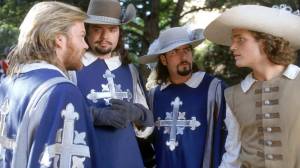 protect the king. Outmanned, Rochefort must let the three men leave. They meet with D’Artagnan outside the walls for their scheduled duels, revealing to the lad that they are all Musketeers. He will keep his word to fight them, but it will bring him no pleasure to kill them. Their duel is interrupted by the Cardinal’s guards again. D’Artagnan insists on joining their fight, making it a more even four against five. A rather fantastic fight sequence plays out, each Musketeer dispatching their guard (or two in the case of Aramis). D’Artagnan’s fight leads him to the top of the wall, which the guard eventually falls off. Still a devout man, Aramis administers last rights to the deceased; Athos quietly tells D’Artagnan that he was once one of the Cardinal’s students. Porthos cheerfully states, “you boy, are arrogant, hot tempered, and entirely too bold [he’s not wrong]. I like that, reminds me of me.” Aramis admonishes his friend, “don’t encourage him,” for he’s now made an enemy of Rochefort and the Cardinal. Rochefort appears after the three Musketeers ride away. D’Artagnan gets it in his head to ride at the man in black (like a joust), shouting “long live the Musketeers!” Rochefort knocks the boy off and another guard finishes knocking him out.
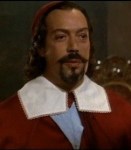 Meanwhile, in the palace, the Cardinal enters the queen’s bathing chambers, after the queen had been discussing love with Constance. He is a lecherous man and the queen is properly wary. The king has even heard rumors of Richelieu’s behavior, but the Cardinal passes it off, adding that there are rumors that he makes pigs fly along with plotting against the king and visiting the queen in her chambers.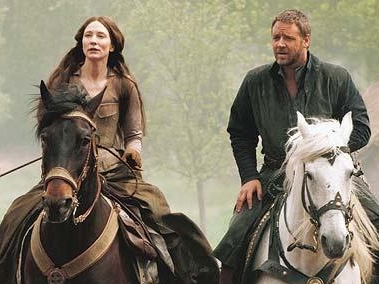
 God did. King by divine right.” [Historically, yes, this was a common notion, but it didn’t really become a major political theory until the seventeenth-century]. This document before him seeks “to limit the authority given to me by God.” He burns the charter amidst the barons protests. He then charges Robin Longstride of theft and incitement to cause unrest. The man pretended to be a knight, a crime punishable by death. John declares Robin and “Outlaw!” (he gets really angry on that word). In Nottingham, the Sheriff reads the decree and an arrow is shot to hold the paper when he asks for a nail. Robin of the Hood now dwells in Sherwood alongside Marion, his men, and the boys. The film closes with the script, “and so the legend begins.”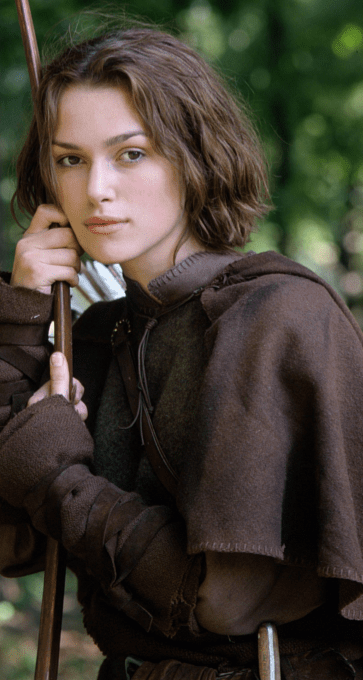
 at his parents’ dying wish, he attempts to charm Marion (she knows not to trust him). Meanwhile, Robin visits the church to gather information. The bishop stands by the story that his father was a devil worshipper. Robin does not believe it (nor does Marion or anyone who truly knew the man). On his way out, Robin runs into the Sheriff and cuts his cheek. The Sheriff’s yells “I’ll cut your heart out with a spoon!” Later, Gisborne inquires “why a spoon?” “Because it’s dull and will hurt more, you twit!” (Such a memorable line!)
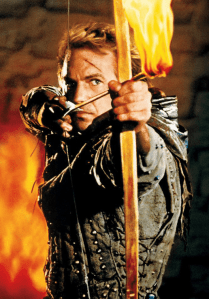 recognized and captured at the public hanging and gets tied to one barrel. The Sheriff orders the executions to begin, starting with Little John’s son. The first plan is now out the window, but Robin has to act. He shoots the rope strangling the boy, revealing himself to the guards. But Azeem is ready to light the powder kegs. Many awesome explosions and arrows flying, the theme plays in the background. Little John crashes into the scaffolding. Robin shoots a flaming arrow (the scene that’s in every promo) to save Will. Marion screams for Robin and he’s off to rescue his lady. Azeem rallies the English to fight back against the Sheriff’s troops, then joins Robin inside the castle.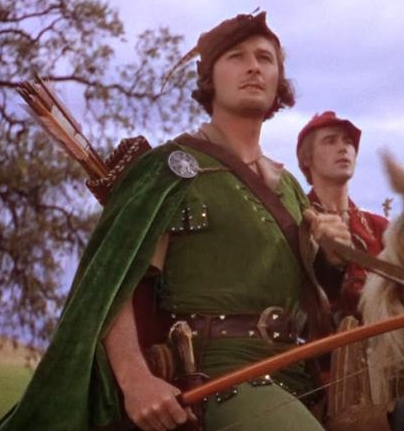
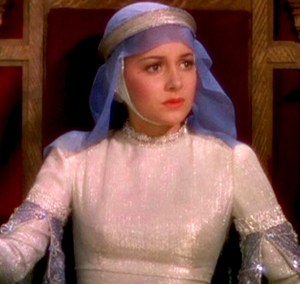
 vows. Then – the most epic kiss of all time! I gush every time I see it, or hear the music and remember the scene. Now married, Will swings over to the Dutchman, after seeing Jack in trouble. The masts of the two ships tangle. Will gets a hold of the chest, but Bill, not realizing who he’s attacking, stops Will. Elizabeth now swings over and faces Jones. He knocks her down and Will stabs him. But Jones cannot die. He twists the end of the blade sticking out of his chest so Will can’t remove it. He sees the emotions exchanged between Will and Elizabeth; “love, a dreadful bond, yet so easily severed.” Jack stops him, showing that he’s holding Jones’s heart, his broken sword poised over it. In retaliation, Jones stabs Will, ironically with Norrington’s old sword that Will crafted. Bill finally comes to his senses and tackles Jones, giving Jack the chance to position Will to stab the heart. Jones, now dead, falls into the whirlpool.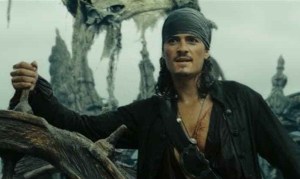

 But the river is not steady; there are always new things Just Around the Riverbend, waiting to be discovered, including a waterfall and exhilarating rapids; another favorite scene of mine. [I loved to sing this song on the bus; I got looks.] Pocahontas comments that in exchange for being safe, we lose our sense of adventure. “For a handsome sturdy husband/who builds handsome study walls/and never dreams that something might be coming/just around the riverbend.” “Should I choose the smoothest course/steady as the beating drum…is all my dreaming at an end?” The river leads the young woman to Grandmother Willow, a wise spirit with a bit of spunk. There, she explains her dream of a spinning arrow. Grandmother Willow instructs her to Listen with Your Heart to determine what her dream means and the path she should follow. The wind tells her that there are strange clouds coming. Indeed there are; the sails of the Susan Constant.



 Dreamer in the Mirror