“I’ve been punched, poisoned, pelted with fruit!”

First, let me apologize for the delay.  I actually had this almost ready to post, barring my round up at the end a month ago; but life got complicated for a bit and then I found Game of Thrones (check out my other post today).  But, I’m going to get back into this; enjoy!

Merlin: Season 2

The second season begins with Merlin dealing with The Curse of Cornelius Sigan, an evil sorcerer brought back to life when his tomb is opened. People being their greedy selves release the soul of Sigan into a living host, a bootlicker named Cedric (played by Mackenzie Crook, Ragetti from the Pirates of the Caribbean franchise) who manages to cause trouble for Merlin so he becomes Arthur’s servant in order to get a hold of keys to the tomb. Merlin bemoans “everything I do is for him [Arthur] and he just thinks I’m an idiot.” Arthur even throws him in prison. He breaks out so he can ask the dragon for help, but the dragon extracts a promise that Merlin will set him free in exchange for information. When Merlin faces Sigan, the sorcerer goes all Darth Vader, “join me and together we can rule.” Merlin, like Luke Skywalker, refuses. It is better to serve a good man. He’s almost consumed by the soul of Sigan but off camera gets it back into its crystal. Uther, being dense as usual, figures that they must renew their efforts to eradicate sorcerers. How ’bout, Gaius said don’t open the tomb and you wanted riches, so did so anyway?

In The Once and Future Queen, Arthur wants to be judged as his own man, not as the prince. So he concocts an idea for the upcoming jousting tournament. He won’t compete as himself; he’ll have an unknown man do all the public appearances and compete in the joust in the helmet so his opponent won’t pull up at the last moment in order to not harm the prince. (Bit like part of Knight’s Tale). Arthur secretly stays at Gwen’s home for the tournament, but still acts like a rude prince at times. Gwen stands up to him and he listens. Yet trouble still lies in wait; an assassin has been sent to kill Arthur. The assassin spots Merlin and follows the boy, finally discovering Arthur. The assassin takes the place of Arthur’s final opponent and uses a tipped lance to injure the prince. Arthur (with the secret magical help of Merlin) defeats the assassin; he still wants to prove to himself that he is a good and worthy knight. There’s a funny rant by Merlin in the episode of all his duties. He still has to clean the leech tank at the end, though.

Morgana’s magic becomes apparent in The Nightmare Begins. While she dreams, her eyes flash gold, starting a fire. Uther suspects outside magic, but Gaius knows the truth. Merlin deduces it as well and wants to help Morgana. Some of his actions are seen by Arthur, who interprets them as affection for the king’s ward. (We the fans have on occasion paired Merlin and Morgana together). Merlin thinks that the Druids may be able to help. When he asks the dragon for help, the dragon warns Merlin that the “witch” cannot be trusts and it would be better if she never knew the extent of her powers. Merlin won’t abandon her, so the dragon won’t help. Merlin manages to track down the answers and sneaks Morgana out to their camp. Which Uther sees as someone abducting his ward and sends Arthur and his knights to kill all the Druids. At the camp, Morgana meets up with young Mordred again and is so pleased to have some answers, she doesn’t want to go back to Camelot. She tries to flee but an earlier injury hampers her. Merlin secretly manages a distraction; Morgana is recovered and Mordred flees (but not before Merlin witnesses the boy’s power and Mordred calls him Emrys).

Lancelot and Guinevere are reunited in the next episode. Gwen accompanies Morgana on a day trip to visit Morgana’s father’s grave. On the way, they are ambushed by bandits. Morgana manages to get away, but Gwen is still prisoner. Uther won’t send Arthur after a servant and in public, Arthur agrees. In private, he prepares for a rescue. Gwen is held for ransom (believing her to be Lady Morgana) by Hengist (played by James Cosmo, who has appeared in Last Legion, Game of Thrones [Lord Commander Mormont], and is Father Christmas in Chronicles of Narnia). He likes his entertainment in the form of cage fights (cause those were a thing in fantasy medieval times). Who should appear and win his bout but Lancelot? He recognizes Gwen and knows that Uther will not pay the ransom, so he must get her out. He is aided by Arthur and Merlin (once they pass the wildren [“giant…baby rats”] by spreading gaia berries on their face). Arthur and Gwen are sent through the tunnel first, Merlin stays back with Lancelot so he can use magic more openly. Once they are free, Merlin notices that Gwen and Lancelot have shared some tender moments, and he knows that Arthur has feelings for Gwen. Lancelot and Arthur even speak about their shared feelings for the young woman. Lancelot, being the chivalrous knight that he is, won’t come between Arthur and Gwen, so he leaves again.

An “old friend” of Uther’s visits in the two-parter Beauty and the Beast, Lady Catrina, the last of a noble house. However, the Lady Catrina is actually a troll (who most likely killed Catrina and took her place). The troll uses a potion to look beautiful, but still prefers to eat rotten food and sleep in filth. Uther is utterly enchanted by the Lady Catrina – figuratively and literally; she enchants him to marry her so she will gain riches and power. Merlin figures out the truth of her and goes to Arthur. While Arthur is put off by the sickening romantic gestures of his father, he won’t hear Merlin call the woman names. Until she reveals herself as a troll when Merlin switches her potions. But Uther is blind. The only way to break the enchantment is for Uther to cry tears of true remorse, per the dragon (after he has a laugh). Arthur is not sure it will work; Catrina has dismissed Merlin for a crime (that Arthur knows he didn’t commit) and had Uther disinherit Arthur. Gaius knows that Uther truly loves his son, so concocts a potion that will make Arthur appear dead. Merlin just has to get him the antidote in time. (There’s a bit of a stutter there, when Merlin gets knocked out and vial smashed, but it turns out alright in the end). The plan is ultimately successful and Arthur stabs the troll.

In his continuing pursuit to rid Camelot of magic, Uther calls in The Witchfinder. Merlin was almost seen playing with magic. Aridian [Tywin Lannister in Game of Thrones] arrives in Camelot and quickly finds three women who have also witnessed magic (which reminded me of the Salem witch trials) and accuses Merlin of being a sorcerer. Arthur scoffs and Merlin insists he has nothing to hide. Aridian “searches” Gaius’s chambers (more like destroys) and discovers a magical bracelet. He arrests Gaius and “questions” (read: interrogate) the elderly man. Aridian reveals that he suspects Merlin and Morgana and will have them exectued, unless Gaius confesses. Gaius confesses. But Aridian won’t hold up his end of the bargain with the comeback that he doesn’t bargain with sorcerers. Merlin (with some help from Arthur this time) sees Gaius. The bracelet wasn’t either of theirs. They realize Aridian is a fake. Now they just have to collect proof. With some help from Gwen, they uncover that the three women all had bought eye drops which caused hallucinations. Merlin magically leaves evidence in Aridian’s chambers, so he’s implicated upon a search. Then he helpfully falls out a window. Gaius is thus released and Uther attempts to apologize. Gaius calls his old friend out that he suffered at Uther’s hands, not Aridian’s. He was not the first falsely accused. Gaius shares a joke with Merlin after that the boy should promise to never save his life again.

Arthur finally discovers the true circumstances of his birth in The Sins of the Father. Morgause rides into Camelot as a knight and challenges Arthur. She almost has him beat in the fight, but extracts a promise for him to meet her later and submit to her challenge there. She also stops to speak to Morgana and gifts the young woman with a bracelet to help ward off bad dreams. Gaius sees the bracelet and realizes who Morgause is; Morgana’s half sister. The bracelet bears the crest of the House of Gorlois; Gaius admits to Uther that he was the one who smuggled the girl out of the castle after her birth to be raised by the High Priestess. (How does Morgana not recognize the crest on the bracelet?) They fear what Arthur will discover from Morgause and Uther forbids Arthur from leaving. Arthur of course sneaks out. His challenge before Morgause is to willingly place his head on an execution block. She swings the axe up, but sets it aside. As a reward, Arthur may have one wish. His heart’s desire is to see his mother. Arthur wonders, as Morgause casts magic, maybe his father’s view has been wrong. Merlin gets his hopes up a little; he and Arthur even bonded over never knowing one of their parents (Merlin never knew his father). Igraine appears to her son and admits that Uther used magic to aid in his conception and the Old Religion demanded a life in exchange. Arthur rides back to Camelot to confront his father. They fight and Arthur calls his father out. Merlin breaks in and stops the fight; claiming that Morgause lied. He has to protect Arthur and that means saving Uther. Arthur would never forgive himself for killing his father. Afterwards, Arthur thanks Merlin for showing him that magic is evil and dangerous. Uther is grateful for Merlin’s loyalty and views the young man as a “trusted ally in the fight against magic”. Gaius is proud.

Merlin meets a young Druid woman named Freya in The Lady of the Lake, locked in a cage, supposedly cursed. He frees her, even after Gaius warns him not to. Merlin falls for the kind girl, telling her she doesn’t have to be scared of magic. Unfortunately, a beast begins attacking people in Camelot, one that can fly and leave human footprints. Gaius discovers it is a Bastet. Meanwhile, Merlin decides to get Freya out of Camelot; he’ll go with her to protect her. But Gaius makes him see the truth on Freya’s condition. Arthur corners her in beast form and mortally wounds her. Merlin cannot save her, but takes her to a lake to die in peace. He sets her pyre alight, tears streaming (we cry too). Arthur sense Merlin’s sadness and tries to cheer him up with some jokes.

A visiting king tries to stir up trouble in Sweet Dreams, having his jester enchant Arthur to fall in love with Lady Vivian (played by Georgia Moffett, the daughter of Fifth Doctor Peter Davison, married to Tenth Doctor David Tennant and played the Doctor’s daughter in the titled episode opposite Tennant…ain’t BBC great?) Vivian is rude at first, but is also enchanted to fall in love with Arthur so war will be declared between Uther and King Olaf (played by Mark Lewis Jones, who among other roles, was Uther in The Mists of Avalon…which makes it very funny to think that he’ll challenge Uther). Arthur’s enchantment also causes problems with Gwen, because he tells Merlin he wants to demonstrate his love to a woman, whom Merlin assumes is Gwen, causing Merlin to leaves flowers and a note for Gwen. Merlin eventually needs Gwen’s help, after Arthur breaks her heart a bit not showing for a date; true love’s kiss will break the love potion (just like in every fairy tale). It works! Arthur keeps the peace between the kingdoms. Vivian’s spell is not broken, but hopefully the right man will come along for her. Gwen tells Arthur that she cannot be his queen.

Morgana slides further towards the villain side in The Witch’s Quickening when Mordred sneaks in to Camelot to persuade Morgana to steal a crystal. Merlin hears the commotion and has Arthur knock on Morgana’s door. She refuses to let Arthur search her room, which makes Arthur tell Merlin off. Merlin knows that Morgana is the one who steals the crystal, rumored to show all time: past, present, and future. The dragon warns him that a union of evil is foretold between Mordred and Morgana. Merlin follows Morgana to Mordred’s camp where they plot against Uther. Gaius helps send Arthur in the right direction, reporting to Uther on Alva, a charismatic fanatic magician. Morgana warns the camp and Merlin leads the knights to the camp, where they’re ambushed. Merlin trips Mordred, but the boy shoves spears through two knights. He won’t forget what Merlin did, but still escapes. Only Alva is left standing. Arthur has Merlin guard the crystal; Merlin fears the power, but it compels him to pick it up. He sees a vision of Camelot in flames. Alva stands trail and doesn’t give away Morgana. Morgana confronts Uther and disowns him for hunting down sorcerers, then sneaks down and eases Alva’s escape. Both Merlin and Uther suspect her involvement. Uther issues a warning that his persecution of magic will continue. Merlin fears the future he saw and Gaius tries to comfort him; the future is not yet written, he’s only seen one possibility. But the dragon calls to Merlin to fulfill his promise.

The ante is upped in The Fires of Idirsholas. Like the Nazgul, the knights of Medhir are raised from the dead to bring doom to Camelot. Morgause uses Morgana as the host for her spell to put everyone to sleep in Camelot. Merlin and Arthur are away, investigating the knights. They’re the only two of their guard to escape and make haste back for Camelot. The dragon insists on another promise of freedom before he offers help. Merlin swears on his mother’s life; he’ll follow through. The dragon tells Merlin he must kill Morgana to save everyone else. He puts hemlock in his waterskin and gives it to Morgana. She realizes what he’s done and Morgause bursts in to save her half sister (Morgana still doesn’t know). Merlin bargains the antidote for Morgause to stop the spell. She agrees to save Morgana and magics her way out. There are a few funny bits when the three teenagers are trying to save Uther, and Merlin at first does not give away that Morgana has magic. Arthur is very brave when he fights the knights by himself. Gaius reassures Merlin that he did the right thing. And now, Merlin must keep his promise. He frees the dragon.

Which leads to the dragon attacking and burning Camelot (like the vision) in The Last Dragonlord. Arthur and his knights are no match for the dragon. They must find the last dragonlord, who Gaius reveals is Balinor (remember the visiting priest from The Musketeers?). Gaius comes clean to Merlin before he leaves with Arthur that Balinor isBalinor_mortaly_wounded the boy’s father. At first meeting, Balinor is not who Merlin thought he would be. He needs the man’s help healing Arthur from a dragon scratch (the young knight received it saving Gwen). Balinor does not want to help Camelot; Uther betrayed him. He had Balinor call in the last dragon, under the guise of peace, instead to chain him up and hunt Balinor down. But Merlin reminds him of Gaius, so he’ll come. In the woods, Merlin reveals he is Balinor’s son. But they only have a few hours to enjoy their family; soldiers attack and Balinor is killed protecting Merlin. Merlin can’t even tell Arthur why he mourns the man; the son of a dragonlord would be suspicious to Uther. Arthur will make a last stand against the dragon. Merlin insists on coming. Most of the knights are killed and Arthur is knocked out. But Merlin is able to draw on the powers of a dragonlord (since his father is dead) to make Kilgarah stop. He shows mercy when Kilgarah pleads with the warlock to not end a noble race. Kilgarah feels that they will meet again. Arthur wakes after the dragon flies off and Merlin informs him that the prince dealt a mortal blow. Gwen hugs Arthur when they return and Gaius hugs Merlin, calling him “my boy.”
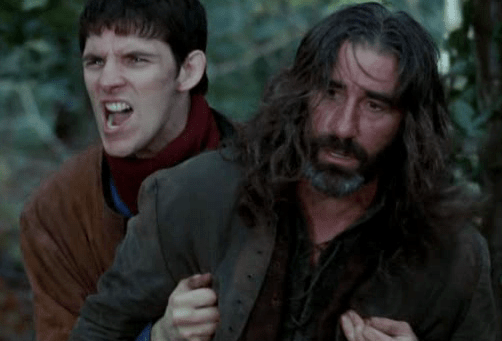
I liked the evolving relationship between Arthur and Merlin; they’re definitely friends, even if a bit lopsided. Arthur is comfortable enough to joke with Merlin, even if he doesn’t treat him with the best respect. This is the reason I love the show; the banter between Merlin and Arthur. Our characters are tested this season; you pity Morgana for her fear of magic. She’s raised by Uther to view magic as evil and then finds out she has it and cannot control it. I wish Merlin hadn’t had to poison Morgana; it would have been nice for him to have a confidant his own age within Camelot. And poor Merlin, to find his father and lose him within a few days’ time. Never completely trusted the dragon. He thinks that killing hundreds of innocent people is the proper recompense for one man locking him up?

As always, let me know your thoughts or questions.  (I’ll add any further thoughts that come about)

On to Season 3 next time.

Merlin Gets to Call Arthur a Prat

Merlin – Season 1

In a land of myth, and a time of magic…The destiny of a great kingdom lies on the shoulders of a young boy. His name…Merlin.

merlin opening

Ran on BBC for five seasons from 2008 to 2012 featuring younger characters; young adults, before they became famous. For those who watch British television, it has some familiar faces and names (a whole bunch have appeared in Doctor Who). Colin Morgan (he was the teenage boy in the episode Midnight, and did go on to have a small part in The Huntsman: Winter’s War) leads the cast as Merlin with Bradley James by his side as Arthur. Angel Coulby (again, a small role in Doctor Who, The Girl in the Fireplace) is Gwen and Katie McGrath (a variety of roles; leading lady in A Princess for Christmas opposite Sam Heughan [before he became Jamie Fraser in Outlander] and Roger Moore, a small part in Tudors, King Arthur: Legend of the Sword, she was Zara in Jurassic World and has had reoccurring roles in Dracula and Supergirl) is Morgana. Veterans Anthony Head (has appeared in Doctor Who, Buffy, Galavant, and Percy Jackson: Sea of Monsters) is Uther Pendragon, Richard Wilson (who has also been in Doctor Who) is Merlin’s mentor Gaius, and John Hurt (The War Doctor, Ollivander in Harry Potter among over 200 credits and recently passed in 2017) voices the Great Dragon. It’s not specifically set in England; all of the place names being fantasy related. The show centers in Camelot, though the features a castle that actually exists in France.

We open with The Dragon’s Call, the dragon narrating that no young man, no matter how great, can know his destiny (this is before the opening was used before each episode). Merlin walks into Camelot just as Uther decrees a sorcerer executed. He has banned magic from his kingdom and they have enjoyed twenty years of peace. An old woman curses Uther and disappears. Merlin heads for Gaius’s chambers and demonstrates his innate magical ability when he saves Gaius from falling. Yeah, that’s going to be an issue; the boy was born with magic and cannot help it. And now lives in a city where he will be executed if found out. Morgana opposes Uther’s harsh law on magic (she’s not aware of her legendary abilities at this point), and shows herself to be a strong female to openly stand up to her guardian. Merlin meets Arthur as the prince is tormenting a servant; Merlin refuses to show proper decorum, referring to Arthur as a prat. He ends up in the stocks, twice, meeting Gwen as well, who is Morgana’s servant. The old woman from before has transformed herself into a famous singer in order to get into the palace (played by Eve Myles who is Gwen Cooper from Torchwood and Doctor Who and was Mrs. Jenkins in the Victoria series).

Throughout the episode, Merlin hears a voice calling him. He eventually ventures below the castle and encounters a dragon. The Great Dragon informs the young warlock that his and Arthur’s destines are entwined. Arthur is the Once and Future King, destined to unite Albion and bring magic back. Merlin’s role is to protect the young man; a duty that Merlin is not keen on at the beginning. Nevertheless, when the witch puts everyone to sleep and tries to kill Arthur, Merlin uses his powers to save the prince. Uther “rewards” him for his loyalty by making him Arthur’s servant; neither boy is terribly happy about the appointment.

Valiant brings a tournament for knights to compete. Arthur is expected to win since he’s the prince. The knight Valiant however has a magical trick up his sleeve to ensure his victory; a shield with three snakes that can come to life and do his bidding. Merlin eventually discovers the shield and tries to convince Arthur to drop out of the tournament. The servant manages to get the prince to believe his accusations, but they have no proof and Arthur is embarrassed in front of the king. He dismisses Merlin, but Merlin will see his duty through. Morgana also has dreams of Arthur dying and even tries to persuade him to save himself; Arthur cannot back down from the fight. Merlin discovers a way to bring the snakes to life on his own and quietly does so in front of the whole court. Morgana throws a sword to Arthur, who dispatches the snakes and Valiant. There’s almost a tender moment between the two after, but they bicker with each other. Merlin is once again Arthur’s servant and their lives carry on.

A plague breaks out in The Mark of Nimueh, caused by the sorceress Nimueh (played by Michelle Ryan who was in the Doctor Who episode Planet of the Dead). Merlin struggles to learn when it is appropriate to use his powers. (He is often in the position of: “Merlin, don’t do this thing.” And Merlin does the thing). He heals Gwen’s father when he falls ill, but that simply causes more problems. Gwen is accused of being a sorceress and Merlin tries to cover for her. Arthur talks him out of any consequences by saying the boy is in love with Gwen (they are adorably awkward around each other at times) [reminder, no Arthur does not know that Merlin has magic, he’s simply saving a friend]. Gaius and Merlin figure out it’s an Avank monster and gather Morgana and Arthur to destroy the beast. Gwen is saved, but Gaius and Uther both know the sorceress responsible.

The Poisoned Chalice is one of my favorite episodes, since it shows the tight friendship that Arthur and Merlin have already built. Nimueh sneaks into Camelot as part of King Bayard’s court, there to sign a treaty with Uther. Nimueh poisons a cup that is given to Arthur, then disguises herself as a servant and speaks to Merlin, spurring him to take the cup to save Arthur. When the poison takes effect after a moment, it drops him to the ground. Gaius figures out what the poison is and the antidote, but it’s a dangerous mission. Arthur barely hesitates, agreeing to retrieve the ingredients. Uther forbids his son from the mission. Arthur, encouraged by Morgana, disobeys his father and rides out. He battles a few beasts and encounters Nimueh, who leaves him to die by giant spiders (why did it have to be spiders?) While a fever rages through Merlin, he mutters magic, which Gaius has to cover in front of Gwen. He conjures a blue sphere to light Arthur’s way, and even urges the young man to save himself. Arthur grabs one vital flower and escapes. Uther puts him in the dungeon for his disobedience; he’ll just have to get a new servant when he’s let out (Uther has a habit of being cruel). Gwen manages to sneak in and get the flower and Gaius has to secretly use magic to make the antidote. Again, it takes a moment for the draught to take effect, but Merlin recovers. Huzzah!

We meet Lancelot in the self-titled episode (remember, played by a fresh faced Santiago Cabrera; later to be Aramis). He saves Merlin from a griffin attack and is injured in the process. Upon waking in Camelot, he expresses his lifelong desire to be a knight. One problem: the First Code. Knights must be from noble families; Lancelot is not. Merlin magics his way around that, including his friend in the lineage of a noble house. He encounters the librarian, Geoffrey of Monmouth (as in the writer of The History of the Kings of Britain, one of the earliest developed narratives of King Arthur). Lancelot proves himself in a test against Arthur and is knighted. But it’s all ripped away when Geoffrey discovers the lie. Arthur has no choice but to imprison Lancelot. Meanwhile, the griffin has come to the castle. It is a magical beast and can only be vanquished with magic. Merlin has a plan and is aided by Lancelot (who, upon being let out of prison by Arthur, insists on staying and goes to Gwen for weapons and aid. Gwen in turn fetches Merlin). Lancelot charges at the beast while Arthur lies knocked out. Merlin mutters his incantation and the lance glows, defeating the griffin. Uther refuses to reinstate Lancelot’s knighthood after his heroic deeds. While Arthur fights his father, Lancelot quietly reveals to Merlin that he knows of the boy’s magic; he heard the incantation. But he won’t reveal the secret. He does agree to leave Camelot.

Morgana becomes very ill, “all but dead” in A Remedy to Cure All Ills. A man comes to Camelot spouting that he has a remedy to cure all ills and will see to Morgana. In fact, the man is a sorcerer and caused the illness (with a creepy bug). He cures Morgana, which was something Gaius was unable to do, calling into question Gaius’s outdated methods and age. Uther offers the position of court physician to the man, retiring Gaius. Gaius intends to leave Camelot, though Merlin begs for him to stay; the man has been more than a father to him and Gaius admits he looks on Merlin like a son. The sorcerer causes Uther to fall ill next. Gaius confronts the young man, realizing he recognizes him; he was a boy during the Purges and his parents were burned by Uther for using magic. We also find out that Gaius knows the great dragon beneath Camelot. The dragon counsels Gaius that Arthur cannot unite Albion until Uther is dead. Merlin manages to rescue his mentor and reverse the sorcerer’s illness. Gaius is reinstated and Uther is none the wiser to the magical ailments that went on under his nose.

The Sidhe (an Irish term for faeries, a carryover from when they were considered gods) make an appearance in The Gates of Avalon. Merlin and Arthur are out hunting and come across bandits attacking and father and daughter. Arthur rescues them (with secret magical assistance from Merlin) and escorts them to Camelot. They’re invited to stay and Arthur clearly is infatuated with the daughter Sophia (played by Holliday Grainger. Among other roles, she is Anastasia in the updated Disney Cinderella movie). Arthur has Merlin cover for him so he can spend time with the young lady, landing Merlin in the stocks twice (this is the season Merlin spends in the stocks).

Meanwhile, Morgana has been having dreams of Sophia drowning Arthur; she saw Sophia before the young woman stepped foot into the castle. Indeed, Sophia is trying to drown Arthur; Merlin follows her father to the woods one evening and overhears their plan to sacrifice Arthur so Sophia can regain her immortal life as a Sidhe. Morgana goes to Gaius, who believes her and sends Merlin after them. He destroys the Sidhe and rescues Arthur. And still ends up punished.

The Beginning of the End (very ominous) introduces the Druids. A young Druid boy (who looks like a young Merlin) and his father are chased by guards; the boy is injured and the father is captured. The boy calls to Merlin – mentally, for aid, calling him ‘Emrys’. Merlin helps him and hides him with Morgana. Morgana quickly becomes attached to the boy, holding him as they hear his father executed. Uther demands the boy be found; any who harbor him will face execution as well. The boy’s wound becomes infected and Merlin is hesitant to bring in Gaius. Merlin seeks counsel from the dragon, and the dragon reveals that the boy will be Arthur’s downfall. Morgana, Gwen, and Merlin try to sneak the boy out, but Morgana and the boy are caught. Uther is furious at Morgana. Arthur is more sympathetic than his father and agrees to help get the boy to the Druids. Morgana will dine with Uther so she cannot be suspected. Arthur will get the boy out of the dungeon, but he needs Merlin’s help. Merlin almost doesn’t follow through, heeding the dragon’s caution of future danger. But he comes through and Arthur manages to get the boy to the Druids. Only then do we find out the boy’s name: Mordred. Uh oh.

Another element from the legend comes into play in Excalibur. Nimueh raises a knight from the dead on the same evening Arthur is officially crowned as prince of Camelot and Uther’s heir, now that he is of age. The knight breaks into the festivities and throws down a gauntlet. Sir Owain picks it up and will face single combat. Arthur would rather face the knight than have his knights be sacrificed. Gaius suspects and with the help of Geoffrey confirms the black knight is Sir Tristan du Bois, Uther’s brother-in-law, killed by Uther’s hand when Tristan challenged him after his sister Igraine’s death. Owain is killed by the black knight in combat and the gauntlet is thrown again. Uther stops Arthur from picking it up, instead, Sir Pelenor will face the challenge. He fares better the next day, but still falls. Merlin has noticed both times that wounds that should kill the black knight don’t. He’s once again dealing with a magical entity. Arthur this time throws down his gauntlet; he will face the black knight. Everyone tries to talk Arthur out of it; he will be killed. Nimueh visits Uther and we discover they used to be friends. Uther had asked for her help to give his wife a son. But she was not to know that it was Igraine’s life that would be lost to gain Arthur’s. This is why Uther despises magic. Uther finally goes to Gaius for help; a sleeping draught.

In the meantime, Merlin has been working on another plan. A sword burnished by dragon fire can kill a wraith. Merlin gets such a blade, promising to the dragon that only Arthur will wield it. It gains an inscription that reads on one side: Take me up, and on the other: Cast me aside. There’s a hiccup when Arthur is sleeping and Uther takes his place, including the sword. It’s does its job, but the dragon is furious. He orders Merlin to take the sword where it can never be found; the young man throws it into a lake (this is the sword from the opening sequence). Arthur confronts his father about his actions and Uther finally admits to his son that he is not a disappointment.

Merlin returns home during The Moment of Truth. His mother, Hunith comes to Camelot begging help; raiders are attacking their village. But they lie in another kingdom and Uther cannot send knights, it would look like an act of war. Merlin will return with his mother, intent on staying so he can look after her. Gwen and Morgana accompany him and they’re joined later by Arthur. Arthur encourages the men of the village to fight and stand up to Canan and his goons. One young man is outspoken against him, Will, Merlin’s old friend. His father had been killed serving a king and so he doesn’t trust nobles. Will incidentally knows that Merlin has magic and debates with him on using it, so he can spare the village. But Merlin must keep it a secret from Arthur. Gwen and Morgana join the men in the fight (wearing impractical mail). Merlin finally has to use magic, which Arthur witnesses. But Will was standing next to Merlin so it could have been either of them. Will takes a bolt for Arthur and as he dies, he takes credit for the magic; what can Arthur do? Kill him? Hunith talks her son into returning to Camelot; she sees that he and Arthur are friends; two sides of the same coin. The day will come when the truth will be known.

Arthur slays a unicorn hunting one day in The Labyrinth of Gedref, causing a curse to befall Camelot. Overnight their crops die, then the water turns to sand. An old man appears and tells Arthur he must face several tests to lift the curse. One evening, Arthur and Merlin, while looking for the old man, come across a peasant stealing food. Arthur lets the man go. Water returns. But when they venture to the woods, the peasant taunts him and Arthur fights him. The remaining grain rots and Uther decrees that the food must be saved for the army. But Arthur cares more for his people than for himself and refuses to give the order. Merlin persuades the old man to give Arthur a final test. Then follows Arthur through a labyrinth. At the end, Merlin sits across from Arthur at a table, two goblets, one filled with poison. Merlin tries to talk Arthur into letting him drink the poison; he is only a servant. But Arthur tricks him and drinks all the contents. ‘Twas ultimately not poison and Arthur wakes. The crops re-grow overnight and Camelot is saved. Arthur buries the unicorn horn and proving that he has a pure heart, the unicorn lives again.

Gwen’s father is caught consorting with a sorcerer in To Kill the King and sentenced to execution. Morgana takes pity on him for Gwen’s sake and tries to help him escape. He is killed. Morgana is furious for Uther for the way he handled the situation. If it involves magic, he loses all rational sense. He locks her in the dungeon overnight for her backtalk. Arthur pleads with him off camera in the morning to release his ward. So she decides that Uther must die and allies herself with the sorcerer. Under the pretense of visiting her father’s grave, Morgana gets Uther into the open. Merlin follows and takes care of the other men. But at the grave, Uther reveals he looks upon Morgana as a daughter and appreciates that she makes him question his actions, like her father did. From now on, he tells her, I want to listen more and quarrel less. Morgana no long wishes Uther dead and when the sorcerer attacks, she stabs in him the back as he tackles Uther.

The first season ends with Le Morte d’Arthur (like Malory’s tale). Arthur, Merlin, and his knights are in the forest, hunting the Questing Beast. They lose Sir Bedivere to the beast (like in the tale). Morgana has another dream of Arthur dying and in distress begs him not to go back out. He does and in a cave is scratched by the beast. Gaius states that a bite from the Questing Beast is fatal, there is no cure. Uther tries to carry his son to his room, but falls to his knees in the courtyard. Gaius tries to make the lad more comfortable, but Merlin searches for another answer. The Questing Beast is tied to the Old Religion and carries the power of life and death. Merlin goes to the dragon for help. He’s instructed to go to the Isle of the Blessed and strike a deal, a life for a life. Merlin willingly gives his life for Arthur. But he meets Nimueh on the Isle. She gives him water from the Cup of Life. With it, Arthur is healed. And Merlin strangely doesn’t die.

Instead, his mother arrives back in Camelot, gravely ill. Merlin is furious at the dragon for misleading him. The dragon insists that Merlin must do everything in his power to free the dragon, to free magic. Merlin tells the dragon he will not be back. Now, Merlin can’t find Gaius. He races after his mentor, who has chosen to give his life for the boy. Merlin strikes out at Nimueh, bringing lightning upon her. The balance of the Old Religion has been appeased. Gaius lives, Arthur lives, we see some tender moments between Uther and his son, along with a moment between Gwen and Arthur. Merlin tries to say goodbye to Arthur without really saying goodbye and being the men they are, they can’t really tell each other how they feel; that they’re friends and they’d miss each other. It’s another of my favorite episodes.

The theme of destiny runs throughout the series. The Great Dragon harps on it anytime Merlin asks for help. Gaius refers to it. Others speak to Arthur about his destiny as king. It’s a lot for two young men to take on, particularly when they don’t know the full extent. We as the audience know they’re ‘destined’ to become legends. For now, though, they’re teenagers. Merlin has to hide a part of himself from the person he’s supposed to protect. They all make mistakes. It’s fun to see these characters more human. Not as legends, but as young people, relatable.

Morgana’s costumes in particular have a modern flair. This is a fantastical take on the legend, rather than a historical take (Last Legion, King Arthur. Those have their places. This is fun). What made these characters into who they are? How did Arthur and Merlin have such a strong bond? It’s adorable to watch Arthur become protective of Merlin so soon. While he was raised by a sometimes-tyrant like Uther (he truly loves his son, he just has a funny way of showing it), Arthur is a different man than his father. He puts everyone else before him; well, he still gives Merlin a list of chores to do.

We will continue this discussion in Season Two next time.

There’s Always a Twist

I wrote this originally directly after the episode aired, but held off posting due to spoilers.  Read now at your own peril:


Because I need to work through my feelings on the finale of Season 14…

I’d say three words, but I shouldn’t swear online.  Though now I’m debating, who was the bigger dick?  Metatron or God/Chuck?  We thought God was cute; we thought God was our friend.  Nope.  I mean, it sets up the last season well.  My feeling is he’s unleashed a whole bunch of the monsters Sam and Dean got rid of (Bloody Mary, that freaking creepy clown).  They’re surrounded by zombies or something, fighting, which is what they excel at.

Episode turned out completely different than I thought it would.  Jack has never been my favorite character.  I was sad when he died originally, but he just fits an awkward spot.  The last half of the season has been Jack-centric and how many ways can we twist this around.  But when it came time to get rid of him; him talking to Cas made me sympathetic.  Yeah, when Dean was holding the gun, I was more concerned with “don’t hurt Dean.”  ‘Cause he can’t die yet, but that means nothing.  I literally sat up on the couch the scene before the commercial when Sam grabbed the gun.  And now I want to punch God in the face.

So, I feel bad for Jack, though I don’t think we’ve seen the last of him.  He looks to be in the Empty, with Billie.  Not sure what that exactly means.  God is a dick.  And I worry about my boys.  And as always with Hellatus…we have to wait like six months!!!  (Gives me plenty of time to finish re-watching The Road So Far, and read a couple books)


Always willing for a Supernatural discussion

Giving the women of Arthurian legend their due

Mists of Avalon

Based on the book by Marion Zimmer Bradley; I read the book when I was doing research for my Morgan le Fae capstone project (in order to complete my Creative Writing major; and at 876 pages, I am pretty sure it is the longest book I’ve read). It has greatly influenced elements of the fantasy series I am planning: how the Faerie kingdom works, heck it’s influenced character names. I also made a deal with my brother; he said he wouldn’t read it since it was about women, I found that sexist. In return, I would read Hunt for Red October by Tom Clancy and a Clive Cussler book. And after having Morgan le Fae vilified by almost every other version of the tale; mainly since she is a female with magic (Merlin has magic, but since he’s a man, he’s good…that bothered me a lot in Mary Stewart’s Arthurian Saga), I cheered that this presented the characters in a better light (well, more so in the film than in the book; the book is heavily pro Morgaine and the Old Ways).

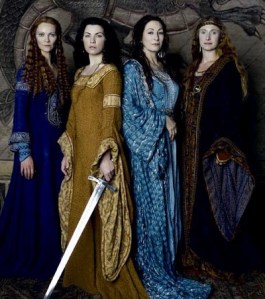
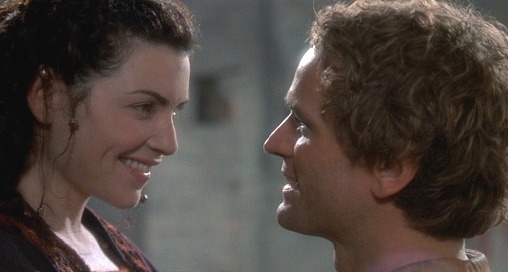
The film was actually made for TV in two episodes. It stars Anjelica Huston (she was the stepmother in Ever After) as Vivianne, Julianna Margulies as Morgaine, Joan Allen as Morgause, Samantha Mathis (she’s older Amy March in Little Women) as Gwenwyfar, Caroline Goodall (the mom in Princess Diaries) as Igraine, Edward Atterton (he plays jerkass Atheron in an episode of Firefly) as Arthur (he’s nicer in this role), Freddie Highmore (he’s the lead in The Good Doctor amongst other roles) as young Arthur, and Hans Matheson (Lord Coward in Robert Downey Jr’s Sherlock Holmes, and Thomas Cranmer in The Tudors) as Mordred. Loreena McKennitt’s Mystic’s Dream features in the movie several times (I was already familiar with the artist when I watched the movie).

The film is really told as a flashback by Morgaine. She tells us that most stories about Arthur are lies and the true story is not known. The story takes place in a time of violent upheaval in Britain; the Saxons are invading. They need one great leader to unite them all. A major point of contention is the Old Ways worshipping the Mother Goddess and the new religion of Christianity. The Old Religion embraces Christianity, able to coexist. Christianity…not so much. Morgaine’s father was a Christian man, Goloris, Duke of Cornwall. Her mother was Igraine, who still secretly followed the Old Ways. Igraine’s sister Morgause lived with them and she was more open about following the Goddess. Their eldest sister is Vivianne, the Lady of the Lake. She and Merlin come to Cornwall to speak to Igraine. The current king, Ambrosis is old and due to name a successor, but they’re looking further ahead to the future. They’ve seen one who will unite Britain, but he needs to be born to two who follow the Old Ways. Igraine is to bear the king, but not by Goloris; instead to one who bears a dragon tattoo. Morgause offers, but Vivianne shuts her down. Igraine refuses. But she and Goloris attend the king, where she meets Uther Pendragon, and man who bears a dragon tattoo. He sees her afterwards and they speak of a recognition they both feel; they were lovers in a former life. Igraine still tries to resist, but it doesn’t help that Uther is named Ambrosis’s successor. Goloris notices Uther’s interest in his wife and he is turned against the High King.

But Igraine later has a vision of Goloris attacking Uther and acts to warn Uther. The two men face on the battlefield. The magic weakens Igraine. The next day, Merlin comes to Cornwall with Goloris, who goes up to see his wife. Morgaine also has the gift of Sight and realizes that the man is not her father. Goloris’s men bring his body back to Cornwall and it is apparent that the man with Igraine is Uther. He takes Igraine and Morgaine to Camelot and makes Igraine his High Queen. They do seem to love each other and it’s cute when Uther sits alongside Morgaine as they wait for Igraine to give birth. Morgaine gains a little brother, Arthur, whom she loves dearly. Their time of happiness comes to an end when Vivianne and Merlin show up; both children must be fostered. Morgaine and Arthur both cry when they’re separated; Arthur goes with Merlin and Vivianne takes Morgaine to Avalon.

women of mists of avalon
Morgause, Morgaine, Vivianne, and Igraine

Avalon lies near Glastonbury, where the Christians have erected a monastery. To get to Avalon, one must pass through a lake covered in mist. A powerful priestess can part the mist. The Old Religion teaches balance between good and evil; the Mother Goddess rules over Nature and all Nature is sacred. Morgaine acquires power over the elements and joins the sisterhood. Igraine sees this and whispers to Uther “she’s been taken.” A visitor comes to Avalon once Morgaine is an adult; she hopes it is Arthur but instead it is her cousin, Lancelot, son of Vivianne (his father is never mentioned in the film and mentioned once in the book). Lancelot wishes to have his mother’s blessing to fight alongside the other knights against the Saxons; she wishes that he would stay in Avalon. She sends Lancelot and Morgaine to the Stone Circle. Morgaine is attracted to her cousin, but then they hear the bells of Glastonbury and Lancelot catches sight of a pretty young nun and asks Morgaine to part the mists. The young Christian is Gwenwyfar; Lancelot asks her to stay in Avalon a while, but Morgaine returns the mists. Lancelot leaves.

Morgaine is prepared for the Beltaine rights, the Great Marriage. She will play the Virgin Huntress and bed the Great Hunter. They are both masked. Afterwards, Morgaine hopes that the man was Lancelot…well, about a minute after that we see the man in question washing up. Not Lancelot. The man expresses his desire to see the woman again to Merlin, Merlin names the man Arthur. (Uh oh). Arthur must set out for Uther, who is the midst of battling Saxons. Arthur arrives in time to block a blow to the king, but he still dies. A vision of Vivianne instructs Arthur to take up the sword, Excalibur, a sword from Avalon; though he must swear to obey the Old Ways. He rallies the troops and wins the fight. Morgaine returns to Camelot for her brother’s coronation. He swears to deal fairly with both Druid and Christian; he will rule a kingdom united. Her aunt Morgause has wed King Lot of Orkney (in the Scottish Isles). Lot even mentions that if one man could save Britain, it’s Arthur. Igraine plans to retire to Glastonbury and ask for forgiveness for her actions against Goloris. The priest assures Morgaine that her mother has friends among the Christian community and they will take care of her. Arthur is thrilled to see his older sister again. He tells her that he intends to marry Gwenwyfar, but there is another woman that occupies his thoughts: he knows not her face or her name; they were both masked. Morgaine realizes with horror what happened. She confronts Vivianne, who holds that everything has been done in the name of saving Avalon. Vivianne hopes that Morgaine will follow her as Lady of the Lake. Morgaine rejects the offer; she will still follow the Goddess, but not Vivianne; she will never set foot in Avalon again. She will keep the child she now carries, but she will not let Vivianne train.

In the meantime, Arthur has put Gwenwyfar in the care of Lancelot. They are ambushed and once they escape, they speak of the brief moment they had between Avalon and Glastonbury. They cannot fight their attraction to each other and passionately kiss (more uh oh).

Morgaine takes refuge with Morgause in Orkney. Lot urges his wife to let the child die so their son will be Arthur’s successor (a nephew would take precedent over a cousin). Morgause, for some unknown reason, uses dark magic to curse Gwenwyfar; she will bear no sons for Arthur. The woman intends to follow her husband’s instructions, leaving the babe in front of an open window in the middle of winter. But in a fever after giving birth, Morgaine reveals to Morgause that the boy’s father is Arthur. Morgause has a cunning plan; be the influence on the boy and then when he ascends the throne, it will be her will done in the kingdom. Morgause dislikes Vivianne and doesn’t trust her (doesn’t make Morgause a good person, but it’s one redeeming quality she has, that she does not blindly follow what Vivianne decrees.) The Morgaine telling the story as flashbacks comments that it was this point that altered the fate of Britain forever; a new dreadful power was born. Several years later, Morgause suggests that Morgaine returns to Camelot to see her brother. Morgause will keep Mordred with her in Orkney (not the best idea).

morgaine and arthur
Sister and brother reunited

So Morgaine returns. Arthur is once again pleased to see his sister again (I find it adorable, their sibling affection…we should all know by now that it’s one of my favorite relationships shown). Gwen attempts to befriend Morgaine, though she admits the other woman frightens her since she follows the Old Ways. She summons the courage to ask her sister-in-law for herbs and spells to help her conceive; it is her greatest wish and desire to give her husband a son. Morgaine visits Lancelot; she still harbors affection for the young man (though I notice that the adults of the film barely age, not till the very end). She also knows of the affection that Lancelot shares with Gwen. Lancelot declares he loves Arthur more. Unknown to the pair, Arthur is watching from above. Another of Arthur’s knights, Accolon catches Morgaine’s attentions. He too follows the Old Ways. At the next Beltane, Morgaine gives a charm to Gwen to help her conceive. Following the information he has gained, Arthur asks Lancelot to bed his wife with him (he’s also a bit drunk when he asks this, but states that he wouldn’t be able to ask if he wasn’t drunk). A child conceived in the king’s bed will be the king’s child; he feels he is at fault for their childless state (nope, Morgause’s fault). All three agree. Accolon follows Morgaine and they spend the evening together.

Afterwards, Lancelot is upset with Morgaine for the charm. “How can I go back to the way things were?” Morgaine counsels he is not to blame for loving Gwen. But to help the situation, Morgaine arranges for Lancelot to marry Elaine, a young lady who is attracted to Lancelot. At the wedding, Gwen confronts Morgaine that her charm failed, there is still no child. She feels guilty for even turning to magic and the circumstances of that night. So she plots. She notices that Morgaine seems happy with Accolon. Accolon’s father, King Uriens of North Wales attends at the wedding and is an important ally of Arthur. Arthur wishes to reward his old friend, who wishes to marry. Gwen suggests Morgaine as a match (this is when I begin to dislike Gwen). Arthur has his sister’s best interests in mind and they ask Morgaine, but Gwen deliberately keeps mum on who exactly Morgaine is agreeing to marry. Arthur is shocked at Morgaine’s acceptance, but announces the betrothal. Morgaine is surprised to find herself engaged to the father, not the son. But she carries on and moves to North Wales. She finds that she is actually happy there.

On Avalon, Vivianne knows that Gwenwyfar tricked Morgaine. She confronts Merlin, but there was nothing the old man could do. Sadly, the time has come for Merlin to die. (In the book, another young man takes up the mantle of Merlin of Britain). Merlin comforts Vivianne that they haven’t failed; they’ve always done what they thought was right for Avalon. But he urges her to find some small measure of happiness. Mordred is their best hope now.

Speaking of Mordred, he has come to manhood. Vivianne appears, asking him to be Avalon’s champion. Arthur cannot be relied on any longer, he is beginning to forget the Old Ways. And he does not have an heir. Vivianne tells the young man that he is the king’s son. Mordred says it cannot be; his mother is the king’s sister. To Vivianne, that doesn’t matter; his blood is strong in magic. When Mordred speaks to Morgause, she cautions that Mordred cannot take the throne now; Arthur’s flame has never burned brighter, his knights will tear apart anyone who challenges him. Instead, he needs to discredit the king. And the best way to do that is through his queen. Mordred weeps; he’d rather love his father like everyone else does. He’d rather love his mother, Morgaine. He is already weary of God and the Goddess and Fate (he’s sympathetic, for a moment). But he drinks to Arthur’s death.

Mordred goes to Camelot, asking to be one of Arthur’s knights. He wins his place when he bests another in a duel. Arthur embraces him happily as his nephew. They’re a bit surprised to learn Morgaine had a child; she does not speak of it as there was sadness in his making (that’s one way to put it). After a while, Mordred confronts Arthur about his due. He asks Arthur to name his successor and reveals the truth of that Beltane ceremony years ago. Gwen begs Arthur to dispute it, but he cannot. Lancelot later finds Gwen crying and she reveals the truth as well. Mordred has planned this and has knights waiting to arrest them when they’re found kissing. The couple escapes. Arthur refuses to pass judgment on the matter; he loves both Lancelot and Gwenwyfar. He leaves the matter to Mordred.

Morgaine intends to return to Avalon after Uriens’ death, but she is attacked and injured. She tries to sail to Avalon, but cannot part the mists. Instead, she comes upon Glastonbury, where a nun spots her. It’s her mother, Igraine. When Lancelot and Gwen ride from Camelot, he takes her to Glastonbury, where she sees Morgaine. She apologizes for separating the siblings, it is her greatest sin, coming between their love. Morgaine is brought up to speed and rides back for Camelot, to save her brother and her son. The Saxon’s final assault on Britain has begun. Morgaine meets up with Vivianne on the road to Camelot. Vivianne confronts her sister Morgause when they arrive. This is not what the Goddess intended. Indeed not, it’s Morgause’s will. Morgause tries to stab Vivianne, but instead she’s the one who falls to the blade. Mordred cuts down Vivianne in retaliation.

Morgaine goes to her brother and rallies him to take up Excalibur again and stand against Mordred. At the battle, Lancelot returns to Arthur, bringing more men, but the Saxons still outnumber them, now with Mordred at the lead. The two face off on the battlefield (why do they take off their armor? Idiots) while Morgaine rides from Morgause’s and Vivianne’s pyres to stop them. Mordred mortally wounds Arthur, and Arthur strikes Mordred down in return. Both have tears in their eyes. Mordred’s last word is “mother” as Morgaine holds him. Arthur asks “take me home, sister. Take me to Avalon.” They set sail. But the mists still won’t part for Morgaine. Perhaps it has been lost due to their disobedience. Arthur offers Excalibur, Avalon’s sword, as a sacrifice. Morgaine throws it into the lake. The mists separate for a moment. “We’re home, Arthur.” But Arthur dies. The mists cover again. The bell of Glastonbury tolls. Avalon has faded from the world of men; only Glastonbury marks the spot now. The Saxons overran Britain and the Goddess was forgotten. Though many years later, Morgaine wonders if perhaps it survived, as the Virgin Mary.

As I summed up in my paper on the characterization of Morgan le Fae, Mists of Avalon delves into greater detail on elements of traditional Arthurian legend. It explains why Excalibur is magical, it includes how the sword ended up in the lake and its connection to the Lady of the Lake. I don’t think it gives great reasoning on why Mordred became evil, aside from influence from Morgause. Honestly, Morgaine should have kept Mordred with her. That could have prevented some problems. He stated he loved his parents and literally a minute later is plotting their downfall. This story gives a reasonable explanation for how a child came from a union between brother and sister, without being completely *squick.* The whole “for the greater good” excuse is annoying. It’s annoying in Harry Potter and just about everywhere else it is used. Vivianne is portrayed as a grey character. She honestly believes what she is doing is right, but the methods are not great. And she didn’t know that Mordred was being raised by Morgause? How did she think that was going to turn out?

I typically have liked Gwen in other tales, naming my main character after her, but not in this retelling. She’s petty and whiny. The Gwen from Mercedes Lackey’s book is an excellent role model; but I have my character pretty well figured, though she, as much as my story, has evolved over the years. Heck, my plot has evolved since I wrote my capstone paper. After reading Mists of Avalon, my focus shifted to Morgan. And I’m still doing research!

Re-watching this film, after the mental evolution of my story, has changed my feeling on some other characters. Lancelot is mainly fluff, there because the legends say he is. Again, a reasonable explanation is given for the love triangle and I believe that Arthur is progressive, and a good man, to allow it to carry on. It does cause problems with his knights. I mean, overall, characters typically have good intentions in the beginning. But everything becomes complicated and scheming gets in the way. I like this portrayal of Arthur. He is truly a good man. The three women: Vivianne, Igraine, and Morgause (the book states they echo the Mother Goddess and I just realized that their inspiration for my characters make mine echo the Goddess as well…not sure how I did that, but nevertheless, cool) have good and bad sides, like good characters should.

Some of the costuming is better at times; what the ladies where in Avalon is…well, I understand they were going for a fantasy look, but I’m not sure it was the best portrayal. Some of Gwen’s gowns are pretty, as are Morgause’s. Some of Morgaine’s gowns are not as successful. The fur on Mordred at the end was ridiculous.

This ultimately is one of my favorite portrayal’s of the Arthurian legend (the other, you may be able to guess, is BBC’s Merlin series). It’s a complete story and aspects are answered. The movie does not delve too deeply into the religious differences (unlike the book). (I’m looking at you, First Night and King Arthur).

So, next time, we’re on to the first season of Merlin.

And if anyone has questions or is interested in my paper on Morgan le Fae, let me know!

“We eat ham and jam and spam a lot”

Monty Python and the Holy Grail

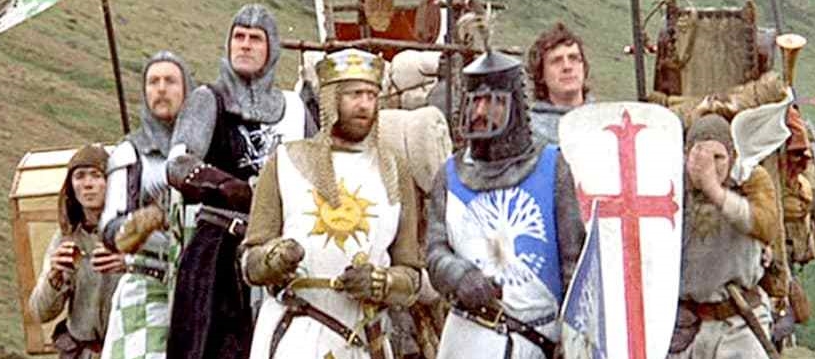
Because Terry Jones is an Arthurian scholar, not only is it the funniest re-telling, it is also the most accurate re-telling of Malory’s Le Morte D’Arthur (I’ve read the book, not my favorite, but yes, this film is very accurate). About the most famous of Monty Python’s repertoire; it’s also the only one I can stand. I’ve tried watching their other films and I don’t know if it’s because I’m American, or I just simply don’t get their humor, but I do not like them. Took me several years to talk myself into watching this film and I do find it funny. In 2006, it was adapted into a Broadway show, Spamalot. The main characters are all played by about six main cast members: Graham Chapman, Michael Palin, Terry Jones, Terry Gilliam, Eric Idle, and John Cleese (who I first knew as R then Q in Pierce Brosnan’s run as James Bond; he’s also narrated Winnie the Pooh).

The opening credits are…odd to say the least. At one point, there is a title card signed by Richard Nixon, there are subtitles that may be Swedish discussing moose – they end up sacked – multiple times. Then there’s crazy music and a bit about llamas. Finally, we reach the movie, set in England 932 AD (filmed largely in Scotland). We hear galloping…turns out, they’re coconuts (apparently a gag developed since the movie didn’t have the budge for horses). Arthur, King of the Britons, defeater of the Saxons, sovereign of all England, is looking for knights to join him at his court in Camelot. The first castle he comes to discusses swallows and coconuts. Then he rides by someone calling “Bring out yer dead!” He comes upon Dennis the peasant shortly afterwards, who goes on about systems of governments [I would not want to learn all of his lines] and points out “strange women lying is ponds distributing swords is no basis of government,” annoying Arthur, who “represses” him.

Arthur comes upon the Black Knight next, battling the Green Knight. Arthur must face him and cuts off an arm. “‘Tis but a scratch,” the knight states, carrying on with the fight. Arthur chops off the other arm. “Only a flesh wound.” Next it’s a leg and Arthur mocks, “what are you going to do, bleed on me?” when the Black Knight insists he can fight. Finally, when Arthur removes the other leg, the knight calls it a draw. A brief view of monks intoning “Pie Jesu” and whacking themselves in the face with boards, and we come across Sir Bedevere educating peasants on how to test if a woman is a witch. From there, Arthur gathers Lancelot, Galahad, Robin, and “Sir Not-Appearing-in-This-Film.” They ride to Camelot! (It’s only a model). On second thought, they better not, it is a silly place (after a song-and-dance number rhyming with Camelot).
Monty-Python

God appears and gives Arthur the quest for the Holy Grail. They come across a group of taunting Frenchmen next (giving us the line “your mother was a hamster and your father smelt of elderberries!” which I heard in high school from my boyfriend at one point; not that I had any clue what he was talking about). They try a variation of the Trojan Horse, except with a rabbit, that they have forgotten to get inside. They run away, and as a modern history professor announces, separate. The professor is killed.

First: Brave Sir Robin (and his minstrels)…runs away from a three-headed knight. Next: Sir Galahad, the Chaste, sees a Grail in the mist and comes upon the Castle Anthrax, filled with young women. Lancelot rescues him from the peril; Galahad would not have minded facing the peril. Arthur and Bedevere face the Knights Who Say “Nee,” who demand a shrubbery. In the midst, we have the Tale of Sir Lancelot, who receives a note to rescue someone from a horrible wedding. Turns out it’s a young man. Lancelot gets carried away and starts hacking at guards and guests. The boy’s father lets him drop out a window, except he’s not dead. As he starts to sing a song, Lancelot beats a hasty escape. Arthur and Bedevere acquire the required shrubbery, but now the Knights want more. Except they cannot stand the word “it.” Robin joins the pair and they ride away.

Animation shows that they meet up with Lancelot and Galahad. A year passes as they search for the grail (they eat the minstrels and “there was much rejoicing”). They discover Tim the Enchanter (sounding very Scottish) who leads them to a cave, guarded by killer rabbit. Yep, killer rabbit; only defeated by the Holy Hand Grenade of Antioch (after some more running away). They discover a note inside in Aramaic, telling them where to find the Holy Grail. An animated monster, the Black Beast, chases them, but is taken out when the animator suddenly dies (lots of fourth wall breaking). Then, they’re on to the Bridge of Death, where they must answer three questions in order to cross. Typically, it’s name, their quest, and Lancelot passes when he answers with his favorite color. Robin perishes at “what is the capitol of Assyria?” Galahad messes up his favorite color. The old man falls when he asks Arthur about the “airspeed velocity of an unladen swallow.” Arthur specifies which one. On the other side (from a brief intermission), Lancelot is nowhere to be found. The modern police inspectors arrested him. amidst holy music, a Viking-like ship (it has a huge dragon head prow) appears and carries Arthur and Bedevere to a castle (looks like Eileen Donan a bit). Except the French have gotten there first.

An army appears at Arthur’s request and they get ready to charge. Only for the police to stop them and arrest the two knights. The camera falls…and that is the sudden end to the movie. Apparently, budge had a hand in the affair.

It is a funny re-telling, but I have to be in the mood to watch it. I prefer more dramatic interpretations. There’s a short Merlin fanfic that intertwines with Monty Python: The Trouble with Legends by slightlytookish.

Up Next: Mists of Avalon

All About the Love Triangle

First Knight

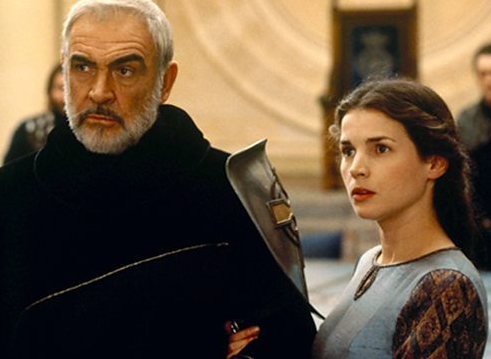
This film focuses solely on the love triangle. Sean Connery leads the cast as King Arthur (I mean, it’s Sean Connery; I can’t say much against him). Richard Gere (Pretty Woman) is Lancelot and Liam Cunningham turns up again as Sir Agravaine. To me, Richard Gere is not an action hero; fine lead for a romantic role, but not at home with a sword. Follows in the footsteps of Prince of Thieves (where Connery cameos as King Richard), a 90’s action adaptation of a literary legend. I don’t think it succeeded as well.

Prince Malagant is the enemy in this film, compared to Mordred or Morgan le Fae (he does appear in the legend, but not usually as the big bad). Lots of plot holes: how is he a prince? Why did he break with the knights? How was he one of them in the first place? What are these wars Arthur and his knights were fighting? Arthur is significantly older in this film than in other adaptations. Scrolling text at the beginning of the film gives us a bit of back story, then we see Lancelot fighting in a town square, offering helpful advice to novice swordsmen. That village is later attacked. The villagers go to Leonesse, to the Lady Guinevere for help. After some discussion with advisors, she decides to accept Arthur’s marriage proposal, to save her kingdom from Malagant. She also truly loves Arthur; she had met him before. On her way to Camelot, her procession is attacked, her carriage hijacked. Luckily, Lancelot is nearby to help rescue the damsel in distress. Guinevere puts up a bit of a fight, but still evident that she needs a man to rescue her. After the rescue, Lancelot kisses Guinevere (why? If you were a gentleman, you’d leave her alone!) Thinking he is utterly desirable, he teases the young lady that she will ask him to kiss her again before her wedding.

Guinevere finishes her journey to Arthur; he in turn truly loves her. Lancelot too ends up in Camelot, in time to test a mechanical “gauntlet” (again, why? Why is this here? I don’t think it’s period accurate). Honestly, it’s a way to further demonstrate that Lancelot is this amazing, fearless fighter. He wins a kiss from Guinevere and cheekily demands she ask him. She refuses, so he plays the chivalrous man and declines kissing her in front of the king and a crowd of people. Arthur is intrigued by Lancelot’s “display of courage, skill, nerve, grace, and stupidity.” He offers the man a place in his kingdom. Arthur shows him the Round Table; everyone is equal, even the king. “In serving each other, we become free,” is their motto. Lancelot declines, but before he can leave the kingdom, Guinevere is abducted, again. He races off to rescue her from Malagant and brings her safely home (well, there’s a stop in the rain in the forest where they discuss love, again).

first knight

After being tempted by Lancelot, Guinevere happily reunites with Arthur. Arthur in turn wishes to reward Lancelot and decides to give him the empty spot at the Round Table and knight him. Guinevere begs Lancelot to leave Camelot; he does not. She and Arthur are married soon after. As the knights are swearing fealty to their queen, word arrives that Malagant has attacked Leonesse. Innumerable troops ride out. They battle Malagant’s forces and defeat them. Leonesse is burned, but survivors had hid themselves in the church (tying in with a flashback of Lancelot’s to his parents’ death, he sits and cries after). Lancelot now realizes that to be a good man, he must leave Guinevere; he cannot jeopardize her marriage to Arthur. He bids her farewell and Guinevere gives in and asks him to kiss her. Aragvaine and Arthur walk in.

Back in Camelot, Guinevere admits to Arthur that she loves Lancelot; but she loves Arthur as well, just in different ways. Arthur still feels like Lancelot betrayed him. There will be a public trial, so nothing is hidden. Lancelot admits to the king that the queen is innocent, and he will die for her if that is what Arthur wishes. Before Arthur can pass judgment, Malagant and his forces overtake Camelot. Malagant demands Arthur kneels before him. Arthur approaches Malagant…then commands his people to fight! He’s shot several times and rushed away. Knights and townspeople fight against Malagant’s troops. Lancelot goes after Malagant, getting stabbed once, then picking up Arthur’s sword and running the dark prince through. But it is too late to save Arthur. Arthur passes his sword to Lancelot, his first knight (how is he the first knight? Aren’t there other, more worthy candidates?) and asks the man to take care of Guinevere. They lay him to rest on a pyre set to sea (keeps in tradition with the legend, but how is that Christian? They mention God numerous times throughout the film and there are crosses everywhere).

Further question: how does everyone else feel about Arthur’s last proclamation? The knights didn’t trust Lancelot at first, then he proved himself, then he’s kissing the queen, now he’s been given Arthur’s blessing.

Costumes are…not the best. Not entirely period accurate, even for the jump forward in time. There’s a lot of blue in Camelot; like, everything. And the helmets are stupid, no wonder they all took them off. Honestly, I prefer Prince of Thieves to this film. The romance doesn’t capture me; I think because I side more with Arthur. Battles are…eh. I mean, they were better in Prince of Thieves. This does not capture the soul of the Arthurian legend.

Up Next: Monty Python and the Holy Grail

Arthurian “Hey, It’s That Guy!”

King Arthur

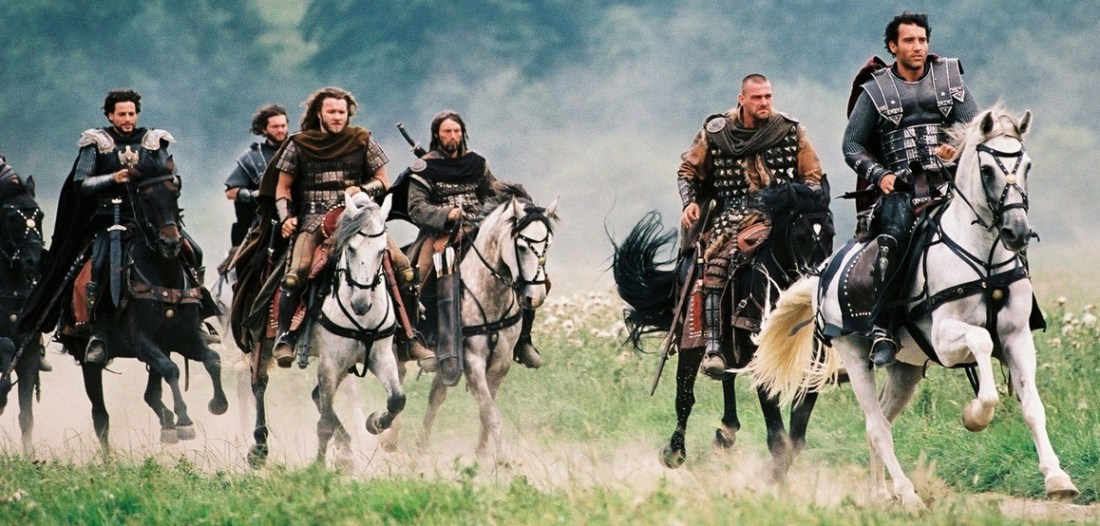
Another film filled with familiar faces. Clive Owen leads the cast as Arthur. Ioan Gruffudd (a Welshman I know best as Horatio Hornblower [blame my brother], but also Mr. Fantastic in the slightly older Fantastic Four movies) is Lancelot, the primary narrator. Mads Mikklesen (later to be Rochefort in 2011’s Three Musketeers) is Tristan, joined by Ray Stevenson (Porthos in the same movie and Volstagg in the Thor movies) as Dagonet. Joel Edgerton (young Owen Lars in Star Wars) is Gawain, Hugh Dancy (Prince Char in Ella Enchanted) is Galahad, and Ray Winstone (Mac in Kingdom of the Crystal Skull, and voices Mr. Beaver in Chronicles of Narnia) is Bors. Keira Knightley is Guinevere, Stellan Skarsgård is Cedric, the leader of the Saxons, Ken Stott (he’s Balin in Hobbit and voices Trufflehunter the Badger in Prince Caspian) appears as Roman Marius. It came out in the wake of Gladiator‘s success and about the same time as Troy, Kingdom of Heaven, and Alexander; also big historical battle movies that attempt to “tell the real story” of popular myths. Produced by Jerry Bruckheimer (of Pirates of the Caribbean, which might be why some of the soundtrack is reminiscent; that, and written by the same composer).

This interpretation, like Last Legion, examines the Roman influence in Arthur. The opening screenshot states “Historians agree that the classical 15th century tale of King Arthur and his Knights rose from a real hero who lived a thousand years earlier in a period often called the Dark Ages. Recently discovered archeological evidence sheds light on his true identity.” Richard Barber’s King Arthur: Hero and Legend states “Arthur…was assigned the historical role of last defender of Britain before the Welsh were pushed back into the western hills (pg. 17).” In The World of King Arthur by Christopher Snyder “a new, independent Britain faced the overwhelming task of deafening its citizens and cities from barbarian invasions. Because he is the most famous of the British defends, the period has come to be known as the Age of Arthur (pg. 35),” roughly 400 AD. A British member of the clergy wrote in the sixth century that the Picts posed a serious threat to Britain and it was decided to hire Saxon mercenaries. The mercenaries were not loyal (surprise) and instead raided Britain, “until a Romano-Briton named Ambrosius Aurelianus assumed military leadership (pg. 38),” and victory at Badon Hill. Obviously, Arthur did not live during the chivalric age that he is so often associated with; there would be more written records. So this film is not far off in its assumptions, but still runs rampant with Hollywood History…eh, these things happened, let’s put them together.

Carrying on…Ioan narrates the beginning that as the Roman empire expanded, it came to conqueror the land of Sarmatia (present day Ukraine area). At the end of the battle, only five of the cavalry were left standing. They were spared, on the condition that they were incorporated into the Roman military, and their sons down the line would serve as well. “Better they died,” Lancelot remarks. He and the other Sarmatian knights would serve under Arthur. Fast forward fifteen years and the knights have a run in with the Woads (based on the Picts, but named after the woad paint they used). They escort the Romans to Hadrian’s wall, where the rest of the Romans are beginning to pack up and leave Britain. Arthur and his knights should be discharged, but the Roman bishop they rescued has one last mission for them before they can claim their papers. He wants the men to go north of the wall, into Woad territory and rescue a Roman family. Oh, and the Saxons are invading since the Romans are leaving.

king-arthur-2004-knights

The knights are angry at the deception; they have fought for a cause not their own for fifteen years, they want out. But they will follow Arthur. Lancelot is still the knight closest to Arthur and overhears Arthur pray to God to spare his knights. They argue over faith and belief; Lancelot does force Arthur to promise that if he should fall in battle, Arthur will burn him like the old customs.

The Saxons have heard of Arthur and are already planning on making their way to the Roman estate to take on the legend. At the Roman estate, Arthur demonstrates his strong sense of justice; he frees several pagans from being stoned in and left to die, including a young boy – Lucan, and a young woman – Guinevere, a Woad. Arthur insists on taking everyone who is able with them to escape the Saxons, knowing that it will slow them down. That evening, Merlin (the leader of the Woads, a bit different position than he normally has) instructs his men to trap Arthur, but not kill him. Merlin hopes to form an alliance with Arthur against the Saxons. Arthur is not keen on the notion, blaming the Woads for the death of his mother, a Briton. Merlin argues that based on that fact, Arthur is part Briton as well; these people left are as much his people as the Romans. They part for the evening. Guinevere ends up shooting and killing Marius when he tries to kill Lucan, leaving Marius’s son, Olecto in charge (a godson of the Pope and due to enter the church). Olecto reveals to Arthur along their journey that the man’s mentor was killed; the Rome Arthur has dreamt of doesn’t exist anymore.

The Saxons catch up to them at a frozen lake. Arthur sends the civilians away, standing with just his knights and Guinevere against a small army. Their bows can hit the Saxons, but the Saxons can’t hit them, so the Saxons move closer. Their combined weight cracks the ice (though why they insist on simply moving forward while the knights pick them off and don’t fire back; I don’t understand the tactics). Dagonet rushes forward and breaks the ice further, dumping a portion of the army. He falls in as well, but Arthur pulls him out. He’s been struck by an arrow and does not survive the battle. The knights return to Hadrian’s wall and are not exactly leaping for joy to finally receive their discharges. They should have never been sent on the mission and then Dagonet would never have died. The Romans still leave even when the Saxons camp out in front of the wall. The knights intend to leave as well; they finally have their freedom and want to return home. Arthur will stay and fight, bringing about another argument with Lancelot, who insists that this is not Arthur’s fight. Arthur pushes for his friend to take his freedom and live it for both of them. Guinevere comes to him that evening.

Cedric, after a meeting with Arthur, is excited to finally have an opponent worthy to kill. But he sends the battered infantry in first. The knights return to help Arthur and the Woads fire from the trees, decimating the Saxon force. Then the rest of the army rushes through the wall. The Woads have trebuchets (for some reason; I don’t think they were used in battle at that time period) and a full battle breaks out. Tristan faces off against Cedric and Guinevere goes after Cedric’s son. Lancelot sees her in trouble and takes over the fight. He’s shot by an arrow, but manages to throw his sword, killing his opponent. Arthur watches Tristan die at Cedric’s hand and fights the leader himself. A backwards stab does the Saxon in and through the haze, Arthur sees Guinevere beside a fallen Lancelot. Arthur cries to the heavens that it should have been his life. He feels he failed his knights; he never led them off the island nor did he share their fate. He holds to his promise to burn Lancelot. Ioan narrates the end that the knights gave their lives in service to a greater cause; freedom. Guinevere and Arthur marry; Merlin declaring him King Arthur. Arthur tells the masses that they are all Britons, united in a common cause. In the background, three horses run by, recalling a notion that Lancelot had grown up with that the souls of great warriors who died in battle are reborn as horses. The knights and King Arthur live forever in the legends told through the generations.

This has never been my favorite version of the Arthurian legend. It took several watchings for me to completely understand the story. The Roman influence threw me the first few times and deviating from the typical legend. I don’t quite understand how Arthur and Guinevere so quickly fell together. There’s really no love triangle (aside from long glances), but I’m okay with that. Arthur is the only character really developed. We get glimpses at the other knights. All of Guinevere’s costumes are impractical. Overall, not impressed. Never fear, we will get to some versions I actually like.

Up Next: First Knight

Arthur Started in Rome

The Last Legion

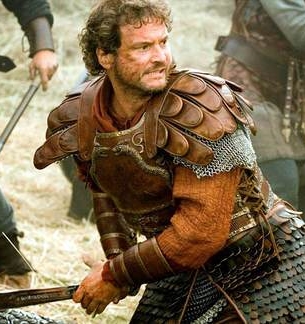
Taglined “Before King Arthur, There was Excalibur,” it has a lot of familiar faces. Colin Firth (King’s Speech, What a Girl Wants, Bridget Jones’ Diary) stars as Aurelius, Ben Kingsley (He was Nizam in Prince of Persia: Sands of Time) is Ambrosinus, Thomas Brodie-Sangster (we just saw him as young Tristan in Tristan and Isolde) is Romulus, the last Caesar; and so many other faces that we’ve seen in historical and fantasy movies; and a lot apparently end up in Game of Thrones [I really need to see that show] While the movie starts in Rome (and I am horrible with Roman names, they all sound the same), it does end in Britain.

Ben Kingsley’s voice explains during the opening of the movie that years ago, legend has it a sword was forged for Julius Caesar, then hidden by his descendant Tiberius. Those who bear the sign of the pentangle guard its secret, searching for the righteous man to bear it. Rome lies in a precarious situation, a new emperor is due to be crowned and the Goths are demanding compensation for their work for the Empire. Romulus, who we think is just a boy running about the streets, is actually the new Emperor; he has Caesar’s blood running through him. His father is controlling and dismisses his teacher, Ambrosinus once Romulus is crowned. Aurelius is charged as the leader of the boys’ personal guard. The Goths attack and overrun Rome one evening. Most of Aurelius’s men are killed, as are Romulus’s parents. The boys is brought before the Goth’s leader and luckily Ambrosinus is able to make an argument to keep them alive.

Now Aurelius must first rescue his men, then his emperor. He has an ally with the Constantinople envoy, who sends one of his guards to help. Romulus will be granted sanctuary in the East. Aurelius is surprised to discover during a fight that the guard is actually a woman, Myrah. While on the island, Ambrosinus recognizes pentangles and sends Romulus after the sword. A plaque at a statue of Tiberius states “One edge to defend, one to defeat. In Britannia was I forged to fit the hand of he was born to rule.” Aurelius, Myrah, and a few loyal Romans rescue Romulus and Ambrosinus and meet up with the envoy, only to discover that everyone else has thrown their lot in with the Goths. There is no safe haven for the boy in the East. The small group manages to escape once again and head for Britain, hoping to find the lost ninth legion and gain allies. They’re followed by Wulfa and his men.

Hadrian’s Wall, a monument to Roman law and order is deserted. The remnants of the ninth legion have integrated with the Celts. They’re no longer soldiers, they’re farmers and have to contend with Vortigyn. Rome abandoned them, so they abandoned Rome. The Goths meet with Vortigyn, informing him of the sword. He is familiar with the blade; in exchange for the boy, Vortigyn gets the sword, and Ambrosinus (there’s a continued flashback of Vortigyn branding a younger Ambrosinus with the pentangle [fun fact: the young man is Ben Kingsely’s son]).
last legion

The Romans start to settle in with the others living at Hadrian’s Wall. Romulus becomes friends with a young Ygraine. A little family starts to develop between Myrah, Aurelius, and Romulus. Then Ygraine is grabbed by the Goths and watches a family (her family? Not terribly clear) die and sent back to the village to inform them that Vortigyn wants Romulus. It is decided there will be one last battle to decide the matter. Aurelius convinces some of the legion to join him and they fight under the Red Dragon banner. They’re vastly outnumbered but fight anyways, eventually reinforced by the rest of the ninth. Romulus decides it’s a fine time to wander about; I don’t think he was really prepared for the battle. Aurelius is wounded defending the boy, using Caesar’s sword. Romulus picks up the sword when it’s knocked away and stabs Wulfa for his parents’ deaths. Romulus charges Aurelius to live; he fought like a dragon. The man tells the boy that he fought like the son of a dragon. Romulus declares, no more blood; no more war, and throws the sword. It lands in a stone.

Years pass and an older Ambrosinus is walking with another young boy, telling him the story of the last legion’s battle. Romulus took on the name “Pendragon,” meaning son of a dragon; and he was raised by Aurelius and Myrah. Pendragon is the boy’s father and his mother is Ygraine. Ambrosinus took back his Celtic name, Merlin. Indeed, the boy is Arthur. The film closes on a close up of the sword, only the letters “E. S. CALIBVR” visible: Excalibur.

Some of the effects are painfully obvious C.G. Why is it that if there is a woman, there must be a relationship? Can she not simply be a female warrior, like a man? Overall, the movie is passable, nothing spectacular. I like how it was tied in with Rome; but the story is a British legend.

Up Next: King Arthur (2004)

Another Tale of Tragic Love

Tristan and Isolde

This tale quite possibly influences elements of Arthurian legend, such as a love triangle. (Well, it’s French). The movie came out while I was in high school and my interest in Arthurian legend and Irish legends were already growing, though the marketing touted it as “before Romeo and Juliet.” Lots of recognizable faces. James Franco is the titular Tristan and Sophia Myles (she would later be Renette aka Madame de Pompador in Doctor Who) is Isolde. They’re joined by Rufus Sewell (Count Adhemar in A Knight’s Tale) as Marke, Mark Strong (Godfrey in Robin Hood and Lord Blackwood in Sherlock Holmes) as Wictred, Henry Cavill (Charles Brandon in The Tudors series and Clark Kent/Superman in the latest DC movies) as Mellot, and Thomas Brodie-Sangster (if his name isn’t familiar, his face is; he’s in Game of Thrones, The Maze Runner, and Nanny McPhee) as the young Tristan.

The scene is set, telling us that Britain in the Dark Ages after the Roman Empire left is divided amongst its tribes, leaving it vulnerable to Irish incursion. The Irish king fears Britain uniting. The scenery is gorgeous as the film opens, showing a young Tristan and his father, preparing for a tribe meeting. They are betrayed and both of Tristan’s parents are killed. He’s saved by Marke, who loses a hand. On the other side of the sea, young Isolde buries her mother and already doesn’t trust her father.

Nine years later, both are young adults. Tristan faithfully serves Marke and they are hoping to work out a treaty once again with the other tribes. He is friend with Marke’s nephew, Mellot and they have discovered a secret tunnel that comes up in the castle’s keep. In Ireland, the Irish king Donnchadh agrees to give his daughter, Isolde to the warrior Morholt in reward for his loyalty; she will be his bride once he returns from Britain. Morholt leads Irish soldiers in collecting tribute. Tristan confronts Marke; they must do something to rescue the young people that were taken as slaves. Marke agrees, but they must be smart and act together. Tristan leads a group in their rescue, but he receives a cut when fighting Morholt. He kills the Irish leader, but passes out a few minutes later; the blade was poisoned (we already know what befalls the victims from Morholt showing it to Isolde. She counters that there is an antidote.) Mellot lays his friend to rest in a boat, set to sea then lit with flaming arrows.

The boat comes ashore near Isolde as she prepares to run away from her father and Morholt. Isolde chooses to save the young man. The young couple eventually falls in tristan and isoldelove…Until Tristan’s boat is found and Donnchadh begins searching for the slayer of Morhot (his sword had been found with the boat); Tristan must flee, but Isolde cannot follow. Tristan returns to Marke’s warm welcome and informed that Donnchadh has been scheming. He has set a tournament, with his daughter’s hand in marriage as the prize, along with a healthy dowry; it is an effort to divide the tribes. Marke hopes that if he wins, he will hold the support of the other tribes. Tristan volunteers to fight for him. (Isolde had told him her name was Bragnae to keep her identity secret; he does not know she is the king’s daughter).
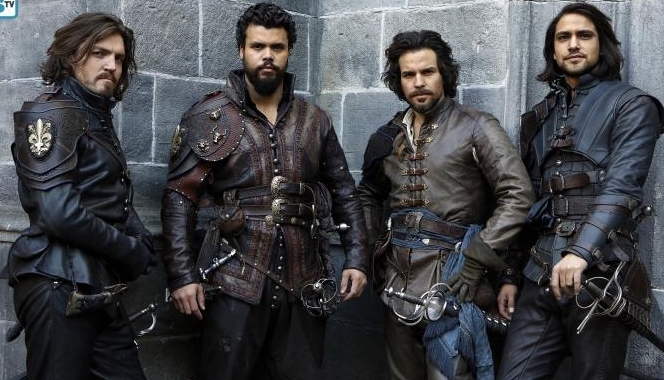
Tristan ultimately wins the tournament (after a vicious fight with Wictred, the main opponent to Marke’s treaty) and Isolde gladly says she will be his, but is disappointed to learn Tristan won her for Marke. Marke is a kind husband, but Isolde is still in love with Tristan. At first, Tristan insists that they cannot have anything to do with each other and avoids his adoptive father and new bride. But Isolde pleads and he eventually agrees to secret meetings. Marke manages to get the other barons to sign his treaty and he will be crowned king. He names Tristan his second, passing over his nephew, Mellot. Which does not endear Mellot to Tristan, who has also been favored as a leader. Wictred, who has begun to notice the attention Tristan pays Isolde, suggests to Donnchadh that the coronation would be a good time to attack. Marke even begins to suspect that Isolde may not be entirely faithful and asks Tristan. Tristan assures his adoptive father that his wife is loyal and tries to break it off with Isolde, burning their meeting place. She still insists that they love each other and must be together somehow.

The coronation arrives and the men ride out, as an old tradition. Wictred leads them to Tristan and Isolde. The barons abandon Marke and he’s forced to arrest the young couple. Isolde comes clean. Just as the Irish are at the castle’s gates, Marke lets them go. Tristan has Isolde get in the boat, then pushes it away. He stays and helps fight. Mellot, hoping that Wictred will show him more respect, shows the traitor the secret tunnel. He’s cut down for his trouble and realizes his error. Tristan uses the same tunnel to sneak behind the Irish, rallying Marke and his men with his timely arrival. Another fight with Wictred, Wictred landing mortal blows, but Wictred falls to Tristan’s sword first. Marke confronts the barons: “there is no middle ground! Slay us, or slay him [Donnachdh].” Fights break out among the opposition. Tristan has Marke take him to the river and Isolde brought. The movie ends with Tristan’s death; Isolde apparently buried him then disappeared. Their love did not bring down a kingdom, like they feared. Legend says that Marke was victorious and reigned in peace until the end of his days.

For being so excited for this movie in high school, it’s fallen on my list. I see the definite influence for the Lancelot-Guinevere-Arthur triangle (which is about my least favorite aspect of Arthurian legend). The movie drags. I connect more with the emotions of Marke than either Tristan or Isolde. It took me several viewings for me to completely understand the storyline. It’s a dark film; as in, there aren’t many sunny scenes. Those that are sunny have a layer of clouds. At the end of this last viewing, I found myself craving a return to Musketeers.

In 2009, Great Lakes Medieval Faire’s theme was the court of Arthur. It was probably the second year I had gone and I remember hearing all the characters on cast and happen to mention “I wonder if they have Tristan and Isolde?”…within hearing of Merlin. Merlin brought the woman playing Isolde over to me. (A few years later, they did Romeo and Juliet and being early to the dance, I was ensured a partner: Puck. I had a wonderful time and that was when I decided I wanted to be on cast someday). It’s funny to watch some of the older videos; because now I recognize people. Oh, hey, I know Morholt (who shouts “For Ireland!” at the end of the match. Arthur says he owns that too…no you don’t). I actually know Puck. And Mordred. And Guinevere.

Next Time: The Last Legion

“All for One and One for All”

Season Three

Four years have passed and we’re thrown straight into the war. Athos is leading a charge in Spoils of War. He’s knocked down and the Spanish begin their attack, but his brothers Porthos and D’Artagnan defend their commander until he is up. Frustratingly, the general insists that the field must be taken, even though the French have no artillery to support them (“Go out there and die for [the king]” is not the most sound military advice). D’Artagnan remains reckless and leads another charge. They blow up the Spanish’s powder and win the day. But the three intend to discover what happened to their promised re-supply.

During the course of their investigation, they come across Aramis, now a monk at a nearby monastery, watching over children. This season’s new villain, Grimaud brings the weapons (stolen from the French army) to the monastery. One of Aramis’s charges, Luc, is quite brave and helpful, eagerly soaking up any stories Aramis tells of his companions. Aramis works with his brothers again and discovers that God made him to be a Musketeer, not a monk. He joins them as they ride back to Paris.

Meanwhile, in Paris, things are not as they left. The only musketeers at the garrison are cadets and they have to put up with the Red Guard, under the leadership of Captain Marchaux and taking orders from Marquis Ferron, the Governor of Paris (why we’ve never seen him before if he’s the governor, and Louis’s bastard half-brother [same father, different mothers, thus does not show on official family trees], I’m not sure. ‘Tis a plot hole). Constance, known now as Madame D’Artagnan runs the garrison while Treville continues to advise the king. Louis and Anne have grown distant; Louis only cares for his son, who is now five years old. Marchaux despises Constance, calling her an unnatural woman. Treville does manage to punch the man in the face (to our cheers).

Grimaud works with Ferron and he’s content to stay in Paris now that the musketeers have returned. The three elder musketeers report to Treville, who has them reassigned to Paris to keep order; D’Artagnan has gone ahead to the garrison to surprise his wife.

He gets thrown in prison in The Hunger, defying Marchaux when the man accuses refugees of stealing grain. Hundreds have fled to Paris for protection when the war ravages their land. One of their leaders is Sylvie, who encounters Athos when he discovers her pamphlets on equality for all (which equals to sedition at that time). He ends up working with her as the musketeers attempt to discover what happened to the grain (she even gets a few fight scenes). Treville argues for justice; there has been no evidence found against the refugees; though it turns out that the villainous trio of Marchaux, Grimaud, and Ferron are working together to frame them. Our heroes win out the day; Athos and Sylvie even kiss, starting a new relationship.

third season musketeers
Our four favorite musketeers are back

Brothers in Arms brings Louis’s younger brother, Gaston, the Duke of Orleans (this is historically factual), into play. Treville and Anne notice that the king is not acting like himself. Louis wants to build bridges with another family member who wanted to overthrow him (remember how well that worked last time, trying to forgive his mother). Louis does reveal to Treville (with Ferron overhearing) that he has the white plague; this will be his last summer. That is why he is spending all the time he can with his son. He swears his Minister to secrecy; just after Treville has admonished Athos that they should tell each other everything. The Queen does not even know.

Constance maintains her friendship with Queen Anne, though when the queen asks when the garrison will be treated to a child now that D’Artagnan is home, Constance shares her worries about bringing a babe into this chaotic world. Athos has to learn his place as Captain of the Musketeers, according to Treville. He should not be riding out constantly with his friends: I argue that he’s more effective that way and Athos is not one to abandon his brothers. He’s a Captain just returned from war, where his position was at the head of the charge, not sitting back and devising strategy. D’Artagnan is coming along nicely, tutoring the cadets and passing on the wisdom of “head over heart.”

Gaston manages to insult a group of veterans. Due to being the king’s brother, Gaston faces no recriminations while Louis doesn’t mind arresting the veterans. Gaston was carrying letters between him and the Duke of Lorraine (a cousin), raising an army against Louis. Of course Gaston doesn’t want those lying about, but he’s not the loyal family member that Louis desires. Tensions rise between the veterans and the royal family, with the Musketeers stuck in the middle. Porthos and Treville attempt to talk peace, but are held hostage. Porthos is disgusted that “I left a good clean war for this,” meaning the machinations going on in Paris. The Red Guard are given permission to fire on the veterans, only after Athos has had a chance to rescue Treville and Porthos. Of course, thanks to Grimaud, the attempt fails and an all out battle ensues. The Musketeers and veterans join forces against the Red Guard, aided by Constance and the cadets, and Sylvie and the refugees arriving. Treville punches Marchaux again. In the end, Ferron throws Gaston in the Bastille once he reads the letters.

An old face, Emile Bonaire reappears in The Queen’s Diamonds [it’s been a while since I’ve watched season three and I forgot the plot line for this one when I saw the title and thought it was similar to 2011’s movie]. Louis’s sister, Henrietta Marie is married to King Charles I of England (I doubted this was true, but looked it up and yes, it is), and has traveled to France for help from her brother; Cromwell has taken over London [I can give you a rant on Cromwell, if you’d like]. She was to meet with a Dutch financier and use her crown jewels as collateral to raise an army against the uprising. But her diamonds are stolen. By Bonaire. When the Musketeers catch up to him, he’s already sold them, so now they must track down the buyers and get them back. D’Artagnan is instrumental in retrieving the first set of stones, using his knowledge as a farmer to approach a horse that’s causing the other men difficulty. There’s a firefight to retrieve the second batch.

There’s a small side story involving Aramis and an old friend, Pauline. Turns out, Aramis grew up in a brothel before his father retrieved him. Pauline grew up in the same brothel and they were childhood friends. Pauline is due to be married to a wealthy noble, but she’s being blackmailed about her past by a servant. She ultimately kills the servant because she will not tell her future husband the truth. She has a break down right before the wedding (and we’re not entirely sure what happens to her). The story crosses over with the main plot when the last diamond is to be used as her wedding ring. The gems are returned to their owner and Bonaire will double the English queen’s money, if she lets him remain with his new wife, her lady in waiting. They’re free, but they can never return to England.

A prison escape occurs the same day as the dauphin’s birthday in To Play the King. This is all Ferron’s planning; while the court is occupied with the birthday celebration, Grimaud will sneak in and rob the gold vault underneath the palace, accessed by the prison, hence why the prisoners needed to be out of their cells. The Musketeers are sent to round up the escapees. Grimaud blackmails one prisoner, a former locksmith, to get him to build a new key in order to get into the vault.

Unfortunately, one crazy prisoner was in the mix, who thinks he’s the actual king (played by Stephen Walters, who is Angus Mhor in Outlander). D’Artagnan takes pity on him when he discovers the man was a soldier, caught in a siege that addled his mind. The young Musketeer takes the man to a convent to heal. The king remains mercurial; he wants his subjects, starting with Ferron, to swear fealty to his son. But he’s embarrassed when Ferron’s weakness (his spine pains him and makes walking difficult) causes the older man to fall to the floor. His adversary, Treville and Athos help him up and even little Louis comes to his aid. Anne leaves when Louis makes his remark. At the same time, the prisoner D’Artagnan took pity on is very dangerous, killing the nuns, and continues to the palace, coming upon the queen. Anne plays along for a while, but just as the prisoner begins to suspect her, D’Artagnan and the others come to her rescue. Louis is pleased she’s not dead, but that’s as far as his grace extends.

Treville still suspects that Ferron wishes to overthrow Louis, but he cannot tell the king, or Ferron will spread word of Louis’s illness across the continent. The Minister does overhear Ferron and Grimaud plotting that they need Gaston and Grimaud will ensure that the Aramis, Porthos, Athos, and D’Artagnan will not stand in their way again.

Death of a Hero starts ominously, Ferron talking about the day you die, and you don’t see it coming, narrating over the opening shots. Aramis is blindfolded, Athos faces a pistol, and a knife is held to D’Artagnan’s throat. So we fear that at least one of our heroes will not survive. Yet, they are safe for the moment. The pistol held at Athos belongs to Sylvie and they spend a rather interesting morning together (who knew the former Comte could be kinky?) Aramis is doing trick shots with Porthos, and Constance is shaving D’Artagnan. Ferron forges Treville’s signature, telling Grimaud that this will the Musketeers’ day to die; he has issued orders for Aramis, Porthos, and D’Artagnan to meet a messenger from the front. Grimaud handles Athos, finding him at Sylvie’s and brutally attacks him (none of the other refugees can bother to help Athos). Sylvie fires two shots at Grimaud and thinks he’s dead. When she returns with Athos, he’s gone. Athos fears for his brothers and calls Treville to the garrison. They ride out after their friends.

Porthos and D’Artagnan are ambushed on their trip. Grimaud comes along to blow up the building they’re hiding in. The two musketeers discuss that they don’t want to die yet. D’Artagnan still wants children (um, you should really have a talk with your wife, get both of yourselves on the same page). Porthos still wants a wife and child. “We refuse to die!” they resolve. And the roof caves in, trapping them. That is the state that Athos and Treville and the cadets find them. Athos frantically searches, until he fears that his brothers are dead. Porthos manages to come to, grasping D’Artagnan’s hand, echoing their earlier statement, calling attention to them. They’re rescued and now must go for Aramis.

In the meantime, Louis has decided to go on a pilgrimage to his father’s grave on the anniversary of his death. He’ll go with one guard, Aramis. Grimaud, when he finds out that Aramis is not with Porthos and D’Artagnan, orders Ferron to kill him, and the king. Ferron has already helped Gaston escape the Bastille. Ferron lies in wait, but cannot bring himself to kill his younger brother, especially after Louis places his trust in him to look after the dauphin and shows Ferron that he will be buried next to their father and acknowledged as family. Later, Louis confronts Aramis about the truth of his affair with the queen. Louis knows. He threatens to hang the musketeer (not helped along by Aramis telling the king that his wife was lonely; Aramis darling, while that may be true, don’t say that to the king). Outside, Grimaud confronts Ferron. Ferron stands up to the villain and is rewarded with being stabbed. He fires a shot in the air to warn Louis and Aramis of danger. A fight breaks out, Louis even helping shoot one guy. When he discovers his brother, Louis declares him a hero, worthy of a full state funeral. It comes out to the musketeers that Louis is dying, and Aramis warns the queen.

Fool’s Gold has our heroes pursuing Grimaud for his crimes. They come across a camp of women, displaced by the war. The four men wrangle an agreement to use the camp as a base for their search Another man in currently staying there, Bastian (played by Harry Melling, Dudley Dursely from Harry Potter), claiming to be an injured solider. The four musketeers soon discover that he’s not a soldier, he’s a deserter and worse, a convict. He and his men are searching the camp for loot they had stolen. Athos doggedly continues on the search for Grimaud, locating a cabin in the woods. The leader of the camp locks him in; she had acted as a mother to Grimaud when the man’s own mother tried to drown him since he was the result of rape. The mother still lives and is in the camp, Juliette. Athos escapes, but the woman poisons him. He stumbles upon the search party and is plagued with horrible nightmares as he fights the effect of the poison, layered on top of the hideous wounds he received from Grimaud two days before.

Back at the palace, Anne tries to make inroads with Louis, now possessing the knowledge that he is dying. She asks to be named Regent. Louis refuses at first, keeping their son from her; he cannot forgive her for her adultery (double standard; what do you call Milady de Winter? Treville even points this out). Anne does persuade Louis to name her Regent; she wishes to still be friends with him. They accept they never truly loved each other, but their marriage was a political alliance.

Porthos meets a young, pregnant widow at the camp, Elodie. While his brothers face off against Bastian and his friends (bar one who agrees to defend the women; he never wanted hurt them and is repulsed by the others’ actions), Porthos helps Elodie deliver her daughter. He offers to stay at the camp for a while, to help, but Elodie insists that France needs him.

Sadly, all of the work Anne had been doing with Louis is undone in Prisoners of War. Anne had secretly been negotiating with Spain through Aramis; not even Treville nor Athos knew. Grimaud captures Aramis and his plan is to discredit Anne; turn the people against her. Anne firmly tells the musketeers “I have been a French queen longer than I was ever a Spanish princess.” “Spain” (actually Grimaud) has asked for the release of Spanish prisoners in exchange for Aramis. The Musketeers have the unhappy duty of getting the prisoners from Marchaux and the Red Guards just as Marchaux is ready to hang them in front of a crowd. D’Artagnan releases his cousin, at the young man’s pleading (I didn’t want to trust him, and it’s a bit out of place for him to show up out of the blue). Of course, the musketeers (assisted by D’Artagnan’s cousin) rescue their friend and Grimaud frustratingly escapes again.

Treville and Constance try to counteract the bad publicity by having the queen support Sylvie’s education of the poor. She can spread her message farther with the use of a printing press. But it’s turned against her when someone (Grimaud) uses her seal to print scandalous drawings of the queen. And, to make it even better, Milady is back in town. Treville wants to hire her services as an assassin for the crown. He warns her against seeing Athos. She doesn’t listen, visiting Athos’s Captain’s quarters. One of the naive cadets unfortunately reveals that Athos is involved with Sylvie. Athos is not pleased to see his former wife (I would think it’s safe to assume they could be regarded as separated by now), despite a kiss. He fears she’s moved against Sylvie. Marchaux in fact arrests Sylvie and plans to whip her for her transgressions, even trying to get the woman to turn on Constance. Milady is hidden in the crowd when Athos arrives and releases Sylvie, shouting “to hell with the law!” A turn on his reaction to Milady’s deception; it was his duty to execute her for killing his brother. Athos tends to Sylvie and Milady agrees to Treville’s offer. At the end, Louis is angry at Anne and Treville is furious at Aramis for his actions and secrecy in the negotiation process.

The Prize startlingly begins with Louis’s death. One moment, he’s recovering from a simple sparring match with Treville, the next he’s coughing blood and dying in Queen Anne’s arms. Treville puts a plan into immediate action; Athos is to hide the dauphin, now king, in Paris, and tell no one; not even his brothers, especially not Aramis. “Civil war is coming to Paris and that child is the prize.” Gaston and Lorraine have an army stationed outside the city. Anne is furious when she discovers her son missing, not helped when the council reveals that Louis named Treville Regent at the last minute. The excuse used it that with the country at war, it’s better to have a solider at the head.
Treville does have another plan; he needs to separate Gaston and Lorraine. Step one is to convince the queen to pardon Gaston so he can enter the city under the ruse of seeing his brother laid to rest. Treville offers Gaston money so he won’t try for the crown. While Gaston is at the palace, they stage the dauphin leaving and Treville rides with Porthos to visit Lorrain and work that angle.

Athos asks Constance and Sylvie for help. The women disguise the prince and hide out with him at the abandoned tavern the veterans had used [episode 3, Brothers in Arms]. Louis, not exactly understanding all that is happening; sneaks out. He’s quickly recovered, but now they must hide in Bonacieux’s old house. Anne approaches Constance, begging to see her son. Constance compromises, but Marchaux and Grimaud are notified that the dauphin is in Paris and suspect Constance. Marchaux tries to take the dauphin when Constance meets Anne at a chapel, but Aramis is luckily to the rescue. He’s unhappy that Athos kept the information from him and Athos begins to suspect that Aramis has a point; secrecy will destroy their brotherhood. D’Artagnan is eager to help his wife. He takes charge of the child, hiding at the laundry that Constance had used when the boy was an infant. They almost escape Grimaud, but the man is clever and stabs D’Artagnan through the floor, revealing the pair.

Everything comes to a head at Lorraine’s camp. Treville has managed to work out a treaty with the Duke, granting him the independence he wants and warning the man that Gaston cannot be trusted. Lorraine knows his cousin and knows that Treville is correct; he even tells Gaston when the young man shows up that he was “a tiresome and vindictive child,” and he “has not changed.” He does not stand for Grimaud abducting the dauphin and a fight breaks out. Grimaud stabs Lorraine several times. Gaston escapes. Treville grabs the boy and manages to pass him off to Porthos to escape, after taking one bullet. He turns, ready to face his last stand and is shot another time. Grimaud, in full view of Aramis and Athos, shoots their leader a final time. Grimaud escapes again and the musketeers are left to mourn their fallen leader. My tears echo theirs.

The show concludes with We Are the Garrison [and if you note, when a character dies, their actor’s name does not appear in the opening credits]. The Musketeers bury their leader, the four bearing his coffin, and mourn his death at a tavern. Athos is so grief-stricken that he cannot even drink. Constance suggests that Sylvie tell Athos some good news, but the woman says that the time is not right. Constance and Brujon return to the garrison for more wine. The rest of the musketeers toast their former captain. Bombs are thrown into the tavern. Athos, Porthos, Aramis, and D’Artagnan are the only four to emerge a few minutes later, in time to see an explosion from the direction of the garrison. D’Artagnan heads their race back, worried for his wife. The garrison is on fire; Porthos tries to hold D’Artagnan back, but the younger man breaks free and rushes in to save his wife. Another explosion tosses the other three back. Porthos is ready to rush in and save their comrade, but Athos tells him D’Artagnan is gone. They start finding some survivors and Sylvie arrives with refugees. As Athos is about to start grieving for their loss, D’Artagnan emerges, carrying Constance. He tells his friends that Brujon is still inside. We fear Constance is dead for a few minutes, D’Artagnan begging Aramis to save her, sobbing “she’s a Musketeer” (I was crying; I still cry every time I see this episode, despite knowing how everything turns out), but she coughs and opens her eyes.

Grimaud reports to Marchaux that only D’Artagnan died in the explosion (he left before seeing the man reemerge). They take Sylvie and send a note to Athos. D’Artagnan is their advantage. When they arrive at the refugee camp, Grimaud sends Porthos and Aramis away to be executed and threatens Sylvie. Athos tells Grimaud that Sylvie does not fear death. Girmaud’s dagger moves lower, pointing to the woman’s belly. A nod confirms; Sylvie is pregnant. D’Artagnan jumps onto the guards just as they’re about to shoot Aramis and Porthos. Aramis sends two shots up, so the Grimaud will think they’re dead, but they come out swinging. D’Artagnan lands some hits on Grimaud, stabbing his shoulder and leg. Then D’Artagnan turns and fights Marchaux. He’s incredibly vicious, but the coward deserves it. Marchaux’s dead, but Grimaud slinks off (will that man die already!)

Athos is terrified and elated at the news that he is to be a father. The child will have the best uncles, who will teach a boy to fight. “And if it’s a girl?” “Then we’ll teach her to fight off the boys.” Good answer! Athos thanks Porthos for his plan; he saved both Sylvie and their child. Later, Athos recommends to Queen Anne that Porthos be promoted. Anne inquires whether Athos is willing to take Treville’s place as Minister. Athos instead suggests Aramis. Anne will consider it. She informs the musketeer captain that a celebration will be held the next day, and all citizens of Paris are invited.

Elodie has shown up; the war found the women’s camp. Porthos has her stay with Constance for the time being. Constance comes across Grimaud in the cellar of the old tavern, though she doesn’t realize who it is. She offers to help him, but he’s gone when she turns around. The next day at the ceremony, Elodie recognizes him in the crowd, entering Notre Dame. Aramis takes charge of the queen and dauphin. Porthos, Constance, and Sylvie get everyone out of the cathedral, and D’Artagnan and Athos go after Grimaud. They pull the fuses on the kegs of gunpowder and chase after the fugitive. He and D’Artagnan trade blows for a moment, Grimaud landing a cut on D’Artagnan’s face. Then Athos insists that he faces the villain alone. D’Artagnan orders his mentor, “I will not raise your child.” Athos and Grimaud each stab the other, and Grimaud doesn’t give up until Athos holds him under water. Their enemy is finally defeated.

The ceremony continues, Athos wrapped in his cloak so his wounds can’t be seen. Anne disbands the musketeers, and reforms them to be protectors of all Paris citizens. The depleted garrison will be recruited from the city. The crowd cheers. As they all leave, Anne promotes Porthos to general; he will return to the front to continue the war. Louis adorably asks Aramis if the man is his new servant (I think this is the only thing the boy says the entire series). Anne begs him to consider becoming her Minister. Athos advises Aramis later to take the position; he’ll be able to watch over his son. While he won’t be known as the boy’s father, wasn’t Treville a father to them all in a way? Anne secretly contracts Milady. Her first target: Gaston.

At the garrison, the Musketeers promote Brujon to a full musketeer and gift him his pauldron. he will accompany Porthos to the front. Porthos has married Elodie so she’ll be provided for in case he dies, and suggests Marie Cessette as a name for the baby (his mother’s name). (I cry this entire ending). Porthos instructs D’Artagnan to only take the best candidates. D’Artagnan is puzzled; that’s the captain’s duty. Athos is taking a leave of absence. “You will return?” the young man almost pleads with his mentor. “Then we will continue this later.” Athos leaves a hat for his pupil (the lad finally gets a hat! And it looks good!) In the end, Aramis does take the position as Minister. Anne is pleased, considering she sneaks a kiss with him in the garden. I adore Athos’s closing quote (I am going to make a pretty art piece to hang on my wall sometime soon).

“What lies ahead of us, I wonder?”

“Really doesn’t matter.”

“Doesn’t matter?”

“Not if we face every challenge the way we always have. With great passion, hearts that stay true to all they hold dear. Courage, no matter how many enemies lie in wait for us. Father, that daylight will always follow the dark.”

“And love?”

“Above all else.”

s3 constanceThe costumes are great this season; they’ve evolved. The Musketeers’ are more militaristic; they have extra padding – you really see it with D’Artagnan. Athos in particular has longer hair (I like it). Constance’s new gowns are awesome, far more practical, bordering on masculine.
I still feel a bit jipped by this last season; there could have been so many more stories (and this is why fanfiction is wonderful!). We could have seen more of Constance and D’Artagnan together, D’Artagnan coming to grips with what his wife has been doing. s3 d'art coupleThere are some pleasant scenes, like the beginning of Death of Hero, when Constance brushes hay out of D’Artagnan’s hair. As for the other relationships: I like that everyone gets a happy ending, but I’m still not quite happy with the sudden pairings. It took two seasons for D’Artagnan and Constance to get together and Aramis and the Queen were in love with each other almost the entire show. Suddenly, Athos has a new girlfriend, with vastly different politics. She’s for equality and he serves the king. Yes, I am glad he is happy; he deserves it. But it still feels sudden. I can see how Porthos and Elodie work; but she was only in three episodes total. How coincidental that Porthos wishes for a wife and child and one appears for him. Again, I’m glad he’s happy and he deserves it, but I don’t see a relationship built. How well will it work out when he returns home?

As with Richelieu, I have a little bit of sympathy for Ferron (not much). In a way, he’s trying to do what’s best for France. He doesn’t want to kill Louis. He’ll certainly take advantage of his death. And he obviously dislikes the Musketeers, which does not endear him to me. Marchaux is a coward and a bully, content hiding behind stronger players (and as D’Artagnan points out; he’s an able-bodied solider who is not at the front). And being cruel to Constance makes me want to punch him, or have Treville punch him harder. And Grimaud is just evil. He delights in pain – and won’t freaking die!

So, what is your favorite version of The Three Musketeers? Do you like the 70’s version with Michael York and Christopher Lee? Who’s your favorite musketeer? [Mine is typically D’Artagnan, influence by Chris O’Donnell’s portrayal, but I adore Athos from The Musketeers]. Let me know!

Since I have spent the past watching various Three Musketeers and reading their fanfiction, my brain has been in Paris. I am still in a bit of shock that Notre Dame burned; it hits a little harder. I am fascinated by medieval architecture and the cathedral is a prime example of the Gothic style. The history of the building that may have been lost.  The citizens of Paris are in my thoughts.

Okay, happier thoughts:

Fanfic Recommendations:

Gaelicspirit, most notably The Details and Broken Places

Richefic, especially All for One which takes place over the entirety of season one

Tea, Coffee and Sibling Rivalry by Forest Archer; the kitten chapter had me laughing until I had to stop for air

Up Next: We move into Arthurian legend (a favorite of mine), starting with Tristan and Isolde