“Near…Far…Wherever You Are”

Titanic

I would think most everyone has heard of this movie, as well as the historical disaster. This was the big blockbuster of the late-nineties; it was nominated for fourteen Academy Awards and won eleven, including Best Picture. And a fairly long movie; when it released on VHS, it had to be on two tapes; and as of 2019, the third highest-grossing movie of all time. Directed by James Cameron (Avatar), who did a lot of detailed research, and a full “hey, I know that guy!” Stars Leonardo DiCaprio (who finally won an Oscar) as Jack Dawson, Kate Winslet as Rose Dewitt Bukater. Billy Zane (did not realize this until looking him up, but he was the voice of John Rolfe in Disney’s second Pocahontas movie, as well as appearing in a few episodes of Charmed) is fiancé Cal Hockley; historical character Molly Brown [there’s a movie about her from the sixties staring Debbie Reynolds] is played by Kathy Bates (who has shown up as Amy’s mother in Big Bang Theory, and was Miss Hannigan when Wonderful World of Disney re-did Annie in 1999). Rose’s mother is played by Frances Fisher (who has appeared in Hallmark movies, an episode of Castle, among other TV spots), Captain Smith is Bernard Hill (later to be King Theoden in Lord of the Rings), Victor Garber (lead in Alias, Professor Callahan in Legally Blonde, Oliver Warbucks in 1999’s Annie, and King Maximillian in 1997’s Cinderella with Whoopi Goldberg, Bernadette Peters, Brandy, and Whitney Houston) is the architect Thomas Andrews. Jonathan Hyde (Prince John in Princess of Thieves) is Bruce Ismay, the managing director of the White Star Line (the company that built and maintained Titanic and its sister ships), and the one I always enjoy seeing for the few minutes in the film, Ioan Gruffudd (Amazing Grace, Fantastic Four) as Fifth Office Lowe.
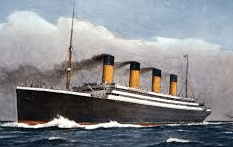
titanic

The film opens with an underwater exploration of the wreck [Dr. Robert Ballard, retired U.S. Naval officer and professor of oceanography at the University of Rhode Island, famously discovered the wreck in 1985, and later found the wreck of the Bismarck in 1989 and the Yorktown in 1998; he was also one of my brother’s heroes when we were growing up; he was very interested in the Titanic, so he was very interested in spying the White Star Line shipyards when we were in Belfast, Northern Ireland…I have a picture of that somewhere]. They find a safe and bring it to the surface, looking for a famous blue-diamond necklace from Louis XVI that would be worth more than the Hope Diamond. Instead, they find a drawing that includes the necklace. A news report brings it to the attention of an old woman, Rose Calvert, who then informs the crew she is the woman in the picture. There’s some speculation that she could be lying, but she knows details about the necklace and the ship that only someone there could have known. Most of the film is her flashback memories (totaling the amount of time it took the actual ship to sink).

Rose and her family were returning to America for her wedding to Cal Hockley, but she is unhappy. At the same time, Jack Dawson wins his tickets in a poker game. He and his friend excitedly race to the ship and explore a bit once its underway. They make it to the bow, where they climb up and Jack yells “I’m the king of the world!” He encounters Rose later that evening at the stern of the ship, when she flees dinner and is ready to jump overboard. He talks her down and when Cal arrives to collect his fiancée, Rose puts it straight that Jack saved her, though she was only looking at the propellers. As a reward, Cal invites Jack to dine with them the next evening. Hoping to cheer his fiancée up, Cal presents her with the “Heart of the Ocean,” a 56 carat blue diamond. Rose is impressed, but not with her intended. She seeks Jack out later, to thank him for his help and discretion, but they get stuck on the point whether she loves Cal or not. Rose is upset that no one notices she is not happy with the role she is made to play, but Jack gives her another outlook on life; one of adventure, never knowing what the day will bring or where you will end up.

Meanwhile, Captain Smith wants to ensure a smooth voyage to America, while Ismay wants headlines. Smith orders the ship to speed up (not wholly historically accurate). Molly Brown, part of the “new money” of the time, and thus frowned upon by the aristocracy, aids Jack in lending him a proper tux for the evening. He charms his way through the upper class, but later passes a note to Rose, inviting her to a real party, in third class. I adore this scene, and the accompanying music, which features Celtic band Gaelic Storm (a big breakthrough for them). Rose proves herself to be more than a pretty face, she drinks and to further prove herself, she goes en pointe (I took ballet for about ten years and never went on pointe, but I know what kind of strength someone needs to balance all their weight on the tip of their toes).

However, come morning, Cal confronts Rose about her below-deck antics; she was spotted. He throws the table, stating she is his wife, even if they’re not married yet (I have a feeling he has been pressuring her to sleep with him before their wedding; just my interpretation). Rose is startled and her mother speaking to her does not help matters. It spells out to the audience that Rose has been forced into this marriage to save face; they have the name, but Cal has the money. Ruth is a teeny bit sympathetic; she knows this is unfair for Rose, but it is a woman’s lot in life, their choices are never easy. Jack sneaks up to see Rose and she tries to send him away, but he’s worried about her. The fire he has seen in her will go out; but it is up to Rose to save herself. Later, Rose goes to Jack; she has changed her mind. He helps her up to the railing at the stern of the ship: “I’m flying!” Cue main theme. The couple shares a kiss. And we cut back to “present day.” That was the last time Titanic saw daylight. The scavenger comments that everything Captain Smith knows from his experience will not help him with Titanic.
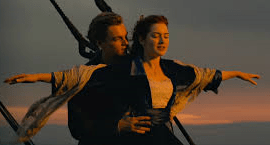
jack and rose

Back to Rose’s memories: Jack returns to Rose’s room with her. She requests a drawing and shows him the Heart of the Ocean. “I want you to draw me like one of your French girls. Wearing this. Wearing only this.” She disrobes and lies on a couch, completely nude and Jack dutifully draws her (behind the scenes note: apparently, the hand that draws Rose is director’s James Cameron’s), and cue main theme. (This intrigues all of the present day crew). Rose leaves a note once they are finished for Cal and leaves again with Jack. They end up running from Cal’s valet, ending up in the cargo hold, in a car. It is there they sleep together, steaming up the window. [And it’s here that I always wonder how this movie is only rated PG-13; I distinctly remember not being thirteen and wondering how my classmates got in to see this movie.] Rose declares that when Titanic docks, she’s getting off with Jack. They are on deck when the iceberg is spotted by the lookouts (no wind makes them hard to spot). The crew try to maneuver the ship around the berg, but they’re too close. (Research has suggested that if Titanic had hit the iceberg head-on, it would not have suffered the same damage and would have remained afloat long enough to dock in New York; of course, that is hindsight). Captain Smith, Andrews, and Ismay are all wakened. Mr. Andrews declares that the ship will sink; five of the compartment are flooded, there was a chance with only four filled, but not five. The ship is iron, it will sink, despite Mr. Ismay’s insistence. Distress signals are started and passengers are told to dress warmly and put on their life vests.

Rose and Jack return to her room to warn her mother and Cal, where Jack is framed with stealing the blue diamond and arrested. Alone, Cal slaps Rose for her indiscretion. They receive word to report to the deck. Rose spies Mr. Andrews; she remembers from his tour that there are not enough lifeboats. Mr. Andrews confirms her thoughts. Women and children are ordered to the lifeboats first; but it is slow going. Most of the passengers do not know of the danger, or else do not believe it; Andrews has to order the crew to ensure lifeboats are filled to capacity. On captain’s orders, the band continues to play to calm the crowd. Ruth wonders blasé whether the lifeboats will be seated by class. Rose sternly tells her mother the truth, to which Cal remarks that the better half of the boat will not die. She then refuses to get on the lifeboat and runs to find Jack. Cal tries to stop her. She spits at him and proclaims she’d rather be Jack’s whore than Cal’s wife.

By now, the bow is underwater, the ship is starting to tilt and take on water in the halls. Rose does find Jack and has to use an axe to cut his handcuffs. They try to make their way back up, but the gates from third class are locked (historically inaccurate). There’s a riot and they break out. The ship is in utter chaos. We see Ismay get on a lifeboat when no one else comes forward. Cal goes back for Rose, putting his coat (which contains the blue diamond necklace) on her and he and Jack tag team to encourage Rose to get on a lifeboat. Partway down, she jumps off (a dumb move, yet terribly romantic). Jack asks when he finds her why she was so stupid; she couldn’t leave him: “you jump, I jump.” Well, this final defiance sets Cal off and he grabs a gun and starts shooting at the couple. He runs out of bullets as they go back into the ship and down several levels. And it’s then that he realizes the coat that has the diamond is on Rose. Cal finds a child lost and crying and takes her on a boat.

The final moments of the ship are approaching. Mr. Andrews and Captain Smith go down with the ship. The band continues playing, ending with the hymn Nearer My God to Thee. An old couple huddle together, not wanting to be parted. A mother in third class tucks her children in, telling them of the Irish land of Eternal Youth, Tír na NÓg. All remaining passengers on deck flee to the stern as the ship splits. The stern rises in the air, Rose ironically notes that she and Jack are back where they first met. As the stern gets sucked down, Jack and Rose and the others prepare to enter the water. It’s the North Atlantic; it’s freezing. Jack manages to find a door floating and pushes Rose on to it. Jack remains in the water. Only one life boat (helmed by Fifth Officer Lowe) returns to find survivors. Molly Brown speaks up, but those crew members overrule her. Contemplating their fate, Rose admits she loves Jack; he insists they will make it and makes Rose promise to survive. But the elements take their toll. Jack freezes in the water and Rose is forced to let him go in order to get a whistle to attract help. Old Rose summarizes that of the 2200 souls aboard the Titanic; 1500 went in the water. Only six were rescued. They and the 700 in the lifeboats had to wait for the Carpathia (of rival company Cunard) for rescue at dawn.

On board, Rose avoids Cal and when asked her name in New York, she gives Rose Dawson. That’s when she discovers the Heart of the Ocean in her pocket. She finishes her tale that Jack now only exists as her memory. But, she walks out to the edge of the ship that evening and drops the diamond into the ocean, to rest with Titanic. I view the final ending, as we pan over her pictures showcasing her adventures, proving she fulfilled her promise to Jack and lived her life, that Rose passes away and is greeted on the Titanic, returned to its glory by all her old friends, Jack waiting to kiss her.

As a result of the disaster, regulations were made enforcing enough lifeboats for all passengers and mandatory safety drills. When one takes the romantic storyline out of Titanic, one can get caught up in the sheer enormity of what happened. I think it was well done on Cameron’s part. There has been a lot of controversy however, on whether Jack and Rose could have shared the door and thus ensured Jack’s survival. The Mythbusters tested the theory that both could have fit on the board and they proved it plausible, though they had the idea to tie Rose’s life preserver to the bottom of the board to give it more buoyancy. Director James Cameron weighed in on the show; Jack was fated to die, so that is why he did not get on the door. The main theme, My Heart Will Go On, performed by Celine Dion, does not play until the ending credits, but it became a smash hit and won the Academy Award for Best Original Song, though it became overplayed (just like Let It Go from Frozen). Personally, I prefer an instrumental arrangement of the piece; it’s still beautiful.

I am not as emotionally invested in this film as some others; probably because I am more invested in other films and just cannot bring myself to get too invovled. Again, it’s an extremely well done movie; the CG effects have withstood the test of time. Kate and Leo have excellent chemistry.

If so interested, there is a well done AU fanfiction story with the characters from Disney’s live-action Beauty and the Beast and Titanic; with Adam as the wealthy heir in a forced marriage and he meets poor Belle. My Heart Will Go On by DisnerdingAvenger can be found on AO3.

Up Next: Australia

She has a Friend, Every Time She Paints

Miss Potter

A romantic bopic of children’s author, Beatrix Potter. It stars Renee Zellweger as Beatrix, Ewan McGregor as Norman Warne, her publisher (the two appeared opposite each other in Down With Love, which is coming up soon in my posting schedule). Emily Watson (she was in Testament of Youth [that WWI movie I watched with Kit Harrington] and War Horse) plays his sister, Millie. Beatrix’s father, Rupert, is played by Bill Paterson; we’ve seen him in Amazing Grace and Outlander.

This film beautifully showcases the Lake District of England and is a huge reason why I want to personally visit the scenery at some point in my life. It opens with Beatrix’s voice-over telling us when writing the first words of a story, one never knows where one will end up. We see her struggle to publish a children’s book and be taken seriously as a single, unmarried woman in 1902 London. Her publishers fob her off onto their younger brother who is making a nuisance of himself; if it gets mucked up, it’s no real loss. However, she is determined to look upon this as an adventure and encourages her illustrated animal friends to do the same. There is a flashback to her childhood, showing that she was a talented artist and making up stories even then.

Luckily, Norman loves Beatrix’s book and quite enthusiastic to work with her on it; everything can be done to her specification. Another flashback shows us that when Beatrix was young, her family started vacationing in the Lake District, where Beatrix got a lot of her inspiration. There was even a young man in the area who liked her stories, Willie Heelis. But Beatrix’s mother despairs of her ever marrying, or at least, marrying properly. She has introduced a string of suitable suitors to her daughter, but Beatrix wants none of them. Meanwhile, she and Norman make a good team publishing her book, and Norman encourages her to produce more stories. The first book, Peter Rabbit, is a success. Norman takes Beatrix to meet his mother and sister and Millie is determined to be fierce friends with Beatrix, bonding over their unmarried states.

In turn, Beatrix invites Millie and Norman to her family’s annual Christmas party. Her father comes to her rescue when her mother disapproves of their “tradesman” status. Beatrix’s present for Norman is a new Christmas story, which the party insists she share. She is a bit scandalous, showing Norman her bedroom, but they are chaperoned and Norman leads her in a sweet dance [I saw this movie before Down With Love or Moulin Rouge and was unaware that Ewan could sing]. Norman proposes, but Beatrix’s answer is interrupted. Then she confers with Millie if she minds. Millie encourages her friend to take a chance on love. Beatrix tells Norman yes. The next day, he visits her father. Unfortunately, Beatrix’s parents disapprove, her father mainly on the point that it is too sudden. They compromise; Beatrix can accept in secret. Their family will vacation in the Lake District for the summer again. If the couple still wants to marry at the end after some time, they will give their blessing. Norman bids farewell to Beatrix at the train station in the rain and they send letters back and forth.

Then, Norman’s letters stop coming. Millie writes, informing Beatrix that Norman is ill. She returns to London, sadly to discover that Norman has died. Millie was the only one who knew Norman and Beatrix were engaged. Oh, I cry every time during this part of the movie. Beatrix returns home, utterly depressed. She tries to draw, but her friends run from something. Millie comes to her rescue. Beatrix must get out of the house. She ispotter cottage quite wealthy now with the royalties from her books; she buys Hill Top Farm in the Lake District, from her old friend, William Heelis. Slowly, Beatrix comes back to life. She draws again and has new stories buzzing about. She reconnects with William, and they share the notion that the landscape of the Lake District needs preserved, farms should be kept farming, not bought out by developers.
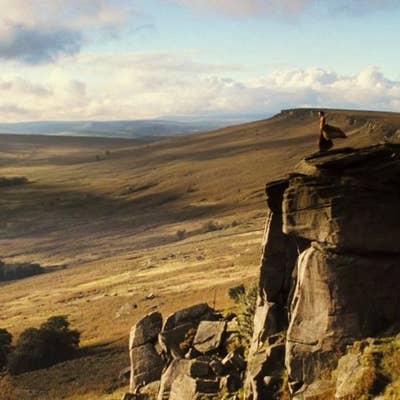
The film ends back at the beginning, with Beatrix sitting down to write. We are told that eight years after moving to the Lake District, Beatrix married William Heelis and she donated 4,000 acres of farmland to the British people through a land preservation trust.

Miss Potter is not a terribly dramatic movie, which makes it a good movie to put on when I don’t want to have to think too hard on something. The scenery is gorgeous and I love Millie Warne’s views on unmarried ladies. I want a home someday like Beatrix’s cottage; it’s so cute. I have always loved bunnies (though I am quite content to let the bunnies that live in our backyard be as close as I get to having a pet), so I’ve always liked Beatrix’s illustrations.

Up Next: Titanic

“Your Hands are Cold”

Pride and Prejudice

Again, this is the 2005 rendition of Jane Austen’s most famous work and is full of familiar faces. Keira Knightley (Pirates of the Caribbean) leads as Miss Elizabeth Bennett. Rosamund Pike (the femme fatale of Die Another Day) is her elder sister, Jane. Jena Malone (one of the contestants in The Hunger Games series) is one of the younger sisters, Lydia. Donald Sutherland (who also appears in The Hunger Games and the original MASH movie amongst his illustrious career) is their father, Mr. Bennett. Opposite Keira is Matthew Macfadyen (Athos in 2011’s The Three Musketeers, star of BBC’s Ripper Street [which I have only caught commercials of during Sherlock and The Musketeers, don’t really have a desire to watch], The Sheriff of Nottingham in Robin Hood with Russell Crowe, and also starred opposite Keira Knightley in Anna Karenina in 2012 [my mother and I sat through that movie, neither of us ever having read the book and were thoroughly confused. That is the movie that led us to creating our twenty-minute rule with any movie; if we are not interested in the movie within the first twenty minutes, we shut if off; because that was three hours of our lives we will never get back]) as Mr. Darcy.

Kelly Reilly (Mary Morstan in Robert Downey Jr’s Sherlock Holmes movies) is Caroline Bingley.  Darcy’s younger sister, Georgiana is played by Tamzin Merchant (she was the young Catherine Howard fated to be beheaded as Henry VIII’s fifth wife in The Tudors series, and even shows up in our next film, Jane Eyre).  The Bennett’s cousin, Mr. Collins is played by Tom Hollander (he showed up in two of the Pirates of the Caribbean movies as Cutler Beckett).  The formidable Lady Catherine de Bourgh is played by the as formidable Dame Judi Dench (M in several of the more recent James Bond films).  And another relative of the Bennett’s, Mrs. Gardiner, is played by Penelope Wilton (Harriet Jones in Doctor Who and Isobel Crawley in Downton Abbey).

The story opens with Mrs. Bennett informing her husband, and her daughters overhearing, that Netherfield Park, a grand estate, has been let at last to a very wealthy young aristocrat. He must see that one of their daughters should marry this Mr. Bingley, but first, Mr. Bennett must visit Mr. Bingley so the women may then visit. Mr. Bennett has already visited Mr. Bingley. There is a ball, where the Bennetts are enjoying themselves when Mr. Bingley arrives, with his sister Caroline, and dear friend, Mr. Darcy. Mr. Bingley is immediately taken by Jane. Elizabeth seems a little interested in Mr. Darcy; her sister has just warned her “one of these days Lizzie, someone will catch your eye, and then you’ll have to watch your tongue,” but Elizabeth then overhears Mr. Bingley and Mr. Darcy speaking and Darcy comments that Jane is the only pretty girl in the assembly, Elizabeth is passing enough. She lets on she overheard him when they speak later. Elizabeth also has to put up with her mother speaking rather crassly.

The next day, a letter arrives for Jane, from Caroline, inviting her over. Mrs. Bennett, hoping it was from Mr. Bingley, insists Jane ride instead of taking the carriage to Netherfield. It begins to rain and Jane falls ill. Elizabeth walks over herself to check on her sister. Mr. Bingley already seems taken by Jane. Caroline attempts to make friends with Elizabeth and is quite comfortable around Mr. Darcy. They discuss women’s accomplishments and Darcy reveals that one of his faults is “my good opinion, once lost, is lost forever,” but Elizabeth cannot fault him for that. Then her mother and younger sisters traipse in for a visit and all return home. Mrs. Bennett is quick to point out the expensive furnishings and young Lydia insists the Bingley’s hold a ball. Mr. Bingley helps Jane into the carriage and Darcy helps Elizabeth, though he quickly walks away after.

Mr. Collins, the cousin who will inherit, visits. He is a preacher and his rectory lies near the estate of Lady Catherine de Bourgh, who acts as his patroness. He reveals to Mrs. Bennett he intends to marry one of her daughters. She informs him that Jane is expected to be engaged soon, so he settles for Elizabeth. Though it looks like Mary wouldn’t mind marrying Mr. Collins. Meanwhile, the young ladies meet the officers of the regiment that is lodging in town, a Mr. Wickham in particular. Elizabeth is charmed by the young officer, but it quickly becomes known that he and Mr. Darcy have a past. Wickham tells Elizabeth that Darcy’s father loved Wickham better and Darcy never got past that and threw him out.

The Bingleys do hold a ball at Netherfield. Elizabeth hopes to see Wickham, but gets stuck with Mr. Collins who stares at her and bluntly states he intends to remain close to her for the evening. Mr. Darcy surprises Elizabeth and asks her for a dance. She is trying to overcome the different accounts of Darcy she has heard in order to make out his character. He hopes he can provide more clarity in the future. There is an interesting part of the dance when the other dancers seem to disappear and it is just Darcy and Elizabeth together. Mr. Collins, who just interrupts Mr. Darcy, reveals that Darcy is Lady Catherine’s nephew (see the similarities with Becoming Jane? A nephew to a powerful patroness). We also witness the rest of Elizabeth’s family in a competition to make fools of themselves; Mary would rather play piano than socialize, Mrs. Bennett speaks loudly that she is sure Jane will be engaged shortly, Kitty and Lydia are rather too social, and Elizabeth’s friend, Charlotte Lucas remarks that Jane needs to pluck Mr. Bingley up; being too shy will not let him know she is interested.

Mr. Collins asks for an audience with Elizabeth the following morning. She mouths to her father to stay, but they all abandon her. Mr. Collins proposes. Elizabeth heartily declines and firmly tells the man that she will not make him happy and she is certain he will not make her happy. This puts Mrs. Bennett in a kerfuffle, she enlists her husband’s help in making Elizabeth change her mind and accept, in order to keep the house, or else she will never speak to her daughter again. Mr. Bennett tells Elizabeth that she will have to be a stranger to one of her parents then, for he will not see her if she does marry Mr. Collins. Turns out, Charlotte Lucas accepts Mr. Collins, figuring she will get no other proposal (after Collins has already insinuated to Elizabeth that she will receive no better offer). Sadly, the Bingleys have left as well.

It seems some time has passed; Jane visits their aunt and uncle and Elizabeth accepts a visit to Charlotte. There, she meets and dines with the great Lady Catherine. Darcy is there, as well as a Colonel Fitzwilliam. Elizabeth is seated next to Mr. Darcy, and then Lady Catherine quizzes her on her accomplishments. After dinner, she is ordered to play the piano (she does so poorly, as she told the lady.) Darcy visits Elizabeth briefly, and awkwardly the next day. But Fitzwilliam informs Elizabeth that it was Darcy who split Mr. Bingley from Jane, due to objections to the family. Darcy finds Elizabeth in the rain and proposes, well, not the best proposal. Not wise to start it with saying you love someone against your better judgment. Elizabeth questions him on Jane and Bingley and informs Darcy that Jane is shy; she doesn’t even always reveal her heart to her sister, let alone a man. Darcy throws back that the rest of Elizabeth and Jane’s family are fools, but the two eldest daughters are excluded. Elizabeth also questions him about Wickham. They part angry, but Darcy leaves a letter. He (somewhat) apologizes for separating Bingely and Jane and tells Elizabeth what really happened with Wickham; he essentially gambled his inheritance away and when Darcy refused to give him more money, seemed to fall in love with Darcy’s very eligible younger sister and planned to elope. Darcy informed him he wouldn’t receive a penny of the dowry and so Wickham left, and Darcy’s sister was broken hearted. Elizabeth returns home very confused.

Lydia is invited to go to Brighton with family friends and Elizabeth’s aunt and unclepeak district invite her to accompany them to the Peak District (which seems absolutely stunning). Elizabeth attempts to persuade her father to not let Lydia go or else she will become the most determined flirt. Mr. Bennett simply wants peace and feels that Lydia is too poor and insignificant to get into too much trouble. Elizabeth and her relatives break down near Pemberly (where Mr. Darcy lives) and decide to visit. Elizabeth wanders and discovers Georgiana playing, and Mr. Darcy. She flees, but Darcy follows. He then calls at their lodgings and invites them over the following day. Georgiana is a cheerful young lady and is determined to be friends with Elizabeth; it is clear Darcy dearly loves his sister. Their lovely day ends in despair when news arrives that Lydia has run off with Mr. Wickham. Darcy feels it is his fault for not outing Wickham sooner; Elizabeth feels at fault for not sharing her knowledge with her family. The men of the family set out after Lydia. News returns home that Wickham will marry Lydia for a pittance.
She flounces in as a happy bride, showing off her ring to her family. Lydia inadvertently reveals to Elizabeth that it was Mr. Darcy who discovered her and Wickham and paid for everything; “he’s not half as high and mighty as you,” she remarks to her elder sister. Shortly after, Darcy and Bingley return to the Bennetts. After their brief visit, Elizabeth is on the verge of telling Jane she may like Darcy. We see Bingley rehearse, then he bursts back in and requests and audience with Jane: “first, I must tell you I have been the most unmitigated, incomprehensive ass…” Jane accepts his proposal: “yes, a thousand times yes” (which is what I imagine the most romantic proposals end with). Jane wants her sister to be as happy as her, but Elizabeth cannot bring herself to tell Jane of what almost was with Mr. Darcy. Their night is interrupted by a visit from Lady Catherine de Bourgh, who speaks to Elizabeth, demanding she does not accept any proposal from her nephew, Mr. Darcy. He is intended to marry her daughter, a match planned since infancy. Elizabeth then orders Lady Catherine out and runs from her family, refusing to speak on the matter.

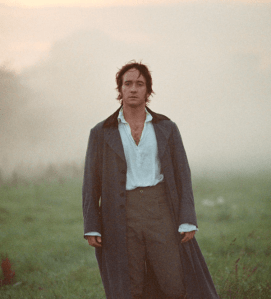
darcy mistShe takes another early morning walk and meets Mr. Darcy in the mist (an utterly breathtaking scene). She attempts to make amends, for judging him so harshly. Darcy tells her, she must know, it was all for her. His affections have not changed; she has bewitched him body and soul [another line I desire in my own proposal]…”I love, I love, I love you and never wished to be parted” (and this is why we love Jane Austen). Elizabeth gently kisses his hands and their foreheads meet as the sun rises. They return to the Bennett household to get permission from Mr. Bennett. He is confused; they all thought she didn’t like him. Elizabeth tells her father she was utterly wrong about him; they are so similar, and so stubborn. In short, she loves him. She also explains how Mr. Darcy has already helped their family, but he would not want Mr. Bennett to respond.

I adore the ending of this film, even though it is not how the book ended. Elizabeth and Mr. Darcy are enjoying an evening together and discuss what endearments Mr. Darcy may use. he inquires when he may call her Mrs. Darcy, when he is cross? No, “only when you are completely, perfectly, and incandescently happy.” He proceeds to kiss her, murmuring “Mrs. Darcy,” he time, until their mouths meet. …sigh, swoon!

In truth, I believe I fell asleep the first time I watched the movie; it is one that needs time and a few watching’s to grow fond of. Mr. Darcy improves with each viewing. I did manage to read the novel after watching the film in college. A quick skimming of the ending enforces why I prefer it in film format; it is much easier to digest, dispensing of some of the flowery language. But as Becoming Jane comments, both sisters ended up with good matches and lived happily. The visual artistry of the film is gorgeous. I do like the soundtrack to this film, much better than the last batch of movies; I actually own it. It is mainly piano pieces, which are played by various characters throughout the film. And the dance tracks are lively pieces.

Up Next: The Gothic romance Jane Eyre


jane austen dressAn added treat: this is me in a Jane Austen inspired gown that I wore for Halloween one year at college; made by my talented mother (I did not inherit that talent).  I still have the dress.
 

“Nobody Hurts My Horse”

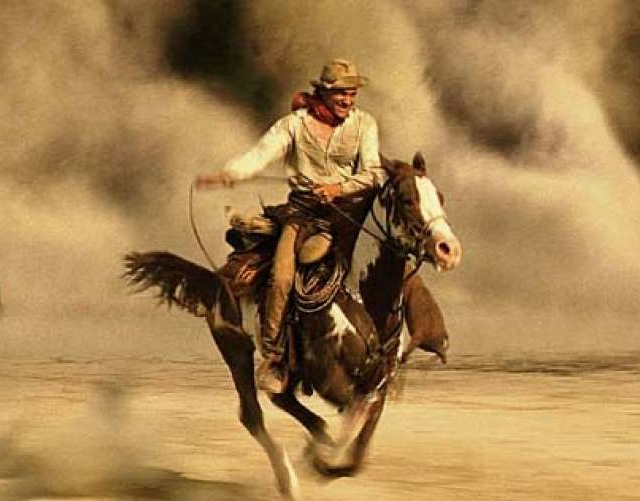
Hidalgo

I know I said Master and Commander was next after the end of Sherlock, but sadly, I cannot find my copy. So I moved on to what turns out to be the last of what I’m calling the “historical” movies. Hidalgo stars Viggo Mortensen, fresh from his big role as Aragorn in Lord of the Rings. Which is why I watched the movie, to be honest. Viggo impressed me in Middle Earth and this story had the added bonus of being about a horse. As many other girls, I went through a phase where I was really into horses. I read book series about riders; I wanted to ride a horse, and in the wake of Lord of the Rings, bonus features showed that Viggo had a connection to his horse on set…we can see what got me to go to the theatre. Which is probably what marketing people were banking on.

The film, which claims to be based [loosely] on the life of Frank T. Hopkins, opens in late December of 1890. Frank and his mustang horse, Hidalgo, have just won another long distance race. But Frank also works as a dispatch rider for the American military. He is sent with orders to Wounded Knee Creek…we can already tell where this might end. Frank seems sympathetic to the Natives, but rides before the first shot is fired. Hidalgo hears the commotion and turns back. Short time jump to eight months later, during one of Buffalo Bill’s Wild West shows, and Frank is drunk during a reenactment of the event, skewed towards making the American military look good and portraying the Natives as wild and bloodthirsty.

Buffalo Bill and Frank have a visitor, from the Middle East. Their land is famed for its pure horse breeding practices and hold the title for greatest endurance horse racer, which Bill has bestowed upon Hopkins and Hidalgo. If Hopkins will not allow the title to be removed, they challenge him to a 3,000 mile race in the Arabian desert, referred to as the “Ocean of Fire.” Hopkins is prodded into accepting and embarks on a ship to get there. He meets a Major Davenport and is (much younger) wife, Lady Anne, who has a thoroughbred mare entered in the race.

Once at the race, Hopkins meets the Sheikh, who sadly only has a daughter left, Jazira, who is intended to marry the prince that is riding the prized Al-Hattal if he wins. The Sheikh also has an interest in the Wild West. They almost strike up a friendship, but it is also clear that no one expects Hopkins and Hidalgo to survive the race, much less win. Several people offer him chances to drop out, but Frank is a bit stubborn. Against a competitor paying to deprive him and his horse of water and a sandstorm, Frank and Hidalgo make it to the half way point. The Sheikh’s nephew (cough-evil-cough) pops in and lo and behold, a raid happens later that evening; an attempt to steal Al-Hattal, though they do get away with the breeding book and the daughter. The Sheikh asks Hopkins to get Jazira back (and he’ll forget the little incident of Jazira visiting his tent [she’s fascinated by the foreigner and wishes to help so she doesn’t have to marry the prince]). A bit of a shoot-out later, and Hopkins returns with Jazira.

hidalgo race

The race continues (and Lady Anne and the nephew are in league with each other; she wants her mare to win so she has breeding rights to Al-Hattal; they intend to kill Hidalgo). One of the other competitor’s falls into a pit…quicksand or tar, not entirely sure. Race rules dictate that no one helps him, but Frank ignores that command. Which helps later when Hidalgo and Frank fall into a spear pit. You may want to look away when Hidalgo gets hurt and Frank has to get him out. Frank’s new friend comes back to help, but sadly is killed moments later. Frank gets some satisfaction for putting the evil nephew in another spear pit, his parting words, “nobody hurts my horse.”

Then Frank almost gives up. Hidalgo is badly hurt. They are far from anything familiar; they’re in a hostile land where people want to kill them. Then he hears a Native chant. He remembers his past, his mother (a Sioux woman; his father had been a cavalry man who had fallen in love with her). Frank joins the chant and gains strength from another people who held the horse sacred, just like the Bedouin. The last two competitors pass him. Frank gets back on Hidalgo, who has stood up from collapsing and it’s a race to the finish. At first, Lady Anne’s horse is in the lead, followed by Al-Hattal, then Hidalgo. Then Al-Hattal takes the lead. Hidalgo passes Lady Anne’s horse and makes a move on Al-Hattal. Our heroes win the race!

Frank returns to America just as the American military is rounding up all the Native’s mustangs, with the intention of shooting them. The Native chief from earlier in the movie who had motivated Frank has sadly passed, but had mentioned the plight to Frank and Buffalo Bill. Frank has one more dispatch; the price for the mustangs has been paid in full [the large prize money]. The mustangs are set free, and Frank lets Hidalgo go. The film finishes by stating that Frank Hopkins was “an outspoken activist for the wild mustang until his death in 1951 at 86 years old.”

I still enjoy the movie. It is very roughly based on some true events, but it is ultimately a story that we want to have happened. We love when an underdog triumphs; we want Hidalgo to beat all those pure bred horses and prove everyone wrong. Viggo was amazing. He learned Elvish for Lord of the Rings and he has a similar quality when speaking the Sioux language.

Next Time: Time to start some romantic movies. First, a few with a more historical base, starting with Shakespeare in Love.

Before the Jubilee

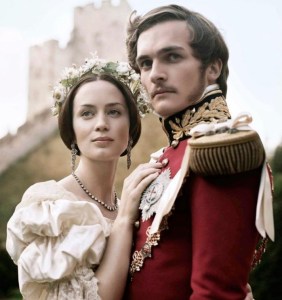
Young Victoria

This was the movie that got me interested in Queen Victoria, one of the most famous British monarchs. We tend to remember her as the widow who dressed in black and was supposedly “not amused.” This film shows the start of her reign and the start of her marriage to Prince Albert Saxe-Coburg-Gotha. Their story is told more fully in the British serial Victoria and Albert, which features Victoria Hamilton as the queen. Hamilton has recently played the Queen Mother in Netflix’s The Crown. Masterpiece has also begun a series on Victoria, starring Jenna Coleman (and others who are very recognizable from BBC, including our old friend Rufus Sewell as Melbourne). Victoria’s reign brought the monarchy to be viewed with respect and an essential British institution, “the queen had become a proud symbol of the stability and power of Britain…the greatest empire known to history (Royal Britain, pg. 213).”

This film also boasts an all-star cast. Emily Blunt (Devil Wears Prada) is Victoria, Paul Bettany (Chaucer in Knight’s Tale and Vision in the MCU) is Lord Melbourne. Miranda Richardson (Rita Skeeter in Harry Potter, Madame Giry in the film Phantom of the Opera, Queen Rosalind in The Prince and Me, and Queen Mab from the mini-series Merlin which starred Sam Neill) is Victoria’s mother, the Duchess of Kent. Another Harry Potter cast member, Jim Broadbent (Professor Slughorn, also Professor Kirke in The Lion, The Witch, and the Wardrobe, Harold Zidler in Moulin Rouge, and he pops up in Game of Thrones) is King William. And baddie Sir Jon Conroy is played by Mark Strong (Russell Crowe’s Robin Hood, Robert Downey Jr’s Sherlock Holmes). And fun fact that I did not realize until now, the screenplay was written by Julian Fellowes, the same man who wrote Downton Abbey.

The film’s opening sets the stage: “In 1819, a child is born in a London palace. Caught between two Royal Uncles – the King of England and the King of the Belgians, she is destined to be a Queen and to rule a great empire. Unless she is forced to relinquish her powers and sign a ‘regency order.’ A Regents is appointed to govern in place of a monarch who is absent, disabled…or too young.” Victoria herself feels she was born more fortunate than others, but a palace can still be a prison. She lived a solitary childhood; slept in the same bedroom as her mother, could not go down the stairs alone, having to hold the hand of an adult. Her time was severely censored. Her mother’s advisor, John Conroy, hoped that there would be a regency enacted when her uncle died, allowing Victoria’s mother to rule, and thus John to rule her. Victoria knew what sort of man he was and prayed for the strength to meet her destiny.

We briefly glimpse the coronation in 1838, then jump back a year. Conroy is attempting to force an ill Victoria to sign the regency document, but she still refuses. Meanwhile, her uncle in Belgium hopes for English aid to keep him on the throne, so he and his advisor come up with the plan for his nephews Ernst and Albert to visit Victoria. Albert is tutored on what Victoria likes and dislikes, clearly setting the stage to entice Victoria to marry him. Albert’s not terribly keen on the notion, but attempts it nonetheless. When he finally mentions one of his own likes, Victoria gives him a smile. She confesses to him that she feels like a chess piece. Albert understands what it is like living inside your head, never showing your true emotion to the outside world.
Victoria’s mother and John Conroy have kept Victoria from court; the king is not fond of either adult, but loves Victoria. Victoria insists on attending the king’s birthday and meets Lord Melbourne who starts winning her over. The king declares his dying wish is to live long enough for Victoria to turn eighteen, so there can be no regency. John still insists and goes as far as to lay hands on Victoria (in actuality, he wasn’t quite that stupid).

Victoria does indeed turn eighteen before the king dies and she becomes the new queen. Her first order of business, separate her from her mother. She will sleep in her own room from now on. Victoria admits that she is young, but she is willing to learn and intends to devote her life to serving her people. Albert had to return home, but they continue to write letters to each other. Victoria informs him she is the first monarch to live in the recently completed Buckingham Palace (the current monarchy still lives there primarily).

young victoriaShe also glows about Melbourne. Albert decides to return to England to spend time with Victoria (by now, he has fallen in love with her. She has admitted to Melbourne she has made no promise to Albert, but she still feels alone). Albert counsels Victoria to play the chess game better than the others, and that others will expect Victoria to fail and taken advantage of her inexperience. He believes in her. And truly cares about the working people. Melbourne doesn’t want to upset the status quo, though he does tell Conroy “you have played the game and lost.” We witness the coronation again, in the context of what we have just learned. Victoria wants to rule on her own for a while and thus, even though she danced with Albert at the coronation ball, he must return home again. They continue to write letters and Albert worries for Victoria.
Melbourne loses power and Peel becomes Prime Minister, but Victoria does not like Peel and Melbourne ends up back on the job, but that bypasses what the people want and creates a constitutional crisis. Rioters turn up at Buckingham. There is an assassination attempt. Albert continues to write to Victoria that he believes she can rule her country. Victoria decides to invite Albert back, and proposes. We catch a glimpse of their wedding (yes, Victoria was the one who made famous wearing white at your wedding).

Sadly, Victoria being queen means they cannot go on an extended honeymoon like most upper class people. (Albert makes a comment about visiting Scotland, that it would most be like Germany. It is true that they enjoyed visiting Scotland and bought Balmoral Castle, making it a royal residence that the current queen still enjoys visiting.) Then comes the difficulty of Albert fitting in to England and finding a way to support his wife while she is queen, but also still able to act like a husband, though they do end up expecting a child. Victoria disliked Albert getting involved with politics and they have an argument. The next day, they go on a carriage ride and there is another assassination attempt. In the film, Albert is injured, real life, no. But Victoria does put their desks next to each other. Afterwards, history would prove that “he played an increasingly central role in affairs of state and meeting with ministers (Royal Britain, pg. 220).”

The film summarizes that Victoria and Albert had nine children. “Among their descendants are the Royal Families of Britain, Spain, Sweden, Norway, Yugoslavia, Russia, Greece, Romania, and Germany [this is how World War I was an overgrown family squabble].” They reigned together for twenty years until Prince Albert died in 1861 from typhoid fever at the age of 42. “In memory of her husband, Victoria had his clothes laid out every day until her death at the age of 81. Among their accomplishments, Victoria and Albert championed reforms in education, welfare, and industry. Their unflagging support of the arts and sciences was most famously celebrated in Prince Albert’s Great Exhibition of 1851.” The last statement the movie makes is that Victoria remains the longest reigning British Sovereign. To date. This film was made in 2008. It is no longer true. Her descendent, Queen Elizabeth II became the longest ruling British Sovereign in 2015 (Victoria reigned 63 years, her great-great-granddaughter has now reigned 65 years. Personally, I think it’s awesome that the two longest reigning British monarchs are women).

Historically, “Victoria and Albert’s marriage, stable life and large family did much to restore the dignity and standing of the monarchy after the excesses and public disgraces of the early Hanoverian kings (Royal Britain, pg. 220).” The film does show and more so in the longer serial and television series, it was not smooth sailing. They had difficulty with their eldest son, Edward, the Prince of Wales. When Albert died, Victoria did indeed go into black and withdrew from society for at least ten years. What I liked about this film is that is shows that Victoria and Albert truly loved each other. I liked the way they tried to support each other. As I stated earlier, it showed a different side to a monarch I knew was important, but haven’t studied in depth.

Up Next: A popular Victorian literary hero, Sherlock Holmes (Guy Ritchie’s film starring Robert Downey Jr.)

“Well Fiddle-dee-dee”

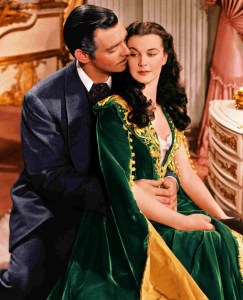
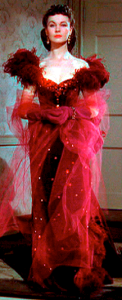
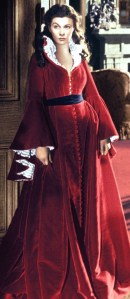
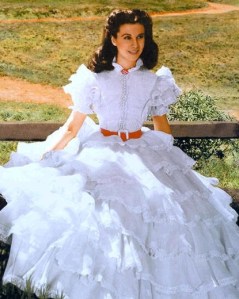
Gone with the Wind

Based on the 1935 novel by Margaret Mitchell (no, I have not read it, though I know it is over 1,000 pages long [and those pages are thin; to put that in perspective, Outlander is 850 pages and Game of Thrones is about 800]), it takes place in Georgia during the Civil War. Adjusted for inflation, it is the highest-grossing movie of all time and won an Academy Award for Best Picture. AFI ranked it as the sixth greatest movie of all time; and it is one of my mother’s favorite films. I remember a friend of hers from when I was young who participated in Civil War re-enacting and wore gorgeous Southern belle gowns, quite possibly another influence in my interest in history (there also exists pictures of my brother and I as youngsters for Halloween dressed as a Confederate officer and a Southern belle [that dress lasted several years, we kept letting the pleats down]). We’d see her every year at local Victorian days celebrations…and it’s only years later that I have made the connection on why Civil War re-enactors were at a Victorian celebration…because they take place during the same time period. Though it’s understandable to miss the connection, the Victorian era spans sixty years and is also primarily thought in regards to European history, not American history.

Its cast is well known. Clark Gable is Rhett Butler. Olivia de Havilland (who we saw in The Adventures of Robin Hood alongside Errol Flynn [who was considered for the role of Rhett Butler]) is sweet Melanie Hamilton. Vivien Leigh became a star as Scarlett O’Hara, and won the Oscar for Best Actress. Of special note is Hattie McDaniel, who played Mammy; she was the first African American to be nominated and win an Oscar, she won Best Supporting Actress, beating out co-star Olivia de Havilland.

“There was a land of Cavaliers and Cotton-Fields called the Old South…there in the pretty world Gallantry took its last bow…Here was the last ever to be seen of Knights and their Ladies Fair, of Master and of Slave…Look for it only in books, for it is no more than a dream remembered. A civilization gone with the wind,” the opening of the film explains. It is a very romantic view of the South. The plantation Tara is just as famous as its inhabitants. Scarlett is seated with her beaux, dismissing their talk of impending war. She’s upset to learn that the lad she fancies, Ashley Wilkes, of the neighboring Twelve Oaks plantation is due to announce his engagement to Melanie Hamilton. She schemes to try to win him, but he is in love with Melanie. Scarlett does not see that she is not a good match for Ashley, and she could have the pick of any man that hangs off of her. She quickly engages herself to Melanie’s brother, Charles, even though he is promised to another woman. Melanie is sweet and truly loves Ashley and wants to be friends with Scarlett. Scarlett also meets Rhett Butler at the Wilkes’ barbecue, a visitor from Charleston who already has a reputation. Talk continues of the war, which is declared and the young men whoop and holler and cheer and ride out to volunteer. The young one feels that the war will be quick, decisive, and they’ll whoop the Yankees. Ashley and Rhett have a little more of an idea on how things will turn out.

Scarlett’s husband dies soon into the war and she must go into mourning. But it’s not very fun. So her mother suggests she join Melanie in Atlanta; she may even get to see Ashley when he is home on leave. Scarlett runs into Rhett again in Atlanta; he’s making a name for himself as a blockade runner. Rhett is attracted to Scarlett; he recognizes another like-minded person; as he remarked to Scarlett back at Twelve Oaks, he is no gentleman and she is no lady. In a way, he wants to tame her. He declares he will not kiss her, but she should be kissed, often, and by someone who knows what they’re doing (i.e. him).

Then comes Gettysburg. And the South begins losing. Rhett remarks to Scarlett one day it is a result of the South living in the past. Luckily, Ashley comes home for Christmas. When he leaves, Melanie is not feeling well, so he has Scarlett promise to take care of her. Scarlett is still hoping to win Ashley from Melanie, but promises, as a sign of her devotion to Ashley. The ladies begin work as nurses, then Sherman’s attack comes to Atlanta. He bombards the city first, then the South burns their ammunitions before he can reach the city. Turns out, Melanie is pregnant. And they can’t get her out of the city because she’s in labor. (This is where the famous line “I don’t know nothin’ but birthin’ babies” comes, after the girl made a fuss about knowing everything). Scarlett helps deliver the baby and sends the black girl to fetch Rhett Butler (from a brothel) to help them out. They manage to escape just before the ammunition blows. [Fun fact: the burning scenes were the first shot and they burned old set pieces to make room on the lot.]

Rhett leaves Scarlett, Melanie, the baby boy, and the slave girl on the road to Tara, declaring he’ll join the army to make a last stand. The women press forward and find Twelve Oaks abandoned and destroyed. They carry on to Tara to luckily find it still standing (the Yankees had used it as a headquarters). And there are even a few people home; Mammy, and Scarlett’s father, her two sisters who are overcoming an illness. Sadly, her mother had just passed away; and Scarlett had wanted to leave Atlanta to return home to her mother. Her father is confused in his grief, so Scarlett takes over running the plantation. The first act ends with Scarlett vowing to never go hungry again.

This movie does has an intermission (and an overture and entr’acte. I kind of wish long movies now came with an intermission; better for bathroom breaks in theatres). We come back with the movie briefly summarizing Sherman’s march to the sea (yes, that actually happened. No, Sherman is not well remembered in the South) and the arrival of carpetbaggers (Northerners who moved to the South during the Reconstruction to take advantage of the building economy). Times were hard in the South, and at Tara. They start to take care of returning Confederates and Ashley returns. Melanie and Scarlett are thrilled. Then comes the news that a Northerner has jacked the taxes on Tara sky high. Scarlett is desperate to come up with the money to save her beloved home, though she throws the old foreman out (there’s bad blood there going back before the war, he got “white trash” [I’m assuming a prostitute] pregnant, finally has married her after all these years, but Mrs. O’Hara caught a sickness from the woman and that caused her death…so no, Scarlett is not going to listen kindly to this man). Her father tries to chase after him and falls jumping a horse, causing his own death.

Scarlett goes to Ashley for help, even asking him to take her away from Tara. But he thinks highly of her and won’t let her feel so defeated (he’s not helping her fall out of love with him…heck, they even kiss). Desperate, she thinks of Rhett Butler. She makes new gown out of old curtain [this later becomes a bit in a parody of the movie on the Carol Burnett Show; heck, Scarlett’s whole wardrobe is as legendary as the movie, everyone has a favorite dress]. She flounces in to visit Rhett and almost has him believing she’ll marry him out of love, but he figures out her angle. He can’t help, his money is all tied up overseas and he’s being held prisoner by the Yanks. That’s when Scarlett stumbles upon a new idea; her sister’s fiancé has managed to start earning money and Scarlett ends up marrying him herself so she can get the tax money for Tara. She even manages to talk Ashley out of moving to New York, gaining sympathy from Melanie, who still tries to explain her actions to everyone else. That woman is really the most kind-hearted person. Scarlett starts a lumber business so she’ll never have to worry about money again.


Trouble comes about again, endangering Scarlett, her new husband, Ashley, even Melanie and Rhett. Rhett helps save the day, but Scarlett’s husband is dead. She starts drinking after that and Rhett visits. He proposes, fully knowing what kind of woman Scarlett is. He’s thrilled to be able to shower her with presents and treat her properly. He agrees bring Tara back to grandeur and build a grand house in Atlanta as well. But Scarlett, in her desperate climb to the top, has not gotten a good name in high society. This comes along when she give birth to a baby girl, that Rhett is all too eager to spoil. Her proper name is Eugenia Victoria, but they call her “Bonnie Blue” for her blue eyes. Still vain, Scarlett wishes to regain her eighteen-and-a-half-inch waist line from her youth; Mammy points out that will never happen. So, Scarlett simply won’t become pregnant again. Rhett’s not terribly pleased, especially when she carries on about Ashley and has kept a picture of him all this time. But Rhett will give their daughter a place in higher society, and goes out of his way to be sweet to all the right people.

Ashley doesn’t help matters when he continues to meet with Scarlett, call her dear, wish for her happiness, and give her hugs. They’re caught by friends of Melanie. Scarlett tries to stay home from a party, but Rhett insists she show her face. And Melanie carries on as nothing is the matter. At home that evening, Rhett reveals that he knows Scarlett still drinks. He carries her to bed. Afterwards, Rhett suggests a divorce from Scarlett, though he’ll keep Bonnie. Scarlett refuses, insisting that her daughter will not leave her house. Rhett goes on an extended trip to London and indeed takes Bonnie with him. He butts head with the nanny when Bonnie wakes from a nightmare and Rhett tells the nanny off for leaving Bonnie. The nanny points out that Bonnie will always be afraid if she’s coddled. Rhett dismisses her. Bonnie asks after her mother, so Rhett returns home. Bonnie is thrilled to see her mother. Rhett intends to leave right away for London again, but Scarlett reveals she’s pregnant. They start arguing at the top of the stairs, Rhett jokes that maybe Scarlett will have an accident. She goes to hit him, but he steps out of the way, causing her to in fact, fall down the steps. Scarlett loses the baby and Rhett is worried about her, but is kept from her.

Later, Scarlett is recovering outside and Rhett asks forgiveness. He wants to make another try at their marriage. The two are watching Bonnie ride her pony; the young girl insists she can jump side saddle. Both parents warn that she can’t. She does so anyways and falls off her pony. The fall kills her. Rhett is distraught. Mammy calls for Melanie to help Rhett. Melanie talks him around, but faints afterwards (this may be due to her being pregnant again, which everyone figured she couldn’t or rather shouldn’t, considering how the birth of her son went). Rhett and Scarlett are present as Melanie worsens. Melanie calls for Scarlett and asks her to look after her son, and Ashley. Scarlett throws herself at Ashley when she comes out of the room, which leads to Rhett quietly leaving. Scarlett finally realizes that Ashley truly loved Melanie more than Scarlett, which she promptly blames her behavior on Ashley, for never telling her. Which makes her realize that she loves Rhett and run home to him. Rhett is leaving. Scarlett begs for him to stay; “where shall I go, what shall I do?” “Frankly, my dear, I don’t give a damn” [AFI’s top movie quote of all time]. Scarlett falls to the stairs, sobbing. Then she remembers something her father told her, before the war. “Land is the only thing worth working for; worth fighting for; worth dying for. Because it’s the only thing that lasts.” There’s no getting away from love of the land if you’re Irish (Gerald O’Hara was born in Ireland). That’s what Scarlett will do; she’ll return home to Tara and think of some way to win Rhett back. But she’ll think on that tomorrow, “after all, tomorrow is another day.”

While this is one of my mother’s favorite films, it’s never been one of mine. I can’t rightly tell you why.  I watched long movies as a youngster; one of my favorites is Chitty Chitty Bang Bang.  This movie has gorgeous gowns and considering I went as a Southern belle for countless Halloweens, I should at least be interested in that.  The story does slow down a bit during Scarlett’s second husband…I actually forgot that part of the movie existed, but that’s not something I would have recognized as a youngster.

Nor am I sure that as a child I would have recognized that Scarlett is a vain, selfish character.  She gets better for a time.  I think she did come to care for Melanie, as much as she looked down on her at the beginning.  She wouldn’t leave Atlanta without her.  She made sure she recovered well.  I liked her character growth when she took over the running of Tara.  Then she dropped all of that when she married her sister’s beau.  And goes right back to being a priss once she marries Rhett.  He almost had a chance of curing her; he had the best chance of anyone.  I preferred his characterization once he married Scarlett and he was utterly thrilled when Bonnie was born; aside from wanting to spoil her rotten.  Ashley is a bit of a simpleton; he couldn’t have ended things a lot better with Scarlett if he had just laid it all out, firmly, when he announced his engagement.  I’m not sure I really understand why Scarlett wanted him in the first place; her main desire was she wanted to steal him from Melanie, but before the announcement was hinted, she was fine flirting with every other man.  Ashley let it carry on far too long.  But Melanie is the sweetest person I have ever witnessed.  She’s not dumb, just can’t see the worst in some people.  She sees good in Scarlett, which the young woman needs.

I loved lots of things my mom did, just not this.  Don’t know why.  Personally, I would not call this the best movie ever, but my heart has been won by other stories… Chronicles of NarniaLord of the RingsHow to Train Your Dragon, etc.  Nevertheless, it is well done.  Margaret Mitchell never wrote a sequel, in fact, this was the only novel she wrote.  Scarlett was written by Alexandra Ripley in 1991 (remember, the original book was written in 1935).   Rhett Butler’s People by Donald McCaig acts as a prequel and was written in 2007.

What are your thoughts on Gone With the Wind?

Up Next: Back across the pond for Young Victoria

Bayonets!

Gettysburg

As already covered in last week’s post: based on the book Killer Angels by Michael Shaara

Gettysburg sign
Sign to Gettysburg Park

and covers the most famous battle of the Civil War. My brother sat down and watched this movie when he came home from kindergarten one day. (Yes, my family is full of history buffs). I’ve also already mentioned that my parents took my brother and I on summer vacations to Gettysburg; it was a pleasure to return in high school and again during a college choir trip. I’m the dork that asks about the canons. I’m not entirely sure why my own high school class came to love parts of this movie, but they do bring back a fond memory or two. What I found helpful during our lessons on this were maps laid out of each day and major movements of each army. I still have that project…buried away somewhere. This is one way that the book is better than the movie; I still can’t keep everything straight. And I can’t rightly remember if our concert band played this theme or not for a concert; it is a stirring theme nevertheless.

A few casting changes: Martin Sheen portrays General Robert E. Lee, Stephen Lang now plays Major General George Pickett, Tom Berenger plays Lieutenant General James Longstreet, and Sam Elliott is Brigadier General John Buford. The film opens with pictures of the major players with the stars listed and transforms into pictures from the film, showing how close the hair and makeup department got with their work.

The two armies are circling around each other; Longstreet has a spy who scopes out the Union line, mainly since J.E.B. Stuart is nowhere to be found. Lee needs information and also begs his general to stop his habit of riding at the front of his men when they fight (Longstreet point out it’s hard to lead from the back; a popular criticism of that style of leadership in battle); this is a result of the death of Jackson; Lee cannot afford to lose Longstreet. It appears to be an accident that the armies found each other at Gettysburg, though the general consensus is, it’s good land, and it’s very hot and humid (which it is, especially in July). Buford is first to arrive at Seminary Ridge (yes, there is Seminary and Cemetery Ridge) and guesses what both Lee and Meade (new general of the Union forces) will do. Since he is there, he makes the decision to fight for the high ground. The Union retreats a bit on the first day and Longstreet wants to break away and make for Washington. Lee decides (stubbornly, in my opinion) to stay.

It is from “Buster” Kilrain we get the title of the book, remarking to Lawrence Chamberlain, “if men be angels, then they be killer angels.” He remarks that Chamberlain is an idealist; Kilrain is fighting to prove that he is better than the horrible men that do exist. On the other side of the battlefield, we meet more of the Confederate leaders, including Pickett and Freemantle, a British envoy to the South. He later remarks to Longstreet that Northern and Southern Americans have different dreams. Longstreet brings up England’s own civil war (yes, there was one, but fought differently. I believe it was mentioned in Gods and Generals that America is trying to mimic Europe’s bloody history). Longstreet also feels that the slaves should have been freed before the Confederacy ever fired on Fort Sumter. But, they’d rather lose the war than admit a mistake. And they like their leaders religious and a little mad.

A theme that echoes poignantly in this film and the books and was very true of the war; there were friends who fought each other on opposite sides. Longstreet knew Grant from the wars in Mexico. Another key friendship is between Confederate Armistead and Union Hancock, best friends from previous wars, now across the same battlefield. Hancock is not taken lightly by the Confederates; they know how well he fights and what he will do. Both men wish to visit each other, one last time, during a lull in the fighting. Longstreet even approves Armistead’s request, but they never have an opportunity.

Devil's Den
Devil’s Den, from my trip in 2009

Come the second day of battle, Confederate Hood is ordered to take the high ground around Devil’s Den, terribly rocky terrain. He tries his darndest, but ultimately fails. The 20th Maine becomes the flank of the Union army on Little Round Top and are ordered to hold the line. The Confederates move up the hill five or six times and Maine repels them, though they take hits and casualties. When they’re low on bullets, Chamberlain orders them to charge down with bayonets. This is the part that my class re-enacted when we visited Gettysburg. It is a rather amazing scene. At the end, the Confederates surrender and Maine has earned a little break.

Little Round Top
Little Round Top, also from 2009 trip

Stuart finally arrives and faces Lee. He tries to resign for the slight he has made to his own honor, but Lee won’t let him. He needs his best cavalry leader, but Stuart needs to do better in the future. In the morning, after Lee comments that they are a day away from Independence Day and they may well gain the South’s independence, he orders Longstreet to have Pickett’s men charge the center of the Union line, correctly figuring that the flanks will be reinforced. A big problem though, there is an artillery unit smack in the middle of the line, under the command of Hancock and the Union troops have managed to fortify the center; they are well entrenched and Longstreet realizes the danger Pickett’s men will be in. Lee feels it will work.

A slight deviation from historical facts has the 20th Maine moved to the center of the Union line, figuring it will be quiet. Lawrence Chamberlain and his younger brother Thomas (whom he always has to discipline to call him “sir,” not “Lawrence”) were there on that day, asking for supplies. They take cover when Longstreet’s artillery starts firing, hoping to break the line first, sadly after they find out that Kilrain has died from his injuries the previous day. Pickett’s men charge: realize, this is a mile of open terrain for the Confederates to cross, with no cover, right at canon fire. Pickett urges his men to victory for Virginia. What Longstreet feared (since this movie was made long after the actual battle, characters can have incredible insight) occurs. It’s a slaughter. Hancock is shot and refuses to be moved until the battle is decided. Armistead is shot leading his men to the line. Pickett, far back from the action, openly worries “what’s happening to my boys?” Thomas Chamberlain finds Armistead, who is desperate to see Hancock, only to find out that Hancock has been injured. He calls out for his friend: “not both of us!” At the end of the fighting, the Union soldiers chant “Fredericksburg!” in relation to the defeat they suffered under similar circumstances there.

Lee decides to fall back; tells his men to retreat and fight another day. He comes across Pickett, who stands in shocks and informs the general, “I have no division.” The film closes on the Chamberlain brothers hugging. Pictures play again, summarizing what happened to many of the main characters. Longstreet remained Lee’s most dependable solider. He died in 1904 at the age of 83. Stuart was mortally wounded at the Battle of Yellow Tavern and dies May 12, 1864. Pickett’s division was virtually destroyed. He survives the war to great glory, but broods on the loss to his dying day. Hancock survives his wound and runs in 1880 for president, only to lose to Garfield. The package that Armistead left with Longstreet to be delivered upon his death was his personal Bible for Myra Hancock, Winifred’s wife. Chamberlain received the Congressional Medal of Honor for his actions at Little Round Top. Lee served until the end of the war; he surrendered to Grant at Appomattox April 9, 1865. He died in 1870, “perhaps the most beloved general in American history.” (I completely agree with this).

Gettysburg is remembered as the turning point of the Civil War; it is the most North the Confederacy ever got. It is also the biggest and bloodiest battle on American soil; combined losses total over 53,000. And similar to Gods and Generals, Gettysburg was filmed on location at Gettysburg. A few scenes were filmed at a nearby farm, due to changes over the years. This is I think the only time Gettysburg allowed a movie to be filmed on location. They’re careful with re-enactors every year; the park is one of the best preserved in the country. It has set the bar for what I expect from battlefields, which is why I’ve been disappointed elsewhere.

I have traveled Virginia a little bit, but haven’t visited any of the other Civil War battlefields; it’s something I know my mother would like to do. We’d also like to visit Lee’s home in Arlington. Virginia is just chockfull of history and historical sites; it is the first colony (he he, we’ll cover that in 1776), thus a center of Colonial history and Civil War history.

As always, if you have any questions, let me know. If I can’t answer it, there’s a decent chance someone in my family can, ha ha.

Up Next: The epic, Gone with the Wind

They say war is horrible, but continue fighting anyway

Gods and Generals

One time period of American history that I know well is the Civil War, certainly influenced by the number of books my mother has on the subject and her own well developed interest in the topic. When I took a history course solely on the Civil War in college, and needed books for a project, I simply called her up and said I needed books on Robert E. Lee. That weekend, I was delivered about a dozen of the books she could readily find (we have more, somewhere). I also realize this topic has gotten more heated in recent years due to…we’ll say politics and recent events and I have no desire to tackle that. Thus, this run down may end a bit shorter than I originally envisioned.

Gods and Generals is the first book in a trilogy of historical novels about the Civil War. The first written was the middle book, Killer Angels, written by Michael Shaara; it focuses on the four days of the Battle of Gettysburg, eventually turned into the movie, Gettysburg. Gods and Generals was written about a decade later by his son, Jeff, as a prequel, dealing with the major battles of the beginning of the war and again, about a decade after the first film was made, the prequel was filmed. There is a third book, The Last Full Measure, which was originally supposed to have a film made of it as well, but the poor box office performance of Gods and Generals scrapped that idea. Jeff Shaara has also written numerous other novels dealing with other time periods of American history (and we have some of them scattered in the house). These are not movies to take viewing lightly; they’re four hours a piece (Endgame was only three).

During my sophomore year of high school, our curriculum focused a great deal on the American Civil War. We read Killer Angels in English class (and I got laughed at for reading in an Irish accent for an Irish character). We watched Gettysburg in history class and took a trip to the battlefield. I was already familiar with the place; my parents took my brother and I there a couple times for summer vacations. Pictures exist of the two of us climbing all over Devil’s Den. Our final project was a joint paper for English and History on the subject of the Civil War. (I chose Southern women on the home front). And me, being the little nerd that I am, after reading Killer Angels, I proceeded to read Gods and Generals and The Last Full Measure…well, I can’t recall if I actually finished Last Full Measure, or if I gave up. The first two books are excellent, the third one was weird.

A bit like another trilogy of novels written on the Civil War that was turned into a mini-series, North and South. (Written by John Jakes, who has written other novels on American history, and not to be confused with the British show of a series of books written by Elizabeth Gaskell, which Richard Armitage stars in…if you’re still confused, let me know, and I will endeavor to clear up the confusion). After finishing the Shaara books, I read North and South, Love and War, and Heaven and Hell. The third book in that series was really weird. The premise of this series features two young men, Orry Main of South Carolina, and George Hazard [no, not the Dukes…and yes, I’m a fan {the original, not the stupid remake with Jessica Simpson, I refuse to watch that}] of Pennsylvania. They become friends at West Point and then all hell breaks loose in the country. The mini-series stars Patrick Swayze (of Dirty Dancing and Ghost fame) as Orry Main and James Read (the father from Charmed) as George Hazard. Kristie Alley also shows up.

Back to this movie: Stephen Lang stars as General “Stonewall” Jackson (he was Major General George Pickett in Gettysburg, was a bit weird watching them in reverse order and sitting there, thinking, “Pickett looks familiar….oh.”) Robert Duvall is General Robert E. Lee, Jeff Daniels is Lieutenant Colonel Joshua Lawrence Chamberlain [I do not remember how military ranks fall, though if you have a question, I will find out], and Kevin Conway is Sergeant “Buster” Kilrain. The film opens in April of 1861; Robert Lee is offered the command of the continental army, to quell the rebellion of the southern states, by force, for challenge the central government. Lee refuses; his home is in Virginia, his loyalty is to Virginia, he has no greater duty than that to his home, Virginia. He views, as a lot of people at that time, Lincoln as invading the country of Virginia and the South. We’ll get this argument out of the way early: the Civil War was fought for states’ rights; the South’s argument was they were sovereign states that should be ruled by their state governments, not a federal government. They did not want influenced by politicians in the North. This argument actually goes back to the creation of the United States (we’ll cover it in the musical 1776). Yes, many of the leading politicians of the South wanted the ability to keep slavery; which is horrible and morally and ethically wrong and should have never been started to begin with. However, most southerners did not own slaves. And honestly, the North didn’t have a lot of room to talk; their ports participated in the slave trade (pops up in 1776) and many factory workers were treated worse than slaves. Factory workers were expendable; there’s always more in line waiting for a job. Smart plantation owners treated their workers decently in order to retain good workers. Again, not arguing that slavery is right; it’s not. But, the view that the South was doomed from the start, the “Lost Cause,” is northern propaganda due to winning the war. Winners write the history.

Carrying on: the film turns next to the Virginia Military Institute (VMI), where Jackson is teaching. Historically, not the best teacher. He even remarks that his method is to lecture. If the concept is not grasped, he repeats the lecture word-for-word the next day. As a college-educated individual, not the best method. Outside, the youngsters are rebelling against the northern call to arms and take down the American flag. Next, the delegates of Virginia have decided to officially secede from the United States (again, feeling that Lincoln and the North are invaders and wish to impose their will through coercion) and have appointed Robert E. Lee as general of the Army of Virginia, following in the steps of his grandfather, Lighthorse Henry Lee (a general for George Washington in the American Revolution) [also related to signer of the Declaration, Richard Henry Lee; we’ll see him in 1776]. We stop briefly in Fredericksburg to see a family sending its men off to war. We also see several instances where “Stonewall” Jackson is a devout Christian, believing that anything that happens is God’s plan, and openly praying for help in the coming war.

They cover the march to Manassas, in July of 1861, one of the first battles of the Civil War. It appears here that Jackson earns his nickname “Stonewall:” “there is Jackson standing like a stone wall,” amidst canon fire. This is still the European style of fighting, where each side lines up and fires at each other. They do advance towards one another at times and the goal always is to gain the high ground (better firing position). Some of Jackson’s VMI cadets are over eager and charge the Union lines before ordered, their commander is forced to follow, breaking Jackson’s plans. He insists to his First Brigade that discipline will win the day; indeed it does. He unfortunately finds those cadets after the battle, dead, but does not cry. Again, God’s plan will out.

We pop up to Maine, where Lawrence Chamberlain is teaching at Bowdoin College. He decides to join the war effort and meets up with his younger brother, Thomas at training with the 20th Maine volunteers. He also gains his right hand man, Kilrain at training. Kilrain (not a true historical character) points out there are friends from Ireland on the southern side; he feels they are trading one tyranny for another.

December of 1862 rolls around and the Confederate and Union forces are circling Fredericksburg. The family we met earlier is trying to get out. The slave maid finally persuades her owner to flee with her children; she’ll stay behind and keep looters out of the house (she dresses her and her own children up in fancy clothes and claim the house as hers). The Union finally takes over the town and they indeed come to the house. She lets them use it as a hospital and tells them she hopes the Union wins; but her family are good folks. And they do seem to treat her well; but slavery is still morally wrong. You want a maid, fine, you pay them and don’t consider them property.

Hancock wants to cross the river sooner rather than later, but Burnside is in command and decides to hold for the pontoons to arrive. Hancock mentions the “wily Grey Fox [meaning General Lee] has outmaneuvered us again.” Hancock’s plan would have put the Union in a much better position. This is why the Union went through so many generals; they had Washington breathing down their necks and every time they made a mistake, they were simply replaced. Many of the better trained generals fought for the Confederacy, due to where their homes lay. The Union meets the Confederates on the field of battle head on, under heavy artillery fire. There is a stirring scene where the Northern Irish Brigade (a real thing; I’ve got a book about them) faces off against the Southern Irish Regiment. The South is well protected for the most part behind a stone wall and the North keeps taking hits. We hear uilleann pipes over top the scene and when the South has beaten the North back and a few of the men are crying for having to shoot kinsmen, they shout “Haroo!” (this is where the saying comes from). Even the Fredericksburg family mentions the Irish Brigade; they had sent help during the famine and some of the ones they helped save may have just died on the field. But Hancock sends another brigade to try to take the ground.

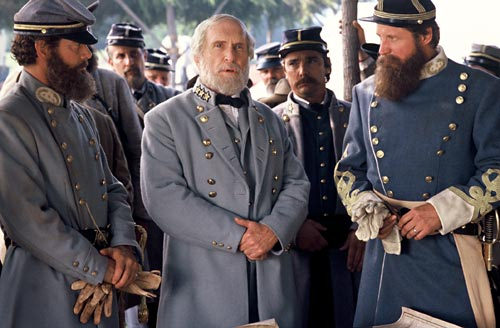
conf generals
Jackson is on the left and Lee is in the middle

Three days later, the Union finally retreats. Lee mentions “it is well that war is so terrible, for should we grow too fond of it.” At one point, the 20th Maine was forced to use dead soldiers as shields when they got stuck on the battlefield overnight. Lincoln sends word to the Union soldiers that though Fredericksburg was not a victory, neither was it an accident. And the casualties were not bad compared to what they could have been. Kilrain mutters, “compared to what? The Scots at Culloden? The English as Bunker Hill? The French at Waterloo?” Later, he listens as Chamberlain discusses he views on the war. Chamberlain cannot understand how a group of people can claim they are fighting for their freedom, when they hold another race in bondage.

Christmas of 1862 finds the Southern commanders at an estate not too far from Fredericksburg, hosted by the wealthy family. Jackson strikes up a darling relationship with the young daughter, practicing for when he finally sees his own daughter, born after the war started and whom he has not met yet. Billy Yank and Johnny Reb (slang nicknames for Union and Confederate soldiers, respectively; there is also a song entitled Johnny Reb by Johnny Horton, about the Confederate soldiers. Horton has done other historical songs, most notably The Battle of New Orleans.) meet in the middle of the river to trade coffee for a smoke; a modicum of peace. The Confederates are also entertained with a show from Texas.

A few months have passed and the southern army has not moved far. Jackson sadly gets word that the little girl he befriended has died of scarlet fever. At this time, he allows himself to mourn for all of those he has lost. But his wife and baby girl meet him shortly afterwards and his spirit is lifted. We have come to the Battle of the Wilderness in the beginning of May of 1863. Calvary leader, J.E.B. Stuart (whom my brother did his report on and dressed as a Confederate officer) informs Jackson and Lee that they have found the Union flank. Jackson wants a surprise attack and to keep pushing them. That night, he rides out beyond the Confederate line. When he tries to return, he is fired upon by his own men, who do not stop firing. He’s hit several times and ultimately loses his left arm. While he recovers, he develops pneumonia. The Union army has moved on and secured Chancellorsville. Lee feels while Jackson has lost his left arm, “I have lost my right.” Lee pleads to God to not take Jackson, for he still needs him. But Jackson does not recover. His funeral is held at VMI; he is buried in Lexington.

The film ends stating that Lee decides to take the fight to the North after the loss of Jackson. This directly leads to the Battle of Gettysburg. It is also noted that the movie was filmed on location in Maryland, Virginia, and West Virginia.  I also discovered some, not-so-cheerful trivia: it is well known that a lot of the extras for both Gods and Generals and Gettysburg were re-enactors.  Well, due to when this movie was filmed, they lost some of the extras when they got recalled to the military after Spetember 11th.  And Martin Sheen originally wanted to reprise his role as Robert E. Lee, but he was currently filming The West Wing; if his contract had been approved, he would have been on a flight to LA on September 11th.

I’ve never been a battle historian. I have taken a military history course, as an overview course; but I do not understand tactics. Upon re-watching this film, I find that I enjoyed the book much more; I was able to connect with the characters better (even with a four hour runtime, things always get cut when transforming a book to film). For me, this movie drags. It’s good that they decided to frame it mainly around “Stonewall” Jackson, and focus on only a few other main characters; though they still forgot a lot. But, if you like the Civil War, this is definitely a film to watch. I’d love to go visit Virginia and tour some of the battlefields and study more of that specific history.

Next Time: Gettysburg

“Through many dangers, toils, and snares”

Amazing Grace

As the opening of the film states, this is based on the true story of William Wilberforce, a man who changed history, ending the slave trade in Britain. Which, being American, we don’t tend to consider slavery elsewhere.

“By the late 18th century, over 11 million African men, women, and children had been taken from Africa to be used as slaves in the West Indies and the American colonies. Great Britain was the mightiest superpower on earth and its empire was built on the backs of claves. The slave trade was considered acceptable by all by a few. Of these, even fewer were brave to enough to speak against it.”

The film features Ioan Gruffudd (he appeared as a minor character in James Cameron’s Titanic, was the titular Horatio Hornblower in the miniseries, Lancelot in the 2004 King Arthur movie, and Reed Richards in the first two Fantastic Four movies) as William Wilberforce, Benedict Cumberbatch, before he landed his hit roles, as William Pitt, Michael Gambon (Dumbledore after Richard Harris passed away) is Lord Charles Fox, Rufus Sewell (Tristan and Isolde and Knight’s Tale) is Thomas Clarkson, Ciarán Hinds (Mance Rayder in Game of Thrones) is Lord Tarleton, and Toby Jones (Dr. Zola in the MCU, the voice of Dobby in Harry Potter, the Dream Lord in an episode of the Eleventh Doctor’s run in Doctor Who, he also appeared in Ever After) is the Duke of Clarence.

The movie jumps back and forth between “present time” while William is trying to rest and heal from colitis, and recounting how he’s gotten to where he is. William’s cousins take him to Bath to take the mineral water; and set him up on a date with Barbara Spooner. She’s intrigued to meet him; she supports his abolitionist work, but he doesn’t want to talk about it. He begins his tale fifteen year prior where he is playing cards at a club after a day in the Parliament. His opponent, the Duke of Clarence tries to offer his slave as payment during a game. Wilberforce [of Wilber as he is referred to during the movie, to avoid confusion with William Pitt] refuses. Wilber and Pitt discuss how, as young politicians they want to change the world. Wilber is reminded of a song his old preacher wrote, a former slave captain, he found God and wrote Amazing Grace. Wilber enters the room again, Pitt silences the men, and Wilber sings [behind the scenes note: that was Ioan actually singing (I am not surprised, he is Welsh, and Wales is filled with wonderful singers)].

Wilber debates at that time whether he should enter the political field, or devote his life to God. Pitt wants him by his side when he plans to become Prime Minister; the youngest in history. “We’re too young to realize certain things are impossible,” and we do them anyway. Pitt arranges for Wilber to meet other abolitionists and Equiano. Wilber even visits his old preacher for advice. The preacher supports Wilber entering politics (as someone at the dinner suggested, Wilber should do both). He has work to do, taken on the other members of Parliament. We jump back to Wilber fighting his illness. He takes opium to counter the symptoms. Barbara returns for a meal and they are sent outside to talk. Wilber feels like he failed his task. Every year, he presented a bill, and every year it failed.

wilberforceHe continues to speak of the early years. He gave a tour of the docks to shock the aristocrats with the horrors of slavery. Equiano published his account. They had a petition signed by 390,000 of the common people, and Lord Charles Fox of Parliament. This is after Lord Tarleton states there is “no evidence the Africans themselves have any objections to the trade.” (Yeah, I doubt that evidence). Wilber shouts back “no matter how loud you shout, you will not drown out the voice of the people!” Tarleton scoffs at the notion of the people. The bill failed the first year. Five years in, there is talk of revolution in Europe, spurred by the American colonies. And opposition, in the form of abolition teeters dangerously close to sedition in those times. Barbara argues that now is the time to regroup, the war with France is being won and when people stop being afraid, they remember their compassion.
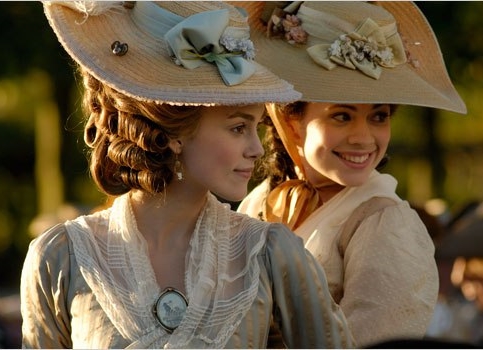
Barbara and Wilber find they are both prone to impatience and rash decisions. They get married. Wilber gets his voice back, and his friend. As Wilber’s Prime Minister, Pitt urges caution. He is friend, to hell with caution. Wilber’s preacher has finally published his account of his years slave trading. He urges Wilber to use it, and damn the people with it. Wilber gathers the team back together. A lawyer amongst them suggests they cheat. First, they take away slave ship’s protection of a neutral flag, tying it in with the war effort and it is brought up by someone not part of their inner circle. And the opposition has been given free tickets to the races, so the bill is sure to pass. Pitt, who is gravely ill himself two years later, makes sure his successors will back Wilberforce.

Everyone is in attendance when the final vote is taken. The “Home and Foreign Slave Trade Act, the unamended bill calling for the abolishen of the slave trade throughout the entire British Empire,” 283 to 16, passes. Cheers erupt. The Duke of Clarence tells his friend Lord Tarleton of noblis oblige; his “nobility obliges me to recognize the virtue of an exceptional commoner.” Everyone stands and applauds Wilberforce. “William Wilberforce continued to battle injustice for the rest of his life. He transformed the hearts and minds of his countrymen on education, healthcare, and prison reform to accomplish his second great dream – making a better world.” Bagpipes play the tune Amazing Grace as the film finishes. “William Wilberforce continued campaigning until his death in 1833…he is buried in Westminster Abbey next to his friend, William Pitt.”

I find this film uplifting. I cheer for Wilberforce through all the setbacks. It also reminds me why I hate politics, whatever the form. There are several points I want to cry; when William Pitt dies, as Wilber’s best friend. When the bagpipes play Amazing Grace. When Wilberforce finally wins. It’s a great cast, full of wonderful actors. Ioan was stupendous; I prefer him in this sort of role rather than Mr. Fantastic (though he’s not bad there; we’ll cover that once I get into the superhero movies). Overall, a good movie. Just not one to put on if you’re not in the mood for a little heartache.

Up Next: The American Civil War, starting with Gods and Generals

Fashion and Politics

The Duchess

“When she arrives, all eyes are upon her. When absent, she is the subject of universal conversation. And what we see her wearing tonight, I look forward to seeing on the rest of you tomorrow! The Empress of fashion – the Duchess of Devonshire!”

Keira Knightley continues to play period roles (Pirates of the Caribbean, the 2005 film Pride and Prejudice, 2012 Anna Karenia [that’s three hours of my life I’ll never get back and I still don’t understand what the story was]) stars as Georgiana, the Duchess of Devonshire, Ralph Fiennes (Voldemort from Harry Potter and the new M in James Bond, amongst other roles) is the Duke of Devonshire, Hayley Atwell (she would go on to be Peggy Carter in the MCU, the mother, Evelyn Robin in 2018’s Christopher Robin, a brief role in Testament of Youth and Disney’s live action Cinderella) is Lady Bess [Elizabeth] Foster, and Dominic Cooper (younger Howard Stark in the MCU and Sky in the Mamma Mia movies) is the politician, Charles Grey. I watched the film because of the lead actors; it’s not a time period that I study closely.

The film starts in April of 1774, Georgiana and her friends are outside, watching young men, including Charles Grey race each other, while her mother settles her engagement to the Duke of Devonshire. Georgiana is seventeen and believes that the Duke truly loves her. On their wedding night, the Duke remarks “I never understand why women’s clothes must be do damn complicated.” Georgiana replies that they are one of the few ways women have to express themselves. She’s very nervous for their wedding night, but the Duke gets right to business. Her mother points out that a wife’s duty is to provide her husband with a male heir; she shouldn’t be concerned with talking with her husband.

The Duke is the primary sponsor of the Whig party and thus hosts dinners where the party members give speeches. He’s quickly bored of the speeches and leaves, but Georgiana stays and becomes involved in politics and gains favor of the primary members. But in private, the Duke has many affairs, which shocks Georgiana at first. Then one of his illegitimate daughters is brought to the house when her mother dies and the Duke expects Georgiana to raise young Charlotte without a fuss. “Consider it practice for our son,” he tells his pregnant wife. Later, at a party, Georgiana goes into labor (and modern audiences wince at her drinking wine while pregnant). The Duke expects it to be a boy. It’s a girl. When Georgiana’s mother visits, he barely speaks to her, frustrated that it is not the promised son (sound like some other historical guy we all know?) They jump to six years later, Georgiana content with her three girls, Charlotte, HarryO, and Little G.

duchess

While visiting Bath and taking the waters “for her health,” Georgiana and the Duke both meet Bess Foster. Georgiana quickly befriends the woman. Bess’s husband is enjoying his mistress at home and Bess wished for diversion. Her husband also is keeping her three sons away from her (now we know why the Duke is interested in her) and has a habit of beating her, which is not illegal. Georgiana manages to convince the Duke to invite Bess to stay with them. They attend a play that is a satire of the Devonshire’s marriage. In attendance of the play is Charles Grey. Bess speaks to him and remarks that it is well known the Duke is the only man in England not in love with his wife. Bess later remarks to Georgiana that Charles is clearly in love with G. She demonstrates that intercourse can be pleasurable and instructs Georgiana to close her eyes and imagine it’s Charles Grey.

Georgiana continues to help draw attention for the Whig party and gets to visit Charles Grey who seeks to work his way up the political ladder. She’s delightfully happy, until she returns home to hear moans coming from Bess’s rooms and the servants refuse to answer if it’s the Duke in there. Georgiana confronts the Duke. She has never objected to the Duke’s many affairs, she has accepted whatever arrangements have been made. But Bess is her one single thing of her own; she is her sole comfort in their marriage. Her husband has “robbed me of my only friend!” The Duke comes back with he has upheld his end of the marriage, but his wife has not (by not giving him a son). Georgiana wants Bess out. The Duke refuses. Georgiana runs to her mother’s home. Her mother advises she give up her gambling and politics and set to the duty of providing her husband with a male heir (I’m guessing people of this time have still not figured out that it’s the man who determines the sex of the baby, like the woman has any control).

Bess explains to Georgiana that the Duke of Devonshire is the most powerful peer of the realm; he is her only hope of getting to see her sons again. Georgiana orders her out of her room. She understandably feels betrayed by her dear friend. The three boys arrive at their home and Georgiana witnesses the attention that the Duke readily bestows upon the boys (which he has never shown for his daughters). Georgiana visits Charles and gives in to their feelings. Charles points out that Georgiana likes to “please other all the time.” “It’s what I’ve been brought up to do. It’s a difficult lesson to unlearn.” At home, Georgiana tries to make a deal with the Duke. She will give him and Bess her blessing if he will accept her feelings for Charles Grey. Bess tries to rescue her friend and points out that G is only asking for what the Duke and Bess have. The Duke silences her. He will not make a deal; he is not the one to ever make deals, he has everything. He can’t make any of Bess’s sons his heirs. Georgiana leaves the table. The Duke thunders after her and forces himself on her in her rooms. Screams echo through the large house and Bess takes Charlotte away from the door. “Give me a son,” the Duke orders Georgiana, “until then, stay here. And do as I say.” [I hate this man for that.]

During another party, Georgiana is quite drunk. Her Whig friends try to help her, but her wig ends up catching fire. The doctor determines that she is pregnant. Next scene: bells are ringing. The baby is a boy. The Duke pays Georgiana as part of their arrangement. While the Duke is away celebrating his heir, Charles calls upon the house. It was Bess’s idea. After another party, they sneak away. Georgiana decides to go to Bath on her own and gets to spend more time with Charles. Until her husband and mother show up. Here again we see the double standard imposed upon women: it’s fine for the Duke to have his mistress live in the same house as his wife, but it’s not fine for Georgiana to spend time with a man who actually loves her. They leave letters from the children for Georgiana; the Duke has set an ultimatum: give up Charles, or he will destroy the man’s career and never let Georgiana see her children again. Georgiana gives in and reads the letters, then rushes home.

At dinner, Charles shows up shouting for Georgiana. She tries to calm him; she still loves him, but she cannot give up her children. Charles insists he wants to marry her and he doesn’t care if their children are boys or girls. Georgiana goes back to dinner. And tells the Duke that she is carrying Charles’s child. The Duke has Bess tell Georgiana that she is to go to the country to give birth and the child will be given to the Grey family. Bess also stands up to the Duke and informs him that she will accompany her friend. She comforts Georgiana when she breaks down after giving up her daughter, Eliza to the Grey family.

When Georgina returns, the Duke attempts to comfort her; he wishes for their lives to find a calm normalcy. He asks her to show unity by showing up at a party together. The trio arrives and Georgiana reenters society. She has a brief conversation with Charles Grey, who tells her that he is engaged and that he has a new niece, Eliza, that Georgiana should meet someday. The film shows a few statements over the ending scenes of Georgiana playing with all the children: “Georgiana continued to be one of the most celebrated and influential women of her day. Charles Grey became Prime Minister. Georgiana, Bess, and the Duke lived together [for twenty-five years] until Georgiana’s death. With Georgiana’s blessing, Bess went on to marry the Duke and become the next Duchess of Devonshire. Georgiana frequently visited Eliza in secret. Eliza named her daughter Georgiana.”

While not a favorite movie of mine, I find it interesting. The scene of the Duke raping Georgiana is one that has stuck with me since first seeing the movie. I don’t quite drool over these gowns, but I do recognize that they are stunning. The movie also demonstrates that arranged matches rarely go well.

Up Next: We actually go back in time a little to Amazing Grace