Honour is a gift to yourself

Rob Roy

Another Scottish hero story, though adapted for Hollywood; it came out the same year as Braveheart and followed in the wake of Prince of Thieves. Bears no connection to Walter Scott’s novel.

“Rob Roy MacGregor has become the quintessential Highlander – a curious blend of patriot, freebooter, outlaw, and frontiersman; a man of honour who was also a bandit, a cattle-rustler and the chief of the protection racket….Rob Roy MacGregor was a frontiersman of his times, in that he and his clansmen lived in the frontier lands between Highlands and Lowlands – the Trossachs at Loch Lomond [Lomond is mentioned once or twice in the film]…the third son of the fifth chief of his clan…grew up to be immensely strong, with exceptionally long arms, and became renowned for his skill with the broadsword….Like so many Highlanders he was a Jacobite (Scotland: The Story of a Nation, Mangus Mangusson, pgs. 568-9).”

The Clan MacGregor had been outlawed by King James I (of England, VI of Scotland…a bit confusing) in 1603, so Rob actually used his mother’s clan name of Campbell. “To some he was nothing but highwayman and a gangster; to others he was a latter-day Robin Hood, robbing the rich to give to the poor, ambushing government troops and freeing their prisoners. He was captured on several occasions, but always managed to escape. His exploits became legendary for their audacity (pg. 570).” But the main plot points of the story are correct in the film. They made up one of the villains, Archibald Cunningham. Rob Roy was eventually pardoned and when he died, he was considered a hero. “In a treacherous age he had never betrayed a trust nor broken his word. He had always been his own man (pg. 571).”

Ironically, Irishman Liam Neeson was cast as the titular Scottish hero, Rob Roy (most famous as Jedi Master Qui-Gon Jinn in Phantom Menace, the voice of Aslan in the recent Narnia movies, an action star in the Taken films, and the titular Oskar Schindler in Schindler’s List [which I have not seen, not sure I want to, due to subject matter]. He played an famous Irishman in Michael Collins [I have seen, but it’s more political and confusing], Hannibal in the rebooted A-Team film, and Ducard in Batman Begins [and another funny note; years ago Disney had cast Scotsman Sean Connery to play an Irishman in Darby O’Gill and the Little People]). John Hurt (the War Doctor, Ollivander from Harry Potter, and the Great Dragon from Merlin) is the Marquis Montrose, Tim Roth (Emil Blonksy in The Incredible Hulk, which is part of the MCU and the villainous Febre in The Musketeer) is Archibald Cunningham – he wears foppish clothes, but you know he really wants to be wearing black. Andrew Keir (who has a filmography going back to the fifties, including the epic Cleopatra) is the Duke of Argyll and Brian Cox (we just saw him in Braveheart amongst his other movies) is Killearn.

The opening of the film tells of the hard times in Scotland; “this story symbolises the attempt of the individual…to retain respect and honour.” Rob Roy and his kilted men are chasing other Highlanders who stole cattle from the Marquis of Montrose. Rob kills their leader to prevent further bloodshed. He also has it in his mind to ask the Marquis for a loan, in order to turn a profit on another herd of cattle. The Marquis has already butted heads with the Duke of Argyll (Duke outranks Marquis). Montrose’s ward (maybe nephew?), Archibald Cunningham bests the Dukes champion…because English nobility like to wager on two Scotsmen fighting each other for sport. Montrose’s right hand man, Killearn, has an idea involving Archibald and Rob’s money. Instead of the promised creditor note, Killearn gives Rob’s chosen man a bag of coin (making it easier to steal and more dangerous to transport). Then Archibald lies in wait and ends up killing the poor man; Archibald in place due to Killearn’s scheme. When Rob does not receive the money, he has to go before the Marquis again. Montrose will waive the debt, if Rob agrees to swear that the Duke of Argyll is a Jacobite.
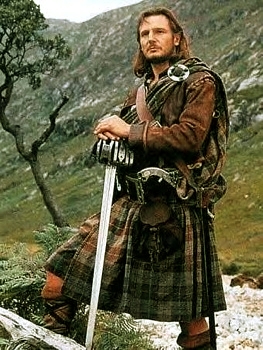
rob-roy

Historical note: Jacobites supported the Stuart claim to the throne of Scotland and England, meaning James Stuart and his descendants. In 1603, when Elizabeth I died without an heir, the line of succession picked up with the offspring of Henry VIII’s sister, Margaret, who had married James IV of Scotland. They had a son, James V, who had a daughter, Mary, Queen of Scots [a contemporary of Elizabeth and there’s a whole story there], who had a son, James VI. Thus, he ascended the throne, joining the two crowns. This began the reign of the Stuarts in England. His son, Charles I, ascended at James’ death. Charles was executed for treason and Oliver Cromwell stepped in (hated by many…there are murals of the Irish hatred of him). His son, Charles II was eventually restored to the throne. After him was his son, James II, but he was deposed in the Glorious Revolution. This is when the famous Jacobite uprisings occurred, sporadically from 1689 to 1759 [the film states it takes place in 1713], again, think Outlander. The Jacobites wanted James II, or his son back on the throne. Instead, English parliament awarded his Protestant daughters, Mary and Anne joint rule. Mary died and her husband ruled for a while until his death, then Anne took the throne. Though Anne had seventeen pregnancies, none of her children survived, which is when this story takes place. If we continue on, since England wished to remain Protestant, despising Catholics (thank you, Henry VIII), none of Anne’s Catholics relatives (like those in Scotland) could claim the throne, thus picking up the line of Charles I’s sister, Elizabeth and through her picked up the Hanover title, leading to George I (of many George’s) and thus the House of Hanover. Yes, it’s all quite complicated and I barely understand it since it was never properly covered in my undergraduate history courses. I obviously know of the Jacobite rebellions and support them (thank you, Scottish romances) and England needs to keep its nose out of Scotland’s business. To sum it up, political tensions are bubbling and the English and Scottish don’t like each other.

Carrying on: Rob refuses to bear false witness as it would be dishonorable for him; he doesn’t care about the Duke. Montrose shouldn’t be so shocked; it would be breaking a commandment, but he calls for Rob’s arrest. Rob escapes and takes to the hills. Cunningham is given permission to hunt him down and starts at Rob’s home. His wife, Mary, sends their boys for help, while Cunningham (and Killearn watches) burns the land, shoots the cattle, and rapes Mary. Killearn has the gall to tell her as she proudly holds her head high amongst English soldiers, “they say it’s not a sin if you don’t take pleasure in it.” Rob’s younger brother finally runs in to try to pick a fight once the soldiers leave. Mary tries to wash Archibald off her and the brother is horrified. She insists that Rob is not to be told; it’s what they want, it will only get her husband killed. “If I can bear it to be done, you can bear to be silent!”

In retaliation, Rob and his men steal Montrose’s cattle and rent and hurt him in his purse. Honestly, Montrose has suspicions of what Cunningham and Killearn cooked up, but he does not want his name mocked. A serving girl that Cunningham got pregnant reveals what she knows to Mary when Cunningham does nothing about the baby. Rob takes Killearn and plans to hold his own trial, with the serving girl as a witness. But she’s desperately in love with Cunningham and kills herself. Mary tries to reason with the man and he attempts to turn the tables on her. She cuts his neck, terribly wounding him. The brother aids Killearn in drowning. Retributions escalate. The brother fires on soldiers who are plundering the Highlands. He’s shot for his trouble and reveals Mary’s secret to Rob before he dies. Rob tries to escape, but is ultimately captured by Cunningham. He’s taken, bleeding and worn to Montrose. Montrose, who really does know what kind of man Cunningham is, orders Rob to be hung. Rob tries to hang Cunningham instead and escapes into the river.

In the meantime, Mary has gone to the Duke of Argyll for help. Since Rob won’t stand against the Duke for Montrose, Argyll will help. He offers protection to the outlaw and when Rob returns home, he arranges a meeting between Rob and Cunningham. Mary admits to Rob about the baby; she can’t know who the father is (she and Rob are shown in a very loving (cough cough) relationship. Rob seems alright with the baby, even telling his children that an addition is on its way. Argyll makes an agreement with Montrose, if Rob wins, the debt is called off, if he loses, Argyll will pay the amount and the matter will be settled. Cunningham holds the advantage most of the duel, staying out of reach of Rob and landing damaging hits. But he allows Rob the chance to grab his sword when Cunningham has him at his mercy and lands a deep blow to Cunningham, killing him. Rob returns home.

My feelings on Rob Roy; I found it long after I was already in love with Scottish history. It fits right in the time period I am used to reading but since it deals more with Rob’s grievances against Montrose and Cunningham, I just don’t get into it. Admittedly, the duel at the end is very cool. It’s well done and has a good cast; I just don’t swoon (unlike certain parts of Outlander; but it’s against probably due to the difference in genre).  Another interesting note; at several points in the film, they use O’Sullivan’s March, an Irish tune.  Aye, Scottish and Irish music do share many similarities, but why could they not find a Scottish tune to use for a film about a Scottish hero?

Next Time: Carrying on to the latter 18th century with The Duchess
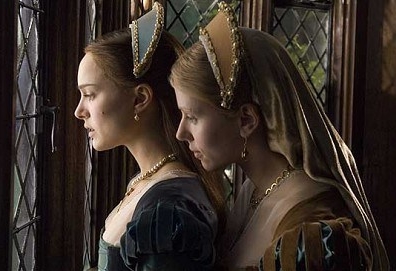
The First Queen Henry Beheaded

The Other Boleyn Girl

The title of this blog is taken from the rhyme to remember Henry VIII’s wives: “divorced, beheaded, died, divorced, beheaded, survived.”  Henry divorced Catherine of Aragon, beheaded Anne Bolyen, Jane Seymour died, he divorced Anne of Cleves, Catherine Howard was beheaded as well, and Katherine Parr survived Henry.  Based on the popular 2002 novel (emphasis novel, meaning fictional) by Philippa Gregory. A lot of familiar faces in this film (and ironically, a bunch of them show up in the MCU). Natalie Portman (most famous as Jane in the Thor movies and Padmé in the Star Wars prequels) stars as Anne Boleyn while Scarlett Johansson (now known as Black Widow) is her elder sister, Mary (not younger as they state early in the film). Eric Bana (who we saw as Hector in Troy, also plays the villain Nero in the rebooted Star Trek films, he was Bruce Banner in the 2003 Hulk movie which is not part of the MCU, and I had forgotten he was Uther in King Arthur: Legend of the Sword. I forgot because I’ve seen the movie once and dislike it), is Henry VIII. Benedict Cumberbatch (Sherlock, Hobbit, Amazing Grace, War Horse, Star Trek Into Darkness, The Imitation Game, Richard III in The Hollow Crown, and now Dr. Strange) has a relatively small role as William Carey. Eddie Redmayne (before he was Marius in Les Misérables, Stephen Hawking in The Theory of Everything, and Newt Scamander in Fantastic Beasts) also had a relatively small role as William Stafford. Jane Parker may look familiar; she’s played by Juno Temple (she’s the queen in the 2011 The Three Musketeers and one of the fairies in the Maleficent movies). The Duke of Norfolk sounded familiar; he’s played by David Morrissey, who was in an episode of Doctor Who. Oh yes, and say hello to Alfie Allen (Theon Greyjoy from Game of Thrones) who briefly appears as one of the king’s messengers.

I have read the book (it may have been after I watched the movie), and I had issues with its historical inaccuracy, because Tudor England is a period of history that I have done a fair bit of reading on; and one that my mother (also holds a Bachelor’s in History, like my brother…well, he now has a Master’s) has done even more reading on. Unfortunately, most of those books are packed away somewhere. Already mentioned that Mary was the elder sister, not Anne as stated in the film. Anyways…the movie opens with three small children playing; their futures already being discussed. The father remarks that the family can improve their standings with their daughters, but to truly get ahead, one needs more than a fair look and a kind heart.

Time jump ahead to Mary Boleyn marrying William Carey, as discussed at the beginning. At the castle in London, Catherine of Aragon delivers a stillborn son; she apologizes to her daughter, the princess Mary, that there is no brother to make the country safe. There is a fear that if Henry does not have a legitimate son to pass the throne onto (he does have an illegitimate son, Henry Fitzroy), England will descend into civil war, which it already went through when he father took the throne (War of the Roses). A man, the Duke of Norfolk, Thomas Howard, rides away from court and to his sister’s estate (if the surname Howard rings a bell in regard to the Tudor dynasty; Henry’s fifth wife, Catherine Howard was a relation of the Boleyns’). He plans for his family to aid the king in a delicate matter; Henry will be looking for a mistress and Howard plans to put Anne boleyn sistersin his path. Anne accepts the challenge. Preparations are made for a royal visit. But when Anne is too daring on a hunt, the king is injured, so the Duke sends Mary to tend to the king. Once Henry returns to court, he calls for Mary, her husband, and family. Mary and Anne become ladies in waiting to Queen Catherine, and William Carey is made a member of Henry’s privy council (a high honor). Catherine suspects why the Boleyn sisters are now in her household and Anne becomes jealous of Mary’s attention from Henry. She tells her sister “I will make my own way.”
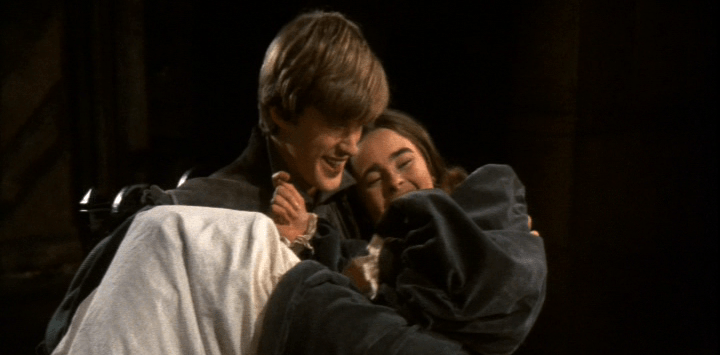
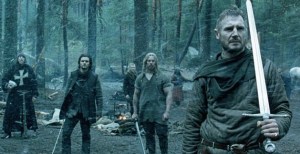
Henry trusts Mary; he understands what it’s like to be the second child. (Okay, on the one hand, yes. Henry was the second son of Henry VII, he had an older brother, Arthur. Catherine of Aragon was originally married to him before he died young. Then Henry was faced with becoming king. And we’ve already covered that Mary was not the second child). In the wee hours of the morning after, Mary has to report to her family; this is no longer a private matter. Their uncle openly states he hopes Mary will give Henry a son. Excuse me, Mr. Duke of Norfolk…Henry isn’t married to Mary, so the son won’t be legitimate, just like Henry Fitzroy (historically, “Fitz” as part of a surname signified that the child was a bastard; thus “Fitzroy” meant “son of the king.” But not legitimate). Henry gives William Carey an assignment away from court. What is not mentioned is that Carey dies at some point. Meanwhile, Anne runs off and secretly marries Henry Percy, the heir to the richest land owner in England. However, as a peer of the realm, Percy’s marriage has to be decided by the king. And he’s already engaged. In the movie, Anne is banished for France for a few months to prevent scandal. In actuality, both Mary and Anne spent several years in France as part of their education. And Mary possibly had a reputation she gained there, which is why Henry may have been interested in her. There is only one historical recording of her by Henry and no actual evidence that she was a long term mistress, nor that she bore any children to Henry. Anne’s mother gives her the advice that women can better achieve what they want by allowing men to believe they are in charge; it is the art of being a woman.

In this movie, Mary does become pregnant by the king and is seen openly walking with him (not likely. Henry was devoutly Catholic at this point. It’s one thing to take a mistress, and expected of royal men [but frowned upon by women…double standard]. It’s another to set aside your lawful wife…whose nephew is the Holy Roman Emperor). Her family becomes highly favored and gains new titles and lands. The mother is quick to point out to the father that this all can disappear as quick as it comes. But when Mary is confined for the health of her child, the king’s head can turn and another family can pull the same stunt that the Howards and Boleyns have and put their daughters’ in the king’s eye. They fear the Seymours. So they recall Anne. She takes the opportunity to flirt with Henry. Mary knows that Anne will not act in Mary’s interests; she will act with her own. And Anne beguiles the king. But she holds out against his sexual advances; she knows she cannot fully trust him. He’s already been unfaithful to his wife and has taken her own sister as mistress. There will be no difference in Anne. I cannot remember from my reading if it was truly Anne’s idea for Henry to break from the Catholic church in order to annul his marriage, or if it was Henry’s idea so he was not bound to Rome. Anne allows Henry to have hope when her sister bears a son, knowing she’ll lose the king if not.

We know that Henry breaks from Rome and establishes his own Church of England and brings about the Reformation. His marriage to Catherine is annulled based upon her being married to his elder brother before him (there is historical contention whether their marriage was actually consummated). Henry marries Anne. She eventually bears him a healthy daughter, Elizabeth. Henry remarks “if we can have a healthy daughter, we can have a healthy son.” The movie shows one miscarriage (historically, she miscarried when Henry was grievously injured in a joust). She also had a stillborn child. Research has come out that Henry had a condition that affected his wives that they had difficulty carrying multiple pregnancies, particularly later in their lives. The film shows Anne, desperate, asks her own brother George for help. His wife, whom he has a strained relationship, witnesses the plea and reports both to the Duke of Norfolk and the king himself. Anne and George are subsequently arrested; Anne charged with adultery and incest. In truth, most of the charges are believed to have been the work of Thomas Cromwell, a former ally until they clashed politically (though not completely proven). (Cromwell is not even shown in this film). And she was charged with adultery with seven men, including some members of court. She was found guilty, even by her own uncle (this was all political for him). Being queen, she was executed by a skilled swordsman. The film shows Mary pleading with Henry on her sister’s behalf and expecting Henry to spare Anne. He does not. She’s shown picking Elizabeth up from her mother and leaving with the child (she was already at Hever Castle with her own household at this point, including the former princess Mary).

The film finishes summing up what happened to several of the characters. Mary did indeed marry William Stafford. But it was done in secret and angered both King Henry and Anne and she was banished from court, mainly due to his inferior prospects. She had four children (though at the closing of the film, they show three, one of them being little Elizabeth). Her first child was actually a girl, then a son, both by William Carey. She may had had two further children by William Stafford. On the bright side, the film is correct in stating “Henry’s fear of leaving England without a strong successor turned out to be unfounded. He did leave an heir, who was to rule over England for forty-five years. It was not the boy he yearned for, but the strong red-haired girl Anne gave him – Elizabeth.”

I will admit, the costumes in the movie are gorgeous, though they seem to dress Eric Bana in wide coats to give the impression of the girth Henry displayed later in life. At that age, Henry was still young and athletic. I don’t think it does a well of a job displaying the intrigues that The Tudors does, but they’re trying to compress a lot of events into a two hour film. It does show that a lot of what occurred were older men using young women as pawns to gain power and wealth. And if you want an author to read who has done a lot of research into the Tudors, read Alison Weir.

Next: Slight change in plans (due to me not being able to find the movies I wanted, but I think it will be okay), we’ll jump to Rob Roy.

But, a quick note on Anne’s daughter, Elizabeth.  I remember reading the Royal Diaries book on her as a girl.  I actually read several of them and the Dear America books, and that’s a contributing factor to me later becoming a history major.  Elizabeth I was my first favorite queen and partly led me to British history (I already liked Robin Hood at that point, but this was a queen, a woman I could admire).  Of course, actually studying history gives a lot more insight to what was simplified for a children’s book.  I remember it painting Mary in very bad light, yet I eventually learned there are parts of her tale that are sympathetic as well.  I believe that Elizabeth I was a great queen, but she had her downfalls as well.  And the Tudors lead into the Stuarts, which became another favorite time period of mine to study.  When I graduated college with my history degree, I considered for a while finding a job near Jamestown and the other early colonies so I could tie in my interest of British history with American history (did not work out, decent paying jobs in the field with the experience that I had are hard to come by; I’ll spare you my rant on the viscous circle that exists.)

Just thought I’d give a little insight.  If you have any further questions, let me know!

The Nine Day Queen

Lady Jane

Stars a very young Helena Bonham Carter and Cary Elwes. Sir Patrick Stewart portrays Jane’s father, Henry Grey, the Duke of Suffolk. Joss Ackland, who is the wise and loveable Hans from The Mighty Ducks (along with the scheming Victor Landbergh in 1994’s Miracle on 34th Street, and was Andrei Lysenko in The Hunt for Red October) briefly appears here as Sir John Bridges. Lady Jane Grey, rarely referred to as Queen Jane, appears as a footnote in English history; she ruled for only nine days.

When Henry VIII died in 1547, his young son, Edward VI, aged nine, ascended to the throne. His uncle, Edward Seymour, ruled as Lord Protector and named himself the Duke of Somerset. But he was replaced in 1552 by John Dudley, the Earl of Warwick, who became the Duke of Northumberland and the new Lord Protector (Duke is a higher rank than Earl). This is where the movie picks up. Dudley, like many others advising the young king, want to keep England Protestant after Henry’s split from the Catholic church. Henry VIII’s will laid out that if Edward died without children, the crown would pass to his eldest daughter Mary, a staunch Catholic, then to his younger daughter, Elizabeth. But, if Dudley and his cronies pass over both Mary and Elizabeth as bastards, as they were declared when Edward was born, they can pick up the Tudor line with Henry’s youngest sister, Mary, who had married Charles, the Duke of Suffolk and had a daughter, Frances, who married Henry Grey and they had Lady Jane. (Henry’s other sister, Margaret, was married to James IV of Scotland, and in this movie is declared not a valid to pass the crown, though not explained why. This familial line will come into play after Elizabeth I passes). Most importantly, Lady Jane was a devout Protestant.

Dudley wonders about marrying Jane to Edward, but it is clear that Edward will not live long enough to bear children. Edward is shown hunting with her father, but when her father rebukes her for her interest in books, rather than things useful to a husband, Edward shows her kindness. Jane is shown visiting the princess Mary in 1553, where Mary warns her to take care. Dudley decides to marry Jane to his youngest son, Guilford. Neither child is pleased about the arrangement. Guilford is shown drinking in taverns and was dragged out of a brothel. Jane fights the engagement, declaring she doesn’t want to marry anyone (though I don’t think she would have opposed a marriage to Edward; they got along very well). Her mother beats her, repeatedly. Still Jane refuses, not believing that the king wishes this for her. Dudley retrieves Edward to talk to Jane. He tells her it is her duty to obey her parents, and her king. Edward trusts Dudley (wise modern adults do not) She finally relents.

Edward collapses after his visits and the doctor tells Dudley the young king has only a week left to live. Dudley commands the doctor to keep Edward alive, using arsenic, to give him more time. I don’t believe this is been completely proven, but it is one theory some historians have. The marriage between Jane and Guilford does not start well. Jane has no desire to live has husband and wife, instead, she wishes to devote herself to her studies. And Guildford gets drunk at their feast and passes out in the marriage bed. They are to live at the old monastery of Hertfordshire, until their parents have need of them. Peasants greet the couple on the road and want their land back. When Henry VIII dissolved the Catholic monasteries, the lands were stripped from the peasants who worked it and the treasures inside were distributed to loyal courtiers. Guildford explains this to Jane, who has studied philosophy and theology, but doesn’t quite understand the world around her. He also explains that a shilling is no longer worth a shilling since it’s not made out of silver (similar to our penny. Used to be made out of copper, now it’s made out of zinc). When Jane demands why doesn’t he do anything if he sees this problem, he shouts back that it never works. He later apologizes to Jane and asks her to explain her beliefs. They start getting to know one another and their passions. Which leads to them consummating their marriage and turns everything around.

jane and guildford

They spend several happy days together, a true honeymoon. They share their wishes; Jane wishes for the country to be true to the Protestant faith. Guildford wishes that men wouldn’t be branded for beggary when they have no land to farm. They wish that children would be loved, for a better world. Meanwhile, Dudley convinces Edward to change the succession and make Jane his heir. Once he has that, he allows Edward to die. The Privy Council argues the new succession; both Mary and Elizabeth are threats. But Dudley has his way and the couple, already fearing their parents’ scheme, plan to run, but are given word of Edward’s death and taken to…possibly Westminster, they never say. Jane is declared Queen and she tries to say it’s not right. She would be aware that Mary would be next in line. But everyone kneels and her mother leads her to the throne. She’s crowned and they urge her to name Guildford king. She cries out for her husband and he breaks away from his brothers to comfort his wife. The people are ordered out so they can speak. Guildford explains that together, they are like a coin, two parts of a whole. They can work together. Guildford wants her to be queen; she lets him crown her.

The people aren’t too keen on Jane being Queen; they want Mary. They want a return to the familiar. Mary sends a letter declaring herself as queen. Jane’s first command is that she wants a real shilling; one actually made of silver. She dismisses the Spanish Ambassador, stating that her people and their suffering comes first. He’s insulted when she mentions “wardrobe” to Guildford, not realizing that she is donating the royal wardrobe to the poor. Jane and Guildford also want a school for the poor children, the monastery land returned to the poor. Jane argues with their fathers on who should lead the army against Mary. Jane wants her father close, though Dudley had arranged for Henry to lead. Guildford suggests Dudley lead. Frances recalls that Dudley claimed he could control his son, and shouts that her daughter is stupid.

Only nine days have passed and her Council is gone. Guildford looks on it that now they are really ruling England. Jane just wants it to be over. Henry comes in; it is. Mary is pronounced queen. Henry tries to apologize and makes amends to Jane, but Frances insist they flee. Guards separate Guildford and Jane and take them to separate cells in the Tower of London. Dudley failed at leading the army and is imprisoned as well. I don’t understand his confrontation with Guildford, though he seems to be switching sides, to save his own skin.

Mary has Jane brought to her. She understands that this was not Jane’s fault. They will be tried and condemned, but Mary has the power of reprieve, which she will use. But Mary also loves Philip of Spain, who is to be her husband. The Spanish Ambassador, on word from Charles V, the King of Spain and Holy Roman Emperor (her mother’s nephew, making him Mary’s cousin), insists that all discord must be gone before Philip will marry her. Then Henry joins the rebel forces to put his daughter back on the throne, insisting to his wife “I owe it to my daughter! She has need of me!” The rebellion ultimately fails and forces Mary’s hand. The couple may be saved, if they renounce Protestantism. They are allowed to see each other, but cannot speak. Mary’s confessor, whom Jane met two years prior, tries to convert Jane. But her will is strong and he cannot condemn a belief so pure. He allows them one last night. The couple can keep their ideas untarnished and will be alive together in the afterlife. “We’ll fly, away, beyond their reach. So far that their touch cannot tarnish us. And at last we will be – nothing – nobody – each other’s – only this time, forever.” Guildford is led away first. The confessor describes to Jane what happened to her husband as she is led to the private gallows. The shilling survives all this and Mary shows grief for just a moment, then goes to greet her husband. Lady Suffolk curtsies to Mary and the closing narration echoes a passage from Plato that Jane translated for the confessor at the beginning of the movie: “Soul takes flight to a world that is invisible. But there arriving, she is sure of bliss. And forever dwells in Paradise.”

I feel this is an underappreciated film. While there were dramatic scenes added I’m sure, this did follow history much better than other movies. No, Lady Suffolk most likely would not have been part of Mary’s court that soon after her husband’s failed rebellion (and he most likely would have rebelled more so he could control his daughter on the throne – but we want to believe the best from Patrick Stewart) and on the day of her daughter’s execution. But it does show that parents controlled their children’s destinies and those children didn’t often have a choice. Jane didn’t want to be queen; she was never trained to be queen because the likelihood of her becoming queen had been slim. Jane and Guildford were not instantly in love. It took compromise and swallowing their own pride and a willingness to hear other ideas. But they were so cute together; wonderful performances from Helena and Cary. I appreciate that they made Mary appear human and not completely mad or crazy, as she is often depicted in Tudor stories.

Next Time: We go back to Henry VIII proper with The Other Boleyn Girl

Hollywood History Sometimes Gets On My Nerves

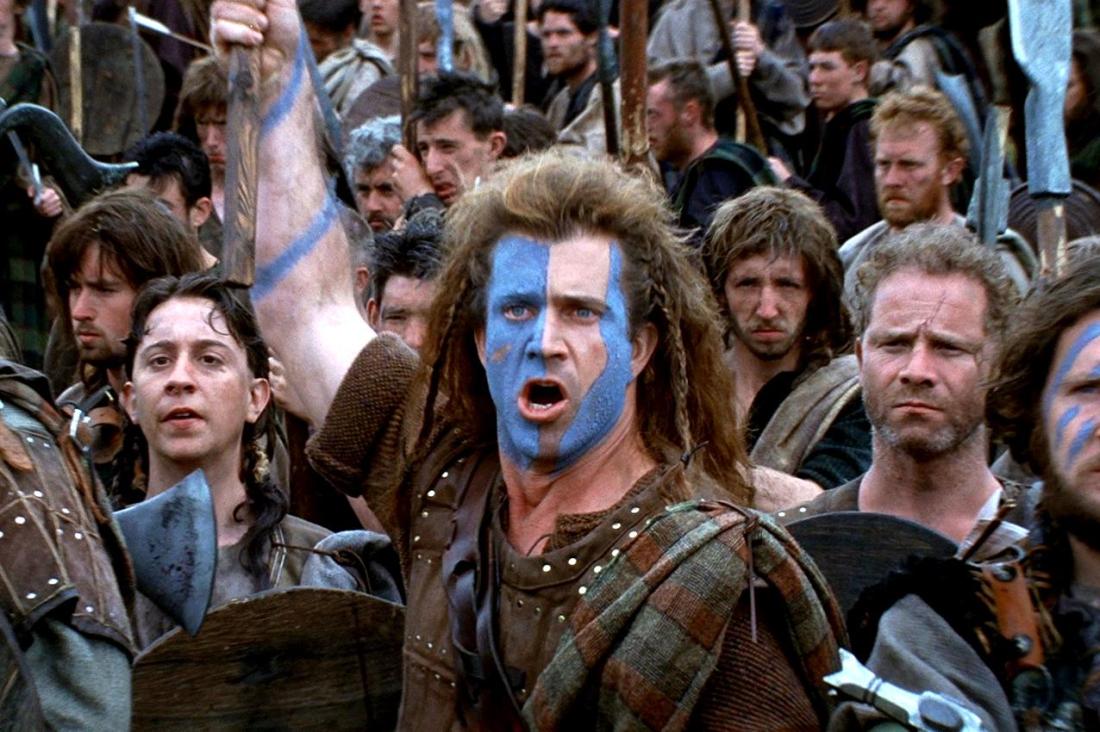
Braveheart

Just about the least historically accurate movie ever filmed. While there is not a lot of written history about William Wallace from that time period, there is in regards to other elements of the film. Mel Gibson and writer, Randall Wallace (no relation) have stated that they did not intend for the story to be accurate, just a good, cinematic story. I came to this movie several years after getting interested in Scottish history; and no, this movie had no influence on that. I actually got into Scottish history due to historical romances, many of which take place during Robert the Bruce’s campaigns against the English. So my loyalty is to the Bruce (another national hero in Scotland). There is a Wallace Monument near Stirling in Scotland, a statue on the Bermersyde estate, near Melrose in the Scottish borders (where William Wallace really was from, not the highlands), and there is a statue of him alongside Robert the Bruce at the gates to Edinburgh castle. There is a Robert the Bruce statue erected at Bannockburn, which is near Stirling, and was refurbished in time for the 700th anniversary of the significant battle.

Before I delve into the history portion of the movie, let’s cover cast real quick. Obviously, Mel Gibson stars as William Wallace (Braveheart was actually an moniker for Robert the Bruce). Hello James Cosmo as the elder Campbell. Brian Cox (Agamemnon in Troy and William Styker in the X-Men trilogy) is William’s uncle Argyle Wallace. And playing another red-head, Brendan Gleeson is Hamish (Reynald from Kingdom of Heaven).

The film begins in 1280 and the opening narration claims the king of Scotland had just died without an heir. Not true: Alexander III ruled until 1286 and had an infant granddaughter, Margaret. She ruled for four years (bringing us to 1290), never having set foot in Scotland and there was a succession crisis upon her death; there were thirteen rival claimants for the throne. The two strongest contestants were John Balliol and Robert Bruce, both descendants of King David I’s daughters (Royal Britain by Charles Phillips, pgs 69-70).

The narration continues that the king of England was Edward I, known as Longshanks, and referred to him as a pagan. Yeah, Edward was not pagan. There were no true pagans in Britain since the Vikings. Edward I even fought in the Crusades. Maybe they were hoping to pass this off as “creative license,” that the Scots would consider Edward pagan. Though, it’s hypocritical to make the comment that history is written by those who hang heroes as a way to pass off this as correct Scottish history. Because Britain as a whole was Christian. And Catholic. And England was Christianized before Scotland.

“Edward brought a ferocious martial vigor to his reign, forcefully imposing his authority on his realm, ending Welsh independence and waging a series of brutal wars in the north that later earned him the nickname ‘Hammer of the Scots’ (Royal Britain, pg. 50). He erected a ring of castles in Wales and borderlands to control the Welsh. He annexed the land and made it a principality of England. Hence why the crown prince is known as the Prince of Wales (remember the Black Prince from Knight’s Tale? This is how he had that title. Even though he died before becoming king). This is when the Welsh hero Llywelyn ap Gruffudd comes in to play. When the succession crisis arose in Scotland, the Scottish nobles asked Edward to arbitrate. Well, that just opened the door for Edward to take control through choosing John Balliol, who would swear fealty to Edward. When Balliol was captured and put in the Tower of London, the Scottish nobles revolted. And that’s when the Stone of Scone (ancient coronation stone of Scotland) was taken and put in Westminster Abbey. It was finally returned, 700 years later in 1996 (British Kings and Queens by Sandra Forty, pgs. 60-61).

So, right off the bat, we know this movie has messed with the timeline “for dramatic purposes.” You can’t just put things together, “hey, these happened in this place at some point,” and mash them together. That’s Hollywood for you. Carrying on with the story they are telling, young William Wallace witnesses the massacre at the first gathering, called by Edward. The men left for another meeting and William’s father and older brother are killed off screen. William’s uncle Argyle fetches William and remarks the evening after the funeral, that the men are playing “outlawed tunes on outlawed pipes.” Another time period inaccuracy: bagpipes and that music weren’t outlawed by the English until the 1700s, after the Battle of Culloden (think Outlander). So they’re a good 500 years off.

Another historical note: tartans as we know them today and are represented in the movie, are not referred to in written form until 1471. “References to tartan in Gaelic literature date from the early sixteenth century, and descriptions of the multicolored clot appear in Lowland Scots by the 1570s (Clans and Tartans of Scotland and Ireland by James Mackay, pg. 15). The big craze for tartan was brought by English King George IV when he visited Scotland in 1822, wearing a kilt. “Although tartan features prominently (an anachronistically) in the film, it bears no resemblance to an identifiable sett (pg. 36).”

Edward marries his son to Isabella, princess of France, though I don’t believe she is actually named on screen in the entire movie. Though prince Edward has a favorite amongst the court, Piers Gaveston (again, never named), and quite possibly closer than that. That bit is historically accurate. However, Edward II didn’t marry Princess Isabella until after his father’s death (Royal Britain, pg. 52). They’re just mucking up the whole timeline, aren’t they! Longshanks has the brilliant idea to breed the Scots out of Scotland. “The trouble with Scotland is that it’s full of Scots!” Edward declares (not sure if he actually said that), and declares ‘prima noctis,’ that any English noble has sexual rights to any common Scottish woman the first night of her wedding. That was not actually a thing, pretty sure the Catholic church would frown upon that.

This kicks off the trouble. William has returned home after being educated by Argyle. He rides through a wedding and witnesses this fictional right being enforced. All the while, a young woman is making eyes with him. It’s his old flame, Murrin (she had given William a thistle at his father’s funeral. And that is all the back story they are shown, but they’re supposed to be desperately in love with each other, after having no contact with each other for at least a decade). Then William takes her riding and immediately wants to court her. You haven’t seen each other for over ten years, how do you know you’re compatible? Her father refuses until William proves he’s only interested in peace. They still meet secretly and marry secretly. A creepy old English guard notices them being friendly with each other and tries to force himself on Murrin. William attempts to rescue her, but she’s still captured and her throat is slit by the English magistrate, who claims he has shown leniency to the Scots and they’ve lived in relative peace. William rides in, seemingly surrendering, then pulls out what looks like nun chucks and attacks the English. The other Scots join in and William soon slits the throat of the magistrate.

Men start gathering to Wallace’s cause. They next attack a Scottish castle. Edward starts worrying about the rebellion, but leaves his son to take care of it while he journeys to France (um, if the French king’s daughter is married to the English king’s son, why does England still have to go fight France? Probably because England was fighting France at that time, because Edward II hadn’t married Isabella yet). That solves nothing. The Scots just attack another castle. Robert the Bruce is discussing Wallace’s rebellion with his father. His father urges him to retain ties to England, as many other Scottish nobles do. Robert wants to side with William. The Irish join the Scots, eager to fight the English  historically, at this time, the Scottish and Irish did fight each other).

braveheart

And we come to the battle of Stirling. Which is supposed to have a bridge, conveniently missing in the film, since it was too difficult to film. That’s why the English had problems; they got bottlenecked. Really, this movie isn’t too great with geography. Edinburgh looks nothing like what it should. There’s a big hill in Edinburgh, that is not shown at all. Continuing with the movie version, the common Scots don’t want to fight for the nobles and start to leave before Wallace rides in with anachronistic blue face paint. He gives a rousing speech “they make take our lives, but they’ll never take our freedom.” He rides with the nobles to pick a fight, demanding that the English “beg forgiveness for a hundred years of theft, rape, and murder.” The battle begins, with England eventually retreating. I always feel bad for the horses in battle scenes. I know they’re not actually harmed, but in history they were.

William is knighted and tries to persuade Robert the Bruce to join him. The people and the nobles respect the Bruce; if he leads, they will follow, including Will. William and his men proceed to attack York and behead the king’s nephew. Outraged, Edward decides to send Isabella to negotiate peace, sensing that William will not harm a woman. Alone in the English court and distant from her husband, Isabella falls for William Wallace and sends him warnings when she can. Wallace will not yield to England. Edward tries to trap William, but is secretly foiled by Isabella. William once again approaches the nobles to unite Scotland. Robert gives his word to William, but his father has other ideas.
Come the battle of Falkirk, the Scots face the English again. But Edward has bribed the Scottish nobles and they leave the battle. Edward has more men in reserves and crushes the Scottish army. A helmeted knight faces Wallace and unhorses him. Underneath the helmet, it’s Robert the Bruce. Wallace is shocked and Robert feels bad. He sends William to safety and yells at his father later. Once he’s healed, William kills the nobles who betrayed him. He runs to the hills and tall tales about him spread. He sees the princess again and they sleep together. There is montage of the princess in love while both elderly fathers grow ill.

The nobles betray William again; William trusts Robert who does try to save him, but is not successful. William is taken to trial in England and will not confess to treason; he never swore allegiance to Edward I. He is found guilty and will be punished. Isabella tries to talk William into confessing, but he won’t. She goes to the king to beg mercy, but he won’t yield. She remarks to a guard that the king will be dead in a month and his son is weak, so who will truly rule? To Edward, she murmurs that “a child not of your line grows in my belly; your son will not sit long on the throne, I swear.” Not true.

As already stated, Isabella and Edward II aren’t married yet at the time of Wallace’s rebellion. And their son isn’t born until 1312. Edward II wasn’t a good king either and even had another favorite, Hugh Despenser after Gaveston is beheaded by his barons (not thrown out a window by Edward I as shown in the movie). And Isabella indeed became powerful when her husband took up with Despenser. She plotted Edward II’s downfall with Roger Mortimer; in 1326 they captured Edward and in 1327 forced him to abdicate for his fourteen-year-old son, also named Edward. Later that year, he was murdered in Berkeley Castle in Gloucestershire. A few years later, Mortimer is sent to the Tower and Isabella is exiled (Royal Britain, pgs. 53-54).

The film shows William’s drawn-out torture. First, he is hung. Then released and urged to confess. Then he is racked, and released, and urged to confess. By the time he is laid out, the crowd is pleading for mercy. But William shouts “Freedom!” as his entrails are removed (mercifully not shown on camera). He is beheaded (not shown, thankfully), drawn and quartered. Longshanks dies as William shouts. The closing narration hits on Bannockburn in 1314, where the Scots won their freedom. Robert the Bruce leads them to victory. That event just celebrated its 700th anniversary and I know my British magazines all featured articles that year.

I beg your pardon on the amount of history I wove in; I have a passion for Scottish history, as I mentioned, born of historical romances. I also was teased for my interest in Scottish history in high school, which just makes me stubbornly hold on to it (bit like a Viking, lol).  This is the type of writing I like to do, mixing in history.  I enjoyed it in college, and being the little nerd that I am, I miss is.  So I did enjoy diving into this film and examining the true history of the time period.  And now I want to carry on reading some of my Scottish romance series I have been neglecting.  We’ll see if I actually get to them (I’m to the point that I have started some books I’ll have to re-start because it’s been so long.  This was so much easier in college!)  A decent note for the movie; yes, we cheer for Scottish independence, I’ll never argue against that. And it does keep me more awake that the previous few historical movies. And the musical theme is just beautiful.  I am interested in watching Netflix’s film with Chris Pine on Robert the Bruce, Outlaw King.

Next Time: We start delving into the Tudor dynasty (another time period I am familiar with), starting with Lady Jane

A Kingdom of Conscience

Kingdom of Heaven

Another epic tale; studios marketed as a successor to Gladiator since they were filmed by the same director, though Kingdom of Heaven showcases the politics of the Crusades. I like aspects of the movie that show a more neutral representation of conflicting Christians and Muslims. The Holy Land is a hot spot; always has been. I took a class in college on the Contemporary Middle East and I’d watch bits of this movie to give myself hope that a resolution could eventually come. I’m not sure how historically accurate the portrayal is (we’ve hit that my concentration is in British history and mythology); but like I comment on Disney’s Pocahontas, this what we wish the story was.

I seem to find movies that share a lot of actors. Orlando Bloom is back directly after Troy to star as Balian. Liam Neeson is Godfrey, David Thewlis (most recognized as Professor Lupin from Harry Potter) is a Hospitaler knight. Michael Sheen appears as a priest. Kevin McKidd (Colin from the rom-com Made of Honor, voiced the MacGuffins in Brave, and was Poseidon in Percy Jackson) appears with Nikolaj Coster-Waldau (Jamie Lannister…yeah, I didn’t realize he was in this film either). Another surprise: Marton Csokas who plays Guy de Lusignan, is Celeborn (Galadriel’s husband) in Lord of the Rings. Another Harry Potter alum is Brendan Gleeson; there he was Mad-Eye Moody, here he’s Reynald de Chatillon. Eve Green, the Bond girl from Casino Royale and Morgan from Camelot is Sibylla. And say hello to an old friend: Jeremy Irons in Tiberius. Oh, and Ian Glein makes an appearance at the end as King Richard of England.

The film starts in France in the year 1184, right before the third Crusade. Balian is a blacksmith (Orlando Bloom seems to repeat the roles he’s good at) whom we are told has recently lost his wife; she killed herself after the death of their infant child. The friendly village priest urges Balian to go to the Hold Lands to atone for his wife’s sin. And then mentions that she no longer has a head, all while wearing her crucifix that he stole. Balian kills the idiot (yeah, he’s an idiot for mocking a man working near fire with the death of his wife) then flees for Godfrey’s encampment. He has just been informed by godfrey and menGodfrey that the man is his father (meaning Balian grew up as a bastard; his life really isn’t going well, is it?) Godfrey gladly takes his son in and begins to teach him the art of being a knight. Even defends him against guards who came to arrest him. Godfrey takes an arrow, which then festers. The Hospitaler tends to Godfrey as best he can, but they make for Messina, the port to the Holy Land. Godfrey instructs his son to serve the king of Jerusalem. On his death bed, he knights his son and calls him to defend the people.
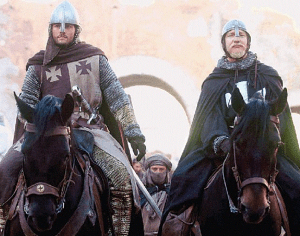
Be without fear in the face of your enemies.  Be brave and upright that God may love thee.  Speak the truth, even if it leads to your death.  Safe guard the helpless.

Balian, now Baron of Ibelin, makes for the Holy Land. There is a storm at sea and he is the only one to survive the shipwreck, besides a horse. Balian meets two Muslims, who challenge him for the horse. The master fights him, ultimately losing, while the servant tries to stop the fight. Balian has the servant take him to Jerusalem, then gives him the contested horse. The servant remarks “your quality will be known among your enemies before ever you meet.” Balian prays at the Holy Mount, but does not receive the answers he seeks. He soon takes his place as his father’s son at court. He meets Sibylla, though he doesn’t tell her who he is at first. He then meets Tiberius, an old friend of Godfrey’s. Tiberius has to deal with Reynald and Guy, who cause trouble. Well, Reynald more openly than Guy since Guy is married to Sibylla, who is sister to the king. The king has negotiated a peace with the leader of the Muslims, Saladin.

The king tells Balian that Godfrey was one of his teachers whom he had great respect for and offers him the wisdom that Balian’s soul is in his own keeping. He orders his newest knight to protect the pilgrim road. Godfrey had told his son to be a perfect knight; a rarity and one that Tiberius is not sure Jerusalem is ready for. Balian brings his lands back to life and Sibylla visits him. They willingly go to bed with each other (another woman who is unhappy with her husband, but Guy is rather cruel). Quick question: if Balian grew up as a bastard blacksmith, how does he know reading, writing, and battle tactics? Guy and Reynald attack the pilgrims. When they are found out, well, Reynald takes the blame, the court argues. Guy declares that there must be war between the Christians and the Muslims (or Saracens as they are referred to), God wills it. A Christian army cannot be beaten. The king declares he will meet with Saladin and he will ride at the head of the army, even though it’s detrimental to his health (he is a leper).

Balian is instructed to protect the villagers as the Muslim army attacks Reynald’s land. Balian finds out that the man he spared was no servant, but a general in Saladin’s army. As such, he shows mercy to Balian. The king pleads with Saladin that Reynald will be suitably punished. Saladin agrees. The king strikes Reynald and arrests him. He will have to find a use for Balian; Tiberius needs him in Jerusalem. Back in Jerusalem, the king is putting his affairs in order and asks Balian to marry Sibylla; Guy would be executed for the crimes they all know he has committed. (Guy was their mother’s choice for Sibylla). Balian being a good knight, declines, not wanting Guy’s blood on his hands, recalling Godfrey’s words that Jerusalem is a kingdom of conscience. Tiberius argues that the day will come that Balian will wish that he had done a little evil for a greater good.

The king indeed dies and Sibylla has no choice but to crown her husband king. Guy has Reynald bring him war, and secretly sends men to kill Balian. It is insinuated that Reynald tortured and killed Saladin’s sister, for which he now demands retribution. Guy decides to meet him on the field of battle, even after Balian (fighting off the assassins) Kingdom-of-Heaven knightswarns him that their army cannot go far from water. Balian stays behind and looks to the defense of the city. And yes, Saladin wins the battle, since the Christian army drops from exhaustion (he points out to his generals where the Christians went wrong; yes God may decide who wins a battle, but tactics and planning also play a part. Simply saying “God will protect us,” does not prevent a sword from cutting a body in two). Saladin cuts Reynald’s throat, but won’t kill another king, so Guy lives.
Then he sets his eye on Jerusalem, to win it back for his people. Disheartened, Tiberius leaves. Balian stays. He tells the men who have followed him and the men who defend the city: “None of us took this city from the Muslims.” None of the Muslims attacking were born when the city was lost to the Christians. “We fight over an offense we did not give.” “What is Jerusalem?” Your holy places lie over the Jewish temples the Romans pulled down. The Muslim places of worship lie over yours. Which is more holy?” No one has a claim and yet everyone has a claim to the Holy Land (a priest declares it blasphemy). This is what I wish people would think about. Let’s not fight over it, let’s share it.

Balian knights all the men who fight. When questioned whether he thinks that will make them fight better, he answers yes. The siege lasts several days, until the Muslims break through a walled up gate. Balian goes to discuss terms with Saladin. His concerns are the people within Jerusalem. Saladin offers safe conduct to Christian land to every person, including the knights and the former queen. They will not be harmed, he swears to God. Balian accepts. “What is Jerusalem worth?” he asks the Muslim leader. “Nothing,” and “everything.”

“If this is the kingdom of heaven, let God do with it as he wills,” Balian remarks as they prepare to leave. His Muslim friend returns the horse and offers some wisdom; “if God does not love you, how could have done all that you have.” Balian finds Sibylla, who has renounced her crown. They join hands and eventually end up back in the village in France. Crusaders come by, looking for Balian. He tells them only that he is the blacksmith. Even when the king announces himself, all he replies is “I am the blacksmith.”

I would not say that this is a fun movie. It’s not a light-hearted movie (considering the subject matter, not surprising). It’s one you have to be in the mood to watch. It’s well done, but again, I find it drags at times. And it’s not that I can’t sit through a long movie; I love Lord of the Rings. I will gladly binge watch TV shows. I think part of it is there are so many important characters that we only get a surface story. And a part of me wonders: who gave these Europeans the right to go divvy up land that is not theirs and set their own lords in place? I am sure there are politics involved and history that I have not studied.

Up Next: Braveheart

These Names Will Never Die

Troy

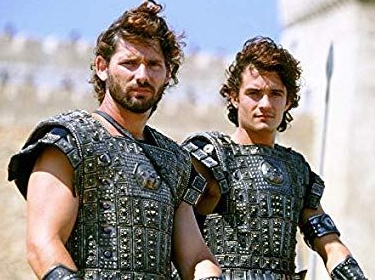
I’ll be honest, I watched this film originally because it has Orlando Bloom in it. And I probably only bought the DVD because I found it in a bargain bin at some point. Released a year after Gladiator, it is part of the early 2000s rash of “epic” movies. It’s an adaptation of Homer’s great epic poem The Iliad. Greek mythology is not what I tend to study, so I have not read this (I think part of it is that I can never keep their names straight; same with Roman names. They’re all the bloody same!) It has an all-star cast as well. Brad Pitt stars as Achilles. Brian Cox is Agamemnon, the king of the Greeks and Julian Glover is Triopas, king of Thessaly, an opponent of Agamemnon. Brendan Gleeson is Agamemnon’s brother Menelaus, king of Sparta (yes, when I hear Sparta now I think of 300. Yes, I’ve seen the movie; no, we will not be covering it [that was far too much death for me; though it was fun to learn about it a bit as part of A.P. English class]). Diane Kruger (she’ll later be in Copying Beethoven and the National Treasure movies) is the famous Helen. Peter O’Toole is king Priam of Troy; Eric Bana and Orlando Bloom play his sons Hector and Paris, respectively. James Cosmo is back as Glaucus, Julie Christie is Thetis, Achilles’ mother. Oh yes, and that’s Sean Bean as Odysseus! It’s been pointed out that Odysseus stars in the sequel to the Iliad, the Odyssey, so he can’t die in this story. Huzzah for Sean Bean.

The film opens telling us these events took place 3200 years ago, with a scrawl setting the stage; Agamemnon has spent decades warring with the kingdoms of Greece and forcing them into an alliance. His greatest warrior is Achilles, but Achilles disdains Agamemnon and threatens all that the king has built. Sean Bean narrates part of the prologue, that we ask ourselves, will our actions echo across the centuries, will strangers wonder how bravely we fought and how fiercely we loved? The idea of being remembered for all time crops up throughout the film.

Achilles is called to defeat Thessaly’s hero in single combat. He does so in one move. He asks the opposing army “Is there no one else?” Meanwhile, Sparta is working on a peace treaty with Troy, tired of fighting all these years. Seems to be going well; until Paris meets up with Menelaus’ wife, Helen. They’ve actually been meeting secretly for several nights and they have fallen in love (apparently, Menelaus is a terrible husband). Now they wish to run away together. And they are dumb enough to do it. I get this is an epic poem and a literary classic, but reading and watching enough royal shows, I have to point out; they knew what they were doing was wrong. There would be terrible consequences and they really don’t want those consequences; and yet they did it anyway! Yes, they loved each other. But a war got started because of it. People died. You couldn’t have left well enough alone, Paris? Hector is a nice older brother and will protect his young brother. Troy welcomes their new princess.

trojan princes

Agamemnon doesn’t care about the slight to his brother’s honor; he’s just happy to start a war with Troy. But, he’ll need Achilles, however much the warrior annoys him. There is one man that Achilles will listen to: Odysseus. His argument to his friend is “this war will never be forgotten, nor the heroes who fight in it.” Even Achilles’ mother says the same; he could stay where he is and have peace and a family, but eventually forgotten. Or he could fight in Troy and win more glory and the world will remember him; but it will be his doom. We all know what Achilles chose. His ship is the first of the fleet to land on Troy. The Greeks take the beach and Achilles attacks Apollo’s temple and has a short encounter with prince Hector. He tells the Trojan prince “go home, tomorrow we will have war.” Another twist is thrown in; Briseis, the niece of the king is a priestess of the temple and is gifted to Achilles. He’s surprisingly gentle with her. But Agamemnon tries to take her for Achilles disobedience. Achilles is ready to defend her, but Briseis declares “I don’t want anyone dying for me.”

Paris challenges Menelaus to single combat to prevent more death. But he loses the duel, saved only by crawling to his brother and Hector killing Menelaus. Agamemnon attacks and Troy proves why they are so hard to defeat. Odysseus finally suggests retreat. He speaks to Achilles after the fight, insisting that the Greeks need him, the soldiers need the morale boost. Achilles rescues Briseis. He once again tries to care for her and she resists at first, holding a knife to his throat. Until he starts kissing her and she drops the knife. I swear, this movie is more about their connection than Helen and Paris. Achilles still insists that he is sailing for home; he will not fight for Agamemnon.

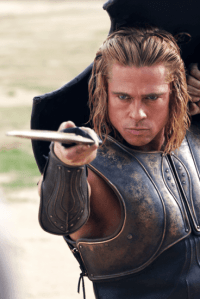
achillesThe Trojans attack at night with giant fire balls, which leads into the Trojan army advancing. Achilles joins the fight and faces Hector. Hector cuts his throat and reveals that it is Achilles’ beloved younger cousin. Hector declares enough for one day. Achilles’ second in command delivers the news. The next day, Achilles rides alone to the gates of Troy and demands Hector to face him. Hector, an honorable man, faces Achilles. And behind the scenes trivia reveals that Eric Bana and Brad Pitt did not use stunt doubles for the duel. (They also has a gentleman’s agreement to pay for every accidental hit; $50 for each light blow, $100 for each hard blow. Brad Pitt ended up paying Eric Bana $750; Bana didn’t own anything to Pitt.) It’s a good duel, but really didn’t enrapture me. Achilles defeats Hector, then ties his body to his chariot to drag back to the Greeks. That evening, king Priam comes to Achilles to beg for his son’s body, so he can have an honorable funeral. “Even enemies can show respect.” Achilles relents and allows Troy to have their twelve days of mourning, and lets Briseis return to Troy. Agamemnon is furious.
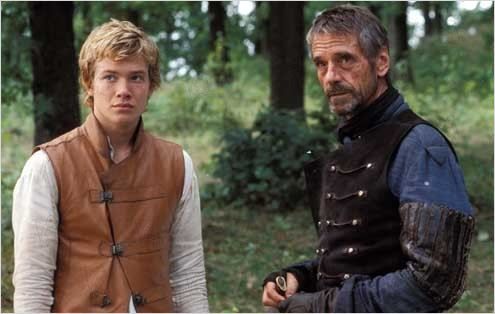
Odysseus has a plan; his men start building. He makes it look like the Greeks have left and they have left an offering of a large wooden horse. Paris advises his father to burn it. He’s ignored. His father ignored Hector’s advice as well. The Trojans drag the horse into their city and celebrate. At night, Odysseus, Achilles, and others emerge from the horse and set about taking the city down from the inside. They get the gates open to let in the army. Well, Achilles is off running to find Briseis, who is looking for Paris. Helen, Hector’s wife and son, and as many others as they can find escape through an old tunnel that Hector showed his wife (because he was smart and knew what could happen). Paris refuses to leave and passes the sword of Troy to a young man so the Trojans will always have hope and can start over. Paris joins the fight with his bow (which is hilarious, because Orlando Bloom is Legolas).
Agamemnon kills the king and tries to take Briseis back. She stabs him and Achilles finishes the guards. But Paris finds them and misunderstands the situation. He shoots Achilles in the heel, slowing the warrior down. Another four arrows strike him. Achilles manages to tell Briseis, “it’s alright. You gave me peace in a lifetime of war,” and sends her with her cousin Paris. He pulls the arrows out of his chest, but the one in his heel is left, so that is how he’s found. Odysseus burns Achilles and the movie fades out as he says “if they ever tell my story, tell them I walked with giants.”

This movie moves slow at times. And I swear it’s more about Achilles than either of the Trojan princes. Helen is not terribly developed. From a certain point of view, one can easily agree that the whole war is her fault. She was unhappy with her husband and a younger, more handsome man took interest in her and she ran off with him. Though Hector does later stop her from running away, knowing that it won’t stop the war that has already come. We witness more nuances of Achilles’ character. He’s more than just a hardened warrior; he cares for his younger cousin and is downright tender with Briseis (this is after seeing him willingly bed other women). Hector is noble; I prefer him to Achilles. Paris is an idiot, though he tries to make up for it at the end. Priam is a bit of an idiot as well, listening to other advisors over his experienced sons. Agamemnon is an idiot as well, the definition of warmonger.

Overall, I’m underwhelmed by the movie. The duel between Hector and Achilles was alright; but they’ve shown all those moves previously in the movie. I didn’t connect with the characters. No, the thought I had running through my head after I heard Sean Bean at the beginning was “does he live?” I put Pompeii on again afterwards. I watched it for the same reason that I did Troy and yet I became more invested in it.

What are your favorite historical periods?

Next Time: Kingdom of Heaven

One Part Brave, Three Parts Fool

Eragon

(Not to be confused with “Aragorn” from Lord of the Rings) Based on the first book of Christopher Paolini’s Inheritance Cycle of which I have not actually read the final book. Flew through Eragon before it was even mentioned as a movie, and the second, Eldest. By the time the fourth, Inheritance came out, I wasn’t able to immediately get it and it had been so long. Now…I’ve forgotten most of the actual plot. I do remember being impressed by the world building; but after getting involved with other fantasy series and doing my own research and work; it borrows heavily from other classics. Which all writers do. Heck, most of my work currently resides as a sort of fanfiction until I develop where I actually want things to go.

The movie differs from the book at times, but is filled with familiar faces. Eragon is played by Ed Speleers, who has gone on to appear in Downton Abbey and Outlander. And he looks remarkably like Lucas Till (new MacGyver) at times. Brom is the ever-talented Jeremy Irons (voice of Scar, Henry IV in Hollow Crown, Aramis in Man in the Iron Mask, and we’ll see him in Kingdom of Heaven). Man in the Iron Mask alum John Malkovich (Athos in that film, he’s also Edward ‘Blackbeard’ Teach in Crossbones [I watched the first season or so once, another series that was a bit too violent for me]) is the evil king Galbatorix. Robert Carlyle (Rumple/Mr. Gold from Once Upon a Time, also in the Stargate TV series, and in the Bond film The World is Not Enough) plays the evil magician Durza. Other people that you may recognize: Dijmon Hounsou as one of the Varden, as well as Gary Lewis (he appeared a couple times in Merlin and Outlander), Steve Spiers (a bit part in Dead Man’s Chest and Phantom Menace, as well as Porthos in The Musketeer) lives in Eragon’s village, and Joss Stone (Anne of Cleaves from Tudors) is a soothsayer.

We are informed in the opening narration (done by Jeremy Irons) that this fantasy land was once ruled by dragon riders and enjoyed peace. Until one turned and took power for himself: Galbatorix. He has crushed all rebellion. Well, until a woman (elf? I think?) steals a stone, is chased, then magics the stone away. A young lad, Eragon discovers the stone and hides it away. Except it’s not a stone; it’s a dragon egg. When it hatches, he touches the baby dragon (which is rather adorable) and is burned. Others throughout the land sense this moment, including the elf (Arya), an old man (Brom) and the king.
Eragon has to bid farewell to his cousin/brother (I forget the precise backstory). Then his village is set upon by evil creatures (who look a lot like Orcs). He’s not home when they find his uncle; his dragon (who has miraculously grown in a matter of days) Saphira keeps him away for his protection. Like Luke Skywalker in Star Wars (which this film plot borrows elements), he returns home to find his uncle dead. Brom finds him instead (and like Obi-Wan, tells the lad that it is good he was not home, for he also would be dead) and carts him off. They must make it to the resistance, to the Varden, to be safe. Druza is still hunting Eragon.

eragon bromBrom is a wise mentor. He demonstrates that Eragon is not as skilled as he thinks he is and his sole purpose at the moment is ensuring that Eragon and Saphira make it to the Varden alive, in order for there to be any hope for the land. Eragon starts discovering his powers and also discovers that Brom was once a dragon rider. But his dragon was killed years ago. A rider can live past their dragon; but if the rider is killed, the dragon dies. So Eragon shouldn’t do stupid things. Well, he’s a teenage boy; he does stupid things.
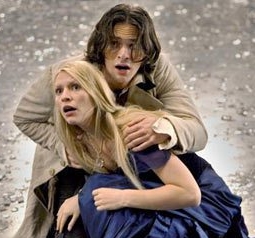
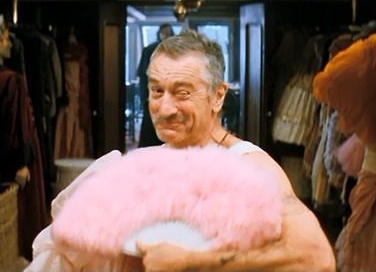
He gets a vision of Arya in danger (courtesy of Durza) and decides to rescue her. Walking straight into a trap. Good thing a mysterious young man shows up and is on his side (he reminds me of Will Scarlett in Prince of Thieves). Brom is also killed, protecting Eragon. The new trio manages to make it to the Varden with Arya (who has also been poisoned by Durza). Then they start preparing for battle. Because yeah, personalized armor appears overnight. Durza is on his way with an army (which reminds me of Saruman at the Orthnac in Two Towers).

The duel between Eragon and Saphira and Durza and his dark magic shadow monster is rather good. Eragon defeats Durza, but we wonder for a minute if the good guys will actually survive. They do, yay. Except now Galbatorix is pissed; and has a dragon of his own.

I liked the film when it first came out, since it had dragons! And sword fights! And magic! The effects are rather well done. Elements of the book have sunk in to influence my own fantasy series; like magic has consequences and there is a language. But those are common to other fantasy series. Now…it’s like a knock-off of Lord of the Rings. After watching it this time round, I had to put on scenes from How to Train Your Dragon to see better dragons. The performances by the veteran actors are well done. Druza is reminiscent of Rumple in retrospect. Jeremy Irons is his usual badass self; John Malkovich plays a villain well. The film overall just seems like it’s trying too hard. And hmm, in retrospect, Arya is a bit of a peculiar choice in name. Nothing like the Arya in Game of Thrones. This one, we are told is badass. Arya Stark is no doubt a badass. And any sort of romance between this Arya and Eragon is stupid. They barely know each other! Rescuing someone or thinking they are pretty does not make a solid foundation.

As I commented above, the film plot (since I do not remember the variations of the book plot) has strong similarities to Star Wars, which follows the hero’s journey laid out by Joseph Campbell and explained in The Hero with a Thousand Faces.  It examines the common elements that make up popular hero stories, that date back to mythology.  Star Wars follows it, Harry Potter follows it.  I have an article sitting on my computer comparing it to How to Train Your Dragon, waiting for me to find somewhere to publish it.  And it’s fine for a story to follow that path; my objection is that this story follows it a little too closely.

In the first leg, the hero is called to another world and initially resists the call (here, to dragons and being a dragon rider), then meets a mentor (Brom).  There is a road of trials (get more into in the books), involvement of a woman (Arya), atonement with the father (not per say in this case, but delved into in the books in an interesting way from what I recall), and finally the return and mastering two worlds; which would occur in the sequel books.  There’s supernatural help and a magical flight – Saphira.  It just seems like the movie is going down a checklist of “must haves in a fantasy story.”  Dragons, magic, crazy old guy, and they don’t try to mask it.

Let me know your thoughts.  If you have any opinion on Campbell’s Hero Journey.

Next Time: We jump into historically-set movies, starting with Troy

The Heart of a Star

Stardust

Based on the novel of the same name by Neil Gaiman, an author well known for Urban Fantasy stories. I’ve heard of him, considering my preference for fantasy stories, but I have not read him. Though I did enjoy this movie. It’s also an example of “hey it’s that guy!” with an all-star cast. The film opens with narration by Ian McKellen. Ben Barnes (titular Prince Caspian) is the young Dunstan Thorn. His older counterpart is played by Nathaniel Parker (uh yeah, that’s Agravaine from Merlin, and he apparently briefly appeared as the remembered father to Prince Caspian in Voyage of the Dawn Treader. So old Dunstan plays father to the young Dunstan). Henry Cavill (the newest Superman, Charles Brandon from Tudors, and Melot from Tristan and Isolde) is almost unrecognizable as Humphrey (it’s the colored wig). The great Peter O’Toole has a few scenes as the king. He has seven sons. Primus is played by Jason Flemyng (who is surprisingly Azazel in X-Men First Class and Vadim in the Musketeers). Also from Musketeers is Rupert Everett (he was decrepit Feron) as Secundus. The featured brother is Septimus, played by Mark Strong (definitely should be familiar to my followers; he’s a bad guy in Tristan and Isolde, the bad guy in Sherlock Holmes with Robert Downey Jr., and the bad guy in Robin Hood with Russell Crowe; he’s not terribly nice in this film either). Michelle Pfeiffer is Lamia the witch, Claire Danes stars as Yvaine, Ricky Gervais makes an appearance, as does Mark Williams (Mr. Weasley). Robert De Niro pops in as Captain Shakespeare.

The story explores the notion that there is a secret, magical realm that exists alongside England, called Stormhold, that is only separated by a wall. Dunstan Thorn is the first to cross over and finds a bustling market going on. He meets a beautiful young woman, the captive of a witch. He would free her, but only the witch’s death will bring that about. Instead, the woman pulls Dunstan into her wagon. Dunstan returns to England, but nine months later, a baby is left for him, Tristan. Eighteen years later, Tristan hopes to win the heart of a stuck-up snob, Victoria. Of course, to him, she’s the most beautiful and most lovely lady. He doesn’t really stand a chance against a traditional gentleman like Humphrey. Dunstan counsels his son that it is a good omen that he does not fit in with everyone else. Tristan tries again to woo Victoria, planning a romantic dinner under the stars.

Meanwhile, in Stormhold, the king dies. Their tradition is that the younger sons all kill each other off, so the only one left standing becomes king. At this point, there are four left. To decide the succession, whichever son can restore the ruby to the king’s pendant will get the throne. There is mention of a single sister; but she cannot inherit. One brother is pushed off the balcony. Another is poisoned before the quest begins, leaving now Septimus and Primus to compete. Incidentally, the ruby that fled the pendant hits a star, causing it to fall to Earth. Victoria and Tristan see the star, and Tristan vows to bring it to her to prove his feelings. So Tristan ventures past the wall. Well, it takes two tries. The old guard beats him off the first time and Tristan comes to find that his father had ventured past the wall. His mother had left a Babylon candle (terribly useful for travel) with him as a baby.

There is another group that hunts the star; three elderly witches. If they consume her heart, they retain their youth and life. (They’re a bit creepy, keeping animals around to sacrifice. I avert my gaze during those scenes). Tristan finds the crater of the fallen star and comes to realize that the young injured woman is the star. She’s kept the necklace that hit her and Tristan intends to march her back to Victoria. Yvaine, the star, is not as keen on the idea, particularly since Tristan had landed on her. But he starts back. He does have to leave her for a bit to get supplies. A unicorn comes along and helps the fallen star, but unfortunately leads her to an inn created by the witch to trap the star. Tristan ends up at the inn eventually with Primus. The witch is about to kill Yvaine when they knock. When Primus becomes too nosey, the witch kills him and advances on Tristan and Yvaine. There’s a bit of a mix up in their escape and they end up in the clouds during a storm.

tristan-and-Yvaine-stardust

They’re rescued by Captain Shakespeare and his band of pirates. Shakespeare loudly interrogates the pair and seems to throw Tristan overboard. It was all an act for his crew; Shakespeare is actually a kind man, but has to keep a fearsome reputation to stay in command. He grew up on tales of England, like Tristan grew up on tales of the realm on the other side of the wall. Shakespeare passes Tristan off as his nephew and teaches him to properly sword fight. Over the course of the week they are traveling together, Yvaine falls in love with Tristan. And Tristan realizes that Victoria is not the woman for him. Shakespeare sends the couple on their way.

The morning of Victoria’s birthday, Tristan leaves Yvaine so he can take a piece of hair to fulfill his oath and deal with Victoria quietly. Sadly, the message is garbled when it reaches Yvaine and she believes he left her for Victoria. Tristan gets a chance to intimidate Humphrey and tell the spoiled pair they’re perfect for each other. Then realizes that Yvaine is in danger if she crosses the wall. He rushes back. But Yvaine is already making her way to him. The woman from the beginning of the film (who slept with Dunstan and thus Tristan’s mother) rushes to help Yvaine, realizing she’s a star. The witch meets up with them, killing the woman’s captor, an opposing witch. She takes the two young ladies with her to her castle, where she plans to sacrifice the star with her sisters.

Septimus in on their trail as well (the brothers, who are all ghosts and follow about since they cannot pass on yet, had noticed that Yvaine was wearing the pendant and Septimus plans to use that to his advantage). He and Tristan pair up outside the castle. Septimus attempts to fight off the witches, but is ultimately killed, though he did take out one of the three witches. He is magically drowned, only to be brought back to fight Tristan. Tristan takes out the other witch, leaving only the main witch. She seemingly lets Tristan and Yvaine goes, but tries to bring the castle down on them. Yvaine uses her shine to take out the witch in the end. When he picks up Yvaine’s pendant, the stone becomes a ruby again. The woman, who is actually Una, the king’s long lost daughter, informs him that he is the last male heir of the king of Stormhold. Tristan is crowned, Yvaine is his queen. It seems that Una and Dunstan may get to be together. Overall, a happy ending.

captain shakespeare

Again, I find this to be just a fun movie to watch. It has nice fantasy elements. I like when Shakespeare trains Tristan. There is a hilarious scene to the tune of Can Can between Shakespeare and Septimus; my favorite scene of the film. The fight between the pirates and the guards is excellently timed to the music. And the crew always knew that their captain was a little…different (he has a closet full of costumes, including dresses). There’s times it gets dark; the brothers murdering each other; the witches. But it ends with a tidy happy ending. At least the young couple had a week to get to know each other. Since they were around each other constantly for a week, it did give them significant time (unlike Tristan’s parents: like, a minute? Really?).

Up Next: Eragon

One Year In

It has been one year since I began posting blogs. I have over sixty posts (I’ve managed that despite taking a month off here and there due to often posting twice a week). That number staggers me at times, because I have barely scratched the surface of my eclectic love of movies. Yes, we’ve done Disney. But I love musicals as well. And action movies. And movie series. I’ve planned out the next couple of months, about until I may break for the holiday season. And I’ve only gotten two categories laid out and doing some rough math…oh boy, there’s still more coming! I originally thought this would be a project for a year. Nope, gonna be more like three. Wow!

After Eragon, we will continue with historic movies, then historic-set romances. Some more modern romances or rom coms (not a long category). Musicals (that’s gonna be a big group). Action/adventure, always fun. The superheroes, including the Marvel cinematic universe. And the pieces that I really want to discuss: Star Wars, Lord of the Rings/Hobbit, Chronicles of Narnia, How to Train Your Dragon, Harry Potter; those expansive series.

In the meantime, enjoy a quick update on some other movies I fit into my life.

Since I got into Game of Thrones and came to love the character Jon Snow the best, I decided to try some of Kit Harington’s other movies. So far, I’ve seen Testament of Youth and Pompeii. Both of which I want to own. I don’t want to give too much away and I know they may not be widely liked films, but I enjoyed them. Well, the second half of Testament of Youth not too much; it made me cry. But it takes place during the First World War, so you can guess why. But Kit’s character is a dashing, charming young man who likes literature and poetry and my heart melts. I’d love a happier tale, of a young lady falling in love with her brother’s friend; that doesn’t end in heartbreak. I should see if more exist. That part reminded me a bit of Jane Austen. And the lead female character is at Oxford. Me being the nerd that I am, was fairly drooling looking at the library. And realizing this takes place at the same time as Tolkien (brilliant movie, I want it as soon as it’s available. We’ll cover it once we get to the two trilogies).

I was surprised I liked Pompeii; as disaster movies are not my cup of tea. The storyline is not the most original, but it was well done. The action is stupendous and Kiefer Sutherland is surprisingly in it; they timed the opening credits well so his name comes up just as he turns around and you realize, oh, that’s him. This made me want to watch Gladiator. And I was disappointed. I dozed off half an hour into the movie and towards the end, I was fast forwarding, begging it to get to the point. What is a bit frustrating is that I like other Ridley Scott films. And I deeply enjoyed his film starring Russell Crowe again in Robin Hood.

If anyone has any suggestions or recommendations on movies or shows to watch, I will consider. I am in no way promising to watch, partly due to, as I’ve stated previously, I am into enough shows and movies and fandoms as it is. My bookshelves plead with me to return to my first love.

And a thank you to all the followers and all the people who have read this blog! I didn’t realize I would enjoy it the way that I do. It combines my love of movies (and talking about movies, because I find them fascinating) and writing. Happy movie watching and happy reading!

fun movies
Look what was waiting for me when I got home! (The first movie will be covered during the “historic” segment)

Inconceivable!

Princess Bride

Based on the book, which I believe I actually read before I saw the movie; a friend lent it to me in high school to demonstrate how to write dueling scenes. Since I had already fallen in love with Lord of the Rings by that point, I just take it as a fun medieval/fantasy story. I have friends who dearly love the movie. Billy Crystal appears in the film as Miracle Max. Fred Savage, older brother to Ben Savage (Boy Meets World) is the grandson. Andre the Giant plays the giant Fezzik. Robin Wright who played Buttercup, kicks butt in the 2017 film Wonder Woman as General Antiope. This is probably Cary Elwes’s most famous role as Westley, though he’s gone on to play Lord Arthur Holmwood in Bram Stoker’s Dracula (I’ve seen parts of it), starred as Robin Hood in Men in Tights, played against type as the villainous Edgar in Ella Enchanted and I guess is now part of Stranger Things (no, I am not going to watch the show; I’ve fallen into too many fandoms as it is).

This is a case of a story within a story; the premise is that a grandfather reads this story to his grandson when his grandson is sick. The tale opens with a beautiful young girl named Buttercup, who torments the farm boy Westley, ordering him about. He always responds with “as you wish.” One day, Buttercup comes to realize that he is secretly telling her he loves her. She then realizes that she loves him; they are true loves. (Fans picked up on this notion in Once Upon a Time, when Hook tells Emma “as you wish,” when she orders him to wait after they share a searing kiss.) Westley leaves to seek his fortune so he could marry Buttercup, but word comes that his ship was attacked by the Dread Pirate Roberts, who never leaves survivors. Five years pass and Buttercup is now raised to a princess and engaged to marry Prince Humperdinck. But she does not truly love the prince. She is abducted during one of her daily rides the day of her engagement announcement by Vizzini, Inigo, and Fezzik. They have orders to kill her and blame it on a neighboring kingdom, thereby starting a war.

First, they set sail. Inigo notes that they are being followed. “Inconceivable!” Vizzini declares (Inigo later points out: “I do not think it means what you think it means.”) Buttercup attempts to escape by jumping overboard, but the water is filled with shrieking eels. They next come to the Cliffs of Insanity; only Fezzik is strong enough to climb, they should lose their tail. Nope, a man in black makes his way up the cliffs as well. Vizzini cuts the rope, but still he persists. Inigo is left behind to deal with him. It is a rather fantastic duel; both are gentlemen about it, Inigo even helping his opponent finish the climb and giving him a chance to catch his breath. (Behind the scenes notes state that the actors performed the duel themselves, tutored by legendary sword masters). We learn that Inigo is hunting for a six-fingered man who killed his father. The man in black wins after a dizzying circle of his sword, knocks Inigio out and continues. He faces Fezzik next and manages to choke him asleep, after being rammed into a rock a few times. battle of witsFinally, the man faces Vizzini in a battle of wits. He pours iocaine powder into a goblet and Vizzini is to guess which one. Vizzini is a smug man, believing he is smarter than any famous philosopher. Then he relies on a simple trick to switch goblets, thinking he’s won. The man in black was more cunning; he put powder into both goblets, but he’s spent the past several years building up an immunity to it. He then pulls the princess along, even though Humperdinck is tracking them.
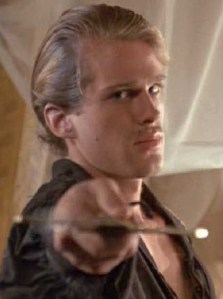
Buttercup admits to her new captor that she does not love the prince; her first love was killed by the Dread Pirate Roberts, whom the man admits he is. Then admits he remembered the lad, but calls Buttercup out for being unfaithful, moving on to Humperdinck. “I died that day!” she declares. Humperdink is close; she pushes the man in black down a hill, telling him “you can die for all I care.” “As you wish,” the man stutters down the hill. She realizes it is her beloved Westley and follows him down the hill. Westley’s mask is now off, revealing it is the same man. They take refuge in the Fire Swamp to evade Humperdink, facing bursts of fire, lightning quick sand, and R.O.U.S (Rodents of Unusual Size, which are creepy and remind me in hindsight of creatures from Merlin). Westley is injured in a fight against a rodent. When they emerge from the Fire Swamp, Humperdinck is waiting for them. Westley is all ready to return to the swamp to protect Buttercup. But she sacrifices her happiness so Westley won’t be killed. Humperdinck promises his fiancée that he will not harm Westley and will return him to his ship. He takes his bride-to-be back and rides off. Westley makes eye contact with Count Rugen; they both know the prince is lying. Interestingly enough, the Count has six fingers on one hand.

Rugen takes control of Westley and plans to torture him on his machine, which sucks the life out of people. Buttercup in the meantime has decided she cannot marry the prince; she loves Westley and will be reunited with him. Humperdinck then promises that he will send word to recall Westley, but if that does not come to fruition, Buttercup will still marry him. In truth, he was the one who had hired the trio to abduct and kill Buttercup; now he plans to murder her on their wedding night; still planning to blame another kingdom and start a war.

Fezzik is reunited with Inigo before the wedding and they decide the break the man in black out, discovering that he is the princess’s true love. Except Buttercup has figured out that Humperdinck never followed through with his promises. She believes that Westley will still come for her and calls Humperdinck a coward. Humperdinck is enraged and cranks Rugen’s machine up to fifty, killing Westley. Everyone can hear his scream. Fezzik and Ingio recover Westley and buy a miracle; they need his brains to sneak into the castle so Inigo can have his revenge. It works only because Westley is “mostly” dead, compared to completely dead. Miracle Max creates the pill to get back at Humperdinck for firing him.

Our heroes storm the castle with some illusions, breaking up Buttercup and Humperdinck’s wedding (the priest has a hilarious manner of speaking), though Humperdinck gets the priest to declare them “man and wife.” Rugen faces off against Inigo, who simply advances on the man despite his wounds declaring “My name is Inigo Montoya, you killed my father. Prepare to die.” Buttercup, despaired that she is married drop your swordto Humperdinck and Westley is dead, per Humperdinck’s word, decides she will kill herself before Humperdinck reaches their marriage bed. But Westley is waiting for her. He is still not back to full strength but gives the prince an epic speech; they will fight to the pain and Westley will leave his ears so the prince can hear every word against him and his promised hideousness. He stands and orders the prince “Drop your sword.” Humperdinck complies and Buttercup ties him up. Inigo finds them and Fezzik is waiting with horses. Westley and Buttercup share the most epic kiss that has ever been recorded.

The boy decides that he doesn’t mind the kissing and maybe his grandfather will read him the story again tomorrow.

There are times this movie reminds me of Mel Gibson’s work, or a bit of a spoof on traditional fantasy movies. Maybe it’s the inclusion of typically comedic actors. Vizzini is a laugh, there’s a little bit between Miracle Max and his wife whom he calls a witch. Maybe it’s the fact that it simply includes a lot of typical fantasy elements, presented straight forward, without trying to add anything. Buttercup is admittedly not a simple damsel in distress. She does try to help Westley fight off the giant rat, after standing there most of the time. They speak of true love often and I can see it once Westley and Buttercup are separated, but not so much while they’re growing up. Westley is an excellent, dashing hero. The costumes are over all fine; but those huge crowns are ridiculous. There is admittedly some epic dialogue. At the end of the evening, a fun movie to put on, not something that needs to be processed deeply.

I’d love to hear from anyone who truly loves this movie as to their reasons, since I didn’t really connect with it.  Maybe I found it too late to completely fall in love?

Next Time: Stardust